Home » Articles posted by Jean-Paul Close (Page 170)
Author Archives: Jean-Paul Close
When leadership and management work together
Evolution has a cyclic nature, clockwise of course. A self aware species develops “leadership and management”. In this drawing I explain how we deal with both in a natural chronological order.

Leadership introduces change after a burst of awareness. It expands into new phases of wellness through the acceptance and co-creative efforts that change entire communities.
Management wants to keep wellness by growing its values out of greed or the fear for loosing it. It tends to avoid change while introducing control mechanisms by building bureaucracies.
Excessive management and focus on growth or risk avoidance tends to blocks leadership out of fear that change affects control mechanisms and hierarchies of power. This unavoidably leads to a crisis, chaos and collapse. After the collapse leadership and change become dominant again with the introduction of new values, making the cycle complete.
When then can Leadership and Management work together effectively in a complex society? That occurs when the eminence of chaos and collapse is so powerfully present and destructive that management open up to leadership development, accepting change as part of the management process. Leadership and management goals can find a match. The purpose then is harmony and chaos avoidance.
STIR Foundation shapes this by taking leadership initiatives around complex issues. We position ourselves in the field of awareness and leadership and invite top level management officials to participate in change processes and co creation towards harmony (symbiosis). The management officials then have to introduce change through managed routines and controlled processes. Total chaos can be avoided when multidisciplinary coalitions address the issues together. This we call Sustainocracy, the complex but highly productive process of interaction between leadership and management.
Experience shows that bureaucracy is largely eliminated, decisions accelerated and result driven processes terminated in years rather than decades. The pain of chaos is reduced to a minimum and surrounded by care.
Awareness breakthough
Have you ever heard of the “gateway to heaven”? It is real. Not many can see it though. Experience shows that the gateway is only reached after a phase of pain. It is clearly visible then but gradually fades away again until we reach a new passage through. That is how we evolve. It is a spiral shape, or sinus wave when we add time. Understanding this is new. Evolution has long been considered purely physical. It is however spiritual. It only adds up to our awareness when passing through the gateway.
At a certain time we may equally our level of evolution and break through to add something to it. This drawing may help you understand. You are right in the middle of it (the drawing and life)

Can you see the awareness breakthrough? It’s the gateway to a new world
Some call the area below the line of self awareness “hell” and above “heaven”. The gateway is referred to the “the end of suffering” and a new beginning. Every time we pass through into a new cycle we add new awareness to our evolution. Societies evolve like this too. I expect a global breakthrough. But not before a lot of pain.
21st century society
“The new, emerging society (I call it “Sustainocracy”) situates itself permanently into this heaven of wellness (symbiosis) through understanding life instead of killing it. It will be an historical breakthrough that is happening right now.” (Jean-Paul Close)
Changing ways of looking at life
Not many people understand the functioning of our complex human systems called society. We interact without asking too many questions, suffering large consequences as they come along. We protect the selfinterest by living life as it comes making choices based on cultural norms, tradition, fears and ambitions. We do not really believe we can do a lot about the bigger picture as individuals.

When tend to be what our surroundings expect us to be (mirror)
When effects of pollution, global warming, migrations of desperate people, financial crises, scandals, etc reach our awareness we do tend to take a broader view of our reality. We may even reach a point that we adjust our daily choices with this new information.
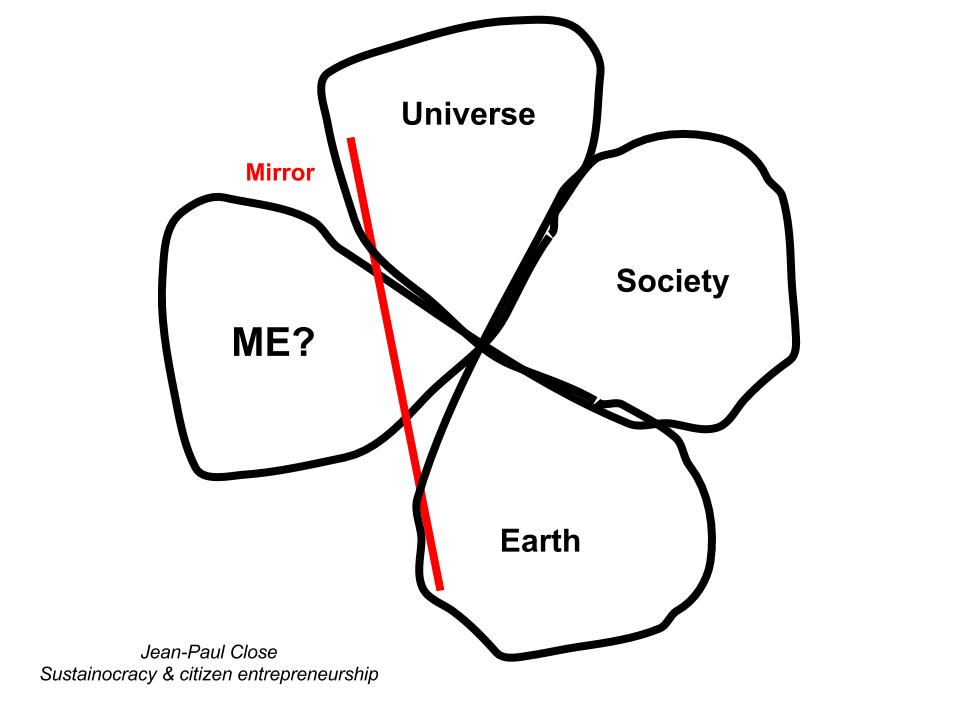
Awareness places me and society within the context of the universe and our planet Earth. We start seeing the reality in a different way, not just what is expected from me by society
Empathy
This awareness has an interesting extra effect on people as we begin to question the way we organize ourselves. We open up to an inner reality called “empathy”. This is a state of consciousness that does not just want us to survive in a competitive world. It helps us try to “do good” too. This “to do the right thing” is a state of mind that requires us to learn to feel sympathy for our surroundings. We open up to observing new realities, such as the suffering of other people, the effects of our actions on nature, the immorality of manipulation and injustice of certain human actions of greed. We arrive at a point that we project our daily choices on the world wide issues and take action accordingly within our span of control. We open up to understanding the bigger picture and see our own role with more clarity. Changing this role changes the human world of systems that, as a consequence, are forced to adjust.
Consumer conscience
On a worldwide basis we see our shops being packed with goods through an old system of supply and taxes on which institutions (business, government, banks) rely.
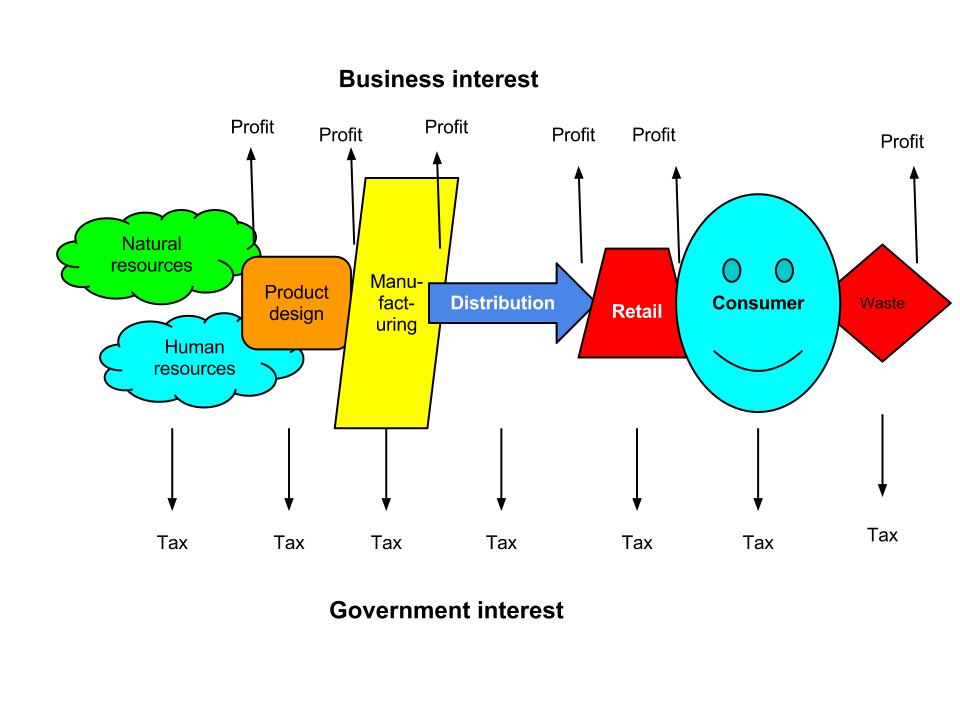
Property is past on in every step in the chain
You can’t solve problems by increasing them
It is in their system’s interest to keep this chain functioning because it produces labor, involves technology, keeps consumption going and produces funding for infrastructures and bureaucracy. It also provides means to address the consequences of this system. As the consequences grow exponentially, so does the need for money in this globalized system.
We understand that it produces the problems but we all depend on its functioning. How do we change it without putting this machinery on hold?
The first change is our own sense of “empathy” we the related change of our daily choices. We force the human systems to adjust to the newly growing popular mentality.
The second change is that the supply chain is stressed due to unsustainable chackles inside the system. The supply chain tries to optimize and reorganizes itself to remain strong.
The third change is provoked by the global issues themselves. If for instance competition for raw materials becomes as demanding as competition for sales the intellect is forced to look for adaptation to avoid system’s collapse. There is a lot of stress everywhere demanding leadership to cope with stressful circumstances.
Two complexities
The way we (STIR) addtess this at yhe top level of regional goverance and economuc development is by introducing a new complex system next to the old one. It is a system based on responsibility of change rather than keeping a supply chain going. It helps participants anticipate without being surprised by circumstances and the unexpected.
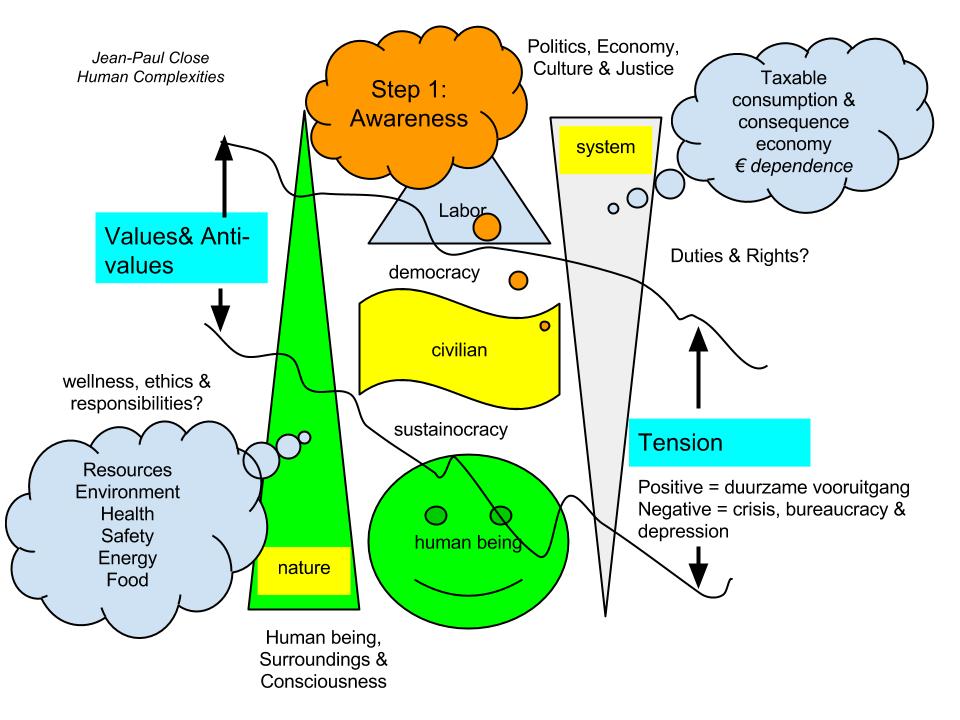
Awareness means that we manage to place the human system as instrumental, not dominant in our human evolution
When tension builds up locally in the old system relief is found by looping initiatives through the new system in a multidisciplinary way. This exercize helps people in charge to open up their minds to alternatives and choose their best options.
By doing so we achieve another interesting process, the development of the consciousness (to be) with the use of instruments to change things for the better (to do).

The psychology of change in a paradigm shift is the true transformative challenge of humankind
The biggest challenge we face in human reality is to integrate our growing awareness and empathy (awakening to new realities) with the systems that produce sustainable human progress and wellness. It becomes clear in our minds that for our own stability we need change. This is excitingly new when we come from an era of conservatism due to lack of awareness. The more we all become aware, the peacefuller we adjust our lives and systems through innovation of our structures and lifestyle. We start enjoying the prospect of progress rather than fearing the consequeces of change.

Awareness changes the world

