Home » Articles posted by Jean-Paul Close (Page 202)
Author Archives: Jean-Paul Close
Otto Scharmer (U-Theory) versus Jean-Paul Close (Human Complexities)
This is the second in my series of comparing commonly used methods and models in current human organizations (business, government, society, etc). The first reflected about Kondratiev and Close.
Today I try to compare the “U-Theory” of Otto Scharmer with my model of Human Complexities and its phases of Fear for Change, Paradigm Shift and the positioning of Sustainocracy. (Watch a short 11 minute explanation on Sustainocracy via YouTube here)
The U-Theory
The U-Theory has become a popular tool for trainers and coaches as well as executives teams in organizations to develop new, innovative ideas in a co-creative way and bring them into practical reality.
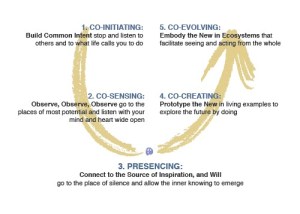
The U-Theory of Otto Scharmer
We see a U shaped model with five key points for progress: Co-Initiation, Co-Sensing, Presencing, Co-Creation and Co-Evolving.
When I compare this with my own model of Human Complexities there are of course striking similarities but also some curious differences to think about.

The Human Complexities cycle
The four arrows (regression, collapse, enlightenment and co-creation) in the model of Human Complexities represent the movement between four states of evolving communities (greed, chaos, awareness, wellness) using the complex psychology of people and ways of structuring organizations and communities. It is always cyclic in a clockwise manner. After ever cycle the community has gone through a learning process. When we place the cycles one after the other in history and over time we can see an evolutionary path resembling a spiral, producing a line from chaos into sustainable progress.
The representation of human complexities in a crosslike drawing has to do with our perception of progress and organization by drawing a line from left to right. Right to left meaning just the opposite, a regression. Up means an increase or growing awareness and down the decrease or disappearance thereof. In the middel we see the crissing of the lines “to be” (search for unique edity and universal ethics) and “to do” (our actions and organization). The cross shows the continuous conflict between these two issues that produce the self aware learning curve. In each of the four resulting quadrants the overall dominant human culture is different and so is the intrinsic motivation or fear for change.
Fear for Change
Inside the model of Human Complexities I use the concept of “Fear for Change”. This is needed to show people near or within the stress of a crisis that this a normal path of letting go for renewal. Once aware of this they can face a crisis with more confidence. The current global paradigm shift from economic societal collaps to sustainable human progress is my main concern. In my approach I tend to focus on the side of transformation from collapse via chaos towards renewed wellness in the model. My approach is holistic inviting the entire society to become co-creative.
Schwarmer does exactly opposite, working from with the institutionalized fragments of society.

The psychology of change in a paradigm shift is the true transformative challenge of humankind
Human Complexities (J.P. Close) & Fear for Change
Important differences between the U-Theory and Fear for Change
When we look at the U-Theory and the path of Fear for Change in the model of Humian Complexities we see that both use exactly the same processes to get people to activate their inner energy for creation and co-creation. Despite the different names the steps and significance are the same. Still there is a huge difference…..

U-Theory versus Paradigm Shift
At first sight both methods look and feel the same
In reality the creators of the U-Theory did a very smart thing. They created a sense of simulated chaos within the comfort of a running business. Getting people to step out of the running business of greed to undergo the intense process of reflection and finally reach a state of co-creation is in reality the application of the chaos theory and human psychology in exactly the same way, yet without the need of a formal crisis or fear for change.
Drawing the U-line from left to right (against the stream of human complexities) gives a sense of a deepening spiritual experience within the context of financial recovery, enhancement or growth (greed). The smart thing is that the U-Theory gives innovative meaning to economic systems that have the tendency of becoming bureaucratic an reluctant to change (seeing themselves as eternal cash cows, which they are not).
The paradigm shift and its related fear for change is known for thousands of years already. The first people to describe this intense fear and its process of freedom when one finds a new route by letting go, were intellectuals like Dante (13th century) and later the psychologists and anthropologist of the 19th and 20th century, s.a. Steiner, when the hierarchies started to grow in magnitude and with it the complexities of organizing people and emotions.
The natural process of a system to collapse into chaos, like the Roman Empire and so many other civilizations before and after, is well documented. The intense learning curve through fear, pain, letting go, etc. is also well known now and well positioned, with logic, along the modern cycle of Human Complexities. It is typically applicable in these days of pain, chaos en crises today that are affecting everyone. People start to look at two ways to address the problem:
- How to avoid collaps by applying timely renewal and innovation (U-Theory)
- What to do when inside the collaps to get back into co-creative wellness (Fear for Change)
These are the two routes of least and most resistance, as written before in a previous blog.
This blog also introduced the law of opposites and we can see many in the Human Complexities model (transition quadrants, poor and rich, complex and simple, warm and cold cultures, spiritual and possessive etc). The smart thing that was done by Otto Scharmer and his people was to turn the model of the paradigm shift, including the fear for change, around (fear avoidance).
Just observe the logic:
The model of Human Complexities follows a cyclic route clockwise. The segment on the circle that refers to the paradigm shift starts at the left hand side almost upon the line between chaos and enlightenment, when people let go of old security and become aware of the need of renewal. It continues all the way up to the state of co-creation for wellness. The shape is more line a big “n”.
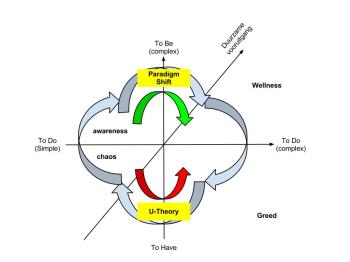
Positioning of both theories
When we look at the U-shape of Scharmer it starts at the same (virtual) point but travels down and to the right to end up on the line of wellness through greed. The psychological effect of visualizing this direction is that fear is eliminated by connected the process to greed (desire for unlimited prosperity). The process of the U-shape is to avoid jumping into the unknown by simulating it within the comfort of an existing organization that looks for renewed innovative or inventive success without the immediate need of a paradigm shift. It is a method for smart executives to transform an organization within its normal operations without the traditional reorganizational stress. This is brilliant.
So the method and knowledge of the Fear for Change within the need for a Paradigm Shift positions themselves essentially in left hand quadrants, the areas of poverty, chaos, illumination and experimentation with survival. The method and knowledge of the U-Theory positions itself in the rich areas of wealth and greed where enterprises want renewal, revival, inventiveness without disputing their reputation nor their original positioning. It is a protected environment for efficient creativity to enhance a competitive position.

Positioning application of the methods
The model of Human Complexities helps us to clarify the particular use of both models and in which situation they should be used. In fact, it is not just applicable in business, it can be applied to the entire society too. Sustainocracy is an example of jumping the state of chaos by inviting executives to co-creative renewal in a multidisciplinary setting that eventually will feed again an obsolete economy with true innovation.
Sustainocracy
The application of both theories is of interest. Sustainocracy positions itself in the wellness quadrant from a societal point of view. In most occasions the paradigm shift through chaos is needed in society due to the different power positions that try to uphold themselves at the expense of the others in the same community. Within each of the institutional pillars the U-Theory can help leadership to progress in such competitive environment. However in a multidisciplinary setting such a Sustainocracym where everyone has a co-creative mission at societal level, the combination of both can lead to remarkable results for the entire society.
So while the executives may be confronted with the own fear for change, within their own leadership, and the intense process of undergoing the risks of re-positioning a company within the context of sustainable progress of society as a whole, the organization itself may well be served through the techniques of the U-Theory that do not include this fear or risk. Knowing about the emotional difference between the two models the executive teams and participating consultants can create programs that are as effective as they can be in turbulent times, producing progress even in crisis with both societal and institutional success.
It would be very interesting to develop situations at regional level to experiment with this.
Psychology of change
Recent blog and internet discussion, and our practical living lab exercises of AiREAS in the Dutch city of Eindhoven, got us again going about the overall complexity of the “psychology of change”.
On the one hand there are the impressive challenges of a global shift, a true transformation of society to save our selves, demanding tremendous changes. On the other there is the powerful resistance and dominance of the world’s institutionalized economics that produces many powerful lobbies to avoid change all together. The latter brings a certain material wealth to the world and to the financial mighty. I already wrote various blog items on it but the complexity of “change” seems an endless and highly repetitive topic. Why? Because it affects us intensely on all levels of society.
The need for change has to do with ethics, sustainable human progress, in-dependencies, our environment and basic human rights, as opposed to nothing of that, expressed through individual and institutional power positions. It also has to do with awareness, responsibility, dominance, different paradigms and massive manipulation as part of the huge human complexities. Both sides of the problem, the desire and the avoidance of change, are firmly established inside the kernel of our individual and collective consciousness, self reflection, evolution and the ethical structuring of our choices. Despite everything there is always a dominant situation of overall avoidance of change.
Manipulation
Manipulation may sound unethical to you but we are being manipulated all the time. Not just through conscious manipulation of powerful institutions but also by the way we perceive our own selves in general. We react primarily to our surroundings using multiple sensory and extra sensory impulses. The way we perceive is the way we react. Within this simple action = reaction there is the “human psychology” involving fear, worry, happiness, wellness, anger, hate, education, jealousy, etc. All this can be manipulated, even by ourselves, consciously and unconsciously. In fact, it takes an intense learning process to to become aware of one’s own behavior, perception and choices, to get more or less liberated from manipulation. We call this a part of our higher evolutionary awareness. Not many people reach that state and those who do often become manipulators themselves with a large array of motives.
While I write this blog and re-read it I realize that I myself am one of them. I have grown over time mostly free from manipulation. Now (before I did not) I can see that I am being manipulated in intention by a dominant money and consumer driven system. This produces some kind of friction between me and the old generalized system. By introducing a new paradigm (sustainocracy) I also manipulate people by showing them a different truth. Despite my desire to be ethical and transparent I do create a new environment with the intention to provide people such a sense of new security that they decide to follow my views and let go of the old paradigm.
All I try to do, which justifies my motivation and passion, is to make people aware of manipulation and help them make up their own mind, without prejudice finally about their choice, not even when they decide to turn their back to me. I see it hence as a challenge to explain myself and Sustainocracy in such a way that people start believing in it, more than the other reigning system. But isn’t that what the system of capitalist consumer economics does too? And has been doing successfully for a long time? So we both compete in the psychology of manipulation presenting two different paradigms to the people. I am of course just a beginner while the other paradigm has thousands of years of experience.
Psychology of manipulation
When it is warm we buy an ice-cream when its cold we wear a pullover. We look around us and decide what we do, need, say, move, ….almost instantly. Our impressions do not just have to do with sensory perception, they are also colored by what we think is right or wrong, just, wishful, desirable, etc. In reality we have been conditioned to instant reaction right from the moment we were born and open our eyes to see the world. Normally we see the face of one of our parents at first, or a doctor or nurse. We see lights, colors, movements …. We smell and taste things….we hear noises, sounds, melodies, voices. All these first impressions reach us without giving it yet a conscious thought, they form however the basis of the big pile of sensory impressions to come that we do reflect consciously about.
After growing up in a certain environment it becomes so familiar, our own unquestionable reality, a specific truth. Every new observation and experience is being compared with circumstances we lived through before in the past. It enhances them, builds them up, or rejects them, until you feel at home right in the middle of those impulses from outside. This helps to react instantaneously on most issues of life during the day and makes you feel familiar with the way others react too. Together we form a culture, a set of values around language, beliefs, behavior, etc, that define us as a community. It gives us a behavioral identity. This gives a sense of belonging that remains united to our local natural and human surroundings. It is important to us because we need speedy adaptation and reaction when our behavioral routine is upset in any way. It is important for our mind to be able to distinguish between the normal and abnormal and react adequately, especially when in danger.
So securities are built up by ourselves and with our cultural environment to make us feel safe within ourselves. We auto-manipulate this feeling out of risk avoidance, fear control and sense of control. This can of course be manipulated also by an organized surroundings that is based on institutionalized principles. This then becomes also a paradigm, a worldview that is conditioned by certain values. Our current ruling paradigm is the one of capitalist economics. The one that I am introducing with arguments is called “sustainocracy”.
That is psychology of manipulation, the sense of providing external security to a community of people by the internal perception of security.
Psychology of change
People are of course reluctant to change when it addresses their sense of security. Nowadays we are confronted with a lot of information on climate changes, pollution, global warming, financial crises, other crises, etc. When we read such issues in the newspapers and watch documentaries on TV we become worried. We still, however live our day to day, everyday life. We are worried about the large picture and yet do what we have always done. “What do you want me to do?” you would say, “who am I to do anything?”, you may suggest. “Let the government solve it” most of us would say. And you are probably right!
Unless your name is on the list of the G7 and G20 encounter, or something like that. Which is what tends to happen. A few hundred powerful people join in global talks but fail to talk about change because they want to keep a capitalist economy going that provides perceived security to many people including the ones in power. And 7 billion people feel too small, too insignificant, too unaware, to do anything while feeling blindly secure in their day to day living experience, expecting that the big G solve it all. Until it is too late.
So if we want to change anything we have to overcome the “psychology of fear for change”. This starts with the aspect of “negation”. This feeling is normal. To accept a responsibility we have to be aware that we actually carry one. Or that we become aware that those who we think are responsible, have good reasons for themselves to avoid change and will therefor not take that kind of responsibility.
As explained above we see our direct environment as a secure cultural nest in which we were born and grew up. If we want to change we attack our inner senses of security and that creates an intense feeling of fear and insecurity. At individual level, despite the awareness that things need to change, we have the tendency of neglecting it just out of fear of the consequences. We tend to place the responsibility elsewhere, outside our own scope. You may say that this the mentality of an ostrich yet it has a strong basis of survival. If everyone would panic upon the wisdom of need for change the chaos would even be more dangerous. Human beings need some kind of leadership to address change.
The need for change grows, the negation too
Meanwhile a growing part of those 7 billion people are being incorporated into the Western example of material wealth. They feel that they have every right, just like European and Americans have enjoyed this wealth for a long time already. They are right of course. Why would they have to step back being the newcomers on the scene while the old guys made the biggest damage? Aren’t all people in the world allowed to have a TV set, a house, a car and a well stocked supermarket around the corner? Sure!
So the biggest challenge of the global shift is to change everything without changing anything. Would it be possible to keep up and expand wellness around the world without damaging it? Many scientists and business people would see a challenge in it, many local small governments also, but national large governments and bankers seem to be more than reluctant. “You can change whatever you want as long as it gives us an economy of growth” they would claim out of self interest. What they really express is their fear for loosing power, control and a financial profit. So when we introduce the need for change we also have to seriously accept the “psychology of change” as a challenge to overcome, including the powerful.
Two ways to change
There is the universal natural way, which is the traditional chaos of destruction through war, depression, recession, poverty, etc which obliges all people to change by external, non human force. When institutions keep up their opposition and negation too long they block the flexibility and adaptiveness of a population around evolutionary change and provoke a natural collapse. The human suffering is huge and so is the institutional because it collapses. It is all expressed by violence, demanding the liability of the old leaders which are prosecuted by the laws of chaos or history books.
Then there is the voluntary way, as proposed ( and demonstrated) by Sustainocracy. When we offer the current authorities the recognition of power, also in the new paradigm, then they feel secure to support change. Fear is overcome by safety, also involving the powerful. So psychology of change has much to do with communication, not just providing means for others to change but also by being the change by providing security in following. Followers show their own leadership by making choices in which we recognize the intense process of letting go of old securities. If the new securities provide a better perspective people are much more willing to open up for change, also when they have a high level position of power.

To overcome fear new securities need to be defined, also for those in power
Yes, I can
Sustainocracy builds a new society directly in a new new paradigm using the same instruments of power and authority of the old paradigm. It is interesting to see that sustainocracy offers more security to the powerful than the crumbling paradigm of consumer economics. Executives that are value (not money) driven are the very first to support the transformation, which is also becoming a transformation of securities, not just of values, economies and ethics. Now executives have a choice and when aware of their own responsibilities they can claim: “I know I can”.
Like every situation when a choice is presented between two paradigms, a new issue arises: “explain why you made your choice”. That will be subject to subject of a new blog.
Kondratieff versus Close
Nicolai Kondratieff (1892 – 1938) introduced a theory about cycles of 50 to 60 years in capitalist economics. The cycles show a sinusoidal shape that can be divided into four different “seasons”: prosperity, recession, depression and improvement.

Those of you who know my model of human complexities (see below) will also recognize the same four situations or states, named in a similar but different way and also following each other in a chronological way, despite human tendensy to counteract the flow in certain stages. Rather than showing a sinus timeline I show a cyclic movement that evolves into an evolutionary spiral (not drawn in this particular drawing that represents just a single cycle showing the phases we go through).
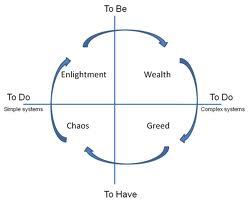
Human Complexities
Using my own model I relate a number of human variables to the cyclic experience, as individuals and as communities. Each phase and change among them has much to do with the human psyche which would explain the linear fluctuations in time in both the Kondratieff and my (Close) model. We can also map generations on both models to see where they stood in relation to economic development or recessions and what emotional or cultural environment supported each phase. In the Kondrakieff sinus this is easily done against very specific chronological data. It is easy to plot also very specific events as points of reference, s.a. World War II for instance.
The points of reference help to relate the different models by synchronization in time and region. World War II got us (large parts of Europe) into a state of chaos for instance. It would be a “starting” point in my model due to the time reference that can also be further extended to a specific regional location. This you can read for Holland, Spain and the USA in chapter 11 of my ebook on the Global Shift (2011)
Then we could observe how generations evolve, one after the other, with the effects of the cycles of human complexities and the Kondratieff sinus of economic seasoning on them. In my model I show that people who grow up in a situation of wealth are being educated accordingly. This means that we are being educated with wealth as a matter of fact. I remember my own growing up phase in the midst of the post war culture of prosperity of the late 60’s early 70’s in Holland. We all wanted to be a millionair by the age of 30. What we were really doing was to create our own crises by mere cultural mentality caused by the environment in which we lived. Generations follow each other up every 20 to 25 years which would show another sinusoidial wave based on culture and mentality following Kondratieff in a different phase. We could probably draw the technological peaks with the mentality ones on the models, just to see how they influence each other.
In my model I do not relate necessarily to periods of 50 or 60 years for one cycle to complete as this may have to do with administrative economics rather than human (generational and environmental) complexities. I have even suggested that in prehistorical times a complete human complexities cycle could take hundreds or even thousands of years, affected more by natural environmental periods of abundance, interaction with hostile encounters or the chaos produced by natural disasters. When we look at the Chinese dynasties a direct link can be made with such cycles. Economics did not exist nor did therefor the Kondratieff sinus. My model did apply though.
Only now, the recent few hundred years we have found the cycles shorten to such an extend that we live through one or two complete cycles in an entire lifetime. My model hence relates to environmental circumstances (culture, war, periods of peace, nature, catastophes, crises, etc) as key influencial factors on human behavior and a historical clear reference with which we can relate human reaction and evolution both technologically and socially.
My model also introduces the line of sustainable human progress along which the traumatic human events can be plotted. This is new in any documentation. I use my transition phases (greed and enlightenment) while economists would only refer to entering and leaving the chaos quadrant as two seperate phases (bull and bear markets respectivily). The line of sustainable human progress is an evolutionary straight line that moves from chaos to wealth and beyond. The transition phases (greed gets us back into chaos and enlightenment gets us back to organized wealth) can also be seen in the sinus of Kondratieff.

Transformation of greed to wealth
Kondratieff shows an organic human logic in time phases with a build up of technological highlights and the economic effects. The same complex origin for progress can be found in the human complexities (psychology, education, culture) within the phase of chaos (war, depression) and enlightenment (the left hand side of my model). Humankind apparently needs stress to be inventive while in times of wealth and greed little to nothing new is added. Instead we see then an increase in risk avoidance, bureaucracy and hierarchies, which translates into a measureable increase in costs of society. This is also the reason of sudden collapse into a recession in cycles of about 7 years (domino effect).
- Year 1: market crisis (consumer crisis for whatever reason)
- Year 2: business crisis (expected turnover not reached)
- Year 3: government crisis (expected tax income not reached)
- Year 4: government dependent instances crisis (education, police, etc)
- Year 5: business downsized, fused, innovated, went broke..builds up again
- Year 6: government gets more tax income
- Year 7: government dependencies get more air
During those seven years all economic institutions go through reorganizations, eliminating bureaucracy and trying to open themselves up for innovation. Costs are eliminated and they are downsized, renewed their structures to get a positive impulse. The impulse gets everything into a new investment round that results in 7 perceived good years and then it starts falling back again. This would suggest that the traditional 7 bad years, 7 good years, 7 bad years, 7 good years could be expalined in a sinusoidal wave of 49 years. With economics we created an artificial environment that shows a more organized sinuswave than when interacting with the multidimensional complexity of nature and the chaotic tribal confrontations of the past.
Sometimes the economic years are stretched a bit after a capital injection, an overenthusiastic increase of national debt, etc. The figure we see returning all the time (“about 50 years” – equivalent to an ancient average generational lifetime) is just a logical reflection of our administrative economic organization of one natural year and our human “perception” of what we believe is good or bad. This would also suggest that if we would half the administrative year or extend it to two years we would see the waves shorten and lengthen respectively. This may be something for further study by someone even though natural seasons may still have some significance in our, otherwise highly automated artificial productivity.
It also has to do with our fragmented structure of society along a chain of economic dependencies. If we set up society differently (eg a Sustainocracy) then the economic world would never collapse. Sinusoidal waves would not exist because we eliminated the duality in our progress by concentrating on a single higher common purpose (sustainable human progress) with highly flexible, dynamically adaptive non fixed, hierarchical organizations. We unite our knowledgeable awareness with our adaptive productivity towards a permanent never ending goal.
What the Kondratieff model does not foresee is the piling up of an exponential curve within the current artificial sinusoidal. This is effect is caused in the last 40 years after the liberation of money for speculation around shortages by the entire, global institutional world. It coincides with the “information technology” era of the 5th Kondratieff wave, which is why it confuses the analysts. Taking also the limited Earth resources into account, the dip of the 5th Kondrakieff wave coincides with my crossing over from greed to chaos and a point of singularity of overall financial collapse.
The creditcrisis of 2008 has been just a warning signal. Banks will never recover despite the huge capital injections and government finances collapse all together. The Kondratieff’s winter and my model’s point of chaos are this time expected to be more dramatic then ever, making the Russian natural winter feel warm, and the Arab spring feel peaceful, compared to previous events. Some think that the solution lies in a new technological phase s.a. nano-technology. I personally believe that the next phase has nothing to do with technology or capitalist economics but awareness and a totally new type of society.
And that is where I come in with Sustainocracy. I cannot create a Kondratieff sinusoidal counter wave now to avoid a mayor crash, nor prevent local poverty from rising, or avoid a potential new world war. I can however introduce a new paradigm that can instantly transform current society, situated structurally in greed (recession) on the way to chaos (depression), into one positioned permanently in wealth (prosperity) by taking institutional responsibility today. This would maybe break or interrupt the sinus or introduce a new aspect that actually supports the sinus but from a different point of view. My own shortcut, interrupting the traditional ups and downs of society, has to do with our current state of collective understanding (awareness, consiousness).
We now collectively understand the above and the consequences of continuing. By introducing sustainocracy we now have a choice. We could trust the sinusoidal wave as an external matter of fact and realize that a new generation of prosperity is hopefully being born today to grow up and make it happen during the Konfratieff dip. We can also take responsibility and use what we know now to create a society based on new facts, a higher awareness, before it’s too late. Like building a Sustainocracy right now in ever city or region in the world.
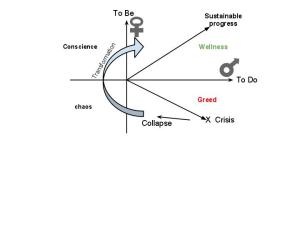
The revolution of the consciousness
How powerful will people remain when the collapse continues and the point of singularity makes the sinus wave the deepest ever? What interest can people have in total collapse? How powerful can these same people become when they assume sustainocratic responsibility and turn the ship with consiousness and planned wisdom before organic logic does it with brutal force? If you are in a position of power today just ask yourself that question.
It can be done through human ethical behavior, leadership and awareness. It is difficul but worth it. I am doing it with people around me who have fragmented authorities and power (government, business, science, civilians) and they use it with me in purpose driven social and technological innovation. We do not place money in the center of attention but sustainable human progress, a clear environmental and social balance in circular economics of value creation. By doing so we create a rapid change in mentality and see a period of many decades and even centuries in reformatting and organizing our civilization with a positive consequences for economies. That I call the second quantum leap of human kind. Not by chance but by willpower and awareness.

AiREAS is the first sustainocratic venture in the world
Sustainocratic transformation is a voluntary act of responsibility

