Home » Articles posted by Jean-Paul Close (Page 213)
Author Archives: Jean-Paul Close
will you eat bread today?
Just imagine a baker in a village of 100 people. Every day he bakes 100 loafs of bread that he sells to the villagers for 1 euro per bread. Every one is happy, every villager has bread to eat every day and the bakery has an economic situation of 100.
For some reason one day there is a shortage of wheat and the bakery cannot make 100 breads, he makes only 80. Due to the wheat shortage the cost price went up and the baker had to sell his bread for 1,50 euro. People were not happy but paid the difference. 20 of them came late and were left without bread. The baker did not really care. His turnover had gone up to 120. The wheat shortage continued. The local population reacted by purchasing half a bread instead of one whole. They had become conscious of the shortages of wheat and realized that they could perfectly well survive with half a loaf since they had been throwing away part of the other loafs anyway. They called their social responsibility “sustainability” but the bakery was not happy at all. He had sold 100 halfs at 75 cents = 75 euro. His economy had dropped despite the rise of the price and he had to throw 30 unsold breads away. Thinking that the market had reduced he decided to stimulate the market again with some marketing and kept the reduction of his production due to the wheat shortage. Due to the marketing costs he had to increase the price a bit more, to 2 euro.
Half the people bought half’s and half bought whole breads. So 50 halves against 1 euro = 50 euro and 50 whole breads against 2 euros = 100 euro. The baker was happy. Marketing works he said. His turnover had grown to 150 euros, double the previous sales! And he only had to throw 5 breads away this time. Market working they call that in economics, and all the consumers had something to eat.
The world market of wheat was struggling further and he had to compete to get his resources. The energy costs were rising too so he ended up reducing his average production to 50 breads against a sales price of 5 euros. Some angry people were buying bread by the slice now and some could not afford bread at all anymore. The 20 richest people of the village did not want to reduce their consumption and offered 8 euro per bread. The baker loved this deal and sold all his bread every day now with a turnover of 20 x 8 euro = 160 euro for the rich people and 30 x 5 euro = 150 euro for the normal people. The economy of the bakery had grown to 310.
The local village council was worried because a number of people had no bread to eat but happy with the growth economy. They could raise the local tax on bread to help the 50 people that were starving and gave them some social help with money. The baker was making a lot of money after all. Government treasury was doing fine as a consequence too. With all his profit the baker had bought a nice house with a large mortgage. The city council had invested in a bit more bureaucracy to assure that the growth economy was properly taxed and invested. People complained about to increase of the cost of living and blamed the baker. He blamed the increasing costs of wheat, production and marketing. But also the tax pressure. The government hammered on economy of growth to be able to tax more and cover the expenses of the socially needed. Meanwhile poverty and social unrest was rising. People were meeting to see what they could do about it and someone threw a stone through the window of the bakery. The next round of baking the baker could make only 30 breads but the population was already in front of his door claiming the entire production for equal distribution. He had no turnover that day and his bakery was damaged. The rich got no bread that day and were furious. They lobbied with the local government to see if their taxes could properly used and get bread from elsewhere. The baker went broke, couldn’t pay his mortgage anymore so the bank went broke too. The government had no one to tax anymore while the bread market got into the hands of the Chinese. After a period of economic growth the village got into a severe recession and chaos.
This simple, funny but realistic story gives a view that economic growth does not solve anything when resources are running out. The only option left for the villagers would be have been to grow their own wheat to eliminate their dependency on outside forces. But what did they know? If they can’t produce their own they have to find something else to eat. But for all they new everything was fine, the economy was growing after all, wasn’t it? How do we deal with this in the big cities around the world where money rules the systems and the dependencies of the people? How aware are people of the world wide shortages if the only point of measurement is the local supermarket and one’s own cash availability? How aware are governments when the economy of growth, tax and social welfare is their only worry?
Moral of the story: A growing economy does not necessarily get you a daily loaf of bread.
How does Sustainocracy work?
Sustainocracy combines the uniform institutional and personal goal of sustainable progress with the democratic process of how to get there. This simple definition implicates a global change in dealing with complex human issues. Sustainable progress cannot be achieved by any single authority. It forcefully needs the value driven cooperation of all institutional authorities together, not in a business economics setting but one of multidisciplinary responsibility sharing.
In our current society of economic, money driven relationships between institutional identities (sales of products, taxation, subventions, contributions, loans, debts, pensions, insurance, etc) such multidisciplinary ventures can only be started by new age pioneers. The reason for this is that Sustainocracy forcefully needs to break through the current change of relationships, dependencies and hand over of fragmented responsibilities to a setting where the human authorities take on the same responsibility together.
Sustainocracy hence has therefor a few characteristics that are strongly different to current complex way of structuring society:
- Institutional power is used to enhance and expand Sustainocratic initiatives to cause greater affect in the community,
- But institutions do not lead the initiatives because they cannot. Institutions are instruments to progress not the cause of progress,
- The pioneer is responsible for defining the complex goal of a Sustainocratic pool of institutional powers. The definition is necessarily related to sustainable human progress because any other objective would not get institutions to work together in an open, transparent and long term format. They have normally differentiated interests that can only be shared and combined in settings of sustainable progress. Examples of a Sustainocratic definition:
- Local air quality, public health and regional human dynamics,
- Local graying/ aging population, self sufficiency, health care and housing,
- Education, social cohesion, cultural diversity and neighborhood development,
- Local energy and food, public participation, self sufficiency, housing and quality of life,
- etc
- A Sustainocratic process is necessarily local 4 local, involving all local citizens,
- Therefor a sustainocratic initiative always involves five elements:
- The pioneer
- The local government (geographic design and public money)
- Creative entrepreneurs (local as well as multinational)
- Educators (science and school)
- The local population (behavior, contribution, participation)
Sustainocratic processes are always purpose driven. They are labeled with an identifying name (s.a. AiREAS, The STIR Academy, VE2RS, etc) to which people and institutions can relate with motivation and commitment. The initiatives are formalized a s new age cooperative entities established for the measurable humanitarian local progress.
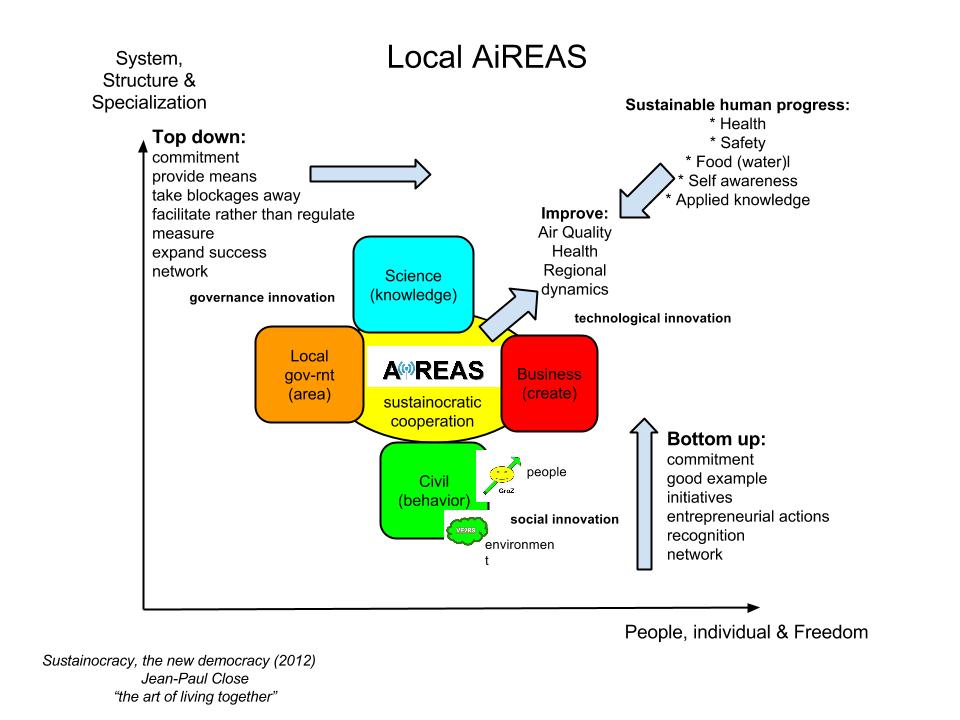
Example: AiREAS as first sustainocratic venture
Advantages of Sustainocracy:
Any key local humanitarian complex issue can rapidly be addressed and solved due to the multidisciplinary format of the coalition, involving directly all necessary authorities who can be called upon their unique competences and authority.
A Sustainocratic group is purpose driven, not money driven.
Sustainocracy eliminates all bureaucracy out of decision making since all parties are directly involved in instant decision making.
Sustainocracy is not a separate institution. It is a purpose driven multi-disciplinary partnership. When the complex objectives have been achieved the partnership will dissolve again.
Sustainocracy demand the general public and scientific know how to take responsibility too, not just the traditional operational parties of government and business. These two authorities are important to avoid the traditional tunnel vision of government (cost saving and bureaucracy) and business (volume sales).
Sustainocracy is result driven within the context of its purpose. That means that reciprocity for all partners is shared when value has been created, not before. One wants money, the other recognition or savings. Reciprocity is not just an economic element but much more complex and varied allowing a diversity of partners to work together without competition.
Problems of Sustainocracy
The problems we encounter are:
Pioneers need to be well trained in their role of connectors of many disciplines. They play a key role to maintain equilibrium between the participants but have no directive power position, yet are extremely influential. They are equally purpose driven and not “paid” as consultant or director. The pioneer are included in the reciprocity program claiming time and responsibility from an individual that is only compensated if results are obtained. Not many people have the talent nor the drive to take this responsibility.
The institutional parties need to adjust their mentality and commitment to a totally new mindset. Government used to be the powerful party “in charge” because of their authority and governance over public money. They need to step back and accept the authority of the team. Business needs to learn to take responsibility with products, services and development for the end result, not just the sales of products. And so on for each of the parties. It takes a lot of “getting used” to this way of working and set aside the old way of behaving in a group.
“Money” is always an issue because of its standardized importance in our current society. It is a very big step for all involved to learn to see real value as something different than money. In the reward we also need to learn that pay back is sometimes not expressed in money but in different values.
The above difficulties are very demanding for the people involved. They can be partly overcome by defining short term results that show each involved what real reciprocity means. The longer it takes to come up with results to easier it becomes for the group to loose faith and fall apart. The difficulties can also be overcome by getting institutional people (executives) on board who know what they are dealing with (trained). They will not have the burden of adjustment and set out the provide speed to the processes. When this happens decision making is instant and execution also. Reflection becomes an issue for progressive new decisions.
Conclusion
Sustainocracy is a unique, modern way to address key issues for human sustainable progress when crises affect a community. All institutional parties are asked to take responsibility together in true value creation. But they have to be prepared to focus on the competences and authority, not their economic dependencies. Money is not a goal but a means. The purpose is the goal and reciprocity is found in institutional continuity based on true and recognized competences.
Sustainocracry is unique because it uses the very same forces that interact in the same society in crisis however in a different format of interaction. Both worlds can co-exist perfectly in which each players decides for itself when and where to participate in economic and sustainocratic processes. In one money and growth is placed in the center of policy making and in the other the human being and progress.
Pioneers of a new world
Introduction
This has become a long blog again. I introduce a solution for all humanitarian problems in the world and all related crisis. It requires a lot of explanation because it involves all current institutional powers in a new setting. And finally comes back to the power of our individual selves. Soon I will publish a booklet on the issue but my sense of urgency is so big that I cannot wait to reach out to those of you who can become already changers of the world after reading this. For humankind it could be the most important blog ever as long as I can reach out to you soul and make you aware. Please take some time to absorb the information and place your own self in perspective. See what happens when you suddenly realize that humankind could get to depend on your own next steps. It is fun AND a huge responsibility. Can you handle it? That is up to you. I am ready to help you when you are.
The destructive force of our institutions
Over the years we have grown dependent on institutional activities because of the impact they have on our lives. The unique capacity of an institution is that it can enlarge a single activity into huge proportions. A single human being cannot do that. We have grown to depend on the institutions because they provide us luxury articles, financial means, governance, jobs with related salaries, scientific knowledge, etc.
Most current institutional structures of today were born already some 150 to 100 years. The conditions in the human world were right back then to allow such fragmented focus to occur with the related growth of institutionalized power. Still now the discussions in this world only talk about growth and more growth as a single sign of strength. Due to this fragmented focus these organizations can only take responsibility for their own small field of highly specialized attention. They started to relate via this specialization to compliment each other in their objectives. A manufacturing company in the 19th century would have its own transportation system, energy supply, uniform making unit for their personnel, etc. But gradually in the 20th century the further specialization allowed institutions to focus on their core business and select suppliers to outsource their surrounding needs. In the middle of the 20th century the patchwork of specialized institutions because so large and so competitive in their mutual interaction that a chain of dependencies appeared and with it new techniques of managing the chain.
Due to the focus on fragmented institutionalized interests the awareness for “the whole” disappeared entirely. Things like pollution, usage of natural resources or humanitarian issues became subject to competitive policies. Institutional survival became more important than the consequences of such survival decisions. Non of these consequences could be challenged by any single authority. What authority should do that? A local government has no global authority to regulate. Yet they do have a dependence for economic growth, imports and exports as well as labor and tax perspectives. Global authorities on the other hand have no formal jurisdiction in the countries or in the institutionalized business enterprises and banking policies. They may have a bureaucratic influence on awareness (like VN resolutions) and certain fragmented authority on addressing common institutionalized interests (like military actions in Afghanistan or embargos on certain countries).
As fragmentation of power grows further, the chain of interdependence becomes more complex. Despite the competitive fragmentation and specialization each individually could grow due to globalization of markets. The competitive shakes outs would start the intense optimization processes in each of the institutions to remain competitive and attractive in the chain. As time went by we see each of them weaken in quality and strengthen in financial speculation. CEO’s and Country presidents became bankers and debt managers rather than protectors of value driven identities.
The overall shortage of resources started to demand its toll on the global organization of giants that could not feed themselves anymore on natural value creation. The liberalization of money from a valuable collateral (s.a. gold) allowed speculation to flourish as only remaining resource to sustain institutional fragmentation and growth. Access to the available resources became available to the highest bidder. Countries who wanted their populations to survive while active with some labor and high debt programs had to grow their debt themselves. The growth of institutions is still the blind common culture of executives and politicians but growth is already for a long time not possible anymore. Not as a natural process of value creation anyway. The only financial growth that can be achieved is through speculation around shortages but this is controlled only by the powerful and has nothing to do with the general public anymore. They are just manipulated to accept a debt they did not ask for and that solves nothing. Humanity is in the hands now of institutionalized, destructive, fragmentary focused financial robots that have no morality nor sense of responsibility except their own self interests, creating crisis after crisis, chaos upon chaos.
The pioneer
Now we go back to the beginning of this blog. The true power of an institution is its possibility to enlarge any fragmented specialization to huge proportions. Their handicap is that they cannot take responsibility other than for their own piece of specialized power. That goes for regional governments, business enterprises, educational institutions, etc, etc. None can take responsibility for true human values yet they all have interest in it because they are part of the institutional survival. Without consuming, demanding, debt creating, voting or working public the institutions will eventually die.
So in one way or another any institution has the intrinsic need to connect again to integral human values but cannot do that for the whole, just for a small part of it, competing for it. So when we talk about the taking of responsibility for human sustainable progress no one can or will stand up to take responsibility other than maybe some local politicians. They tend to promise responsibility that they cannot handle because it s beyond their control. They try to solve it in four year periods which many do not complete, by raising taxes and public debt with solving anything.
Only one can take responsibility and that is the pioneer. It seems funny that with all those incredibly big and seemingly powerful institutions the sole responsibility of human progress could lie in the hands of a bunch of pioneers. But it is true and makes perfect sense.
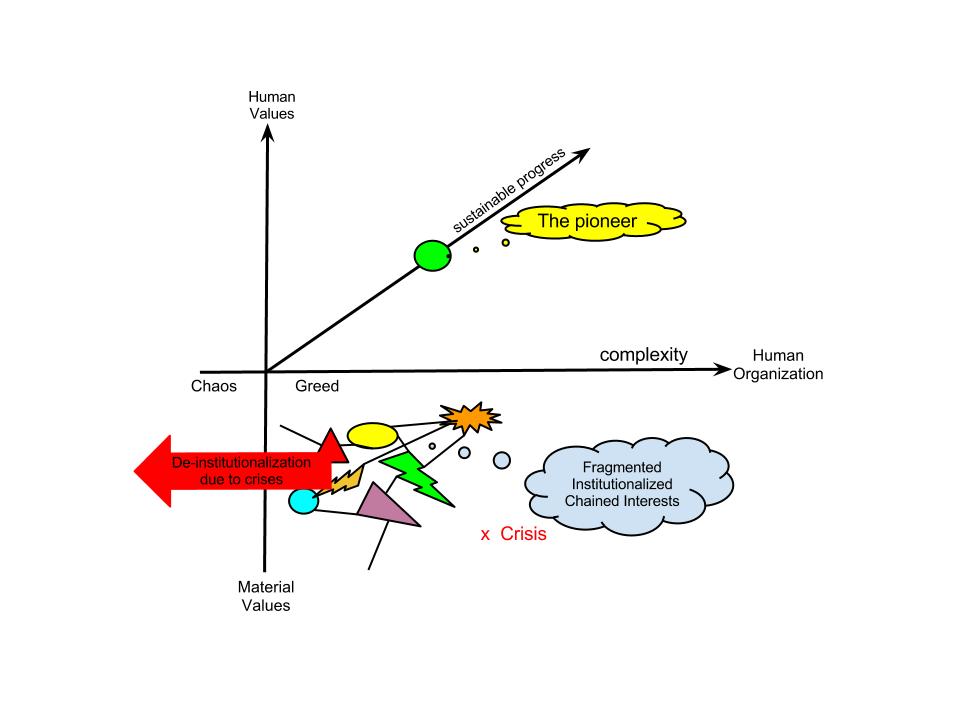
The pioneer positions him/her self in the field of sustainable human values and progress
The robotic institutions can be our enemy when we see their unconscious destructive force while preserving their self interest in their fragmented world of material power, but they can become our friends when we can get to use their institutional powers of expansion in a proper way.
Thanks to the de-institutionalizing powers of a crisis, in which the organizations need to go into survival mode, decreasing in size due to the lack of resources to draw from, they become also often sensitive for new ventures and responsibilities in which their field of expertise can excel. This is an opportunity for the pioneer but also for the institutions. How does it work?
The pioneer takes responsibility for a complex humanitarian progressive proposition. He or she subsequently invites all necessary institutional powers to help enlarge it.
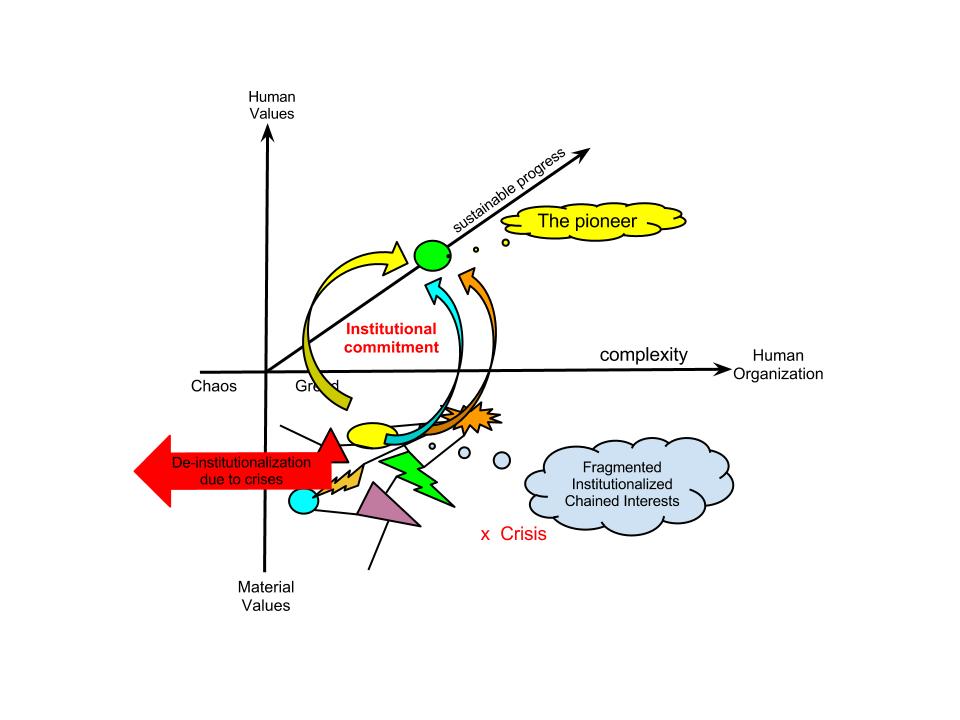
Institutional powers can be used to enlarge humanitarian interests
The role of the pioneer is to define complex progression based on human values. When inviting the institutional powers to join the pioneer they are asked to enhance the responsibility with their own institutional powers. To make a holistic proposition of human values one cannot just rely on a single empowering institution. If that were the case the institution would have done this already by itself. The complexity of the whole is that it needs the entire mix of authorities of a society to become effective, with the pioneer sitting bang in the middle.
Sustainocracy
In sustainocracy the pioneer takes the lead and invites the four key authorities that are needed to expand the human values into common wellness and progress:
- Local government
- Technological innovators
- Educators & scientific researchers
- The local public itself
Drawing all these authorities from the field of fragmented interests, they unite in the field of common responsibilities together with the pioneer. Seemingly contradicting interests suddenly start complementing each other as the focus lies on progressive goals outside the scope of self interest. The self interest can be complied with only if the common interest is achieved. This forces the authorities to enter into co-creative processes by trying to understand each other and join forces. The pivot is the pioneer who safeguards the humanitarian interests in a battle field of institutional giants.
In the Netherlands I have started experimenting with this pioneership. It resulted into a series of initiatives that are proving their value from a humanitarian perspective but also the institutional positioning into a new world. Each of the authorities has a chance to excel in its own field of competence, not by competing or creating interdependence but by combining the individual competences into a common goal. Since executives and personnel in such institutions are human beings too we find that the sensitivity of the hard material robotics become more soft to address human wealth issues through new types of policy makings.
The institutions change slowly into supportive and facilitating identities that gather new public admiration. They truly become extenders of human progress to which they attached their fragmented by highly specialized competences with new perspectives of survival first but institutional sustainability in the long term. The field of chaos can now be managed with the perspective of an institutional alternative, not just to create value but to contribute to a greater cause, enhancing it and expanding it.
Training school
To extend these finding globally I have started a training school for sustainocracy, training pioneers as well as institutional executives on their new age responsibilities and challenges when entering the field of sustainable progress and all related differences with the old paradigm.
http://www.eventbrite.com/myevent?eid=3558815513
Pass the word and help change the world.

