Home » 5K world (Page 11)
Category Archives: 5K world
Global issues, local solutions, global application
Last week I met with Caroline Hummels, director of the department of Industrial Design of the Technical University of Eindhoven. She gave me a copy of her inaugural lecture “Matter of Transformation, sculpting a valuable tomorrow” in which she refers to the transformative global development of economies. She had used the views of Brand and Rocchi, two senior management directors of Philips, who describe an organic move from industrial to transformative economies.

Interestingly (but not surprising) the 4 steps of Brand and Rocchi coincide with my 4 fields of human complexities even though I see them as all inclusive and not just linear
This linear transformation of economies would be motivated by various global issues. The industrial era has globalized and standardized massive manufacturing and logistical processes, creating a uniformity across the world of retail and consumption. It has been a strong growth arena for financial and business dinosaurs. Dinosaurs, not because of their long forgotten era but their oversized dimensions that will become extinct at the first hiccups in the global economies. In my own model of human complexities I refer to this as the area of “greed”. In the “secretes of life” it is the area of natural unlimited growth.
Growth is only unlimited until it meets competition. Global competition then started to place the focus on the consumer through marketing and positioning issues. Rather than massively producing products the turnaround was that they had to fulfill a need too, connecting to emotional values of a target group. The customers became important and sales got more complex than mere distribution. In my own model I refer here to chaos through competition where Darwin’s rules of the strongest, fastest, most aggressive, etc prosper.
The third phase is that competition hardly produces profitable scenarios anymore. Value has been eliminate through all kinds of techniques while focus had been placed on volume sales and growth. This is never unlimited so a new impulse was needed. Brand and Rocchi call this the “knowledge economy” which in fact we see occurring everywhere now. When competition does not work anymore one needs to become smart and adaptive. Smart means that one needs to seek for ways to be different. In my own model I refer to this as the phase of adjustment. It calls for inner reflection that reaches out to rational but also emotional awareness and applied wit. Business become greener (emotional awareness though applied ethics) and use design and local content (rational awareness though applied intelligence) to distinguish themselves. Local gets into the picture again as opposed the long period of globalization. Terms like glocalization, or my own Local 4 Local 4 Global, appear.
Stop!
So far so good. In all these three natural steps of the evolution of economies we see one commonality. They all develop in a transactional world. The amount and quality of the transactions determine the success of the company and economy. On each transaction tax is raised on which the governments depend for financing their local issues around structuring infrastructures for maximization of transactions. Even though industries have been drawn (forced by public awareness and government regulations) to ethical values such as global warming, pollution, safeguarding natural resources, etc it are still the transactions that rule the game and give rise to manipulation, foul play and criminal practice.
The next step is that the transactional structure of the world economies break up and make way for the transformation economy. This economy is not transactional but based on the acceptance of key responsibilities. The increase of complex local issues of human drama, health problems, climate change, water and food shortages, natural and unnatural disasters with the related societal transformations, call for local attention and applied intelligence. All the technological and scientific knowledge is needed to create local ecological and social harmony when the risk of public unrest or disaster becomes big. I called this the era of search for harmony in carrying joint responsibilities through ethical values of responsibility. The motivation may well be less romantic in the cold calculating worlds of business and politics as they also agree that people without work, without perspective or health are poor consumers and unreliable voters. The institutional self preservation calls for taking responsibility even is this has been contrary to their original nature of institutional self interest.
Global issues need to be addressed locally developing local solutions through applied innovations that can find their way into the world as local dramas and needs elsewhere call out for them. This world is then not just transactional anymore. It is a world where ethical values call for responsibility, cooperation and solving existentialist issues locally first. Solutions that no one has created before and cannot be created by any of the fragmented specializations.
This type of economy is inherently different because it has no transactions to address or taxincome but a common purpose to deal with using the available specializations and authorities. You can’t buy a healthy or safe city, you have to co-create it. It is an investment in awareness, wit, vision on sustainable progress, innovation and togetherness.
When local solutions have been found then they can be globalized through the common practice of growth. Local for local adjustments may be required but the inspiration has been delivered as well as the way to address the commonality of the issues which has a global nature applied locally.
We are in the starting phase of the transformation from a transactional world to a transformative one where both are forced to coincide. The word “transformation” may then lead to confusion because the purpose that is being dealt with demands local transformative solutions that transform the local community itself not just products. But to make it happen also the economy itself needs to transform from transactional to collaborative. This affects the way local government, taxes, legal formats, etc work. It is hence much more complex than the previous fractional transitions and natural selections of companies that adjusted better or faster to the new era intelligently using instruments of growth, competition and adjustment. Now they are called to work together in a new format with new rules and manners. They do not interact anymore through the transfer of products, services, taxes, subsidies, policies. They need to interact together around a local purpose in a multidisciplinary way.

Success is more than just “growth”
That is why I refer to the new type of this collaborative local for local for global society as a “Sustainocracy”. It allows participants to distinguish between the various simultaneous transformations, the societal, economical and the functional that they need to deal with. For a long time, maybe even for ever, the transactional and collaborative structures with co-exist. All participants need to get used to these worlds and the fascinating relationship between them that will cause yet another shake out among organizations and the appearance of new ones. The entire functioning of a society will transform including the way its economies work. A totally new field of organizational intelligence appears that introduces a totally new era referred to as the global shift, a mayor break through in human progress.
In Eindhoven we experiment with Sustainocracy in AiREAS (air pollution and human health) and other purpose driven cooperative ventures. I of course invited Caroline, her students and the University to participate. For them it will be challenging because not only products, industrial designs and infrastructures will transform with their insights. Also society, all institutions and the way labor is organized will undergo changes. Educating students that develop a transformative attitude through self reflection, awareness and professional specializations of change, will demand for other types of labor relationships than currently available in hierarchical structures of volume driven dinosaurs. These youngsters will be the new leaders of change in the setting of sustainocratic ventures that will spread across the world following the global issues for local solutions.

Key responsibilities are taken together!
Jean-Paul Close
2013
Where in life do you stand?
Let’s do a little exercise. A bit of awareness development does no harm. Feel free to interact when you are done.

4 clear phases
4 unique phases
There are four universal phases in the cyclic patterns of life that have been identified. Each affects the way we perceive and deal with life’s circumstances. The phases are reflected in the drawing above. For the sake of awareness and understanding I have given them simple names that can be replaced by many other with a similar significance as you can see in the brackets:
1: Change (also: a new life, pioneer, awareness, young, renewal, hope, innovation, space, birth, adaptation, spring)
2: Balance (also: harmony, togetherness, adult, co-creation, trust, love, peace, construction, optimism, wellness, equality, stability, summer)
3: Stress (also: fear, bureaucracy, control, hierarchy, systems, old, growth, automation, speculation, greed, negation, pressure, autumn)
4: Crisis (also: break down, death, depression, competition, confrontations, theft, criminality, hate, distrust, individualism, discrimination, chaos, winter)
These four phases have also teased many economic, philosophical, mathematical, spiritual, anthropological, biological, etc analysts that you may have heard about. I am going to ask you to define where you stand and where you find your surroundings to be? Please decide at first sight where you feel you stand personally today as an individual? If you have difficulties with the bold names to identify your own status you may find it easier to refer to some other word in the brackets. You may feel in winter (referring to a cold spell in your life with crisis, problems, etc) or maybe a new period of passion and idealism (number 1)…
The four situations are not static. They follow each other up in the chronological, numerological order with 4 jumping into 1 again: 4.1.2.3.4.1.2.3.4….. It does not always start at 4 nor 1 of course. It starts when you become aware of the cycles and start to use it for guidance. Your own starting point today is the number you chose at the poll.
So if you chose 2 (balance) you know that 3 (stress) will follow. This will lead to a crisis (4) and eventually to some kind of change (1). The cycle begins than again with a new moment of balance (2) for you. One situation always leads to the other. Sometimes slowly, sometimes very fast. Out of all four situations we always desire balance (2) most yet no matter how hard we try there is never a status quo in life. To achieve balance we need to accept the other three states also.
Life is on the move
Our life is far from static. We are influenced and challenged all the time by a large variety of impulses. Life is an adventure. We need to act to provide ourselves with the (primary) resources to stay alive. There are moments of abundance and scarcity. When abundance occurs we fear loosing it. When scarcity happens we become inventive to try to get back to abundance. We never really have balance because living life is by definition a permanent search for it through adaptive interaction with our surroundings. The amount of personal security we find in our surroundings determines also the amount of willingness we display to challenge it through change. When there is abundance we react relaxed to change, when there is a situation of crisis we are likely to suffer one too.
Where does your surroundings stand today?
If your surroundings influences our situation, behavior and decision making by providing abundance or shortages, opportunities or threats, how would you judge the current situation? You may take your family life as a benchmark, your job, the society you live in…..whatever determines your current situation today most? Don’t worry, the polls are anonymous. They are simply for the sake of awareness building while showing that you are not alone, what ever your specific situation would be.
When you compare your personal answer with that of your surroundings, how do they relate? Do they coincide (1 -1, 2 – 2, 3 – 3, 4- 4)? Are you ahead in the cycle (1-4, 2-1, 3-1) taking a crisis as a breaking point? Or are you lagging behind?
What are you going to do about it?
With this simple exercise of two projections on a universal cycle you make up your mind on how to deal with the situation. The exercise adds the cyclic view to your awareness, a kind of predictability that can be influenced by your level of self awareness and acceptance of these universal realities. So far it has just been a rational exercise of interpretation of these realities through a model by picking a number. The question “what are you doing about it?” draws you into the field of emotions.
Just imagine that you are happily living a harmonic life in the stability of situation 2 (balance). You suddenly now become aware that this situation may not last for ever. This may already be enough reason to enter the phase of stress (3). You will blame me for causing this stress and may want to get back into the dormant state of satisfaction.
Maybe you are in stress (3) of having to work in a job that you intensely dislike simply because you need to pay your mortgage. Your family is living in harmony (2) thanks to your salary. You may not dare to go out to find something else out of fear for a financial or relationship crisis (4). Many risk a burnout like this and enter a mental or physical crisis instead.
There are plenty of other situations thinkable in which you voluntarily or involuntarily have to deal with choices. At hindsight you often say “if only I had known” or “if I had done this or that”. This “if I had…” is of course frustrating but even more complicated is to take action with foresight when at first sight no action seems to be needed. We may call this leadership but we also often call it obsessive worries. Where the differentiation lies has to do with your own wisdom, vision, determination and guts. You are considered crazy or stupid by others when you fail and a hero when you succeed. Does that prevent you from considering action?
As an individual you determine your own life’s adventure. It becomes a different emotional story when you have responsibilities over other people. How do you deal with all this when you are a father or mother taking care of young children? Or the CEO of a large company with many employees? How does a city council deal with this responsibility or the country’s president? Or me, a person who wants the current societies to convert into sustainable human progress with Sustainocracy?

Harmony can be a place to be even when you are elsewhere in the cycle.
Conclusion
Understanding where you are is very helpful. Awareness about the cycle is key to take proactive action when time has come. Many organizations invest in a R&D to produce position 1 opportunities of change but find that the world has grown too complex and fast to come up with novelties alone. A good understanding of the psychology of human complexities is key, not just for business or political structures but for humankind as a whole.
Unique collection of expertise in AiREAS
On June 18th 2013 the second membership encounter took place of the world’s first Sustainocratic venture known as AiREAS. AiREAS is committed to “human health in relation to (air) environmental quality in cities”. It is based on co-creation, a value driven cooperation between business, science, government and the local population of, in this first case, Eindhoven. If fact all key fragmented puzzle pieces of society take responsibility together for a key issue of sustainable progress. Health in this case in relation to the complexity of a dynamic city and environental symbiosis s.a the quality of the air we breath.
The venture applies state of the art technology together with scientific knowledge on the city’s population and current functional reality, introducing all kinds of innovations that should improve the local environment and human health. The first step was to design in an Intelligent Real Time measurement system (ILM) “to make the invisible visible” throughout the city which is also unique in the world. It measures finedust and ultra fine dust while policy makers and scientists make cross reference analysis between pollution and all kinds of other data. In the process transparant interactive communication process takes place with the population to trigger proactive health related social innovation and entrepreneurship. A new culture should gradually appear in which sustainable progress is as important as the economic development of the region. According the high level expertise in science, business and governance, such combined commitment is unprecedented in the world.
The member’s meeting was about the forthcoming installation of the ILM, the next steps to get into profund analysis phase of all the variables, how to communicate with the city and how to present the values created to the rest of the world?
After the meeting an informal barbecue created a first common view of what level of multidisciplinary expertise had been gathered with a commitment to health. Many others are involved too but could not come to the gathering due to professional or other commitments. Those who were there give you an idea with what multidisciplinary force the “healthy city” ambition is addressed as minor step before up the ambition to “healthy planet”.
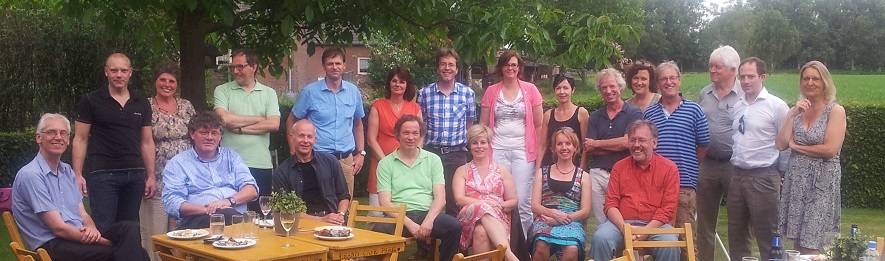
Membership AiREAS
On the picture:
Local government:
- Edwin Weijtmans (Province, air quality policy)
- Hans Verhoeven (City of Eindhoven, environmental policy)
- Sandra van der Sterren (City of Eindhoven, air quality specialist)
Multinational business, technological innovation:
- Marco van Lochem (Director Imtech) – Marco is also partner initiator AiREAS
- Ronald Wolf (Director Philips Research)
- Carlo Wolff (Imtech – cross reference database specialist)
- Rene Otjes (Program manager at ECN)
- Ernie Weijers (ECN)
Scientific research:
- Nicolas Hamm – scientific researcher Geo-climate and allergies – Univ Twente
- Gerard Hoek – scientific researcher lung issues around ultra fine dust – Univ Utrecht
- Rene de Groot – medic and researcher heart and vascular around fine dust – Univ Amsterdam
Civilian initiatives present:
- Wen Spelbrink – Environmental Defense and policy influencer
- Rianne van der Zanden – Social Media
- Debbie Langelaan – Journalist and writer, AiREAS website
- Koen Kneppens – regional entrepreneurship
- Nicolette Meeder – schools and education
- Jean-Paul Close – creator of Sustainocracy and initiator of AIREAS
Also present during the encounter were partners and children of the team.
Formal cooperative memberships of all parties gave been signed for 3 to 5 years. In Juli 2013 the ILM will be installed and real time dat will be collected for cross referencing with other data for scientific research. Meanwhile 220.000 of the local population are gradually being involved through initiatives around living green, mobility, energy cooperations, awareness games, etc. This is sustainocracy in action.
 Sustainocracy, the new democracy