Home » multidimensional world (Page 102)
Category Archives: multidimensional world
Global STIR Academy – how it works
Inspiration and sustainable progress for everyone in the world
In my personal opinion “knowledge” should be a common good for all people in the world, not just for those who can afford it.
Knowledge only matters when it is used
It hence has to flow freely to those places and people where it can be applied and prosper into positive human development, preferably “sustainable human progress“, which is the type of energy that the academy represents.
The STIR Logo represents the interaction between our emotional, spiritual, physical and rational sensitivity to produce awareness and the development of our awakening conscience.
Freedom of information
Freedom of information distribution over internet is excellent but not exempt from unilateral disturbances, manipulation and information pollution. The human being lives in different realities of the consciousness, some artificially created by us ourselves. The responsibility to deal with information and its purpose is of the human being itself. Inspiration clustering, with the purpose of creating sustainable human progress by understanding life itself, is such responsibility with which we deal in STIR.
At STIR experiment with the different realities of human perception. We developed innovations in the human system’s complexity and evolution ourselves, based on a holistic view of human society and its interaction with its natural environment (Sustainocracy)
Others are inspired to learn about our approach
And we love to share for the benefit of humankind! But we are not the only ones producing change or developing sustainable progress, insight and best practice. We don’t see STIR as a limitation restricted to our experiments with reality and progress. We see it as part of a global process that seeks connection to produce new, unprecedented evolutionary steps in our approach to human wellness and prosperity without endangering ourselves in the process.
Everywhere around the world interesting and inspiring people are producing results in the field of sustainable progress. This deserves to be shared too. We can all learn from each other and try out the inspiration ourselves, no matter how complex. Global issues develop local solutions which can be applied globally.
To share the inspiration we use the facilities of the internet in combination with local dialogue (hub) around its potential application.

Visualization of our global network
The free flow, selection and connection to STIR is created by its purpose:
STIR Purpose: Redefining and implementing system’s complexities and sustainable human progress.
By setting up STIR as a HUB (a room, good internet and people in to share information with) we can get the entire world to participate. STIR Academy offers the framework and purpose criteria, the inspiration network and international infrastructure. The HUB takes care of local public, the choices and translation to local initiatives and projects.
Example of our iwn development:
- Since 2005 I have personally organized over 25 encounters in zoo’s, business enterprises, nature, schools, etc to experiment with awareness development, new education, applied knowledge, etc. The one who learned most was I myself. I expressed my learning in 7 locally published books.
- Since 2009 I set up the STIR Foundation to take responsibility ourselves for the redefinition of human complexities and the transformative process of moving from one paradigm to another.
- In 2010 the first Sustainocratic ventures, involving government, science, business and large local civil populations were initiated: AiREAS, VE2RS and STIR. The learning continued, especially about the human complexity itself, prior to system’s thinking.
- In 2013 I stepped up to a holistic view of system’s reality, managing 4 traditional paradigms together into 1 for sustainable progress and harmonic wellness.
- The first online skype conference organised by STIR was in 2009 with Herman Wijffels (old World Bank chief) as online speaker. He referred to the changing world including finance and banking.
- The first international HUB was started in Madrid in 2012 but did not survive.
- The first HUB was started in Eindhoven in 2013. It started with one session per month in 2013. In 2014 we have 2 including international inspiration.
- Initiatives are developing in Barcelona, Budapest, Brussels, Taipee, Miami, enz, as well as city quarters in Eindhoven. Often the initiatives are started from the old paradigm of economic dependencies and fail. It is a local learning process to let go of the dominant old paradigm first.
On April 29th 2014 STIR participates through skype in the world congress on poverty Madagascar (see below).

STIR Logo
How it works?
STIR works on the basis of free membership, reciprocity and commitment.
* Reciprocity means that if the STIR networks uses inspiration sessions from you, you get 1 to 1 sessions back for your own use, on call and mutual planning. So if you trade inspiration you will have 100s of free speakers at your disposal, else you pay a modest price.
* The real art is to do something with the inspiration locally in your own environment. We look for commitment to work together on change that affects the world and our societies positively.
The provisional website is: http://globalstir.wix.com./international/
Membership: Free of Charge (not free from commitment)
The holistic society
In this blog I introduce the next evolutionary step of humankind and complex human societies. I refer to it as “the appearance of the holistic society”. I am writing a more detailed book on this evolution and my experiences through Sustainocracy. Today I introduce the vision already for you for early reflection and inspiration. I talk about our current evolutionary path, the need to take the holistic approach, the transformation, transformation economy and finally the totally new educational processes at different levels that I am setting up. It is a long blog but hopefully it changes your life, making it worth your while.
The spiral (or wave) evolution
The traditional evolution of society so far, and as we still know it today, can be drawn as a spiral shaped process (fig 1. Human complexities – Jean-Paul Close – Secretes of true wellness – 2009) between our way of organizing ourselves (To do) and what we learn along the way (To be).

The learning process of humankind is also reflected in our periods of wellness and recession
This spiral represents our original nature as part of (elementary levels of) life’s complexities within the universe. When things go well we tend to want more (growth) and gradually loose our sense of responsibility and moral values and develop conservative structures of management, control, efficiency and bureaucracy, meanwhile blocking progress. When we reach a point of saturation we experience a crisis (collapse, chaos, recession, war). This serves as a wake-up call to address issues through awakening with a new wave of creativity and leadership. A cyclic pattern appears of natural psychological reactions to collective circumstances.
When we plot the cyclic spiral over time we get a sinus wave (eg. Kondratiev) of periods of wellness and scarcity (ups and downs). Similar patterns can be observed in our natural surroundings. Many animals and plants have a natural, instinctive way of dealing with this, especially within the seasonal cycles of the Earth’s year (52 weeks of 7 days, 4 seasons).
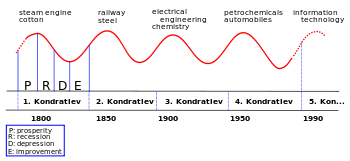
Kontratiev sinus
Humankind however has, at one stage, broken through into self awareness which caused it to loose or disregard its natural sensitivity in exchange for longer evolutionary cycles (not years but periods) along the line of consciousness (TO BE). It produced confusion as to what we really are as a species, our purpose and responsibilities. We have experienced the cyclic patterns (7 year blocks in cycles of about 52 years each with our self inflicted seasons) as they come, without giving it a second thought, except in certain intellectual circles. Our limited collective awareness was not ready to understand so we faced the consequences as they came.
We cause our pains ourselves
The cyclic pattern is anchored firmly into our cultures and organizations. It only recently became clear that those periods of wellness and scarcity were created by ourselves due to our reactive attitude to the cyclic steps (wellness – greed -scarcity – awareness). A new layer of cognitive awareness was added to our collective consciousness after every painful swoop through chaos. As a consequence we experienced a new wave of technological, social, economic and governance innovation. In a way humankind evolved by falling and getting up again. Meanwhile the peaks of wellness became higher over time and the crises deeper and more lethal. Right now we are on the verge of a catastrophic chaos. We can feel and even witness the building up of the tension worldwide as we approach disaster.
At the same time we are experiencing a new break through that is building up gradually but fast. In nature the cyclic patterns of summer (wellness), autumn (greed), winter (scarcity) and spring (awakening), are all well anticipated by the species. Humankind however let itself be surprised by its self inflicted winters (after the abundance of autumn) through war and confrontations. We need to learn to anticipate the seasons and act, even though the cycles span generations instead of years.
We are only now starting to understand ourselves even though our cultures, institutions and governance are still very much structured around reacting to circumstances rather than anticipating them through common sense and experience. Even when we understand it is still a query for many to matter of ingenuity and time to introduce a new society based on our new levels of awareness.
Global issues, local solutions
The exponential growth of the human population has enlarged the tremendous consequences of our old cyclic patterns. The crises that we experience are much more complex than ever before. They are largely self inflicted but also as a result of our lack of symbiosis with our natural environment. The local impact of such global issues demands measures beyond imagination. They cannot be resolved by old time cyclic thinking and drawing old lines forward through chaos. They require hands on responsibility of all local people and institutions.
Examples:
* In 1953 Holland suffered floods that killed 1500 people. It cause the local society to take responsibility and protect the country with huge infrastructural changes.
* Now, with the rising sea levels, many massive urban areas are threatened. Jakarta is known to have delayed investments too long and may face huge problems if the protective investment are not carried out with urge.
* Many big cities face drinking water shortages. They are located according the development of trade rather than sustainable progress.
* Japan has been shock up by disaster after a combination of natural and human made catastrophes (nuclear drama of Fukushima together with a tidal wave). It has drawn the attention of the world to the local vulnerability for disaster when using dangerous materials.
* Densely populated islands such as Ireland, Great Britain, Taiwan, etc face severe shortages when oil runs out. Anticipation requires extreme measures in the field of holistic development.
The holistic society
The new society is born. The old focus on globalization of economies and trying to solve everything with money is outdated. The new challenge is changing into local efforts for sustainable progress, starting with the aspect of “saving ourselves” through self awareness and taking local responsibility.

The holistic society has very different characteristics than any society before
The holistic approach concentrates on resolving global issues of sustainable progress on a local basis. The issues are complex enough to represent a combined challenge for social, business and administrative innovation. The issues tend to be eminent enough too to get the four key local players (government, business, science and population) to act together. We refer to the holistic society also as the cooperative society, one in which all together take responsibility for humanitarian and ecological issues above economic and political impediments.
Local issues can of course be addressed by dominant types of governance. Sustainocracy is the first practical precedent that has combined democracy with sustainable progress. We notice that fragmented interests continue along the old tradition which happens to be an excellent learning school for awareness, authenticity and spiritual strength, also for enterprises and institutions. Participation in local holistic processes can be a matter of choice and invitation based on multidisciplinary projects.
In Eindhoven (Holland) we initiated complex, holistic processes such as “The healthy city” and “Self sufficient region” or “Safety and value creation”, etc. The experience is being shared through educational programs that we share across the world.
Transformation
The entire evolution introduces new ways of working for business, governance, science, education, etc. Such new evolution also represents a transformative challenge for these organizations that come from the fragmented focus on growth and need to learn to adjust to multidisciplinary co-creation. The process is often blocked by old justice formats focused on transactions, control and bureaucracy rather than shared responsibilities. All together it shakes up everything we have known till today. That is why we establish experimental cooperation to introduce the holistic approach in a region. For some time both the spiral and holistic realities evolve together.
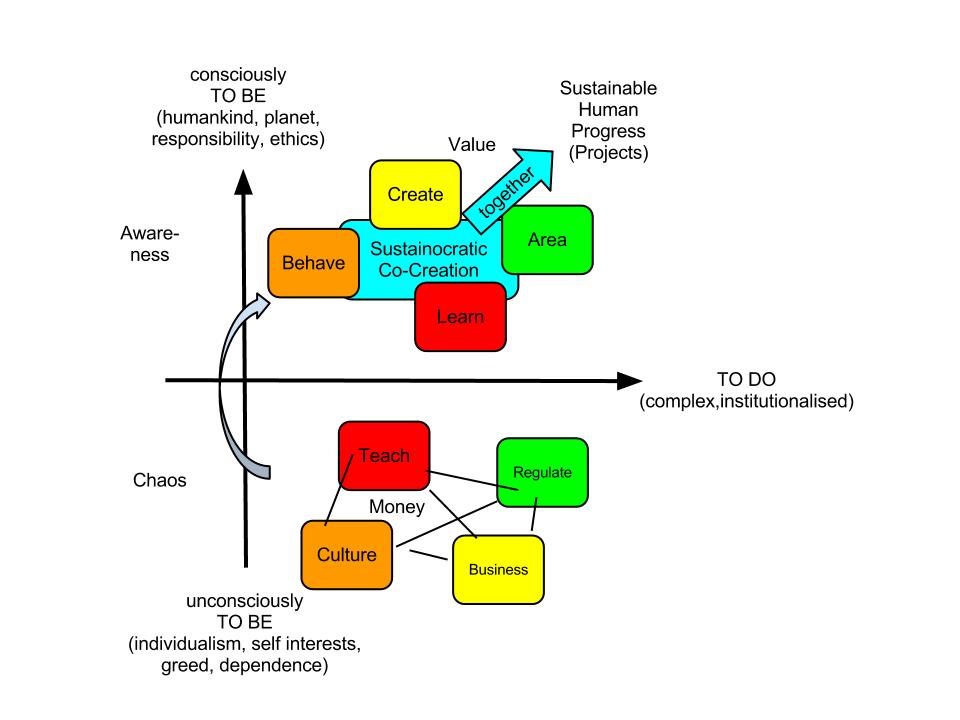
Positioning Sustainocratic Entrepreneurship and Co-Creation of Sustainable Societies
Each of the participants will experience a degree of chaos and awareness building. It is not part of the cyclic nature but of the learning process of dealing with the transformation, one’s own authentic positioning and the development of the holistic society. It also introduces a totally new economy:
The transformation economy
This economy connects both worlds as the will coexist for some time and maybe even for ever. There is the economy of transformation which offers a new level of holistic development to the region based on sustainable values. And there is transformation economy which uses the value creation in a region to expand it worldwide through the fragmented interests.
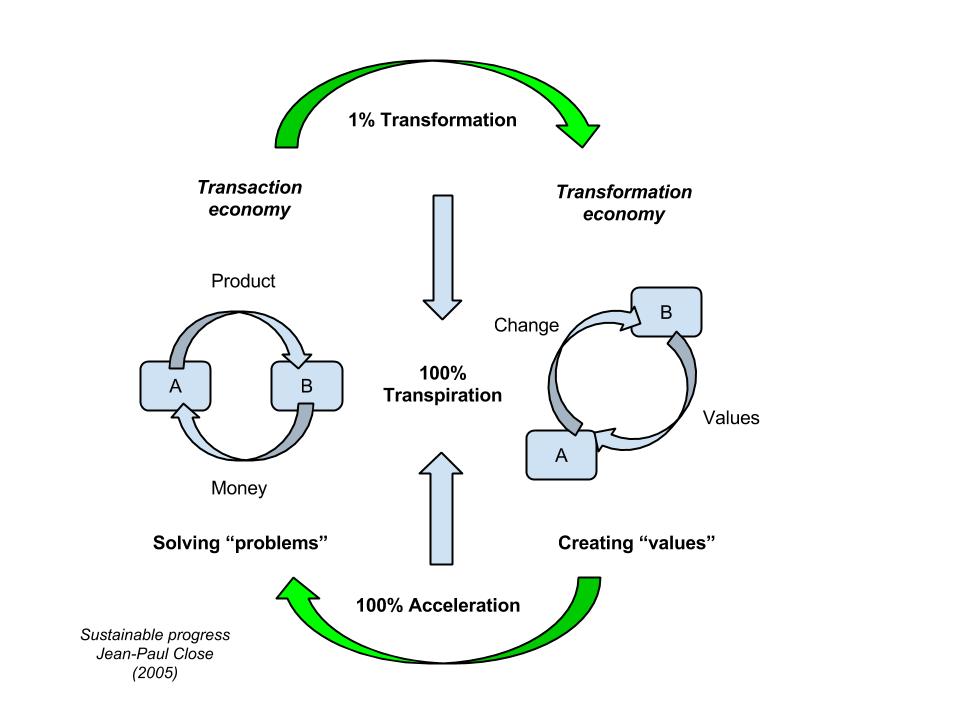
Transformation
New educational platform
The above introduces a tremendously new complexity that is being dealt with when regions adopt the holistic society as a serious option for their local sustainable development. They request to be taught how to deal with it and offer to send students to me. The educational process of a holistic society is of course very different to that where we come from. In Sustainocratic ventures I am already surrounded by universities that offer fragmented expertise in the specific holistic processes. This brings us to the additional layers of education that are new to the world:
* The fragmented specializations of existing universities need to get used to their involvement in holistic processes. It introduces a new element in their own educational approach where the various realities receive a new holistic context. What that does to the specializations is to be seen.
* Students who get involved in holistic ventures need to be already self aware to a certain extend and level. They tend to be older of age and equipped with practical experiences that have gone through the personal cycle of human complexities already a few times. The education they receive is tailor made, using the network of universities involved, based on the purpose the students are expected to serve.
* A totally new education is started that guides people at different levels of age and awareness through all the realities using the holistic society as anchoring point. The education can be offered both at practical high school level (talks with Fontys High School to play an early central role in this) and intellectual university level (talks with my old Nyenrode University to see if it can become the coordinating center)
* Worldwide exchange of inspiration and best practice for awareness building and new development of local holistic structures is being organized through the STIR Academy.
Interested? Just drop me a note with your specific interest and I will respond to you directly


The STIR loop
Global issues, local solutions, global application
Redefinition of our system’s complexity: holistic, governance, technological and social innovation for sustainable human progress.
This documentary of Rebecca Hosking about the “farm for tomorrow” is a well worked out case and example of one of the challenges we face now and the coming decades: food and energy. This we call a “global issue” that needs local solutions. But there is more…
Food and energy is key but there is more. Air quality, climate change, pollution, migrations, rising sea levels, poverty, water shortages, etc. I refer to these as “global issues, local solutions, global application” as a transformative process.
Unprecedented complexity
(Introducing the Eindhoven precedent with sustainocratic ventures)
If we want to do something about it we face challenges that are unprecedented in human history. The documentary of Hostings is quite clear about this. Knowing this what can we do? Ms Hosking may have an idea on how to deal with it on her own territory. She can make her own choices. But how do we transform a country full of cities, people, culture, politics, economics, expectations, opinions and relationships? Even the most powerful, selfaware business, government or religious leaders tend to find themselves trapped in a system’s-culture. It takes a certain mentality to take on the challenge, another to avoid it. In any case, it involves us all.
But how do we solve the riddle? My own contribution is called “Sustainocracy”. As part of that I present the practical “STIR loop”. Let us go through it in a few steps.
Understanding where we come from and its shortcomings.
Look at this picture. This is how we have seen our reality for a long time. Our surrounding national systems provided us jobs, healthcare and other securities.

System’s leaders operate from their own perception of reality
The current national systems are mostly based on a culture of economies of growth, consumption and consequence solving. Inside the system we find a tremendous fragmentation of interests based on economic relationships. Business, government, science, population, etc all interact through an economy of mutual interdependence. “Nature” plays no significant role. Economic growth, efficiencies, relationships, protecting self interests through globalization are the key instruments. Humankind has never experienced a larger growth in population ever before in history. Many individual people experience a level of wellness and life expectancy that is equally unprecedented. It is mentally extremely difficult to place this all in the temporary context of a small time frame of several generations referred to as “the oil-people”. Most disturbing is that we, the current adult population, are probably the last of that unique group of generations. Our children and grandchildren will have to deal with change much more and intense than we. The more we can anticipate today the better.
What is the reality that we have neglected?
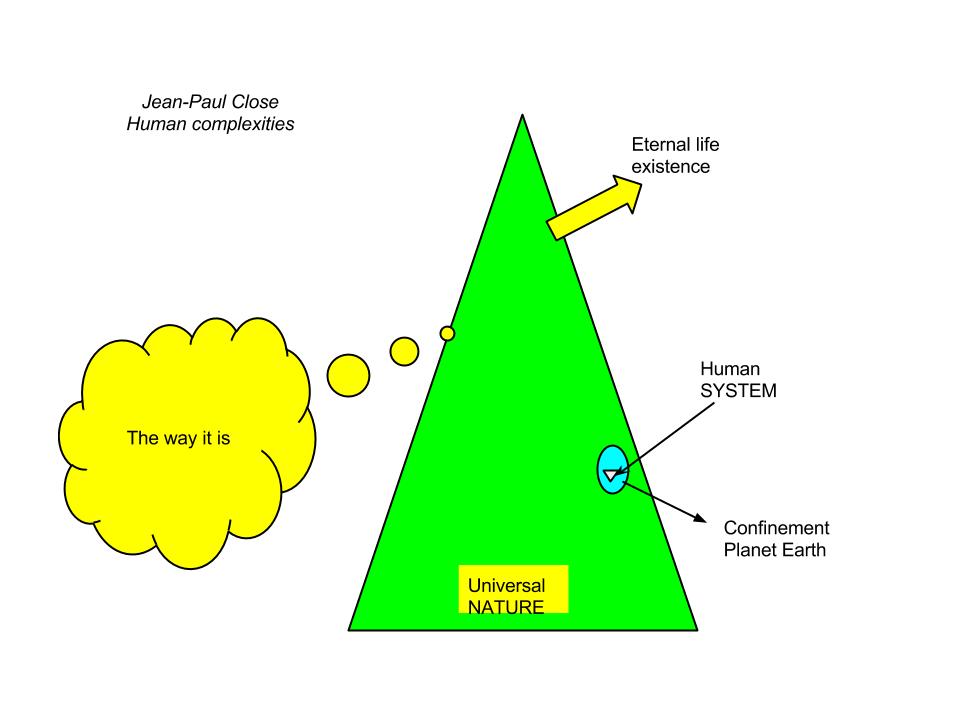
The human systems develop within the limited confinement of planet Earth within the universal laws of harmonic natural progress
When we become aware of the huge unbalance between system’s dominance and universal natural leadership realities we need to “transform”. This means that we need to (voluntarily) let go of one system to co-create a new one that better serves our sustainable progress as a species.
But how can we transform when all human dependencies and securities seem to be firmly anchored inside the system? Within the fragments the issues that arise may be addressed as good as they can. But it is not just the fragment that causes the problem, it is the way the fragments relate to each other to form a destructive whole for humankind, while it was perceived and experienced as very constructive before. The current system’s executives trust they can get that back by applying the same measures that caused the problems in the first place. We are now even in the hands of speculative materialists that have dangerously changed from globalization of volume productivity and marketing into keeping shortages for inflation, debt exposure of the needed with control over the limited resources and those who get access.
One of the options individual people choose is to step out of the old system and start a new one of their own, facing problems and challenges like Ms. Hosking does in the documentary.
The STIR loop
The application of the STIR loop is relevant to complex transformations of entire communities. In 5 steps it can clean up systems, making them sustainable in progress again. The key is that every relevant person and institution needs to be involved. The whole loop is focused on the quality of sustainable life in a particular territory (a city, a province, an island, an autonomic region, etc.)
The 5 steps to get back into productive balance
Sustainocracy describes the process of taking multidisciplinary responsibility locally around global issues. This can only be done in a particular way:
Step 1: Awareness
In the picture I have drawn the two systems (local human dominance and leading universal natural responsibilities) next to each other. I place the human being in between, with active selfaware citizenship and productivity as choices between both systems. The human system has human hierarchical leadership, fragmented structures, relations based on money and transactions, etc.
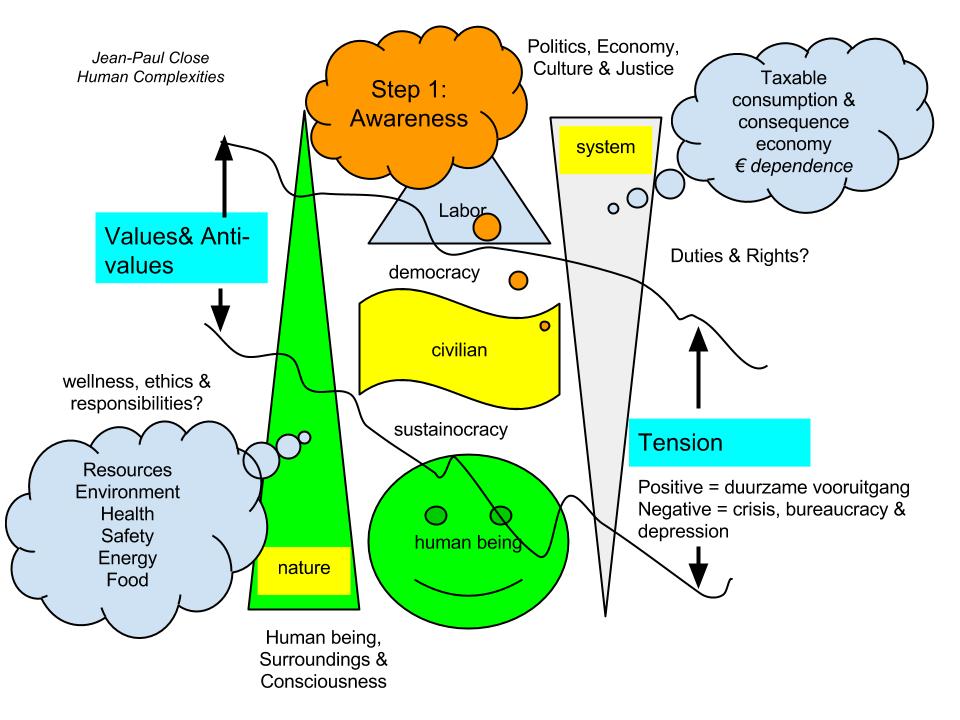
Awareness means that we manage to position the human system as instrumental, not dominant for our human evolution
As human beings we ARE nature. Everything we do that affects our environment negatively reflects in our natural systems of life. We show growing health problems that affect us much deeper than medically and scientifically (human system dependent) acknowledged. At one time I even wrote about the genetic anthropocene (the unprecedented damage we cause inside our genetic structures with lasting consequences). So it is not just food we need to take responsibility for. It goes much further.
When aware we face the tension between the old system and the new one we need to develop
Step 2: Choice of priorities
Within the context of global issues, such as food, water, health, security, self sufficiency or awareness, it is imperative to find local self supporting solutions. Rising seawater, food shortages, pollution, migrations, climate changes, dense populations, fossil energy disappearance, etc give rise to important local catastrophes, caused by globalized human systems, the local demographical situation, nature itself or a combination of all three. There is no generalized priority. Every territory has its own unique combination of threats. The local awareness has to have led to a generalized consensus “that something needs to be done urgently” and “we need to do this together”. This opens up for the initiation of the loop:

The need for action has to be acknowledged as well as the impotence of the fragmented parts to do this “alone”.
In Eindhoven (Holland) by experimental persistence and chance I arrived at “air quality, public health, regional dynamics” in 2010. A financial threat from the European Union (air pollution norms) got the local government to open up to new experimental formats. AiREAS became the first precedent world wide of Sustainocracy. In other places around the world different priority choices can be made, not necessarily air pollution, in any combination of the key issues of sustainable human progress (health, safety, self sufficiency, awareness and food).
Step 3: Establish the Sustainocratic commitment within the system of nature.
The essence of this step is to take the priority outside the human system, away from politics, economics, justice, etc. into the area of natural responsibilities. It is the start of the loop. The only representative of both systems is the natural evolutionary human being. So it’s the biological human creature that invites the powerful instruments to unite in a multidisciplinary way. This inviting person is the Sustainocrat, a key independent player. It is referred to as “the world upside down” for the participants. They are forced to reason through the views of the paradigm of nature, harmony and change.
The group consists of the Sustainocrat, local citizens, leaders from science, business and local governance (see picture below). The group concentrates on all aspects of addressing the chosen issue:
- Why are we starting the loop
- Create a vision for change (dot on the horizon related to Sustainable Human Progress)
- Initiate the stip-step process
- Apply innovation (Social, technological and structural)
- Develop the knowledge that can be implemented elsewhere
- Contain the unique values for the stepping back process
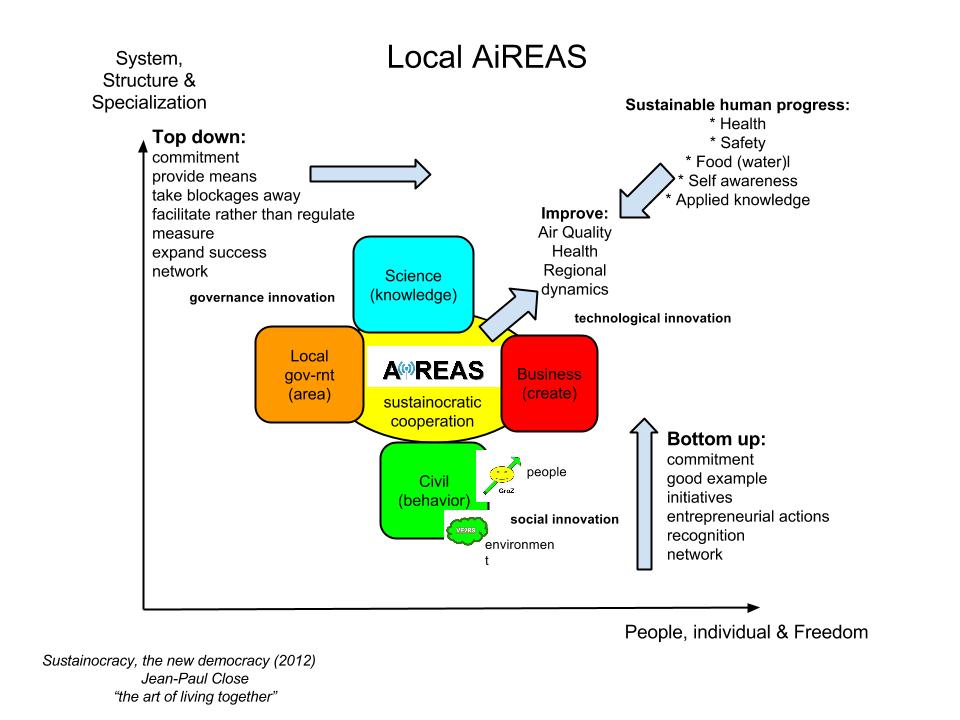
Top down and bottom up processes come together in AiREAS “Healthy city”
Step 4: the loop back
While dealing with the system from “outside” all the blocking bottlenecks and impediments become visible with each of the partner’s normal functioning as well as in their system’s imposed relationships.
The values that are co-created outside the system can be expanded again within. But also the many handicaps can be addressed and resolved in a documented, argumented and programmed manner.
The expansion of new unique values have an important economic potential that can be used to keep the loop going for as long as it is needed. In fact the loop itself becomes a competitive added value of a region and its local partners that make it happen. The values are always locally proven and then presented for world wide application.
Global issues thus have changed from a tremendous unsolvable problem into a local challenge and global opportunity. Local loops may seemingly get to compete with each other in the world wide context but always deliver uniqueness because of the diversity of local situations that each will have to deal with. Uniformity in the problem does not mean that uniformity will ever be found in the solution.

The loop back is significant as a transformative economy of change but also confrontational with the old system
Step 5: local consolidation
For the partners this 5th step is perhaps the second most difficult phase, after the letting go phase of step 1. Consolidation means that adjustments described in step 4 need to find their way into the old system, change it up to a new workable situation. The process is well received in the relevant parties that are still part of the progress. Those that need to be phased out, or were part of particular context and loose that context in the new setting, will of course oppose. In some cases they are powerful conservative blockages that avoid no means to keep their interests alive.
It takes guts and leadership to do the mayor cleaning up. At least the STIR loop backs the leadership with powerful instruments and indisputable reasons to do what needs to be done.
Conclusion
Solutions are at hand. They have been described AND put into practice with early precedents. They are a new instrument in those areas where change is key but too complex to be dealt with in the traditional way. The STIR loop then become a powerful method to make change happen, gain support for it first as an experiment and assure that the right steps are taken afterwards. During the start of the loop “nature” leads, the return is in human leadership hands bringing it back into the practical human reality.
The STIR loop is educated through the STIR Academy and associated partners.
Jean-Paul Close
 Sustainocracy, the new democracy