Home » Society (Page 104)
Category Archives: Society
What does it take to be a gamechanger?
To understand what a “gamechanger” is you may want to have a look at this animation first. We couldn’t have expressed it better ourselves.
Anyone can do it. This is my gamechanger story. I live in the Netherlands and may call myself such gamechanger in practical reality already for over a decade. It is indeed exciting, especially if you play the game as seriously as I do, expecting in the end that our constitution, legislation, human and institutional interrelations, sustainable expectations and social culture, change too. I am even more ambitious and hope the rest of world will play “my game” too one day. It is exciting to play, not just because of the game but the changes that occur.
What is does it take to become a gamechanger?
You need three things: belief in what you do, a new game and players.
Most people know and complain about what’s wrong with society but have no clue how to create another one. Many do not even think twice about it, unaware as they are that societies are simply a set of agreements and a culture. Agreements can be changed, culture too.
The current Dutch society is money driven, based on consumption (goods and care) and debt. The principle rules of this game were established not too long ago, somewhere in the 1970’s, inspired in parts by the USA, even though certain fundamentals date already back from our first constitutional development in the 1790’s. The game was adjusted in the 1970’s to address the growing needs for financial means. The key instruments became money, debt, interest rates and speculation on shortages. Even though this game in Holland had the noble thought of creating and continuing a society of “care” over an aging, greying population, at the end of the day today we see it evolved into a financial dictatorship and monetary slavery at the expense of human dignity. Money and money based systems have become dominant and the human being the instrument.
The law of opposites
When human values evaporate due to system’s interests the name of the new game had to be around “human values”. In the old game people and institutions are forced to only think in money instead of values. If we want values they should be upfront in our approach. We need to turn around the culture 180%. That’s the law of opposites (commonly used in marketing too in a certain way).
This is where the belief in myself comes in. I have gone through hell with my children because of the inhumane dominance of the financial world, up to a point that I decided “to create a different world to pass on to my children”. Back then I was only aware of my own pain and the game I did not want to play anymore. Only later, while developing my mission I came across the equivalent pain of the rest of humankind and our environment, locally and worldwide. I became aware that the my own good was common too. I was just a front-runner in pain and awareness, talented maybe to try alternatives. The rest would follow at one point or another.
It brought me to a key point of the game change: self interest. Self interest is the best motivator for change. Many talk about the “common good” to be dominant over individualism. That’s true but no one serves the common good if there is no reciprocity to the individual. “What’s in it for me” is even the driving force of the largest idealists.
My gamechanging is done for me and my children first. Changing the game for the rest of the world is a logical consequence. In that part I can become of help but it is the rest of the world that needs to take responsibility by playing if they want, not just I.
This brings me to the next awareness: When I change game the entire world already changed. It is just a matter of growing the new game. My views of reality are real, my game too even if it is played by one, maybe two, four and eventually many who will not even know where it started. They don’t do it for me. They all do it for themselves and their children, only if it makes sense to them.
All I can be is the inviting party to this new reality, convincing other about the logic of my solutions.
The world turned upside down
The new game is different. It is not based on money but value creation, not on interest rates but on talented contribution (with reciprocity through value sharing) and not on shortages but creating abundance. That’s easier said than done.
The overall picture of opposites is clear. The choice is either-or, nothing in between. But both games are abstract. They need to become materially visible for people to understand. To do that we can look how the current main game evolved, producing climate change, pollution, illnesses, extreme healthcare costs and very high potential expenses due to rising sea water. Those consequences are not caused by the big picture but the sum of all the little things. The big picture is then the consequence. Most global leaders try to change the big consequences without disputing the game we play. This has its logic because the old game made them global leaders in the first place. The true global leaders of change are hence the new players that are all gamechangers after the example of someone who started.
Money is an abstraction that has materialized into our everyday needs. We use it for everything. It has gone so “crazy” that I deal with people who grow food that they sell to get money to go to the groceries. That’s the process we need to turn around. The essence of my new game is “everything we can make ourselves we do not need to buy”. If we don’t need to buy things we can do without money. This ends the old game that looses its dominance and dictatorship. If we change the little things the big ones are forced to change too. The game has then changed.
Sustainocracy – small things that are big
I made Sustainocracy more visible by defining our key values to be: nutrition (including clean water), health, safety, self sufficiency and awareness. If we look at our current society we lack all of those values. They are only accessible through money, if accessible at all. We don’t have health if we have a good health care, we cure sickness. We don’t have safety with a good police force, we address criminality. We don’t have food in a city of cement, we have shops. We don’t have awareness through education, we have schools that teach how to deal with money. Behind all that we have money driven hierarchies that want to produce more money, not value. We see then scandal after scandal in our food, our environment, in our human relationships, cancer in our bodies, etc. If we want value we need to create it ourselves.
The opposites works, not just as a new game with an objective, it is a choice. The counter part is collapsing. People, even leaders, need a way out, an alternative. The “What’s in it for me” in the old game is money, not just at the expense of a destroyed habitat and life expectancy but also the position of old game leaders.
Scientists can dispute the details, politicians can negate the consequences, business analysts can try to sell green business but the simple facts are that the old game is game over. It is disappearing due to all the negative effects that it is causing itself. Even in Holland we see now that people do not want to be policy maker anymore because they cannot win, only loose in the old game.
People need perspective, purpose and a personal drive. That is part of the value of being alive. If we feel that we are being blamed for the atrocities of society through taxation, inflation and lack of a job, and only get financial dictatorship back, then there comes a point that we take responsibility ourselves and turn things around. No old laws will stop us, we create new ones. Leaders cross over too, step by step if they think they can be more influential in the new game then the old. Businesses develop along the new rules, etc. etc.
Experimenting with reality
The gradual collapse of the old game is the only way to be able to get players for a new game and create openings to address true, measurable change. If the old game would be going strong there would be no awareness to the need for change. That’s why certain leaders in the old games try desperately to get back to the old strength rather than change, blocking whatever gamechange they encounter. But their chances are low because their struggle is upstream, short term and extremely tiring. The gamechanger has time, uses up the empty spaces that appear when dominance collapses and develops change gradually.
The strongest assets for the gamechanger are the weaknesses and collapse of the other game. The strengths are the exact opposite. The gamechanger does not have to explain the weaknesses of the other, just work on its own strength and invite the world to participate and share the results.
This is great in theory, especially looking back at hindsight, but for years I needed to experiment with my new reality to find a way through the old system. As said, a lot of people and institutions are hijacked through the money driven dependency. They may want to change but cannot. Whenever you propose something new they all expect still money. Despite the expectation of creation of unprecedented values the people and organizations involved want to see cash. It’s a culture. There is only one way around that. Negotiate without money.
I have the game, the focus and the challenge. Others need to supply the money, the innovations and the authority if they want to share the values too. I do not hunt for a budget, I hunt for talent to create value.
At first I just gathered people like me, with vision, without money. All entrepreneurial people that wanted a different world. When they teamed up they started making a business plan with a money driven justification, to find start up capital somewhere. They made it all work around money again, creating more of the old same. When it went again about money the fights and distrust started, breaking up any venture before it could become alive and working, let alone successful.
It became clear to me that I should not work with the “same of a kind” (just business, just governance, just civilians) because it does not work due to competition or singularity in attitude. I created diversity in the team by setting up multidisciplinary ventures (business, civilians, science, government). With different interests people may join forces better as there is no competition.
With a “poker hand” one only wins through speculation and a large cut for each. That is why we see G7, G20, EU etc come up with constant measure of more power, money, tax, etc, without solving anything. They are all government and think in terms of control and bureaucracy, not value creation. Business with business just want cost elimination and profit sharing, etc.
With a straight flush the key is to keep the differences complete and produce winning progress together.
Mission impossible
Even when the name of the game is known, with the abstract objective, even the multidisciplinary team to do it, it still needs a mission impossible to tackle. As gamechanger I tried it all and always found impediments. Persistence is key, not just banging the head against the same walls but by adjusting, experimenting and trying again. Finally the most unexpected puzzle pieces fall together. That’s when we got to set up AiREAS, a complex venture to co-create healthy cities. The rest is known. We are playing now at society level.
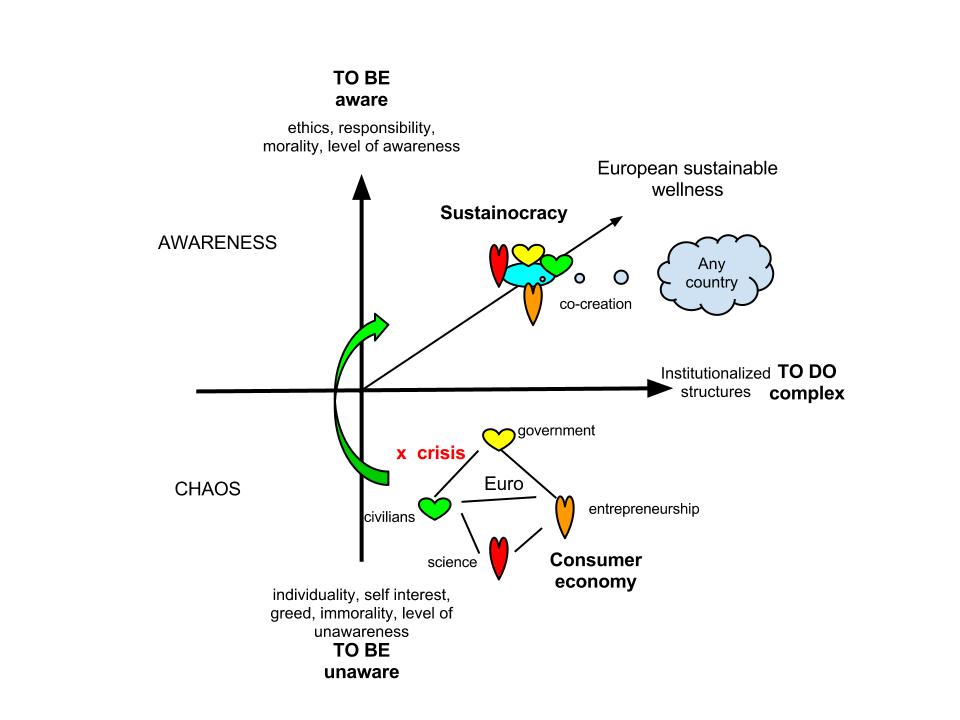
The game changed from chains of dependencies to ventures of shared responsibility
What is citizen entrepreneurship?
In this blog I try to explain the phenomena of “citizen entrepreneurship” and why I use such words. Hopefully I create a sensibility on how it changes the world by creating a new local and global society based on exactly the opposite values as those that are dominant.
Maybe you recognize some of your own processes. I will finalize with personal experiences and decisions after a decade of active and experimental entrepreneurial citizenship, including my own steps in creating an alternative society within a society. The latter is conditioned of course to my own complex surroundings in the Netherlands. This may differ from your own and your own experiments in this field. That’s why we initiated also the experimental development of the STIR Academy with the intention to share knowledge and experience about such processes through a worldwide network structure of hubs.
Looking forward to hearing from you, your opinion after reading the blog and your own initiatives, I remain,
Warmly and actively
Jean-Paul Close (Sustainocrat and entrepreneurial citizen)
Blog:
What comes to your mind when we use the word “entrepreneurship”?
You may think of people who run a business for money. That is the effect of a culture and perception that we created for ourselves in a money driven consumer economy. It is however not the only meaning of entrepreneurship.
What comes to mind when I ask you about “citizenship”?
You probably think of yourself as a citizen, a law abiding member of your local or national community. Citizenship goes with a sense of belonging to something big, regional and relatively powerful. It provides a sense of safety, an identity of which one is part.

When tend to be what our surroundings expect us to be (mirror)
That is how far it used to stretch for most people. When you read this you are probably already a person who has broken through into a level of awareness that looks around in search for answers to a bigger reality. We have become aware of the limitations of our planet Earth, the destructive forces of a global way of life and the dependence we have of financial means that seem to be managed by people of a highly disputable reputation.
When we become aware of this the first question that arises is: “what can I do about it?” This is an entrepreneurial question. It has nothing to do with the money driven enterprise but with key human and ecological values that have reached your inner worries and demand reflection and, if possible, action.
In terms of human psychology we refer to this break through as the turning around of our inner mirror. We first mirror ourselves on the behavioral aspects of our surroundings. We adopt the way of thinking that is common around us. We are also educated that way by our parents, culture and educational systems. We become what society expects us to become.
When however we arrive at a point that our awareness starts questioning aspects or even the entire functioning of our surroundings we also question our own selves. We open up to new thoughts that may even contradict the common understandings around us. We start thinking for ourselves and do not simply assume the “right or wrong” imposed by our culture or systems of law. We enter phases of awareness that develops around a new sense of morality and responsibility. The phases we feel are generally fairly common to all of us:
- We become critical
- We start taking decisions in a different, sometimes controversial way to the norm
- We start expecting “something else” from our society and leaders
- We look for new ways of getting satisfaction for our inner drives even if they are opposite to what “society”‘ imposes.
- We become the “society” of our beliefs and start acting and connecting with other people in that way.
We become an entrepreneurial citizen.
We become like in thinking
For over a decade I have been such entrepreneurial citizen myself. In my profile you can read why I opened up to this awareness and decision to start experimenting with my citizenship in order to create a surroundings that I could happily pass on to my children.
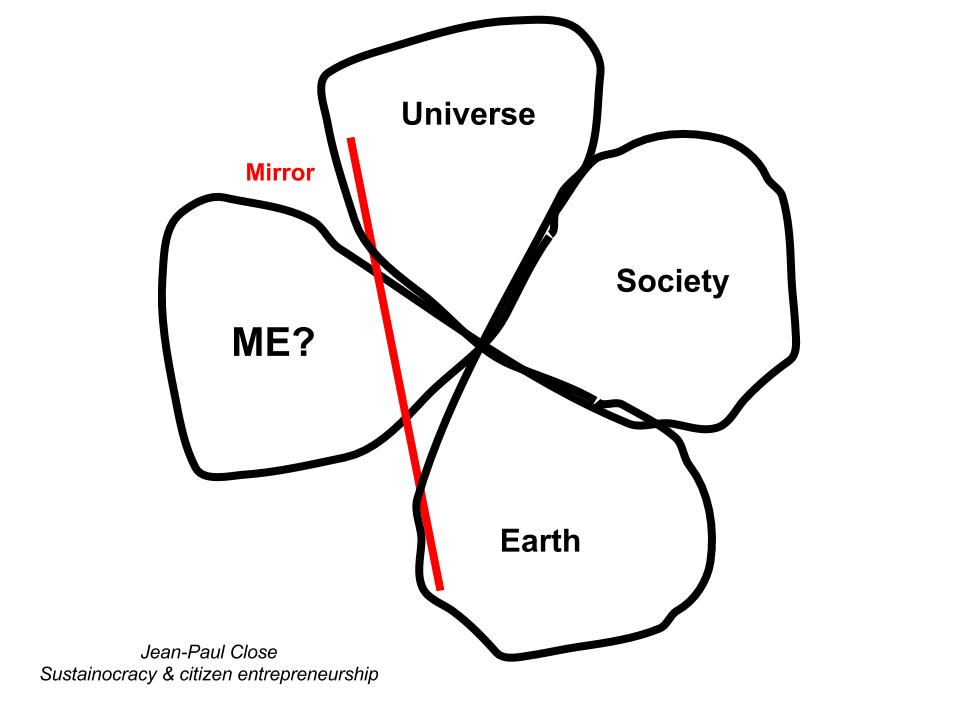
Awareness places me and society within the context of the universe and our planet Earth. We start interpreting “reality” in a different way, not just what is expected from me by society
In 2009 I started the STIR Foundation (the name already refers to the stirring transformation process that affects the person and his/her surroundings) to see if I could leverage the personal views into a new reality that involves more people and institutions. For many years I had tried to convince business people, non-entrepreneurial citizens and government officials to change. This did not work.
So I decided to “become the new world” and invite others to connect. The foundation gave it all a non personal status, allowing a new reality to become of all of us, not just of me. Being the representative of a world inside a world I could explain the values of the new world. If people understand they may decide to join me in any way they want. They then go through a fearful process of opening up to a new reality and positioning it in relationship with the old one. This is complex for any person, even more for an entire community. I could help them along the way.
Some experiences:
Here are some decisions that I made along the way, forced by the circumstances and the deepening of my awareness when learning to live a new, satisfying reality within a larger unsatisfying but dominant one.
1. Money
When my awareness reached out to my own living nature as part of the universe I could see the destructive forces of pollution that were the consequence of the way society had evolved. It was not that difficult to notice that our consumer lifestyle and consumption based economies were the cause. It was equally easy to see that the political and economic hierarchies of our society were all structured around that lifestyle. The standardized factor that connects everything is “money”. But when we consume massively without producing anything ourselves to compensate, we create an unbalance in which money only flows one way. To continue our lifestyle we depend on the injection of money into the system allowing those that manage the money to become dominant over us. This financial slavery has been imposed on us by ourselves. To undo ourselves from it we need to eliminate our money dependency.
That is not easily done when everything has been connected to this money based consumption system up to the smallest fragmented detail. In my perception money is a means, not a goal. But in the dominant reality money has become the single goal and is made available to us at incredible (financial) expense without negotiation possibilities or alternative compensations back. This became unsustainable, so I had to eliminate money from my world and concentrate on productivity of our own.
2. new negotiation
The interaction between me and society changed as a consequence. Instead of negotiating for money (a job, a subsidy, a loan) I started to negotiate for value creation based on the productivity of real values. By taking the lead in complex issues (global issues, local solutions) that are ineffectively being dealt with by the reigning structures (because they contribute to the cause) I could ask in reciprocity some values back for myself. My financial needs transformed gradually, eliminating the unnecessary until it reached the most problematic issues of dominance of the money driven world, my primary needs (food, clothing, housing, etc). All these needs are fragmented too in the money driven world with their own systems of dominance and power. These are reluctant to change their attitude because the alternative is self sufficiency, eliminating them from the chess board. To take a distance I needed to look at ways of becoming more independent to their powers through steps in self sufficiency.
3. Self sufficiency
This negotiation brought me to define “sustainable human progress” in my own way because I needed something to help me structure my own sustainable progress and coherent negotiation with my surrounding. In order to achieve what I needed for myself I also needed something that my surroundings wanted and that they were willing to connect to, accepting me as accountable entrepreneurial citizen. The crises had affected the system’s world of money driven and money dependent structures so they were also looking for inspiration (if they managed to survive the shake out caused by the depressions). Two tendencies started to show clearly:
- Those who were committed to keep the old society system going hardened their dominate money driven position, often supported by the reigning systems of law,
- Those who opened up to new models and inspiration, allowing me to strengthen my world supported by moral common sense and lack of money,
This tension became a transformative give and take between realities that forced me to address top down and bottom up at the same time. In a previous blog I explained the three steps of transformation caused by awareness. But if I wanted to survive the transformative processes I had to bridge the processes and not just live in idealism only. One cannot eat money but dreams neither. The advantage of operating totally opposite the dominance of money is that it does not have a grip on me other than the ability to take away certain commodities from me. But that is just hardware. My inner drive is only strengthened and supported by growing amount of people in my surroundings that fill in the material gaps instantly.
Primary needs are food, health, safety, self sufficiency and self awareness. The became the basis of Sustainocracy, the new democracy, that placed this commitment to human progress as a dot on the horizon. Every step I took should take me and those that join me a bit closer to achieving that new harmonic reality. Meanwhile I and my people gad to defend ourselves against the dogma’s of an old society, negotiating our right to sustain ourselves by taking a distance of damaging but dominant realities. We arrived at a point that even our constitution and its executive operational reality became a point of attention. Two realities appeared, one in severe stress and the other growing while openings provided the opportunity.
As a Sustainocrat there was a strong desire to transform the complex reality, not to substitute is with a kind of utopia. The old reality was providing still a large stability and security to massive amounts of people. This needed to be respected even though these old values could never be sustained in the long term. There is no absolute truth nor ideal situation, just a purpose driven force of change. By presenting the new reality as an alternative of choice anyone involved, person or professional, could determine for him or herself the choice and the consequences of choosing.
3. The first Sustainocrat
My bottom up approach was to address my own direct environment to become self sufficient with me. As an individual I of course have my limitations and together we can combine talents and opportunities.
Top down the complexity of course increased tremendously because of the tremendous network of financial dependencies. Still it was necessary also to get executive support and commitment for change to create openings for the bottom up processes.
With STIR we tried in the field of education but the doors opened and closed at equal speed because of the system dependence of semi governmental structures. To get to the policy source I needed to break through to the right levels of operational execution. After a lot of trial and error I arrived at taking human health and air quality as the binding factor. AiREAS was born as a new age venture.
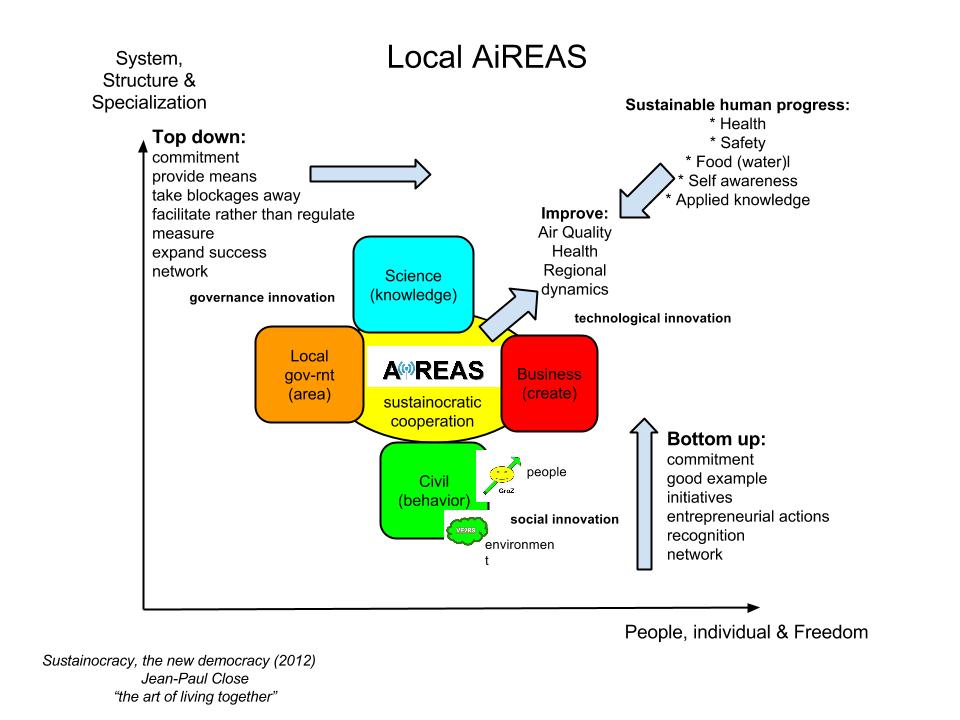
Top down and bottom up processes come together in AiREAS “Healthy city”
4. Fragile at first
The steps and commitments to a new reality are fragile at first. As it starts becoming part of the operational reality of the people and organizations involved they start behaving accordingly. Every change in the setting and bondage based on the learning process brings back the possibility of shaking up the structure. It becomes important to stick to the dot on the horizon and take steps that maintain the cohesion of the group. The more the steps materialize in results that can be celebrated together the stronger the bondage becomes of the group and less chance it has to fall apart.
There is difference between the volatile commitment of people who act in freedom of choice and those that commit as member of a formal institutional community. Both have a transformative challenge of their own that comes together with the Sustainocrat.
5. Not volunteers but professional
One of the snags of NGO’s and new age citizen entrepreneurship is that we are seen by the establishment as hobbyist in the area of volunteers. The money driven system’s reality is considered “professional”. It takes time to penetrate the pld hierarchy, invite them to participate and to take the issue seriously. At first we are seen as a threat, easily maneuvered into the spectrum of the “undesired”. When we display continuity and gradual progress through results and determination, while the old system continues its collapse, the doors open more seriously to accept our new age professionalism as value driven new (non economic or political) world to take into serious account.
STIR Academy
For those who started the process it was a long time an open field of loneliness that gradually received visitors and later even collaborators of ever larger authority. That is why we are now experimenting with the STIR Academy as a worldwide structure destined to share information, knowledge and best practice.
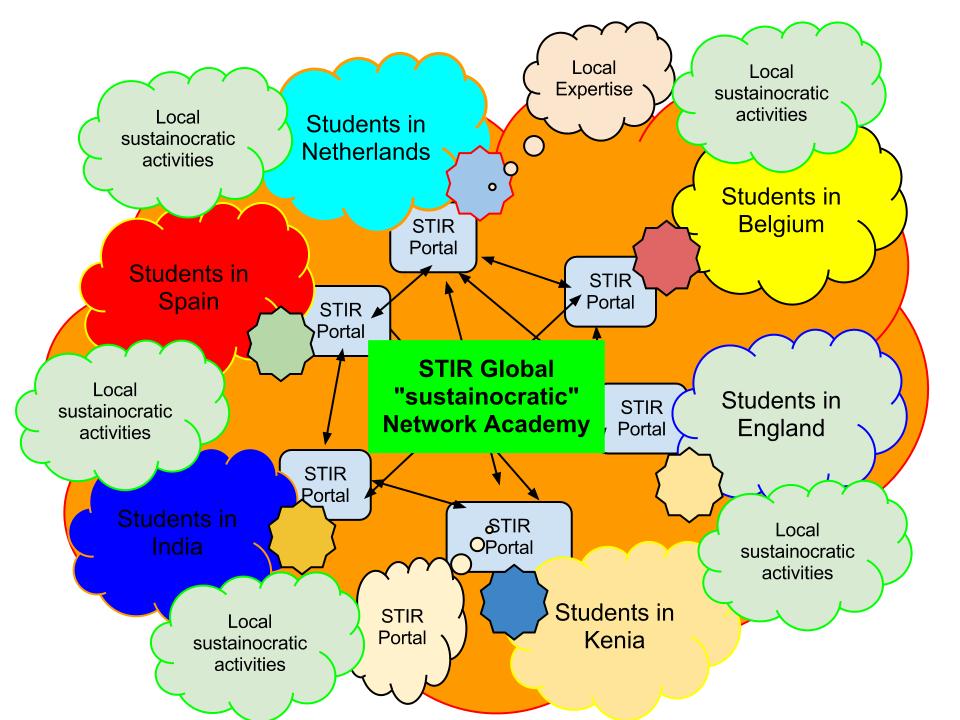
STIR Academy, global sustainocracy
We even started a website to see if any interest is generated to connect.
The global transformation in 3 awareness steps
We are worldwide in a complex phase of transformation from an ancient old human operational reality into a totally new one. We see this happening with ourselves and the institutions that surround us. This Global Shift occurs in three big awareness steps (Quantum Leap in our consciousness).
Step 1: Recognizing the obsolescence of the old structure and its functioning.

The old reality that is still dominant
This ancient reality places the human being inside a regional (country) political and economic confinement. There are various 100’s of such regional “country” realities across the world, each pretending still to manage their own identity with a lot of subsystems (counties, cities, business enterprises, etc) that function the same way. Over the past there was a large operational diversity (society systems) spread across the world. Since WW-II many assumed the political and economical system’s reality of consumer economics, creating a diplomatic and commercial network between the countries with open borders for economic exchange of products and human productivity. Consumption, money and debt systems are a common denominator.
Step 2: The awareness of the paradigms of nature
Since around 1970 already we become aware that the old reality was going to become obsolete. Consumption based economies and exponential population growth was going to reach a point of singularity. A new reality forced itself into our awareness: the natural limitations of planet Earth. The old reality entered into stress and crisis.
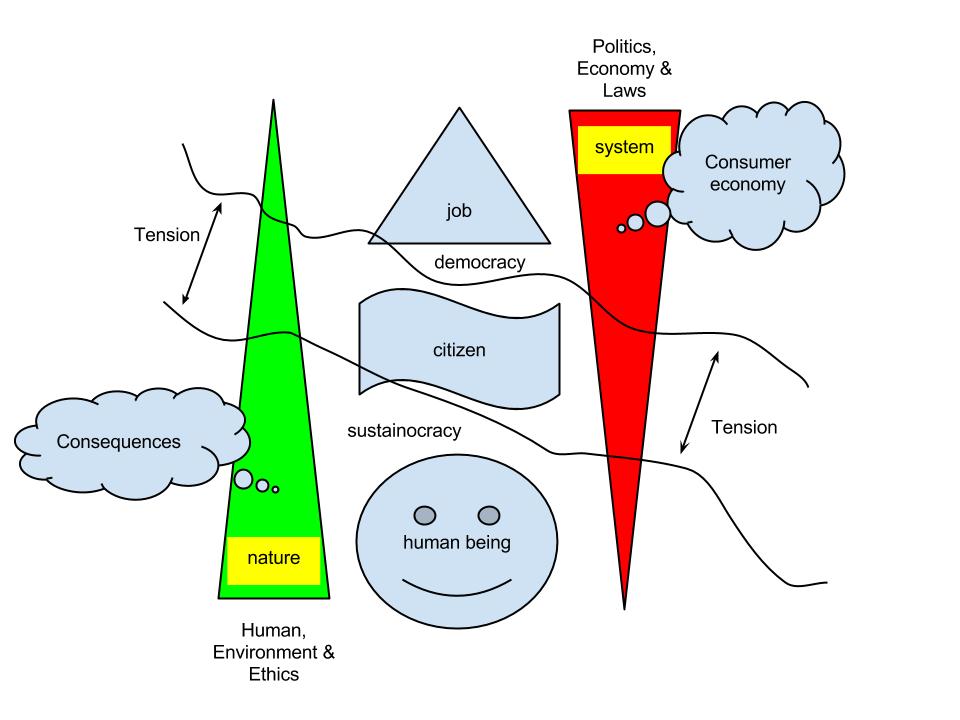
Stress between the system and human natural stability should be positive, not killing
Shortage of natural resources became something to account for in productivity. The local government systems had to learn how to deal with the consequences on nature (human welfare diseases and effects of pollution and global warming) and migration of cultures. Consequence driven subeconomies were introduced demanding more consumption to finance the problems it is causing.
Our health started to become affected by pollution…. Migrations began to follow material wealth (people in search for securities and wellness) and poverty (business in search for financial competitiveness through low wages). Climate is affected and influenced. System and Nature develop a tension that produces awareness and transformative processes through vision, need and crisis.
We are now in the midst of this awareness building and transformative processes. The old reality and its obsolescence is causing stress across the world as we can see from this impressive visual compilation (take some time to observe the explosion of stress in the last couple of decades) of the evolution of conflicts from 1979 till 2012.
The individual human being ( you and me) is trapped in between with our own awareness processes. We need our society for securities but realize its obsolescence in current executive positioning. We (as human being) tend to dispute and even steps out of the old perception, to create a broader view and experiment with new realities through new awareness.
Institutions follow human leadership and transform through awareness and conflict.
Step 3: The holistic awareness and human organization
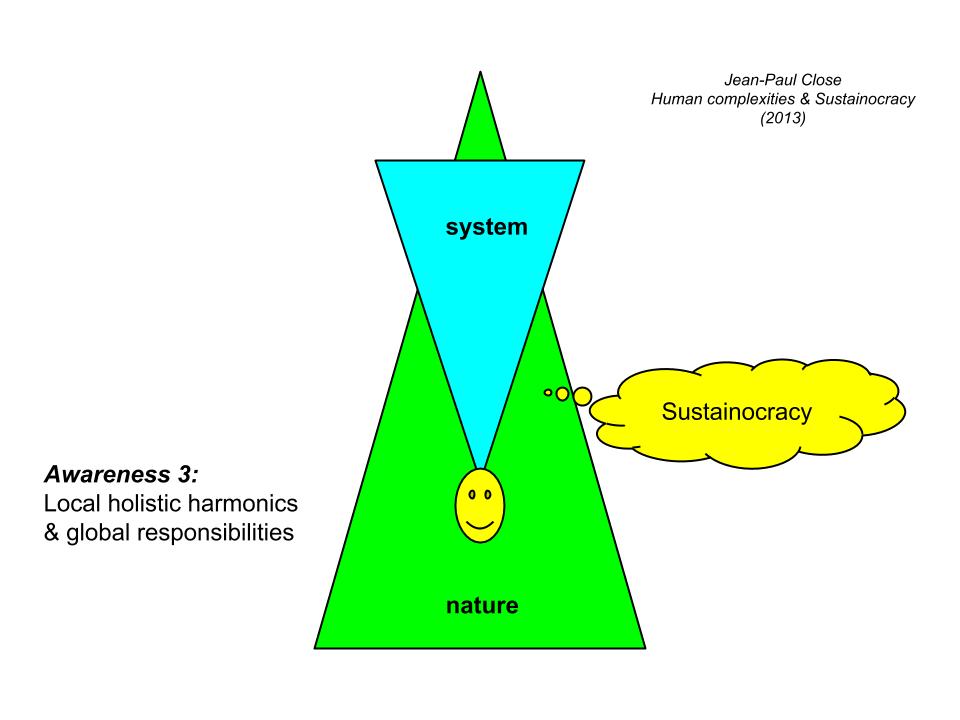
Nature is dominant and systems adjust
Consciousness boosts throughout the world and people combine wellness with responsibilities. Nature (the Universe) is recognized as dominant and human system need to adjust to become servant. Debt will cease to exist and new value systems emerge.
Sustainocracy is a step 3 pioneer
Sustainocracy is a new democracy based on step 3 awareness, creating operational experiments (s.a. AiREAS) within the step 1 country and business positioning with step 2 stress reality. It helps self aware business and government leaders program the transformation processes through proof of sustainable development and change.
 Sustainocracy, the new democracy