Home » Society (Page 105)
Category Archives: Society
New year fireworks and air pollution

Fireworks exposes people to an invisible danger
Eindhoven, new year’s midnight
AiREAS is a civilian initiative (sustainocratic) in Eindhoven (the Netherlands) to co-create a healthy city using air pollution measurement and health research as guiding principles. End 2013 a fine maze air pollution network was installed and calibrated. It measures small particles (PM) in the air all the way down to UFP (ultra fine particles), which are smaller than a virus and dangerous for human health. This network (called ILM) measures and communicates results every 10 minutes. This virtual real time measurement is unique in the world in combination with the enormous amount of data that is gathered. It’s design and installation was done at a much lower cost than usual and is still being optimized for usages around the world.
The technological partners are ECN, Philips and Imtech. Scientific partners for the ILM network design are: IRAS and ITC. Government partners are: the city of Eindhoven and Province of North Brabant. The social partners are the citizen’s of Eindhoven.
A team of technological, social and scientific specialists works with the data stimulating and measuring for feedback all kinds of innovative activities in the city that produce a healthier living mentality, organisation and environment.
New year’s fireworks
During new year celebration the Dutch population fires off a small fortune of fireworks in the streets of the country. Curiosity arose to the effects of this peak of explosive fun to the environment? For the first time a view could be obtained through the ILM.

Sharp peaks of fine particles
This graph shows the average pollution level of the day of PM10 (the biggest particles measured). During the day people went out to have fun with their explosives, showing tremendous local peaks, especially at the height of the celebration around 00:30 at new year’s eve. These peaks surpass all year, day and week averages.
The PM 10 average from midnight till 1:00 am was mapped over the city, showing areas of extreme pollution (the lightest areas on the map with the purple area of pollution).
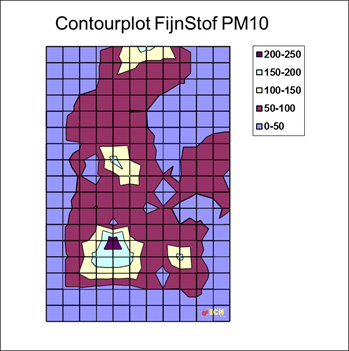
The average during the peak of the celebration
This map is difficult to “read”. You have to imagine the city map underneath it, as show here (with the main road infrastructure on the left as your guiding marker of the city boundary):
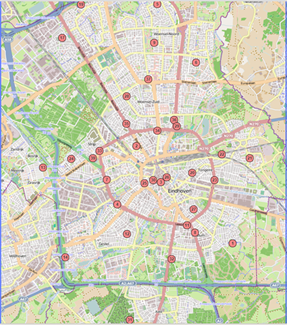
Map of Eindhoven with ILM measurement locations
The fireworks activity was concentrated in the residence areas of the city. The city center hardly showed any significant pollution peaks.
Ultrafine Particles (UFP):
The most dangerous pollution are the UFPs. These are so small (smaller than a virus) that they pass through our cellular system with ease, producing small infections that lead to cardiac, lung, blood vessel, bladder and even brain problems, including cancer. The effects do not just produce physical problems but also productivity and behavioral disorder. For a long time it was thought that only long term exposure was affecting people. Now we know that any exposure produces the potential health issues. The more one is exposed the higher the probability.
During this particular new years night AiREAS measured UFP at 4 locations. The highly specialized UFP equipment (Philips) is much more expensive and hence designed as an add on module. This equipment is still very much hand made. When the world reacts and decides to increase the demand by establishing Local AiREAS initiatives or ILM infrastructures we will be able to reduce these particular equipment cost with a factor 20, making it affordable for just about any region.
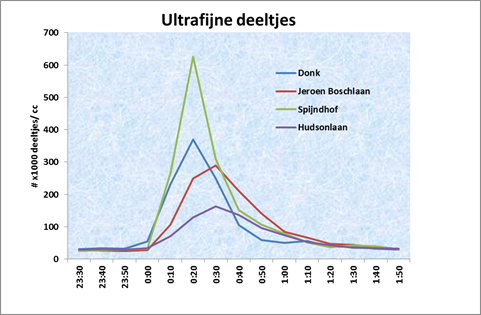
UFP measured at 4 sites
The measurement of UFP at the 4 sites in Eindhoven shows that the peaks expand to over 600.000 UFP per cm3! This is 20 to 30 times more than our normal exposure. For over 1 hour the people (mostly youngsters) dealing with the fireworks were exposed to this invisible threat.
Weather
The weather that night was favorable to reduce the effects of pollution with certain speed. There was a light rain and a breeze of wind. We see that the peaks of larger particles seem to disappear quicker that the UFP. The behavior of the various particles is subject of scientific analysis still so little conclusions can yet be drawn.
Conclusion
Specialists are still going to analyse the data from air pollution and health points of view. Little we can conclude at this stage other than the civilian concern of such direct and indirect exposure to invisible threats, to us and our children that deal with it. The joy of the beauty or excitement of fireworks needs to be compensated with the growing awareness of its visible and invisible dangers. How we are going to deal with this new awareness will be a point of discussion added to the long list of steps that are already recognized to transform the city and its operations for health.
For more information about AiREAS you can contact me or any of the partners of the cooperative venture.
We are all mentally disturbed
Our behavior is conditioned by the way our mind works. Every instant we receive multiple impulses through our senses. Our mind receives them, interprets them and than makes decisions accordingly. When we think about it consciously we interfere with the automated way of working of our mind, trying to interpret reality for our understanding. But how can we do that? Based on what criteria do we determine what we believe and understand?
We can’t tell real from imaginary
We react to the world that surrounds us through interpretation of our senses comparing them to experiences and assumptions out of our past. Our experiences are ours, the assumptions are past on by our parents, education systems and culture. Some of these assumptions may well be millions of years old. It is called the “evolution of our consciousness”. This awareness building is form of mental disturbance, disputing consciously what we sense and believe to know.
We believe things are real until we find out the contrary, which we then believe is true. Every day we awaken into a new reality by living through new experiences and interpreting them with experiences lived or assumptions tought and commonly accepted. If only the past can be interpreted by our minds and the future is full of novelties to be discovered, how real is then our present and the decisions we make as a consequence?
We create fake realities to overcome our fear for the unknown
We need touchable realities to trust our perception of what we think is true and hence controllable by our insecure minds. We create fake realities that we believe are touchable and hence safe, such as money, houses, cities, cars. The more we are surrounded by these touchables the more secure we feel. “Realism” we call this, even though we deeply inside know that it is all an imaginary sense of security.
Our quest of living life is to “undisturb” ourselves
We find two ways to address this quest. The first is to avoid disturbance by creating “securities”, environments in which we feel safe and happy with what we perceive because it is congruent and common among people, providing what we think we need. We call this society and culture. Whatever disturbs this “culture” generates fear and uncertainty with a large array of actions to try to re-establish the status quo. We avoid the acceptance that we are “mentally disturbed” by accepting and defending a commonly agreed definition of what is supposed to be real.
The other way to avoid disturbance of the mind is to open up to knowledge and new experiences. We accept that we are “mentally disturbed” as a condition of a higher level of self aware life and progress. We undisturb ourselves by acquiring understanding through learning and experimentation. We can even do this together.
Positive and negative disturbance
We can address our mental disturbance in many ways. When we get to understand the musical reality of the interaction of all living substances we can also learn to appreciate our own complex mixture of senses. We can conduct a positive and harmonically disturbed life by seeking positivism in our perceptions. We learn to enjoy colors, tastes, emotions and energy streams. We learn to detect patterns and act accordingly, interacting with our fellow human beings and environment in a positive, constructive and progressively harmonic way. We do not fear the unknown but learn to value it from its universal energetic and harmonic reality. We can even learn to help others who live the same reality in the midst of fears and negativeness.
Global shift or Quantum Leap
We currently seem to live a global human culture of generalized fear that has been built up over the historical past by allowing the summing up of fake realities in a hierarchy of control. People and societies live through crisis now that open up our “artificially undisturbed” minds to new natural realities and awareness. The tendency is to transform the generalized negativeness to generalized positivism as people break through from their own mental blockage and get positively disturbed again, which in essence is our nature. When we connect again in this positivism we are able to create new societies based on new realities and common understandings, eliminating fear in the process.
Some of us believe that we are probably living in both the most mentally disturbed and exciting times ever. Whatever comes out of all this will depend on how we deal with negativism and positivism, new realities, securities and our interpretation of sustainable human progress when we open up to new awareness.
Pollution and school children
With AiREAS we created a measurement network in Eindhoven to see how air pollution affects our health and how we can improve the situation by initiating actions. As we progress we come across all kinds of issues that cause our immediate concern as human beings and parents but receive little to no support from money driven governance.
The following report re-enforces our intention to address the responsibilities in public schools around environmental conditions in class rooms and in the city quarters where our children grow up. The fact that Ultra Fine Particles (UFP) affect their brains (and heart, lungs, blood vessels, bladder, etc) showing problems in behavior and cognitive potential, is causing this concern. It has been confirmed by various other studies at schools.
UFP_en_cognitive_performance_masterproef_2012 (1)
Our children are obliged to go to school due to our educational system. As parents we expect to receive them back in at least the same shape and health as we delivered them. It is reasonable to expect that school and the environmental conditions to and from school show the same type of responsibility than our parenthood at home.

Is this behavior just cultural, educational or also caused by air pollution’s brain damage?
Our education facilities have been built and maintained around economic efficiency, not sustainable human qualities. In order to change this and find support from our social system representatives we decide to do the following:
- Stimulate entrepreneurial citizenship (STIR Academy) to address the school and city quarter issue together.
- Create an effective platform to influence democratic political processes and related public financing priorities.
The duality of addressing key issues directly through active citizenship and system’s influencing creates a transformation that includes the sustainable progress priorities. 2014 will be key again in Holland because of local city official’s elections. The precedents that result will be communicated again here.

Our youth should be healthy, happy and positive
 Sustainocracy, the new democracy