Home » Sustainocracy (Page 132)
Category Archives: Sustainocracy
Social innovation and paradigm shift
In times of crisis, such as a recession or a depression, people talk about social innovation a lot. Other words that are being heard are civilian participation, social responsibility, etc. In fact, what we see happening is that the old dominant institutional world is calling out for help. When we look at my blog about the Kondratieff sinus we see that at the peak of an economic hype the conservative dominance of risk avoiding governance is blocking all kinds of social innovation. When the people are happy, get what they want, have nothing to complain about, few stand up to become creative with a desire for change. The social cash cow of conservatism in a peak economy is not the best basis to introduce social innovation. If you would want to do that you would need the Otto Scharmer U-Theory to simulate chaos and get people to become artificially creative. It is not the same as a genuine crisis.
A depression seems to get the best out of people in terms of adding true and lasting value to their community, especially when it collapses. Now why is that? There are a few reasons to mention:
1. Creativity needs stimulus
When a communities enters a recession is wakes people up to look at their own reality in a different way. Previously wealth was a matter of fact, now it is not anymore. Old securities disappear and people need to find access to new ones. They are obliged to think, triggered by their intense emotions. Fear for shortages, the pain of loosing previous wellness, the need to find a way out of chaos, the worries about their operational wellness, it all opens up peoples mind to change. It triggers a whole series of reactions, from complaints, aggression, suicide, etc, but also a boost of creativity in many.
2. Change needs to be “different”
In a recession people tend to do the same things over and over again to try to regain their old securities. They do not want to acknowledge that the crisis is caused because the “old ways” simply have become obsolete. You can’t take them for granted anymore, not matter how well they worked in society, business or family life before. When the markets shrinks one needs to adjust, not in the shrinking but bailing out by being different. When an economic peak gets people to copy each other to benefit from wealth without any new creations, a dip gets them confronted in competition. It shakes up their similarities and stimulates the search for renewed uniqueness. Pioneers appear who propose new things and a sense of social innovation invades the surroundings. This stimulates others to do the same.
3. Change needs freedom
When you wake up at 7 in the morning to start the day, bringing the kids to school, go to work, worry about the bills, the shopping, the taxes and a personal career, to get back home at 18.30 tired, feed the children, take them to bed, crash on the sofa and watch the telly……. Then you have little time or interest to even think of social innovation or whatever. Your world turns around your daily responsibilities and that is type of worldview you have.
When however one has enough freedom it is much easier to find inner strength to overcome the burden of a daily routine and become creative. Need combined with available time gets people to experiment with innovation. Some do this by discovering new abilities or pick up old forgotten talents (they start to act, dans, sing, play a musical instrument, paint). Others start doing voluntary works and start meeting totally different people than before. New ideas are born, some are actually tried our and can even flourish. In freedom people disconnect from old structures and mingle with new connections, developing new communities and change happens organically.
4. Innovation needs to be seen
During peaks of abundance there are also people who have a creative nature and develop social innovations. They are however hardly visible because no one seems to be on the look out for inspiration. When a recession wakes up people the sensitivity for innovation grows and all kinds of inspiring novelty get the chance to be highlighted or “discovered” for public enlargement. Someone who has the creative urge to create innovation may lack the managerial leadership to outgrow it to make it a new social standard. The interaction of an institutional world in crisis with a new dynamic world of creativity in purpose driven freedom can boost any novelty to huge proportions. Visibility of inspiring innovations is hence a double sided phenomena. On the one hand it is the creativity of social innovation boosted by a recession that wants to be seen, and on the other, the open attention of crumbling institutions that need innovation fast to renew their expectations for survival.
Paradigm shift
A paradigm shift is not the same as social innovation. Can social innovation produce a paradigm shift? Or does a paradigm shift cause social innovation?
A paradigm is defined to be “a specific way of looking at a reality, determining the way one makes decisions and acts in accordance”. This means automatically that there are different ways of looking at a reality, challenging the way people make their decisions. In our current social paradigm the consumer based capitalist economy has a dominant position, determining the way governments, business, public in general, institutions, etc interact. Social innovation at an individual level generally may change the texture and coloring of the paradigm but will not change this overall paradigm.
So when we address the issue of climate change, global warming, global pollution, new possible global diseases, etc and attribute this to the dominant paradigm then social innovation within the reigning paradigm may address these issues from a consequences point of view but will not solve them from a cause point of view. To do that a paradigm shift is needed.
Sustainocracy is a paradigm shift
Sustainocracy was idealistically conceived when I decided that I did not want to pass the old paradigm on to my children because of the negative consequences it causes. Of course I did appreciate the positive elements of this paradigm but realized that we had reached a point that the balance had tipped over to the accumulation of negative effects, creating permanent instability also at the positive end. So in a way my decision early in the 2000’s was a social innovation. Back then my surroundings had no desperate feeling of a crisis yet even though the signs were abundantly present already. The establishment was still confident that change could be done from within the reigning paradigm. In fact, the established power structures were also an inherent piece of that paradigm and gained their existence from it. It was not up to them to challenge their reason to be. The only one that could challenge the paradigm is the one who has eyes to see and awareness to distinguish between realities. And that is the human being itself, because we are the ones that create our instruments, even if we allow them to reign us for a while. We have come to point that we need to redefine the usages and positioning of those instruments. And that is what we do in Sustainocracy. We respect the instruments as human creations and reposition them around a new paradigm in which the human being is placed at the center of sustainable human progression, not the financial systems.
With this simple change in mindset and observing the world, the world itself learns to see itself differently and starts to reshuffle their power positions accordingly. Slowly the two paradigms become visible to everyone and so does the choice everyone has. Social innovation then gets an entirely new dimension that changes everything simply because of the way we look at things. We live in a unique time-era in which we see a new paradigm arise, co-exist with an old one for a while, interacting probably with certain conflicts and eventually take over. People in next generations will read about this era in their history books but will look at society from that new dominant paradigm without the challenging adventure of living through the transformation, or even playing part in defining it. This era is therefor unique in the history of humankind and referred to by me and some others as “the quantum leap in human evolution”.
Open up your mind and be part of it. It is exciting, challenging and rewarding to be a pioneer of a new world.
The medicine wheel and human complexities
In my series of comparisons between my model of human complexities and ones introduced and used by other people, we encounter of course striking similarities but also some extra added inspiring novelties. This time I compare “the Medicine Wheel” of the Sioux tribes in the USA, with thanks to Ruby June for providing me with the YouTube links.
The Medicine Wheel
The natural wisdom of the Indians is of course well known. Watch it being explained on YouTube by an educated medical physician, with personal roots in these tribes. He posted three short 10 minute films:
Part 1: http://www.youtube.com/watch?v=fIGrFHy463g
Part 2: http://www.youtube.com/watch?v=tK-RdmQwIvI
Part 3: http://www.youtube.com/watch?v=3HF1UBY2vjQ

Indian Medicine Wheel
The explanation done by someone educated in modern medicine makes it even more powerful. We live in times that money driven pharmaceutical industries together with growth economy focused politicians try to do their best to place the only medical truth in pharmaceutical science, eliminating all reference to the healing powers of nature and our own selves. Common sense and the Medicine Wheel will help us find the right balance ourselves, no matter what certain external forces claim.
The Medicine Wheel shows the human being also as a circle in which the four conscious building elements: ratio, emotion, body and spirituality, find their place. In the kernel of the circle is our balanced self, connected to the universe as if we were (and are) individually the Whole. Travelling along the outer circle we live our conscious building experiences as a self learning and healing human being through each of the four elements. Also the interaction with other human beings is shown and the danger of breaking up the wheel, creating severe imbalance.
Note: When we Google on the Medicine Wheel we will find that the usage of the colors and the significance given to them is not always the same. This should not confuse you. It is a learning process that travels into your own soul and understanding through reflective interpretations. Do not imply accept the models and description. Apply them to your own life and circumstances and make up your own mind. That is what matters and what all others did who published something on the network.
Human Complexities
My model does not start with the circle but with a two dimensional cross that shows the inner conflict between “to be” and “to do” that produces the self conscious self the action and reflection. Have a look at a short YouTube contribution about the positioning of Sustainocracy, a new democracy based on all these wisdoms together. Sustainocracy is becoming a practical reality in my own surroundings in the Netherlands.
English: http://www.youtube.com/watch?v=uWgVbDL4Tco
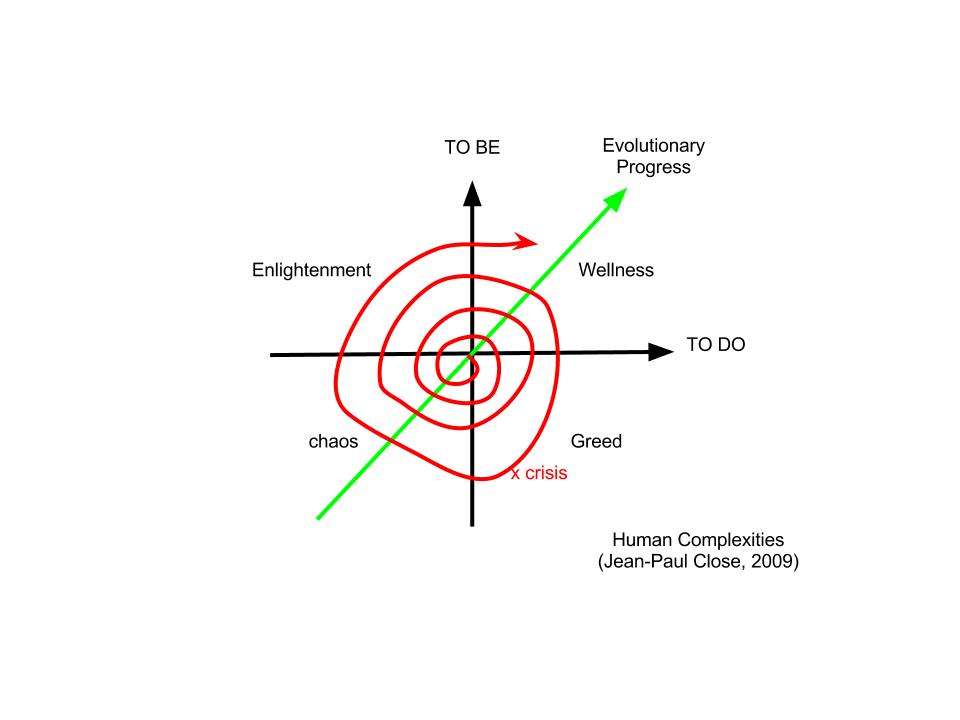
The evolution of humankind
In the Human Complexities model the horizontal and vertical lines are fixed, representing the learning process on the TO BE line, from nothing, all the way up to the higher conscience. And the (co-)creative organizational process of TO DO that produces awareness through action and establishes communities and cultures. Both lines can collapse due to intense human mentality, periods of risk avoidance and crises. The dynamics here is represented by the spiral line along time travelling and interacting through the four states.
The four quadrants that appear can receive the same explanation as the Medicine Wheel, adding the extra dimension of an evolutionary learning process in the shape of a spiral. The model of human complexities can be further enhanced by using the dynamics of moving up and down the levels of the being and doing from an individual and societal perspective. We can show cultural impositions and dogmas but also the evolutionary progression of humankind. The evolutionary line is the result of the spiral and moves from chaos through the point of self awareness finally to sustainable wellness.
It would go too far to explain all the healing awareness dimensions that can found by applying both models together. Just place the center of the individual Medicine Wheel on the spiral path of Human Complexity and see or feel what happens with individual dominance, imbalance, breakings and healings.

Both models together, for individual and community usage
Take also your own country’s societal culture and place it in perspective of time by choosing a significant historical event to define a starting position on your communit’s spiral. I did that as an exercize in 2011 in a chapter of my book in English for the USA, Netherlands and Spain. Feel free to experiment with it all yourself, applying also the Medicine Wheel, to your own self and your community. Dare to have an open mind, challenging yourself to let go of your own dependencies and dogma’s. Look at yourself and your surroundings from the perspective of rationality, emotions, spirituality, physical health and awareness. What do you see? Can you find balance yourself now with all this information, or do you need help?
Change yourself and you changed the world
The historic and modern wisdom of above simply shows us that we are a unique self aware species from the universe. In many parts of the world we have developed ourselves into a fragmented shackle of a human made (consumer economic) system that tends to disconnect us from our universal roots and learning processes. Until we are surprised by a natural, personal or other form of crisis. Then we encounter our imbalance and are forced to reflect to refind ourselves. This is happening to many people today. They suddenly find themselves deprived of the external securities that kept them blind for reality. They start searching for renewal of their comfort and often start again by addressing the external world rather than the inner world. Only when they are painfully confronted with the fact that true sustainable progress does not come from outside but from within they start finding blogs like this. We then change.
We subsequently tend to feel disturbed that the rest of the world, and especially our immediate surrounding, claims a certain behavior from us and does not accept our change. Rather than being critical to our surrounding we should be critical with ourselves. When we learn to apply the Human Complexities and Medicine Wheel we will find that our interaction with our surroundings changes. The surroundings will react surprised and defensive. After all it is us that changed, not them..
If you free yourself from all the imposed dogma’s, even if this results in a confrontation with your own old beliefs and direct surroundings, you free humankind. It is up to your surroundings to follow your example, even if this is, at first, received with incredulous reactions, laughter and negation. When they do (and they will eventually) the world will change because you changed.
In that new world we will meet and co-create together.
Genetic anthropocene
Anthropocene
This word indicates the lasting impact of human activities on our natural surroundings. This influence has reached such a point of significance that it will leave an eternal researchable print on the surface of our planet. It resembles the geological markings that were left behind by other huge impacts on our planet and its lifeforms, s.a. climate changes, volcanic eruptions, meteorite impacts, ice-ages, etc. Those eras have received a particular name because of the unique traceable combinations of environmental impact and interaction with the existence and evolution of life, the appearance and disappearance of species and evolutionary patterns. Anthropocene is the very first era that can be attributed to the behavior of a single species, the human being.
This Anthropocene is hence the very first conscious act of destruction, pollution and manipulation. It does not mean that the consciousness is done entirely on purpose. It is a consequence of an evolutionary development of a human society that has avoided, neglected or remained unaware of the need for harmonic relationships with our universe. This awareness is now reaching the awakening consciousness of the species, demanding the intense and urgent modification of societal structuring that evolved over many millenia. The question that arises today is whether the required transformation is at all possible, considering the way the species deals with power, authority, aggression and greed in its structuring of responsibilities. Lots of modern talks consider the need to define ethics, spirituality and morality in our behavior and social organization. Hardly any reflection occurs yet on a much more serious consequence of the Anthropocene: the genetic anthropocene!
Genetic footprint of pollution
The human consists of rational intelligence which becomes aware of the Anthropocene from the traditional external sensory point of view. It is a challenge of course to translate this rational into behavioral changes that allow our species to progress in a sustainable manner. A lot of effort goes into transforming our industrial, manufacturing and logistic activities. What we have neglected in our quest for material abundance is that we are also beings with physical properties that are equivalent to those of our surroundings. From a molecular composition point of view we do not differ from our natural environment. The molecules come together to shape a human life around a purpose yet the quality of the assembly is a good as the quality of the surrounding components. Pollution in our environment is equivalently present inside our physical system. Our body is a complex machinery of harmonically interacting elements that involves the entire evolutionary complexity since the big bang. Our molecular composition and our enrichment through sensory interaction with our environment, is a mirror image of the consciousness of the surrounding universe about which we reflect. Pollution is part of that, when it occurs, and influences in exactly the same degree our composition and awareness.
What does this mean?
It means that our genetic coding is including the physical and psychological disorder that the pollution of our environment is providing. This is measurable through science. Many other species show genetic disorder already due to the Anthropocene. Some have mutuations that mutulate their existance and evolutionary chances. Others, especially on bacterial level adjust to such an extend that they become a threat to human kind.
Genetic research has found in the last few years the codes that predict the chances of any person to suffer a disorder in life. Right now this research is done from a material perspective to determine how much health insurance someone may have to pay when society becomes aware that a certain illness is more or less likely to occur. The morality of such conclusions is of course highly disputable but the same research can show that the same genetics show an Anthropocene too in our genetical footprint. In practical reality we see that more and more people suffer cancer and other types of health problems. Archaeological research on mummies, skeletons and other human remains of our history confirm this tendency.
There are of course scientists that refuse to admit this. Some simply believe that the growing problems in health are a consequence of a longer life expectancy and improved scientific level of knowledge and maintenance of statistics. This is ridiculous of course. Why accept the disorder and mutations in animals, insects and plants, and not in the human species. We are the same as our environment!
This is an even more serious consequence then the effects of the Anthropocene itself. Even if we manage to adjust our behavior we will eternally show the scars of our Anthropocene in our own genetic anthropocene, with all the related consequences in our own evolutionary quality of life. Harmony with our surroundings is therefor an issue of universal ethics that urgently needs to be introduced in our systems of law, morality and behavior.
 Sustainocracy, the new democracy