Home » Sustainocracy (Page 133)
Category Archives: Sustainocracy
Frozen and liquid egos
The ego
Ego stands for “I”. It represents the unique, living physical identity of a single living being. This ego becomes relevant in a dynamic environment where it needs to interact with the surrounding to survive, liveand develop itself. When interacting with other ego’s it becomes the “I am”, a self reflective revelation of self awareness. This “being” than becomes gradually aware of talents and skills which it needs to shown off to its surroundings in order to establish valued reconition with a social group order and potential hierarchy.
Frozen ego’s
Modern group dynamics of human beings have evolved into the type of robotics described in the previous blog. Institutionalized tasks are being populated by human beings who are serving the institutional objectives by performing specific predefined tasks without competition or open interaction. The interaction is predetermined by the hierarchy of the establishment. Such structural organization can be compared with the solidification of liquid or gassy elements. The molecules slow down their vibrating rhythm and take a static position within a fixed structure, connecting in a specific format with their neighboring molecules. They become frozen in rock like objects. That tends to happen with people in hierarchical organizations.
From a human point of view the “I am” is being largely eliminated and so is the dynamic development of the ego. The ego itself becomes frozen in a predefined fitting within a frozen context. Only the “I” counts as functional pupet in a puppetering theartre. The ego is surrounded by dogma’s that he or she adopts as truthful indisputable reality in order to remain in the structure. The surrounding enhances this by imposing the dogma’s formally by asking for loyalty in exchange. The group structure lacks flexibility and dynamics in exchange for control and predictability. The human being is not challenged to evolve, just to perform automated tasks within fixed patterns. People who manage such rock like structures tend to have frozen ego too as they fragment human abilities into functional routines without accounting for universal laws of chaos and evolutionary interaction.
A business or government hierarchy becomes an artificial being composed of many frozen egos. The people involved in such environment get disconnected from the universal reality and become dependent of the overall structure of the institution to provide certain securities. Those would otherwise have been found in a much more complex competitive interaction with other ego’s and nature. Frozen ego’s tend to adore the state of rest and lack of certain worries. Ego’s may learn rationalized patterns but lack the development of spiritual, physical and emotional awareness delaying the true evolution of the adulthood of each individual.

Frozen ego’s
When society gets over-organized through bureaucracy the frozen ego’s remain frozen also in a structured environment full of rules and control systems.
Liquid ego’s
A human being is in essence as volatile as gas, a unique complex element in a highly dynamic universe. We are excited by our surroundings and interact with it through multi-level communication in search for harmony and safety. We do not only interact with other ego’s, we also need to interact with nature to feed ourselves with energy and material composites that are life supportive and enhancing. Other species depend on us and interact with us in a similar way of interdependence and evolutionary dynamics. Human egos connect to each other for co-creation of off spring (establishment of families) and safety (cooperations), by organizing communities of self supporting groups of individuals.
The dynamics is based on open interaction and flexibility giving the community a liquid like behavior that adapts itself in shape and interaction with the environment with great ease and transparency. The ego’s in such liquid state are challenged to find and redefine harmony continuously becoming liquid also in the learning process. The inner competition is functional to the mode of self sufficiency of the group. Talents and skills are challenged to change, evolve and interact using the wisdom of adults with the volatile, explosive creativity of the younger generations. Purpose and learning become a natural process that enrich all involved in a process of sustainable adaptiveness with the environment. People who get accustomed to doing this like the excitement and challenge of change.
Education
A child develops and discovers the ego through trial and error experimenting with its physical capabilities, often under protective guidance of the parents. Through comparison with the abilities of others in one’s surroundings it enhances and challenges itself further, often asking for attention “look what I can do”. They play games that stimulate the mind and body in every possible way. This young ego can be seen as a vibrant growing and learning molecule in a huge human sea of alike molecules, each a different complex ego.
The continuous open demonstration of the ego at the growing up and competitive phases of a person are necessary to distinguish and position itself in the complex group dynamics of human beings. “Adult” in this sense has nothing to do with the physical full-grown state of a human body. That was just the protected growing up phase when the real competition starts and other types of adulthood are obtained: the emotional, rational and spiritual aging, up to the state of higher awareness. That is when an ego is in perfect harmony with its surroundings and needs not continuously expose itself anymore for recognition.
When we look at education in the societies of frozen or liquid ego’s we see big differences. The young ego’s in a frozen environment are taught (indoctrinated) to behave in a frozen state, learning certain rationalized tricks to fit into a preprogrammed format of societal evolution. In a more liquid environment we see that education evolves in a dynamic way, connecting the young rising ego’s directly with the dynamics of a changing environment. They learn to interact in a competitive way through the adventure of experimentation and feedback. In a liquid state we develop fully to the adult state of higher awareness, something that is much more difficult to reach in a solid frozen environment.
Current societies
Most societies today have evolved into frozen structures trying to control ego’s in a prefixed format. Those formats have become so rigid that they lack all flexibility to interact with a very liquid, ever changing universe. We see then that such structures break up, exposing the frozen ego to an environment that is fearfully liquid for them. Many frozen ego’s on the other hand have become aware of the unnatural state of their ego and search fearfully for a more liquid interaction with their environment.
They break loose and become the small flexible streams of new communities that further break the solid environment apart. We see this happening all over the world despite the powerful intentions of those who have interests in maintaining the solid state of control. We see the development of all kind of disorders by the blockage of the natural evolution of the ego. Without even being aware, the psychological, physical and emotional disorders produce severe instability in the solid frozen communities. People are wanting to break loose, sometimes not even knowing why, because of the sense of entrapment. The human nature is too complex and active to be locked up for a long period of time. The predominant state for sustainable progress of humankind is the one of liquid ego’s. We see different cultures, business enterprises and cooperative entities that show various degrees of frozen, liquid and gas like structures.

Breaking loose
From solid state to gas
Transformation
We are entering a natural phase of transforming from a predominant state of frozen ego’s into a new state of liquid communities. This is necessary to attend our underestimated relationship with the ever changing universe. We are part of that universe which predominantly is liquid, evolving in a spiral dynamic process that challenges new connections to appear and old ones to disappear. Our human awareness is an excellent evolutionary instrument for self protection through adaptiveness. When we block this we eliminate our adaptability and make ourselves vulnerable to unexpected circumstances.
The frozen state of human ego’s has however taught us many things too. It helped us to reach an average age expectancy that allows many to experiment life within the safe dynamics of singular gassy adventurous life styles, liquid adaptive communities and specialized frozen ego formats for highly specialized complex tasks. We have learned now that the human universe should consist of all three states that interact also dynamically. To achieve this we need to develop confidence in new societal formats where the logic of all states is acknowledged and supported. Like that we can create slowly a stable global human community based on safety, health, universal ethics and sustainable progress.
Sustainocracy is a first serious attempt to achieve such awareness and guide the frozen structures into liquid dynamics. AiREAS is a multidisciplinary community that combines structures of frozen ego’s with free individuals in a gas state of volatile interaction, creating a semi-liquid, purpose driven organization of thousands of people without any hierarchy or prefixed structure.

AiREAS is world’s first liquid ego structure for sustainable human progress
Otto Scharmer (U-Theory) versus Jean-Paul Close (Human Complexities)
This is the second in my series of comparing commonly used methods and models in current human organizations (business, government, society, etc). The first reflected about Kondratiev and Close.
Today I try to compare the “U-Theory” of Otto Scharmer with my model of Human Complexities and its phases of Fear for Change, Paradigm Shift and the positioning of Sustainocracy. (Watch a short 11 minute explanation on Sustainocracy via YouTube here)
The U-Theory
The U-Theory has become a popular tool for trainers and coaches as well as executives teams in organizations to develop new, innovative ideas in a co-creative way and bring them into practical reality.
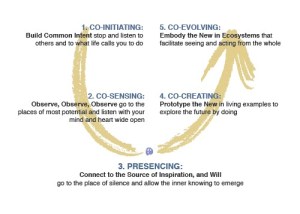
The U-Theory of Otto Scharmer
We see a U shaped model with five key points for progress: Co-Initiation, Co-Sensing, Presencing, Co-Creation and Co-Evolving.
When I compare this with my own model of Human Complexities there are of course striking similarities but also some curious differences to think about.

The Human Complexities cycle
The four arrows (regression, collapse, enlightenment and co-creation) in the model of Human Complexities represent the movement between four states of evolving communities (greed, chaos, awareness, wellness) using the complex psychology of people and ways of structuring organizations and communities. It is always cyclic in a clockwise manner. After ever cycle the community has gone through a learning process. When we place the cycles one after the other in history and over time we can see an evolutionary path resembling a spiral, producing a line from chaos into sustainable progress.
The representation of human complexities in a crosslike drawing has to do with our perception of progress and organization by drawing a line from left to right. Right to left meaning just the opposite, a regression. Up means an increase or growing awareness and down the decrease or disappearance thereof. In the middel we see the crissing of the lines “to be” (search for unique edity and universal ethics) and “to do” (our actions and organization). The cross shows the continuous conflict between these two issues that produce the self aware learning curve. In each of the four resulting quadrants the overall dominant human culture is different and so is the intrinsic motivation or fear for change.
Fear for Change
Inside the model of Human Complexities I use the concept of “Fear for Change”. This is needed to show people near or within the stress of a crisis that this a normal path of letting go for renewal. Once aware of this they can face a crisis with more confidence. The current global paradigm shift from economic societal collaps to sustainable human progress is my main concern. In my approach I tend to focus on the side of transformation from collapse via chaos towards renewed wellness in the model. My approach is holistic inviting the entire society to become co-creative.
Schwarmer does exactly opposite, working from with the institutionalized fragments of society.

The psychology of change in a paradigm shift is the true transformative challenge of humankind
Human Complexities (J.P. Close) & Fear for Change
Important differences between the U-Theory and Fear for Change
When we look at the U-Theory and the path of Fear for Change in the model of Humian Complexities we see that both use exactly the same processes to get people to activate their inner energy for creation and co-creation. Despite the different names the steps and significance are the same. Still there is a huge difference…..

U-Theory versus Paradigm Shift
At first sight both methods look and feel the same
In reality the creators of the U-Theory did a very smart thing. They created a sense of simulated chaos within the comfort of a running business. Getting people to step out of the running business of greed to undergo the intense process of reflection and finally reach a state of co-creation is in reality the application of the chaos theory and human psychology in exactly the same way, yet without the need of a formal crisis or fear for change.
Drawing the U-line from left to right (against the stream of human complexities) gives a sense of a deepening spiritual experience within the context of financial recovery, enhancement or growth (greed). The smart thing is that the U-Theory gives innovative meaning to economic systems that have the tendency of becoming bureaucratic an reluctant to change (seeing themselves as eternal cash cows, which they are not).
The paradigm shift and its related fear for change is known for thousands of years already. The first people to describe this intense fear and its process of freedom when one finds a new route by letting go, were intellectuals like Dante (13th century) and later the psychologists and anthropologist of the 19th and 20th century, s.a. Steiner, when the hierarchies started to grow in magnitude and with it the complexities of organizing people and emotions.
The natural process of a system to collapse into chaos, like the Roman Empire and so many other civilizations before and after, is well documented. The intense learning curve through fear, pain, letting go, etc. is also well known now and well positioned, with logic, along the modern cycle of Human Complexities. It is typically applicable in these days of pain, chaos en crises today that are affecting everyone. People start to look at two ways to address the problem:
- How to avoid collaps by applying timely renewal and innovation (U-Theory)
- What to do when inside the collaps to get back into co-creative wellness (Fear for Change)
These are the two routes of least and most resistance, as written before in a previous blog.
This blog also introduced the law of opposites and we can see many in the Human Complexities model (transition quadrants, poor and rich, complex and simple, warm and cold cultures, spiritual and possessive etc). The smart thing that was done by Otto Scharmer and his people was to turn the model of the paradigm shift, including the fear for change, around (fear avoidance).
Just observe the logic:
The model of Human Complexities follows a cyclic route clockwise. The segment on the circle that refers to the paradigm shift starts at the left hand side almost upon the line between chaos and enlightenment, when people let go of old security and become aware of the need of renewal. It continues all the way up to the state of co-creation for wellness. The shape is more line a big “n”.
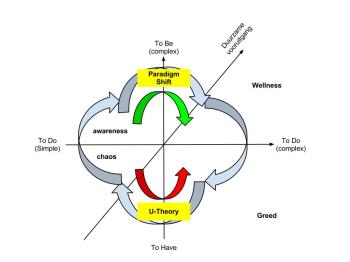
Positioning of both theories
When we look at the U-shape of Scharmer it starts at the same (virtual) point but travels down and to the right to end up on the line of wellness through greed. The psychological effect of visualizing this direction is that fear is eliminated by connected the process to greed (desire for unlimited prosperity). The process of the U-shape is to avoid jumping into the unknown by simulating it within the comfort of an existing organization that looks for renewed innovative or inventive success without the immediate need of a paradigm shift. It is a method for smart executives to transform an organization within its normal operations without the traditional reorganizational stress. This is brilliant.
So the method and knowledge of the Fear for Change within the need for a Paradigm Shift positions themselves essentially in left hand quadrants, the areas of poverty, chaos, illumination and experimentation with survival. The method and knowledge of the U-Theory positions itself in the rich areas of wealth and greed where enterprises want renewal, revival, inventiveness without disputing their reputation nor their original positioning. It is a protected environment for efficient creativity to enhance a competitive position.

Positioning application of the methods
The model of Human Complexities helps us to clarify the particular use of both models and in which situation they should be used. In fact, it is not just applicable in business, it can be applied to the entire society too. Sustainocracy is an example of jumping the state of chaos by inviting executives to co-creative renewal in a multidisciplinary setting that eventually will feed again an obsolete economy with true innovation.
Sustainocracy
The application of both theories is of interest. Sustainocracy positions itself in the wellness quadrant from a societal point of view. In most occasions the paradigm shift through chaos is needed in society due to the different power positions that try to uphold themselves at the expense of the others in the same community. Within each of the institutional pillars the U-Theory can help leadership to progress in such competitive environment. However in a multidisciplinary setting such a Sustainocracym where everyone has a co-creative mission at societal level, the combination of both can lead to remarkable results for the entire society.
So while the executives may be confronted with the own fear for change, within their own leadership, and the intense process of undergoing the risks of re-positioning a company within the context of sustainable progress of society as a whole, the organization itself may well be served through the techniques of the U-Theory that do not include this fear or risk. Knowing about the emotional difference between the two models the executive teams and participating consultants can create programs that are as effective as they can be in turbulent times, producing progress even in crisis with both societal and institutional success.
It would be very interesting to develop situations at regional level to experiment with this.
How does Sustainocracy work?
Sustainocracy combines the uniform institutional and personal goal of sustainable progress with the democratic process of how to get there. This simple definition implicates a global change in dealing with complex human issues. Sustainable progress cannot be achieved by any single authority. It forcefully needs the value driven cooperation of all institutional authorities together, not in a business economics setting but one of multidisciplinary responsibility sharing.
In our current society of economic, money driven relationships between institutional identities (sales of products, taxation, subventions, contributions, loans, debts, pensions, insurance, etc) such multidisciplinary ventures can only be started by new age pioneers. The reason for this is that Sustainocracy forcefully needs to break through the current change of relationships, dependencies and hand over of fragmented responsibilities to a setting where the human authorities take on the same responsibility together.
Sustainocracy hence has therefor a few characteristics that are strongly different to current complex way of structuring society:
- Institutional power is used to enhance and expand Sustainocratic initiatives to cause greater affect in the community,
- But institutions do not lead the initiatives because they cannot. Institutions are instruments to progress not the cause of progress,
- The pioneer is responsible for defining the complex goal of a Sustainocratic pool of institutional powers. The definition is necessarily related to sustainable human progress because any other objective would not get institutions to work together in an open, transparent and long term format. They have normally differentiated interests that can only be shared and combined in settings of sustainable progress. Examples of a Sustainocratic definition:
- Local air quality, public health and regional human dynamics,
- Local graying/ aging population, self sufficiency, health care and housing,
- Education, social cohesion, cultural diversity and neighborhood development,
- Local energy and food, public participation, self sufficiency, housing and quality of life,
- etc
- A Sustainocratic process is necessarily local 4 local, involving all local citizens,
- Therefor a sustainocratic initiative always involves five elements:
- The pioneer
- The local government (geographic design and public money)
- Creative entrepreneurs (local as well as multinational)
- Educators (science and school)
- The local population (behavior, contribution, participation)
Sustainocratic processes are always purpose driven. They are labeled with an identifying name (s.a. AiREAS, The STIR Academy, VE2RS, etc) to which people and institutions can relate with motivation and commitment. The initiatives are formalized a s new age cooperative entities established for the measurable humanitarian local progress.
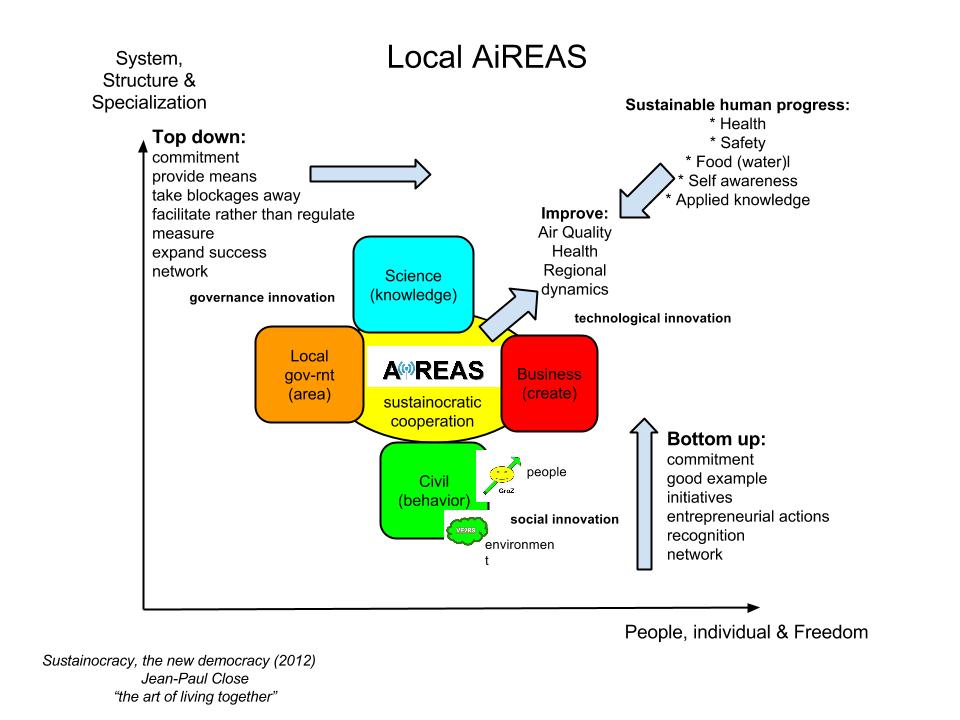
Example: AiREAS as first sustainocratic venture
Advantages of Sustainocracy:
Any key local humanitarian complex issue can rapidly be addressed and solved due to the multidisciplinary format of the coalition, involving directly all necessary authorities who can be called upon their unique competences and authority.
A Sustainocratic group is purpose driven, not money driven.
Sustainocracy eliminates all bureaucracy out of decision making since all parties are directly involved in instant decision making.
Sustainocracy is not a separate institution. It is a purpose driven multi-disciplinary partnership. When the complex objectives have been achieved the partnership will dissolve again.
Sustainocracy demand the general public and scientific know how to take responsibility too, not just the traditional operational parties of government and business. These two authorities are important to avoid the traditional tunnel vision of government (cost saving and bureaucracy) and business (volume sales).
Sustainocracy is result driven within the context of its purpose. That means that reciprocity for all partners is shared when value has been created, not before. One wants money, the other recognition or savings. Reciprocity is not just an economic element but much more complex and varied allowing a diversity of partners to work together without competition.
Problems of Sustainocracy
The problems we encounter are:
Pioneers need to be well trained in their role of connectors of many disciplines. They play a key role to maintain equilibrium between the participants but have no directive power position, yet are extremely influential. They are equally purpose driven and not “paid” as consultant or director. The pioneer are included in the reciprocity program claiming time and responsibility from an individual that is only compensated if results are obtained. Not many people have the talent nor the drive to take this responsibility.
The institutional parties need to adjust their mentality and commitment to a totally new mindset. Government used to be the powerful party “in charge” because of their authority and governance over public money. They need to step back and accept the authority of the team. Business needs to learn to take responsibility with products, services and development for the end result, not just the sales of products. And so on for each of the parties. It takes a lot of “getting used” to this way of working and set aside the old way of behaving in a group.
“Money” is always an issue because of its standardized importance in our current society. It is a very big step for all involved to learn to see real value as something different than money. In the reward we also need to learn that pay back is sometimes not expressed in money but in different values.
The above difficulties are very demanding for the people involved. They can be partly overcome by defining short term results that show each involved what real reciprocity means. The longer it takes to come up with results to easier it becomes for the group to loose faith and fall apart. The difficulties can also be overcome by getting institutional people (executives) on board who know what they are dealing with (trained). They will not have the burden of adjustment and set out the provide speed to the processes. When this happens decision making is instant and execution also. Reflection becomes an issue for progressive new decisions.
Conclusion
Sustainocracy is a unique, modern way to address key issues for human sustainable progress when crises affect a community. All institutional parties are asked to take responsibility together in true value creation. But they have to be prepared to focus on the competences and authority, not their economic dependencies. Money is not a goal but a means. The purpose is the goal and reciprocity is found in institutional continuity based on true and recognized competences.
Sustainocracry is unique because it uses the very same forces that interact in the same society in crisis however in a different format of interaction. Both worlds can co-exist perfectly in which each players decides for itself when and where to participate in economic and sustainocratic processes. In one money and growth is placed in the center of policy making and in the other the human being and progress.
 Sustainocracy, the new democracy