Home » Universe (Page 15)
Category Archives: Universe
The battle between fear and dreams
This mini analysis is based on the evolutionary situation in Holland (1945 – 2020) using the drawing of human and societal complexities. The law of opposites cause rhythmic changes in emphasis that have to do with our inner conflicts and awareness too:
- Fears versus Dreams
- Greed versus Moral justice
The changing energies between the To Be and To Do show a sinus wave over time with periods of 7,7 and 54 years in a life time. The way we deal with this is meaningful for progress.

Cyclic evolution in rhythmic phases
The natural society rhythms are consequence of these opposites that have become the kernel of the diversity of life on Earth but also the learning battle that our human species fights with itself. Every cycle through chaos of our species is exponentially more intense that the ones before. With a global population now of 7 billion, three times the population when world war II ended, the fear for new violent encounters is as high as our dreams for sustainable progress. These two opposites interact in a powerful awareness struggle without precedence. The next few years will be decisive to answer the following:
- Will humankind enter in a destructive, self inflicted (and assisted by nature) chaos that exceeds every war ever before? The eternal battle between greed and moral awareness?
- Or will we overcome chaos permanently by introducing and accepting the law of opposites and learning how to deal with it for progression without chaos? The battle between fear and dreams, the quantum leap when awareness overcomes fear?
Cyclic evolution and awareness
Our understanding today of the cyclic nature of our behavior is enhanced by the mini analysis of the period between 1945 (end of WW II) and 2020 (new collapse) in the Netherlands (equivalent to the rest of the world in similar phases).
1945: When world war II ended in 1945 in the Netherlands, leadership was needed to co-create a stable society (co-create symbiosis). Leading in the argumentation was the destructive force of the war, the reasons behind its development and what could be done to avoid it? The conclusions were that we need to build social securities that moderate the natural potential of aggression of desperate people by giving them a minimum to survive, sufficient to avoid them to follow immoral impulses.

1945 to 1970 reconstruction of a country based on WW I/II awareness
Note: 1945 – 1970 is a 3 x 7,7 year cycle.
1970: The creative social systems (pensions, social security, unemployment funds, etc) are now in place. The “State of social care” had become a fact and should stand model for lasting wellness and peaceful progress. At the same time fear arises in the 1970’s present and at the horizon for the cost of social care. The postwar reconstruction phase is behind us, labor from industrial processes evaporate due to the exodus to low wage regions and first demand on the securities system show inefficiencies. A management culture replaces the leadership culture. The discussion changes from “change for stability” into ” the need for financial growth and controls”.

Growth became the trigger to sustain wellness
Wellness and financial abundance had a positive effect on longevity. Economic growth became the keyword to sustain wellness. The taxable potential of circulating money was important with the foresight of increasing costs to sustain social security. The aging population, statistics on decrease of child birth and expected costs of health care and social securities, showed an unbalance in the future financial stability. Wanting to keep wellness as a norm cannot be seen as greed, the human psychology to sustain it can. We have the tendency of wanting more of the same. This produces the downfall along the axes of moral awareness. Not that we did not learn from the painful episodes in our history, we did. But they grow away from memory as new generation grow up in abundance and peace. Other emotional priorities take the overhand, such as apathy, reluctance, fear, greed, etc. People tend to think now of wellness as a human right and consider the system responsible for maintaining it. The management system develops a structure of hierarchy and power to introduce efficiencies and measures of control. Some important measures were:
- Reduction of the work week from 40 to 38 and 36 hours. This should spread the workload over more (taxable) salaries. Taxed labor was and is one of the mayor sources of income of the government.
- The liberation of money emission from its gold reserve collateral. This should boost the circulation of money, the second largest tax income through VAT development.
- The focus on value added logistics for goods distribution from low wage countries (China, India and Brasil) to the EU, due to our geographical location and trade expertise (a third key source of tax income).
Money became the goal, as a growing means to finance wellness. Tax became the most important instrument for the management of the country. People are slave to the system. “Care” and “Greed” developed into a dual economy of growth: the need for massive consumption of goods and the attention to the consequences of this over consumption, referred to as “wellness deceases”.

The systems starts breaking up
1995: The tension in the system builds up but awareness is at lowest level. Apathy, blindness and reluctance reigns. The economy still grows but by unnatural forces. The consequences of the 1970’s measures lead to a management culture of greed. Bankers took the lead, together with real estate brokers that speculate with shortages of houses. The influx of cheap labor for the supply chain focus increases the demand. The price evolution of a house had become the collateral for money circulation and debt creation. Stones, debt and speculation had become more important than the human being or its capacity to create productive communities. Economy of growth and tax had become dominant with impressive constructions of personal wealth development of heartless speculants. Government had itself tied up in an negative spiral of taxation needs that also captured the greed of state officials who could build personal security, hierarchy and income through the bureaucratic network. The exponential costs of society, that had been expected in 1970, did occur with the unexpected particular emphases on greed rather than need. The credit crisis in 2008 brought the immorality and system’s vulnerability to the daylight. The explosive amount of tensions around the world had not triggered awareness but the bank affairs did, especially that of fear. The instant counter measures were based on massive capital injections out of fear for total system collapse.
The management culture is kept in place by the hierarchical lobbies, legal criminality and fragmented overall money dependence. Everything seems to be done to swim against the stream of progress out of fear for chaos, collapse and loss of authority. This causes multiple tensions to build up further as social securities evaporate, pollution destroys our habitat, greed evolves further, morality is at its deepest point and the system cracks up despite capital injections and increased management through bureaucracy of controls and reluctance to change.

Towards 2020 the choice is ours
2008 is halfway between greed and fear when the credit crisis struck, showing the face of both. Instantly there was a wake up call. The management culture is dominant and seeks measures to sustain itself. Large capital injection, increased control systems and further focus on economic growth are measures of all the fragmented individual self interests that work together.
But 2008 also opened up room for the first initiatives in the field of leadership and change. A new leadership cycle breaks through. STIR Foundation is pioneer and started its co-creative platforms, inviting all those who panicked to join forces. A very first impulse was achieved to connect management of future growth with leadership of change. We achieved temporary progress and showed the way beyond chaos and even avoiding collapse. It was a precedent that collapsed again when management measures thought to have produced positive results. That is natural too. The green line of leadership is still fragile and unsupported. As stated in the previous blog there is only a small time frame when management and leadership can interact together. That is when the expectation of pain and collapse is big enough and a consensus can be reached on the fear eliminating dream (where value creation ends and money making begins).
2020: Even though we live now in 2014 the dot on the horizon does not go much further than 2020. We now stand on the edge of the total collapse that capitalist measures tried to avoid since 2009. From a management perspective, what has changed to date? Nothing! The greedy still benefit in their personal financial growth patterns while social securities evaporate. Leadership is emerging challenging greed, our financial slavery and the system that supports it. STIR is actively developing its precedents. Pope Francis is using very sharp words to condemn the system of growth and calls for responsibility. Leaders occupying management positions open up for co-creation.
Two cyclic battles
From the above we can distinguish two interwoven battles of human development:
- 1945 – 1995: The leadership battle for human wellness through co-creation
- 1970 – 2020: The management battle for sustained material greed through fragmented self interest
Since about 2000 (7 * 7.7 years since 1945) a new leadership battle emerges, this time around “sustainable human progress”. It does not support the management battle. New age 21st century leafership bases itselves on value creation rather than consumption. The law of opposites helps management towards collapse. 2008 was just the beginning. Towards 2020 more of it becomes visible, but can total collapse be avoided?
The 1970 versus 2020 battle
The real battle now is between the 1970 belief and system’s reality that “money solves it all” and the new 2000 leadership belief that “sustainable value is created together”. The latter is based on feeding our awareness with the need to transform the system’s complexity and performance. In history we see that collapse has never been avoided due to the powerful resistance of management forces. The biggest question is now: “Does history repeat itself? Or do we create a new episode and turning point in human history?
My personal choice and daily efforts are for the turning point through persistence, belief in my views of the human complexity and reassured by the precedents achieved so far with Sustainocracy. This can only expand and enhance itself throughout the world. Dream A (money solves it all) can only prosper with Dream B (co-creation through awareness) when they unite in value creation and expansion.
Kind regards,
Jean-Paul Close
Sustainocrat
Awareness breakthough
Have you ever heard of the “gateway to heaven”? It is real. Not many can see it though. Experience shows that the gateway is only reached after a phase of pain. It is clearly visible then but gradually fades away again until we reach a new passage through. That is how we evolve. It is a spiral shape, or sinus wave when we add time. Understanding this is new. Evolution has long been considered purely physical. It is however spiritual. It only adds up to our awareness when passing through the gateway.
At a certain time we may equally our level of evolution and break through to add something to it. This drawing may help you understand. You are right in the middle of it (the drawing and life)

Can you see the awareness breakthrough? It’s the gateway to a new world
Some call the area below the line of self awareness “hell” and above “heaven”. The gateway is referred to the “the end of suffering” and a new beginning. Every time we pass through into a new cycle we add new awareness to our evolution. Societies evolve like this too. I expect a global breakthrough. But not before a lot of pain.
21st century society
“The new, emerging society (I call it “Sustainocracy”) situates itself permanently into this heaven of wellness (symbiosis) through understanding life instead of killing it. It will be an historical breakthrough that is happening right now.” (Jean-Paul Close)
Changing ways of looking at life
Not many people understand the functioning of our complex human systems called society. We interact without asking too many questions, suffering large consequences as they come along. We protect the selfinterest by living life as it comes making choices based on cultural norms, tradition, fears and ambitions. We do not really believe we can do a lot about the bigger picture as individuals.

When tend to be what our surroundings expect us to be (mirror)
When effects of pollution, global warming, migrations of desperate people, financial crises, scandals, etc reach our awareness we do tend to take a broader view of our reality. We may even reach a point that we adjust our daily choices with this new information.
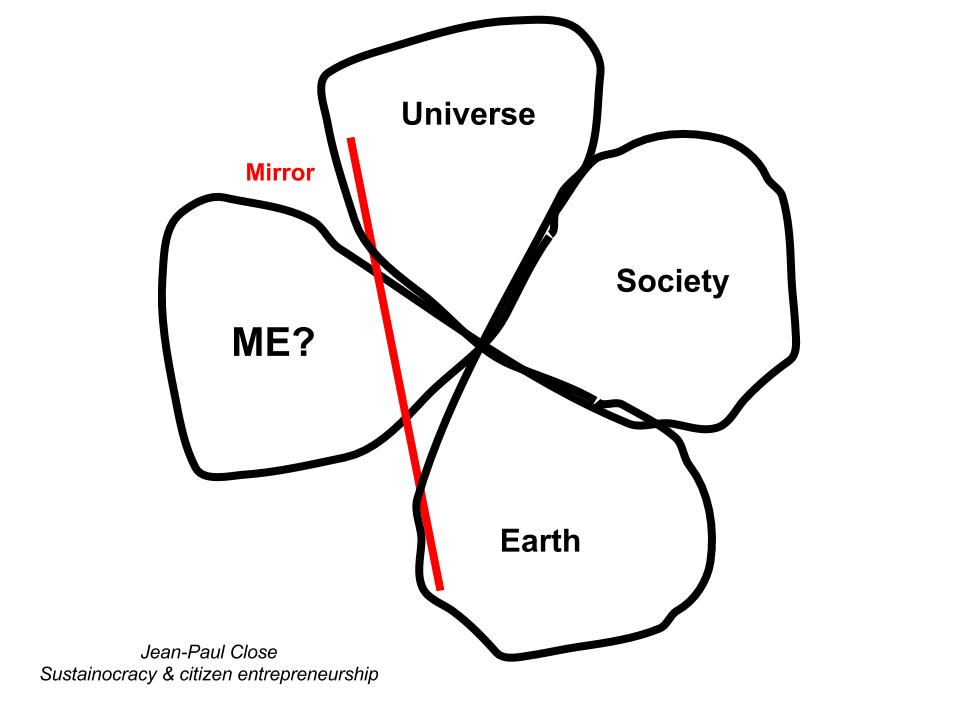
Awareness places me and society within the context of the universe and our planet Earth. We start seeing the reality in a different way, not just what is expected from me by society
Empathy
This awareness has an interesting extra effect on people as we begin to question the way we organize ourselves. We open up to an inner reality called “empathy”. This is a state of consciousness that does not just want us to survive in a competitive world. It helps us try to “do good” too. This “to do the right thing” is a state of mind that requires us to learn to feel sympathy for our surroundings. We open up to observing new realities, such as the suffering of other people, the effects of our actions on nature, the immorality of manipulation and injustice of certain human actions of greed. We arrive at a point that we project our daily choices on the world wide issues and take action accordingly within our span of control. We open up to understanding the bigger picture and see our own role with more clarity. Changing this role changes the human world of systems that, as a consequence, are forced to adjust.
Consumer conscience
On a worldwide basis we see our shops being packed with goods through an old system of supply and taxes on which institutions (business, government, banks) rely.
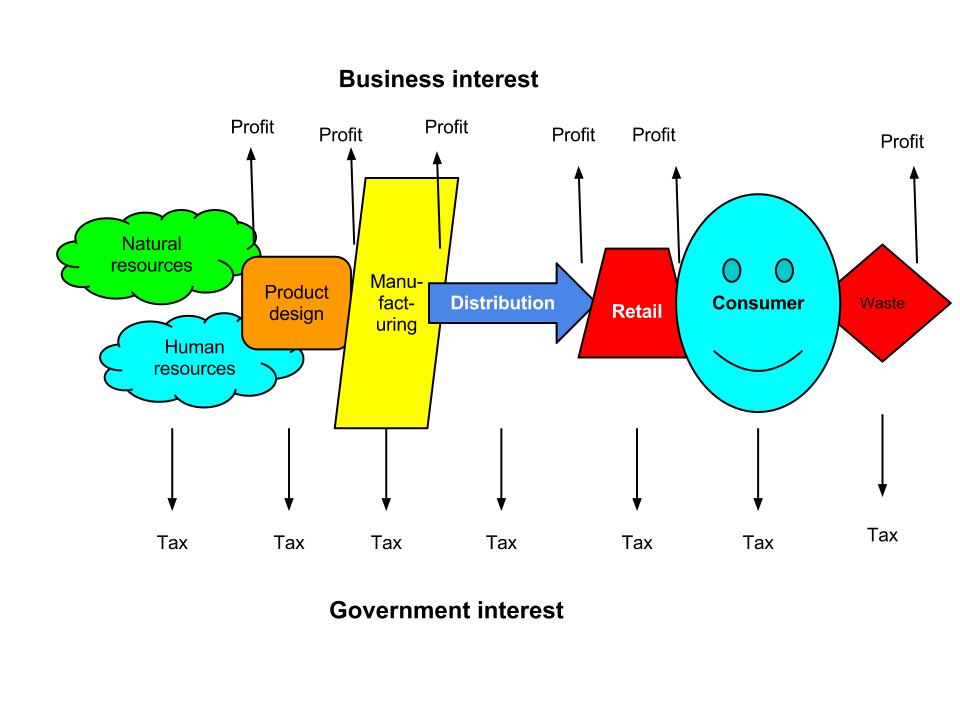
Property is past on in every step in the chain
You can’t solve problems by increasing them
It is in their system’s interest to keep this chain functioning because it produces labor, involves technology, keeps consumption going and produces funding for infrastructures and bureaucracy. It also provides means to address the consequences of this system. As the consequences grow exponentially, so does the need for money in this globalized system.
We understand that it produces the problems but we all depend on its functioning. How do we change it without putting this machinery on hold?
The first change is our own sense of “empathy” we the related change of our daily choices. We force the human systems to adjust to the newly growing popular mentality.
The second change is that the supply chain is stressed due to unsustainable chackles inside the system. The supply chain tries to optimize and reorganizes itself to remain strong.
The third change is provoked by the global issues themselves. If for instance competition for raw materials becomes as demanding as competition for sales the intellect is forced to look for adaptation to avoid system’s collapse. There is a lot of stress everywhere demanding leadership to cope with stressful circumstances.
Two complexities
The way we (STIR) addtess this at yhe top level of regional goverance and economuc development is by introducing a new complex system next to the old one. It is a system based on responsibility of change rather than keeping a supply chain going. It helps participants anticipate without being surprised by circumstances and the unexpected.
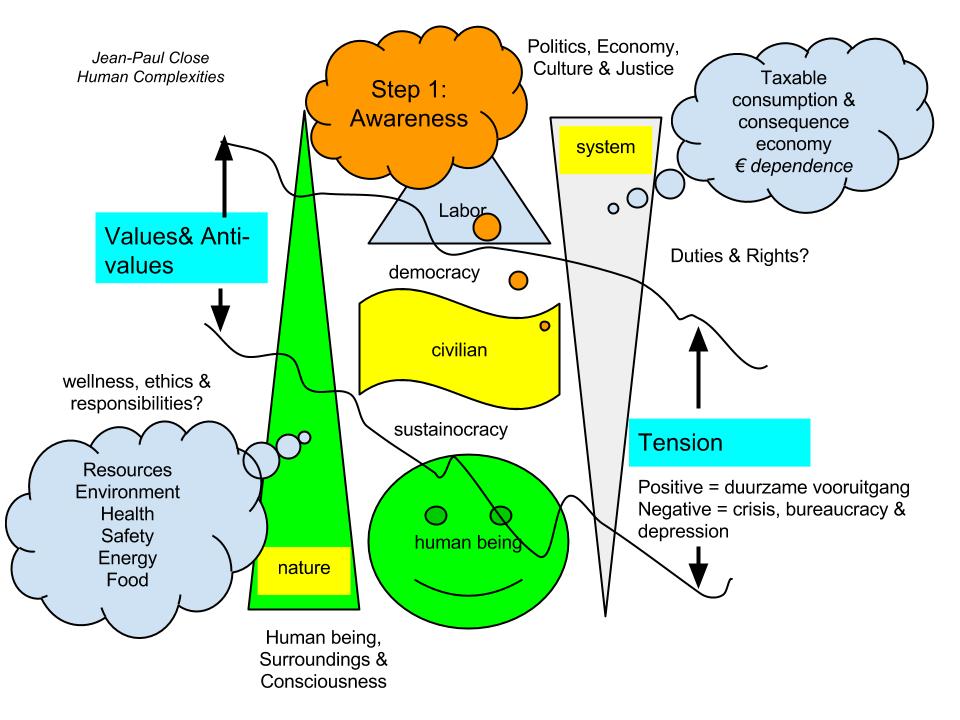
Awareness means that we manage to place the human system as instrumental, not dominant in our human evolution
When tension builds up locally in the old system relief is found by looping initiatives through the new system in a multidisciplinary way. This exercize helps people in charge to open up their minds to alternatives and choose their best options.
By doing so we achieve another interesting process, the development of the consciousness (to be) with the use of instruments to change things for the better (to do).

The psychology of change in a paradigm shift is the true transformative challenge of humankind
The biggest challenge we face in human reality is to integrate our growing awareness and empathy (awakening to new realities) with the systems that produce sustainable human progress and wellness. It becomes clear in our minds that for our own stability we need change. This is excitingly new when we come from an era of conservatism due to lack of awareness. The more we all become aware, the peacefuller we adjust our lives and systems through innovation of our structures and lifestyle. We start enjoying the prospect of progress rather than fearing the consequeces of change.

Awareness changes the world
 Sustainocracy, the new democracy