Home » Universe (Page 9)
Category Archives: Universe
STIR at Smart City expo Barcelona
This year I was invited to the Smart City Expo in Barcelona as one of the 440 speakers. Various media channels had contacted me to meet and talk about this strange word and concept “Sustainocracy”. After finishing off our first phase in Eindhoven of level 4 regional development and our first price in the Vinci Innovation Awards for Europe it became of interest to globalize views. After all the growing instability in the world was crying out for new views and Sustainocracy does provide answers to most issues. The problem is not just to understand that we have a choice, it is the powerful old reality that caused all the problems that is doing its best to remain in control at all cost. This reality is one that has captured us all. When I arrived at Barcelona I wondered what I would find and how my speech would be received? “You are the only speaker in the entire expo who addressed the core values of human life” people exclaimed after hearing me speak. Media representatives reacted positively as my message was enlarged through camera interviews and personal chats. But then they react positively to anyone sharing a talk. Key is to see what happens between now and the next few month. The seed of awareness will land only in fertile grounds of the mind and come to blossom when sustainocratic initiatives find space and support to develop. This is unpredictable and time will provide us with the surprises. I had nothing to sell, a lot to say and more still to invite to. In that sense an Expo is a strange place. But Barcelona was “different”.
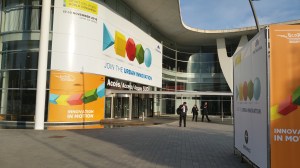
Congress site in Barcelona
I grew up in Barcelona and saw the city develop from a dirty harbor into a unique lively pearl on the Mediterranean coast. I was a 17 year old youngster when Franco died in 1975 and post graduate student international business studies at Nyenrode, worried about my family in Spain, when the military coup of Tejero tried to restore the dictatorship in 1981. I was tourist guide during the world soccer championships in 1982, general manager Philips Spain during the Olympic Games and Seville Expo in 1992. Barcelona hence is in my genes.
When I got to the airport of Barcelona it was a home coming. The signaling at the airport needs serious attention. It is confusing to find one’s way around. When I finally found the bus to the Expo it took us to the old region that I used to know as “Zona Franca” which had gotten into decline after industries like Philips Lighting decided to close their manyfacturing there. The development since had been enormous. Huge modern hotels and large expo buildings now decorate the scene. I was used to the expo at Plaza España but this was a surprisingly new environment.
After a lifetime as executive in the world of industrialization and trade I have developed a natural aversion against the circus of expo’s. Stands full of bored sales people waiting for someone to show interest in their stuff. Their boredom so obvious that no one dares to even show interest. If their offer does not arise their own enthusiasm how would they transmit it to potential customers? Then there are the groups of young “professionals” that gather among colleagues, having fun together with their first real experience abroad. Their conversations must be so interesting that customers interrupting are seen as a clear burden. They are however mixed with expert “expo contact gatherers” hunting for business cards for the follow up at a later stage. It was like this 30 years ago, and it is still like this today.
Yet the Barcelona Expo had a different flair too. The 400 odd stands were mingling technology with regional representations of cities displaying themselves as Smart. Interesting to see expressions of new city development based on quality of life with living green in urban places, new mobility and energy usages, architecture and lots of technological goodies using the Internet of Things for all kinds of applications. Somehow offer and demand seemed to unite in a single space even though all were present with a sales pitch, not one of common challenge and purpose.
Maybe the most interesting part was the enormous offer of speakers grouped in thematic blocks throughout the three days. I was placed into a group with a mixture of speeches. As always I found the presentations just one way informative. The public patiently listened and I had no clue what they wanted to get out of it nor what the expectations were of the speakers. I feared that I would become just one of many. My 10 minutes of glory came and went. I had the opportunity do get a little interaction going by asking those present to try to pronounce “sustainocracy”. They actually did a serious effort which comforts me. At least they will remember when seeing it one day in one of the videos taken that day.
When I asked how many find the core value of “health” important the majority rose their hand, the same when referring to the “health” of their children. My open question asking “how smart Smart Cities really are that remain unhealthy due to pollution?” was answered by smiles from the audience. More disturbing was when I asked how many professionally were dedicated to help create health (not healthcare that repairs damage done) or a healthy environment? Only a few raised their hands. What does this mean? That all others one way or the other do not contribute consciously and may even be part of the problem? As seen in my own hometown we reward financially those active in producing unhealthy situations and pollution while those who try to contribute fall outside of the financial system.
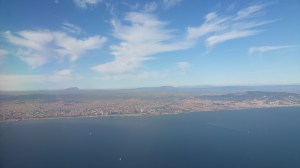
Air pollution lays as a blanket over Barcelona despite all actions to reduce it
We hence need to review our total system, from political and economic steering to rewards and responsibilities. The solution provided by Sustainocracy deals with this complexity on top of the Smart City (level 3) positioning of “intelligent infrastructures”. Rather than using technology in the context of optimization and control we change the context into stimulation health and innovative co-creation in which everyone takes its share of responsibility.

This way of city development is costly and makes the city vulnerable.
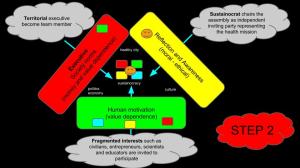
Sustainocracy is a peer 4 way of addressing regional sustainable progress where executive and citizens work together through innovative projects
Inside the open space produced by the facilitating executive in both city governance as technological innovation we position formal citizen’s cooperatives that address the core values of life as defined in Sustainocracy. Smart infrastructures remain needed but transform against the resonance with health, safety and regional self fullfilment. We experimented with this with AiREAS and FRE2SH in the city of Eindhoven with enormous boosts of energy and cohesion delivering multiple values at the same time.

The new society is proactively human value driven. AiREAS is a precedent of Sustainocracy.
“You are the only one in this event that addressed core human values” shows the long way we still need to go. The fact that I was invited to speak was a sign that change is happening. As I walked my old city the many changes were visible. Traffic had been banned from the ancient city core making room for human encounters and pleasant food experiences in a historical ambiance. Compared with other major cities in Europe the price and quality ratio in Barcelona services excelled. Food was delicious and the environment clean and well kept. The public transportation was well organized, with modern easy access and excellent fares that discourage car usage at all times. A 9.95€ ticket for 10, 90 minute rides (including transfers) could be used on all public transport in the vast metropolitan region!
Without any chauvinism I can firmly state that Barcelona this year became my personal Smart City of the year among the category of cities between 1 and 5 million citizens. It may not be strange that my first steps to prove the concept of Sustainocracy was to be done in a small city like Eindhoven (220.000 people yet “smartest city of the world in 2011) and the stepping up into the large world was to be in Barcelona. It is a beginning, yet again, and who knows where it will all bring us. I will enjoy the energy as it grows and will support where-ever it reaches out for more.
Arriving back home I had the satisfying feeling that humankind is doing its evolutionary work. My own little spark of enlightenment is reproducing itself and doing its work as I noticed when I got back home. Various meetings had been held locally without my presence while I was in Barcelona and all had carried the sustainocratic energy. What more can I desire? Gratitude is what I feel.

Using the environment to stimulate for health in Barcelona. The public bench with a foot cycle proves well used.
Cities evolve in awareness like human beings but slower
City of Tomorrow initiative AiREAS was analysed among the Smart City projects in Eindhoven and classified “peer 4” city development. Peer 4 is unique in the world and a major evolutionary accomplishment of both the city and AiREAS. But what are these layers of city development mentioned by the external analysts? And what does it mean for all involved?
City evolutionary steps:
Peer 1: basic infrastructures of the city
Peer 2: functional integration of infrastructures
Peer 3: intelligent interaction between the infrastructures (Smart City)
Peer 4: purpose driven multidisciplinary civilian cooperation with city executives (Eco-city)
There seems to be an important line drawn between peer 3 and 4. While peers 1, 2 and 3 are managed by the city executive through the establishment of a territorial hierarchy, peer 4 has totally different characteristics. Peer 4 involves core human values and value driven interaction with the city’s citizens in which there is no hierarchy anymore. Peer 1, 2 and 3 cities can be seen as destructive black holes that absorbe resources from their surroundings without any return. That is because the citizens and city both interact from a consumption point of view. Peer 4 suddenly transforms the black hole in a warm star that enlightens the surroundings with productivity and core values for life enhancement and wellness. City and citizens work together on those local core human values.
Eindhoven became a peer 4 pioneer with AiREAS (heathy city, healthy people, healthy air) as recognized spark into a new reality.
From an anthropology point of view I compare the city break through from peer 3 to 4 as a “second positive desintegration” at community level, proyecting on the “city’s awareness” the analogy of Kazimierz Dabrowski and the psyche of people. Also, if you like, the level 4 awareness based structuring applies, according MIT’s Sensing views (see below).
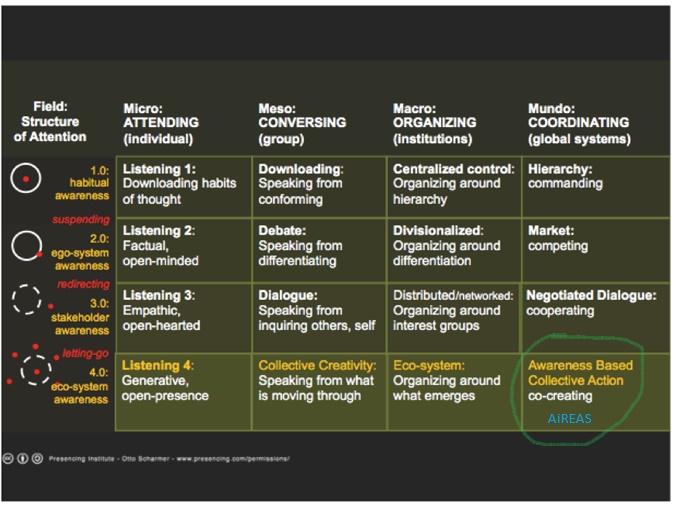
AiREAS is pioneer in this field of work
From black hole to star
Any city starts off as an unaware “foolish” conglomerate of people who, for what ever reason of submission, decide to group together under territorial command. Infrastructures are needed to host those people and create society of some sort. Time evolves and so does the city. The original submissive reasons for any person to come to the city transforms over time too. At one time the motivation was maybe the expected labor in town, now it may be housing, entertainment, care systems, shops and social securities. Many people don’t even decide to come to the city anymore, they are born there and for all they know it is the only reality that exists.
For many generations city governance, with submissive citizenship, was the norm. The city provides a promise of abundance at the expense of one’s human identity. The human being is simply “the consumer”. Nowadays cities cannot keep the promise of abundance. Huge global issues affect the local stability and sustainable progress. Abundance cannot be garanteed anymore even though it is democratically demanded by the citizens. The economic attractiveness and functioning of the city is questioned due to the shortages created by the conglomerate of cities themselves. The lack of productivity of the population makes any city into a massively destructive consumer of resources. Since 70% of the global population lives now in cities, and numbers grow every day, the destructive force of the cities can be seen as black holes that just take without giving anything back. It is not just the resources that are consumed that is devastating, the pollution generated by all cities together and the way countryside productivity has been adjusted to economic norms, produces a lethal natural unbalance.
Human awareness develops when people do things and subsequently enjoy the benefits or suffer the consequences of such actions. The interpretation of suffering develops our understanding of what we are (the “to be” part) through backward analysis.

First phase in life is learning through backward interpretation
We tend to mature in our understanding of life as we build up (painfull) experiences. At one point an awareness breakthrough is encountered. This is when our matured being starts to consciously determine what we do. We have learned so much about life’s mechanisms and essentials that we can anticipate and learn to create rather than destroy. This inner breakthrough is the one referred to by Dabrowski and a unique benefit of the human psyche. Unfortunately we have not yet based our executive leadership on these breakthroughs but gradually we will.
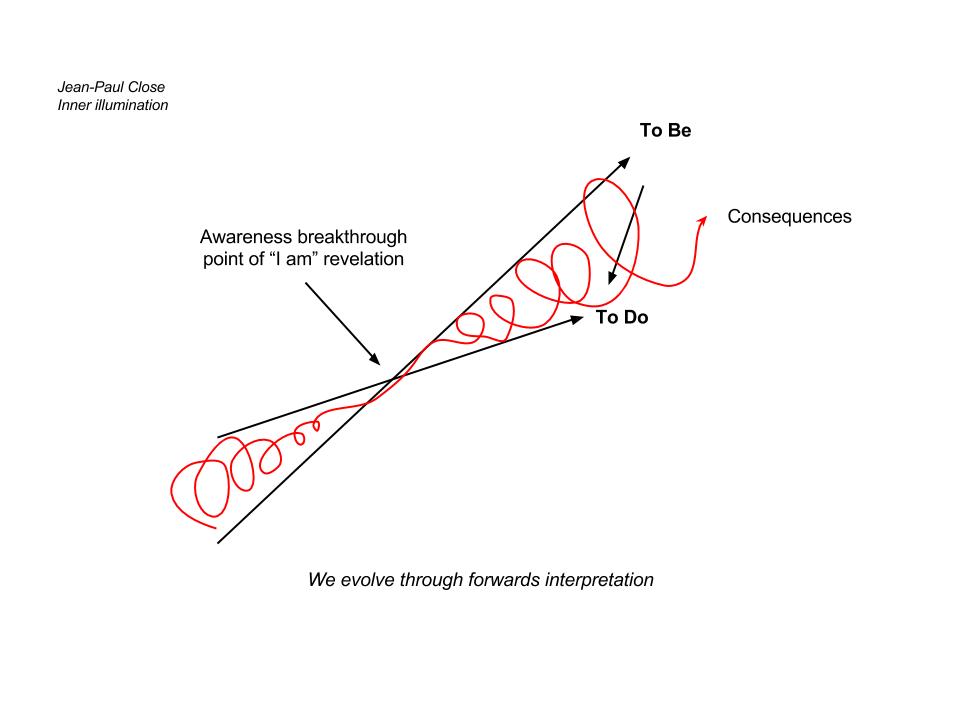
The awareness breakthrough is a real, memorable point in a person’s life
Peer 4 can be seen as a similar breakthrough but at city level. This is unprecedented in human history. It can be seen as a logical and evolutionary consequence of the times we live in and necessary for the survival of the human species. It is an inspiring act of group leadership that steps down from a hierarchical position to adopt a partnership role in a teritorial eco-system.
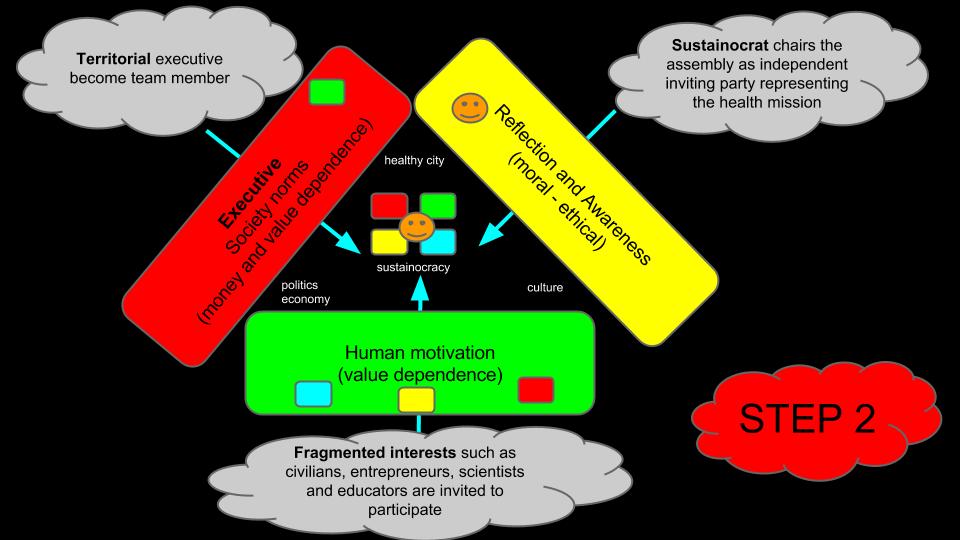
Sustainocracy is a peer 4 way of addressing regional sustainable progress
Eindhoven become powerfully aware of it vulnerability already in the 80’s when its major providers of employment (Philips and DAF) either went broke or moved their industrial processes to China. The pain of unemployment and corresponding social costs brought a severe crisis. It made the city reflect about its vulnerability out of dependence. This became the basis to convert into Smart City’s peer 3 with initiatives like Brainport. The city had become aware that it should remain productive even though this was translated primarily in product innovations for the global market. Triple helix is a typical peer 3 structure in which the three pillars for economic growth (government, education and business innovation) work together to optimize resources and results. Yet the triple helix is still focused on the world economic market of trade (to do). Brainport developed into a highly subsidized technology driven creative institute.
Eindhoven became the hotspot for creative product development but remained vulnerable in the economic context of demand and supply. Natural resources are increasingly being dealt with in a competitive manner as consumption peaks. Human consumption has its limits and inflation produces an enormous economic bubble that does not provide securities for all anymore. Poverty rises, migration starts and unbalance and insecurity becomes the standard. The city realizes at all levels (not just executive) that it needs to become much more self sufficient rather than competitive or consumptive. The main resources of the city are not its way to deal with economic growth but its talent to produce its own wellness. This understanding is a major breakthrough. Balancing value driven creativity with economic drivers becomes the deeper understanding of the essentials of life. A totally new way of dealing with one’s surroundings appears as well as the way citizens are seen in the city’s context, and how citizens see their city. Both develop empathy towards eachother and the objectives the community faces. Everything (governance, business development, education, behavior) starts to resonate with the higher purpose of quality of life in harmony with the natural surroundings.
While previously the city’s citizen were mere consuming parasites now they become primary resources for wellness driven creativity and productivity. Everything one can produce together one does not have to buy. The city’s economy balances out because it gradually becomes self supportive and self aware rather than vulnerably dependent of outside resources that it cannot control. The city develops awareness of its own core needs and takes responsibility by facilitating rather than controlling citizen’s interaction and productivity. It is not the city’s executive that leads anymore, it is the common persuit for core values that does. Both the citizens and the executive interact and adjust to produce the best results together. The entire city dynamics transforms.
Obviously the underlying peer 1, 2 and 3 infrastructural resources are still needed but they also need adjustment to the ecosystem that develops in the city. The city becomes self aware, passionate and energetic, less dependent on resources from outside. An energetic turn around can be felt. People in Holland state often “it all happens in Eindhoven” as they sense the warm and positive vibes. Its own resources sustain the city now, applying awareness, knowledge and tools for sustainable progress through quality of life rather than just trade.
Peer 4 transforms the city also economically. Since local values are created by the citizens themselves a local value sharing system needs to be developed. Citizens are no taxable parasites anymore but cocreators of wellness. People from outside the community can interact with the abundance created inside the city through financial means but those local citizens who put energy into the cocreation should be able to share the benefits without having to pay for it. Taxation transforms from money (VAT) over consumption to a sharing system of creative input and output for the city’s self sustaining progress. Housing is key to keep the value driven citizens in the city as the city recognizes that without them it becomes vulnerable again. The citizens become more important than the real estate which becomes functional to productivity rather that consumption. Also issues like pension-schemes become obsolete because peer 4 value driven interaction and contributions are not age but awareness dependent. A new dynamic interaction develops in which the elderly contribute and share as much as the youngest. Regards are measured in tangible reciprocity, not money. The city becomes less dependent on economy and more on social interaction and harmony. The city executive transforms and becomes more like the spinal cord and stemholder of the community than its brain. The community itself becomes the brain as the city starts to behave like a living body, with all its senses and core value awareness. Peer 4 transforms the black hole into a shining star.
In AiREAS we have been able to create and sense the warmth of our own creative powers and it is great for the city and all involved to be recognized as such. Any city can cross the line to peer 4 and we are ready to share our experiences of the new era that presents itself as more and more “black holes” transform in stars. All our progress is being documented and published through open access briefs. We use the global publishing channels of Springer and New Horizon Research. If you follow this blog you will be kept updated too. Also the global AiREAS Blog will provide you the specifics on progress around healthy city from air quality perspective.
A new leadership perspective and perception appears. For a short time both coexist in tension but after some time the persuit for harmony will prevail growth.

Old (current) and new leadership
My contribution to Anthropology and Sociology
After producing a paper for the Saprej congress it was published in Horizon Research open access publications.
Free of charge download. See below
We are pleased to inform you that your paper has been published, Please refer to the following information for detail:
PAPER_ID: 19690341
PAPER_TITLE: Redefining Human Complexities
ARTICLE_INFO: http://www.hrpub.org/journals/article_info.php?aid=2647
Download: http://www.hrpub.org/download/20150620/SA5-19690341.pdf
 Sustainocracy, the new democracy