What is a sustainocrat?
In 2010 we hosted one of our preparation meetings with all the invited institutions in the Province of North Brabant. Our program was to develop local air quality and health through the multidisciplinary community of AiREAS. Every thinkable institution (government, science, NGOs, technology) was present. They all had the opportunity to present their own programs. But at the end of the meeting everyone was packing their stuff again to go home. This is the moment when the sustainocrat was born. I jumped in the center of the meeting, looked around and asked: “Is that it? Do we have a healthy region now?”
The bags were unpacked again and everyone went back to their seat. That is when the real discussion started. “Who does what?” It was then when we decided that the provincial challenge was to big and complex, that we needed a smaller but complex region where we could look each other in the eyes and take decisions together. The city of Eindhoven stood up and suggested that they could be that initial region. And that is how it started. I have not left that position in the middle of the circle ever since and keep repeating the same questions, over and over again.
ME, I and ALL
UNI-ONE is an initiative of Laurent Ledoux and Moses Garelik from Brussels in Belgium. Here you can watch back their inspiring presentation during the Euro-spes conference in Budapest in June 2024. Reason for me to post it is their approach to the ME, I and ALL, as well as some more insights and activities (such as their empowerment circles) shared in the video that resonate well with sustainocracy.
Sustainable city evolution
The future of cities and regional development is fundamentally different from where we come from. In the article about “breaking with our heritage” I describe this breaking process at individual and city governance level. Nowadays it goes even further than breaking with the facilitating function of our industrial or capitalist economic heritage. This is necessary if we want to have a sustainable future as a human species. It therefore also breaks with hierarchical dominance, citizen domestication, money as prime goal, growth and our cultural behavioral (lack of) ethics, as we all, people and institutions alike, carry the same responsibility. It goes much further than the decorative transition suggested in this animated visualization (source: LinkedIn ). Many cities will have to redefine themselves and their economies, some will disappear or develop into smaller units.

| previous city development | new city development sustainocracy |
| facilitating economic processes (industrial, logistics, real estate, labor, mobility, entertainment, remedial care) | core natural human values based clustering of impact driven processes |
| 100% depended on material resources from outside the city | focused on local self sufficiency in close cooperation with its local natural environment, applying technology and science if necessary |
| essential human values are regulated in a competitive financial environment | essential human values are steering all the silos of the city´s leadership archetypes |
| citizens are seen as a resource for political financial development | citizens are fundamental participants and partners in all the operations and objectives |
| financial growth is a common denominator | sustainably societal harmony and integral wellness is the common denominator |
| ethics is based on financial compliance | ethics is based on existential human values |
| 1 x WIN, 3 x Loss economy | 4 x WIN economy |

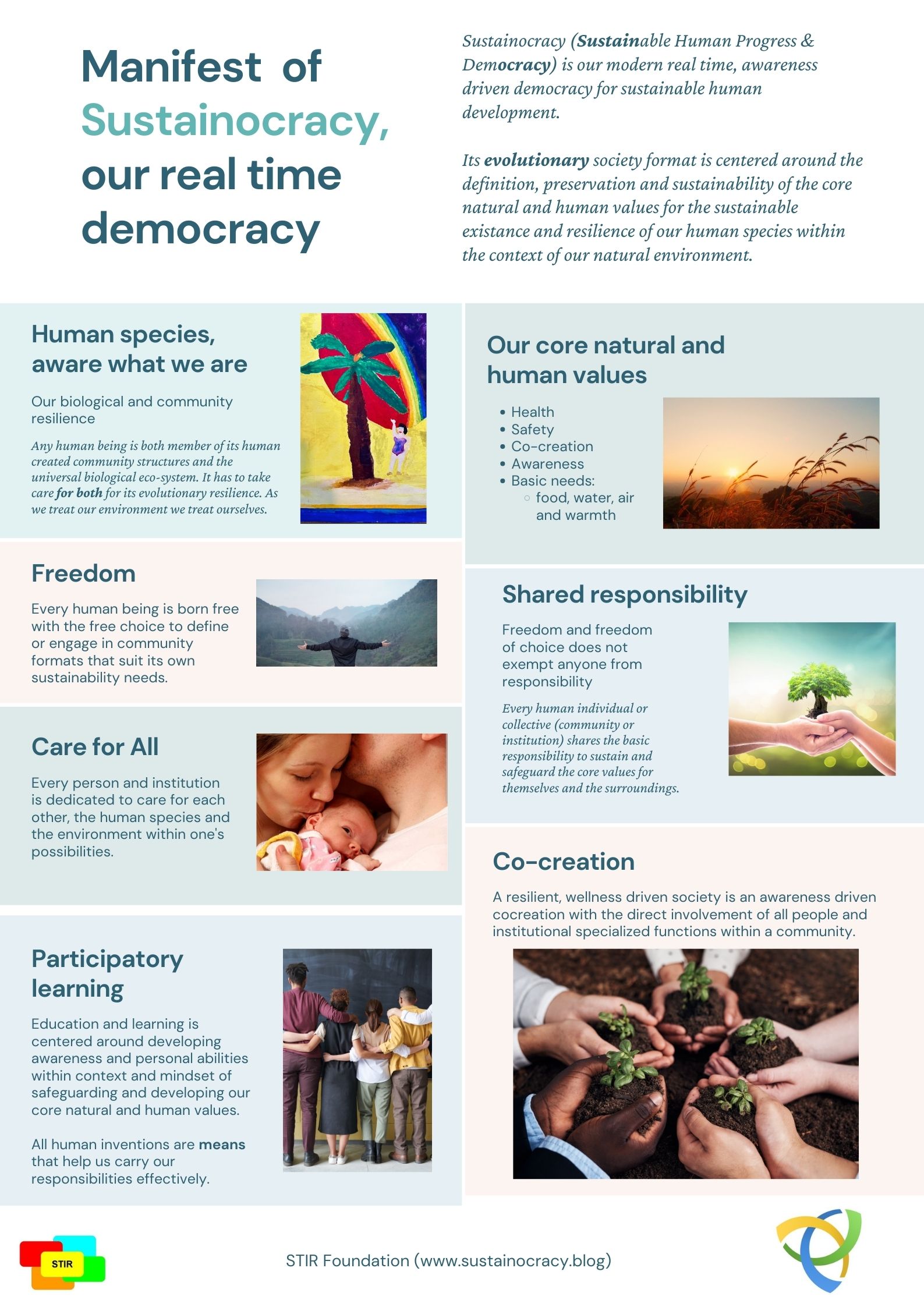
 Sustainocracy, the new democracy