Students today (121212) define their own challenge for Europe
“If you can dream it, you can do it” (Walt Disney)
“Optimism is the faith that leads to achievement”
“What you do today can improve all your tomorrows” (Ralph Marston)
Eindhoven (Holland) 12.12.12 at 12.12 a small group of students, age 17 and 18, taped their own video message. It is destined at their own generation in Europe asking them to take also “responsibility for our own future” and meet in 2013 in Hungary.
A challenging call was formulated to meet in the course of 2013 and joinedly discuss and step up their vision for a strong self sufficient Europe and unite together to make the best of it. The recorded videomessage can be seen here and will be distributed across Europe. It will be used to invite students and their institutions to team up and come to a purpose driven encounter in which “our common future” will be defined and expanded further, taking this 121212 encounter as a first stepping stone.
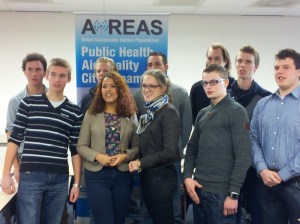
The challengers
Jason, Shari, Veerle, Randy, Bas, Koen, Willem-Jan, Simon, Bart, Arjen
The students’ encounter started at 09.00 a.m. in Fontys Highschool with scholars from both the ROC Highschool and Fontys Eindhoven. An open discussion followed on general issues that concern us individually and all together. This discussion will be summarized on video too. It was impressive, Topics that were dealt with were:
- Multicultural society – the need to adapt to a region, learn the language and show commitment to contribute to the region’s prosperity. There was a sharp disapproval of the growing aggression and a call for tougher punishment measures. Local languages and cultures should be respected even in a broader context when dealing with a united Europe. Shari suggested that we should try to understand each other better even in communication as interpretation of the same words can be different by different cultures.
- Crisis – a strong need was felt to recover stability in terms of jobs and opportunities. The lessons learned from history and our past should be taken seriously. Those who misused the system (bank and government officials) should be punished severely. Willem-Jan: “We accept to take our responsibility and even take our losses as long as we can be confident that these same mistakes and missteps are not taken again”. Banks and governments should develop an ethical responsibility and code of conduct.
- Responsibilities – every single person is him and herself responsible for their own future, not government or some institution. We should show solidarity with the Greek, Spanish and maybe consider one single European government to establish a balance with China, Russia, USA, etc. It is not about money only.
- Sustainable societies – this should be our common goal, not economies or growth. Arjen: “Sometimes one step back means that you can go forward”. Governments should not accept lobbies out of self interest from eg. oil companies but accept change and invest in using technology for our self sufficiency and sustainability.
- Willem-Jan: “We need to learn to live and work together”
The whole interchange of impressions was filmed by Hein, owner of CityTV.nl Eindhoven.
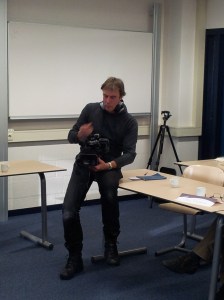
Hein filming this unique event
The openness and transparency of these students was heart warming while they all really had significant views and something to say. Their worldviews had been developed through international visits and projects.
Coach Wim Grommen added that there are 5 basic issues that need to be attended always to create a stable, sustainable community:
- Food
- Health
- Security
- Prosperity
- Knowledge
There is no money in this list and examples were given of communities that develop prosperity without using money.
One of the two girls, Veerle, proposed that the group would make their own videostatement for the 2013 event. One of the students already had one prepared. He also supplied the one-liners at the start of this blog:
**********Jason Clarke**************
“Do you want to change the world we live in today? Are you up for the challenge of making the world a better place to live in? Do you have perseverance, courage and will to reach your goals that will benefit society? The Europe of Tomorrow challenge is the event where you should show your unique talents and share your knowledge, skill and experience with others.
Playing a key role in your team and show your uniqueness that will make the difference! It’s about what you stand for, what you want and how to reach your goals. Share your belief, passion and enthusiasm with others. “Together we can change the world forever”
Making the difference starts with believing in yourself.”
***********************
The statement was received with applause and it was decided to use it here and on the forthcoming event site. Veerle took the lead in defining a shorter message specific for the video, the “call to their own generation”. After some group discussion the definite version was written on the whiteboard. Then this co-creative group decided to make the statement together in front of the camera…….
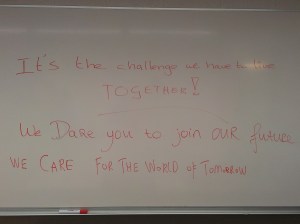
The final statement and challenge
Conclusion 12.12.12 of these students:
All:”We do not have a choice, we need to change our economies and societies into sustainable self sufficiency, applying innovative technology and vision by working together and eliminating misusage of power that blocks this progressive transition.”
This was the admirable conclusion in a morning’s debate of a small group of European 17 and 18 year old students, the “next generation”. It certainly gives the satisfying feeling that our future is in good hands with this generation. It was questioned if students across Europe would have a similar sensitivity? So the challenge was formulated for the 2013 event to check this out and get them to react and join.
The 2013 event:
In September 2013 we will all gather in Hungary. Students from all over Europe are challenged to make this happen. Students and European schools that wish to participate can ask already for the instructions for pre-subscription and preparation by mailing to:
Jean-Paul Close email: jp@stadvanmorgen.com
Thanking all those who participated today in this small but significant event, also part of the global “Day of Interconnectedness”, we certainly hope that we have created a stepping stone for a great event in 2013 and beyond.
12.12.12 Day of Interconnectedness
Nicolette Meeder is partner at the STIR Foundation and working on the definition and practical content of the Global STIR Academy. To send you and our network of contacts and partners around the world a Christmas and New Year wish she made this poem. Today, 121212 is a the Day of Interconnectedness. A beautiful day to share this with you:
To Be in life
Is to see in life
Each other’s vulnerable uniqueness.
Embody that power
With freedom in solidarity
So together we can build a future in trust.
To share and to care
Is to open our hearts
To our existence where it all starts.
Don’t be scared to lose your existence
There’s where life and the Universe
Just gives you a new start.
Raise your head
Look on to the future
Be curious what there will be.
Life has its purpose
Wake up and explore in wellfare
Than just be aware what you will see.
Give simple in complexity to all
That’s what we have To Do
See clearly and conquer our imaginary wall.
Nicolette Meeder – December2012
Otto Scharmer (U-Theory) versus Jean-Paul Close (Human Complexities)
This is the second in my series of comparing commonly used methods and models in current human organizations (business, government, society, etc). The first reflected about Kondratiev and Close.
Today I try to compare the “U-Theory” of Otto Scharmer with my model of Human Complexities and its phases of Fear for Change, Paradigm Shift and the positioning of Sustainocracy. (Watch a short 11 minute explanation on Sustainocracy via YouTube here)
The U-Theory
The U-Theory has become a popular tool for trainers and coaches as well as executives teams in organizations to develop new, innovative ideas in a co-creative way and bring them into practical reality.
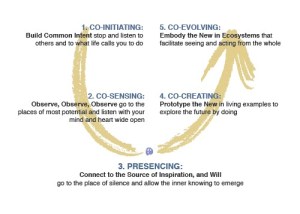
The U-Theory of Otto Scharmer
We see a U shaped model with five key points for progress: Co-Initiation, Co-Sensing, Presencing, Co-Creation and Co-Evolving.
When I compare this with my own model of Human Complexities there are of course striking similarities but also some curious differences to think about.

The Human Complexities cycle
The four arrows (regression, collapse, enlightenment and co-creation) in the model of Human Complexities represent the movement between four states of evolving communities (greed, chaos, awareness, wellness) using the complex psychology of people and ways of structuring organizations and communities. It is always cyclic in a clockwise manner. After ever cycle the community has gone through a learning process. When we place the cycles one after the other in history and over time we can see an evolutionary path resembling a spiral, producing a line from chaos into sustainable progress.
The representation of human complexities in a crosslike drawing has to do with our perception of progress and organization by drawing a line from left to right. Right to left meaning just the opposite, a regression. Up means an increase or growing awareness and down the decrease or disappearance thereof. In the middel we see the crissing of the lines “to be” (search for unique edity and universal ethics) and “to do” (our actions and organization). The cross shows the continuous conflict between these two issues that produce the self aware learning curve. In each of the four resulting quadrants the overall dominant human culture is different and so is the intrinsic motivation or fear for change.
Fear for Change
Inside the model of Human Complexities I use the concept of “Fear for Change”. This is needed to show people near or within the stress of a crisis that this a normal path of letting go for renewal. Once aware of this they can face a crisis with more confidence. The current global paradigm shift from economic societal collaps to sustainable human progress is my main concern. In my approach I tend to focus on the side of transformation from collapse via chaos towards renewed wellness in the model. My approach is holistic inviting the entire society to become co-creative.
Schwarmer does exactly opposite, working from with the institutionalized fragments of society.

The psychology of change in a paradigm shift is the true transformative challenge of humankind
Human Complexities (J.P. Close) & Fear for Change
Important differences between the U-Theory and Fear for Change
When we look at the U-Theory and the path of Fear for Change in the model of Humian Complexities we see that both use exactly the same processes to get people to activate their inner energy for creation and co-creation. Despite the different names the steps and significance are the same. Still there is a huge difference…..

U-Theory versus Paradigm Shift
At first sight both methods look and feel the same
In reality the creators of the U-Theory did a very smart thing. They created a sense of simulated chaos within the comfort of a running business. Getting people to step out of the running business of greed to undergo the intense process of reflection and finally reach a state of co-creation is in reality the application of the chaos theory and human psychology in exactly the same way, yet without the need of a formal crisis or fear for change.
Drawing the U-line from left to right (against the stream of human complexities) gives a sense of a deepening spiritual experience within the context of financial recovery, enhancement or growth (greed). The smart thing is that the U-Theory gives innovative meaning to economic systems that have the tendency of becoming bureaucratic an reluctant to change (seeing themselves as eternal cash cows, which they are not).
The paradigm shift and its related fear for change is known for thousands of years already. The first people to describe this intense fear and its process of freedom when one finds a new route by letting go, were intellectuals like Dante (13th century) and later the psychologists and anthropologist of the 19th and 20th century, s.a. Steiner, when the hierarchies started to grow in magnitude and with it the complexities of organizing people and emotions.
The natural process of a system to collapse into chaos, like the Roman Empire and so many other civilizations before and after, is well documented. The intense learning curve through fear, pain, letting go, etc. is also well known now and well positioned, with logic, along the modern cycle of Human Complexities. It is typically applicable in these days of pain, chaos en crises today that are affecting everyone. People start to look at two ways to address the problem:
- How to avoid collaps by applying timely renewal and innovation (U-Theory)
- What to do when inside the collaps to get back into co-creative wellness (Fear for Change)
These are the two routes of least and most resistance, as written before in a previous blog.
This blog also introduced the law of opposites and we can see many in the Human Complexities model (transition quadrants, poor and rich, complex and simple, warm and cold cultures, spiritual and possessive etc). The smart thing that was done by Otto Scharmer and his people was to turn the model of the paradigm shift, including the fear for change, around (fear avoidance).
Just observe the logic:
The model of Human Complexities follows a cyclic route clockwise. The segment on the circle that refers to the paradigm shift starts at the left hand side almost upon the line between chaos and enlightenment, when people let go of old security and become aware of the need of renewal. It continues all the way up to the state of co-creation for wellness. The shape is more line a big “n”.
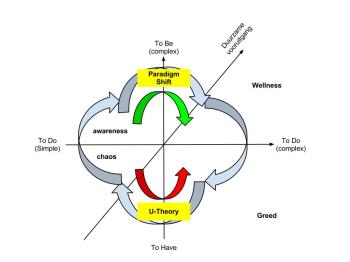
Positioning of both theories
When we look at the U-shape of Scharmer it starts at the same (virtual) point but travels down and to the right to end up on the line of wellness through greed. The psychological effect of visualizing this direction is that fear is eliminated by connected the process to greed (desire for unlimited prosperity). The process of the U-shape is to avoid jumping into the unknown by simulating it within the comfort of an existing organization that looks for renewed innovative or inventive success without the immediate need of a paradigm shift. It is a method for smart executives to transform an organization within its normal operations without the traditional reorganizational stress. This is brilliant.
So the method and knowledge of the Fear for Change within the need for a Paradigm Shift positions themselves essentially in left hand quadrants, the areas of poverty, chaos, illumination and experimentation with survival. The method and knowledge of the U-Theory positions itself in the rich areas of wealth and greed where enterprises want renewal, revival, inventiveness without disputing their reputation nor their original positioning. It is a protected environment for efficient creativity to enhance a competitive position.

Positioning application of the methods
The model of Human Complexities helps us to clarify the particular use of both models and in which situation they should be used. In fact, it is not just applicable in business, it can be applied to the entire society too. Sustainocracy is an example of jumping the state of chaos by inviting executives to co-creative renewal in a multidisciplinary setting that eventually will feed again an obsolete economy with true innovation.
Sustainocracy
The application of both theories is of interest. Sustainocracy positions itself in the wellness quadrant from a societal point of view. In most occasions the paradigm shift through chaos is needed in society due to the different power positions that try to uphold themselves at the expense of the others in the same community. Within each of the institutional pillars the U-Theory can help leadership to progress in such competitive environment. However in a multidisciplinary setting such a Sustainocracym where everyone has a co-creative mission at societal level, the combination of both can lead to remarkable results for the entire society.
So while the executives may be confronted with the own fear for change, within their own leadership, and the intense process of undergoing the risks of re-positioning a company within the context of sustainable progress of society as a whole, the organization itself may well be served through the techniques of the U-Theory that do not include this fear or risk. Knowing about the emotional difference between the two models the executive teams and participating consultants can create programs that are as effective as they can be in turbulent times, producing progress even in crisis with both societal and institutional success.
It would be very interesting to develop situations at regional level to experiment with this.
 Sustainocracy, the new democracy