Choice? Blue or Yellow?
Consider that you are driving on a road and reach a T junction. You can enter the blue road which gets you to a ravine in which you will certainly crash. The road is however one big fun fare filled with goodies (plenty of food, sex and rock & roll, mountains of gold and properties along the way) for you to enjoy quickly before you crash. Once in a while you hear a scream and wonder whether it is of joy or fear just before the crash?
The other road (yellow) is dull, even very difficult to drive due to the many horrible looking obstacles, no goodies at all, even hardship to expect, but it gets you along side the ravine safely and eventually turns away from it.
Which road would you pick? The yellow one for the long term safety where you see hardly anyone? Or the blue one for the short term joy yet unsafe and where you see a lot of people?
When you make your choice and finally encourage yourself to go for safety, the yellow road, despite the powerful attraction of fun, you notice a little man sitting there. He controls a big barrier, preventing access to the yellow track. When you ask him why you may not continue he tells you that he represents justice of a democratically chosen government and local banking system who both control the blue road and all the attractions along side. It has been decided by law that everyone has to take that blue road and he is there to assure that this rule is followed, if necessary by applying the law.
“But this will get me killed” you exclaim. The bureaucrat shrugs his shoulders and says that he is just doing his job. It’s a free country and everyone has the right to vote democratically. Short term fun was chosen so everyone has to have fun even if it gets you killed. Dullness is not allowed and long term dullness is even banned from the choices, even if this saves your life. All banking and government investment goes into placing more attractions along the blue track and upholding the system that has been chosen for.
He even pinpoints far in the distance where you can still see a very narrow bridge over the ravine. “See”, the bureaucrat says “that is the place where the bankers and chosen politicians stand to assure that this system keeps running. It is a small bridge and has only room for them and their interests, nothing else. And look at poor me, I have to sit here and have to tell everyone to take the blue road full of attractions. A hell of a job”.
Now it is again up to you. What do you do? Do you follow the rules imposed onto you or do you make up your own mind?
The story reflects our current system of economies of growth. They are on social and ecological crash course but still oblige people by law to stick to the money driven dependencies of consumption, even if you want to take another route. Sustainable progress is blocked by bureaucracy. The only choice we really have, if sufficiently aware of disaster, is to avoid the bureaucrat, jump the gate and walk the road of safety even though we travel alone in a desert.
Strangely enough most people still take the road of consumable pleasure knowing that it ends in disaster. They do it either for the short term fun, out of lazyness to build a new life out in the empty desert or out of fear for the authorities that impose the laws. What is needed for the masses to pull down the barrier, fire the bureaucrat and build a new society along the empty road?
will you eat bread today?
Just imagine a baker in a village of 100 people. Every day he bakes 100 loafs of bread that he sells to the villagers for 1 euro per bread. Every one is happy, every villager has bread to eat every day and the bakery has an economic situation of 100.
For some reason one day there is a shortage of wheat and the bakery cannot make 100 breads, he makes only 80. Due to the wheat shortage the cost price went up and the baker had to sell his bread for 1,50 euro. People were not happy but paid the difference. 20 of them came late and were left without bread. The baker did not really care. His turnover had gone up to 120. The wheat shortage continued. The local population reacted by purchasing half a bread instead of one whole. They had become conscious of the shortages of wheat and realized that they could perfectly well survive with half a loaf since they had been throwing away part of the other loafs anyway. They called their social responsibility “sustainability” but the bakery was not happy at all. He had sold 100 halfs at 75 cents = 75 euro. His economy had dropped despite the rise of the price and he had to throw 30 unsold breads away. Thinking that the market had reduced he decided to stimulate the market again with some marketing and kept the reduction of his production due to the wheat shortage. Due to the marketing costs he had to increase the price a bit more, to 2 euro.
Half the people bought half’s and half bought whole breads. So 50 halves against 1 euro = 50 euro and 50 whole breads against 2 euros = 100 euro. The baker was happy. Marketing works he said. His turnover had grown to 150 euros, double the previous sales! And he only had to throw 5 breads away this time. Market working they call that in economics, and all the consumers had something to eat.
The world market of wheat was struggling further and he had to compete to get his resources. The energy costs were rising too so he ended up reducing his average production to 50 breads against a sales price of 5 euros. Some angry people were buying bread by the slice now and some could not afford bread at all anymore. The 20 richest people of the village did not want to reduce their consumption and offered 8 euro per bread. The baker loved this deal and sold all his bread every day now with a turnover of 20 x 8 euro = 160 euro for the rich people and 30 x 5 euro = 150 euro for the normal people. The economy of the bakery had grown to 310.
The local village council was worried because a number of people had no bread to eat but happy with the growth economy. They could raise the local tax on bread to help the 50 people that were starving and gave them some social help with money. The baker was making a lot of money after all. Government treasury was doing fine as a consequence too. With all his profit the baker had bought a nice house with a large mortgage. The city council had invested in a bit more bureaucracy to assure that the growth economy was properly taxed and invested. People complained about to increase of the cost of living and blamed the baker. He blamed the increasing costs of wheat, production and marketing. But also the tax pressure. The government hammered on economy of growth to be able to tax more and cover the expenses of the socially needed. Meanwhile poverty and social unrest was rising. People were meeting to see what they could do about it and someone threw a stone through the window of the bakery. The next round of baking the baker could make only 30 breads but the population was already in front of his door claiming the entire production for equal distribution. He had no turnover that day and his bakery was damaged. The rich got no bread that day and were furious. They lobbied with the local government to see if their taxes could properly used and get bread from elsewhere. The baker went broke, couldn’t pay his mortgage anymore so the bank went broke too. The government had no one to tax anymore while the bread market got into the hands of the Chinese. After a period of economic growth the village got into a severe recession and chaos.
This simple, funny but realistic story gives a view that economic growth does not solve anything when resources are running out. The only option left for the villagers would be have been to grow their own wheat to eliminate their dependency on outside forces. But what did they know? If they can’t produce their own they have to find something else to eat. But for all they new everything was fine, the economy was growing after all, wasn’t it? How do we deal with this in the big cities around the world where money rules the systems and the dependencies of the people? How aware are people of the world wide shortages if the only point of measurement is the local supermarket and one’s own cash availability? How aware are governments when the economy of growth, tax and social welfare is their only worry?
Moral of the story: A growing economy does not necessarily get you a daily loaf of bread.
How does Sustainocracy work?
Sustainocracy combines the uniform institutional and personal goal of sustainable progress with the democratic process of how to get there. This simple definition implicates a global change in dealing with complex human issues. Sustainable progress cannot be achieved by any single authority. It forcefully needs the value driven cooperation of all institutional authorities together, not in a business economics setting but one of multidisciplinary responsibility sharing.
In our current society of economic, money driven relationships between institutional identities (sales of products, taxation, subventions, contributions, loans, debts, pensions, insurance, etc) such multidisciplinary ventures can only be started by new age pioneers. The reason for this is that Sustainocracy forcefully needs to break through the current change of relationships, dependencies and hand over of fragmented responsibilities to a setting where the human authorities take on the same responsibility together.
Sustainocracy hence has therefor a few characteristics that are strongly different to current complex way of structuring society:
- Institutional power is used to enhance and expand Sustainocratic initiatives to cause greater affect in the community,
- But institutions do not lead the initiatives because they cannot. Institutions are instruments to progress not the cause of progress,
- The pioneer is responsible for defining the complex goal of a Sustainocratic pool of institutional powers. The definition is necessarily related to sustainable human progress because any other objective would not get institutions to work together in an open, transparent and long term format. They have normally differentiated interests that can only be shared and combined in settings of sustainable progress. Examples of a Sustainocratic definition:
- Local air quality, public health and regional human dynamics,
- Local graying/ aging population, self sufficiency, health care and housing,
- Education, social cohesion, cultural diversity and neighborhood development,
- Local energy and food, public participation, self sufficiency, housing and quality of life,
- etc
- A Sustainocratic process is necessarily local 4 local, involving all local citizens,
- Therefor a sustainocratic initiative always involves five elements:
- The pioneer
- The local government (geographic design and public money)
- Creative entrepreneurs (local as well as multinational)
- Educators (science and school)
- The local population (behavior, contribution, participation)
Sustainocratic processes are always purpose driven. They are labeled with an identifying name (s.a. AiREAS, The STIR Academy, VE2RS, etc) to which people and institutions can relate with motivation and commitment. The initiatives are formalized a s new age cooperative entities established for the measurable humanitarian local progress.
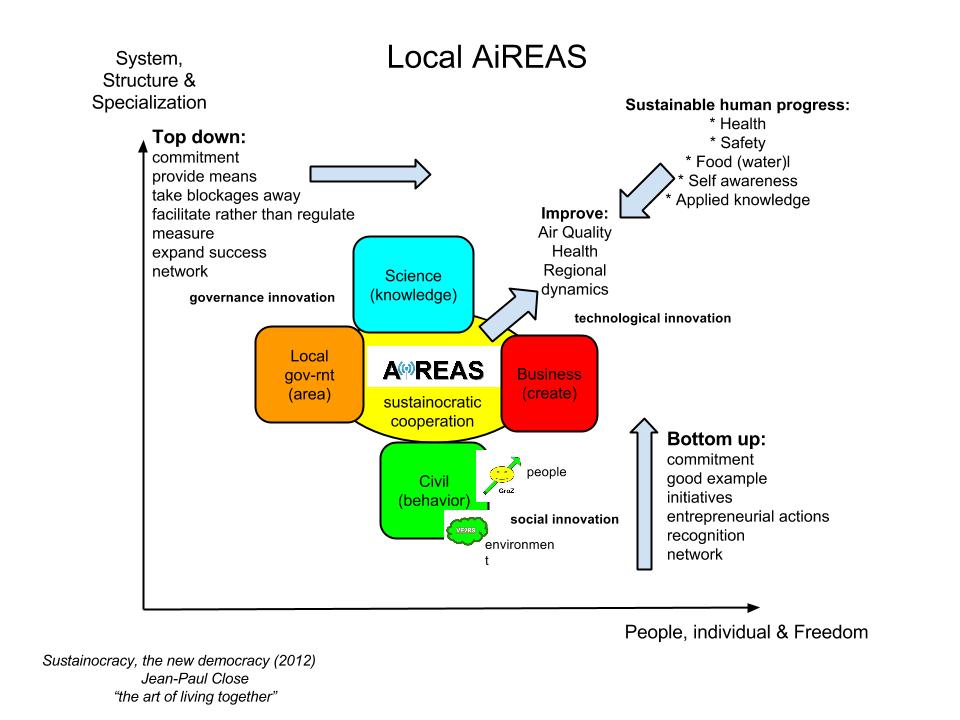
Example: AiREAS as first sustainocratic venture
Advantages of Sustainocracy:
Any key local humanitarian complex issue can rapidly be addressed and solved due to the multidisciplinary format of the coalition, involving directly all necessary authorities who can be called upon their unique competences and authority.
A Sustainocratic group is purpose driven, not money driven.
Sustainocracy eliminates all bureaucracy out of decision making since all parties are directly involved in instant decision making.
Sustainocracy is not a separate institution. It is a purpose driven multi-disciplinary partnership. When the complex objectives have been achieved the partnership will dissolve again.
Sustainocracy demand the general public and scientific know how to take responsibility too, not just the traditional operational parties of government and business. These two authorities are important to avoid the traditional tunnel vision of government (cost saving and bureaucracy) and business (volume sales).
Sustainocracy is result driven within the context of its purpose. That means that reciprocity for all partners is shared when value has been created, not before. One wants money, the other recognition or savings. Reciprocity is not just an economic element but much more complex and varied allowing a diversity of partners to work together without competition.
Problems of Sustainocracy
The problems we encounter are:
Pioneers need to be well trained in their role of connectors of many disciplines. They play a key role to maintain equilibrium between the participants but have no directive power position, yet are extremely influential. They are equally purpose driven and not “paid” as consultant or director. The pioneer are included in the reciprocity program claiming time and responsibility from an individual that is only compensated if results are obtained. Not many people have the talent nor the drive to take this responsibility.
The institutional parties need to adjust their mentality and commitment to a totally new mindset. Government used to be the powerful party “in charge” because of their authority and governance over public money. They need to step back and accept the authority of the team. Business needs to learn to take responsibility with products, services and development for the end result, not just the sales of products. And so on for each of the parties. It takes a lot of “getting used” to this way of working and set aside the old way of behaving in a group.
“Money” is always an issue because of its standardized importance in our current society. It is a very big step for all involved to learn to see real value as something different than money. In the reward we also need to learn that pay back is sometimes not expressed in money but in different values.
The above difficulties are very demanding for the people involved. They can be partly overcome by defining short term results that show each involved what real reciprocity means. The longer it takes to come up with results to easier it becomes for the group to loose faith and fall apart. The difficulties can also be overcome by getting institutional people (executives) on board who know what they are dealing with (trained). They will not have the burden of adjustment and set out the provide speed to the processes. When this happens decision making is instant and execution also. Reflection becomes an issue for progressive new decisions.
Conclusion
Sustainocracy is a unique, modern way to address key issues for human sustainable progress when crises affect a community. All institutional parties are asked to take responsibility together in true value creation. But they have to be prepared to focus on the competences and authority, not their economic dependencies. Money is not a goal but a means. The purpose is the goal and reciprocity is found in institutional continuity based on true and recognized competences.
Sustainocracry is unique because it uses the very same forces that interact in the same society in crisis however in a different format of interaction. Both worlds can co-exist perfectly in which each players decides for itself when and where to participate in economic and sustainocratic processes. In one money and growth is placed in the center of policy making and in the other the human being and progress.
 Sustainocracy, the new democracy