Home » Posts tagged 'AiREAS' (Page 22)
Tag Archives: AiREAS
Where in life do you stand?
Let’s do a little exercise. A bit of awareness development does no harm. Feel free to interact when you are done.

4 clear phases
4 unique phases
There are four universal phases in the cyclic patterns of life that have been identified. Each affects the way we perceive and deal with life’s circumstances. The phases are reflected in the drawing above. For the sake of awareness and understanding I have given them simple names that can be replaced by many other with a similar significance as you can see in the brackets:
1: Change (also: a new life, pioneer, awareness, young, renewal, hope, innovation, space, birth, adaptation, spring)
2: Balance (also: harmony, togetherness, adult, co-creation, trust, love, peace, construction, optimism, wellness, equality, stability, summer)
3: Stress (also: fear, bureaucracy, control, hierarchy, systems, old, growth, automation, speculation, greed, negation, pressure, autumn)
4: Crisis (also: break down, death, depression, competition, confrontations, theft, criminality, hate, distrust, individualism, discrimination, chaos, winter)
These four phases have also teased many economic, philosophical, mathematical, spiritual, anthropological, biological, etc analysts that you may have heard about. I am going to ask you to define where you stand and where you find your surroundings to be? Please decide at first sight where you feel you stand personally today as an individual? If you have difficulties with the bold names to identify your own status you may find it easier to refer to some other word in the brackets. You may feel in winter (referring to a cold spell in your life with crisis, problems, etc) or maybe a new period of passion and idealism (number 1)…
The four situations are not static. They follow each other up in the chronological, numerological order with 4 jumping into 1 again: 4.1.2.3.4.1.2.3.4….. It does not always start at 4 nor 1 of course. It starts when you become aware of the cycles and start to use it for guidance. Your own starting point today is the number you chose at the poll.
So if you chose 2 (balance) you know that 3 (stress) will follow. This will lead to a crisis (4) and eventually to some kind of change (1). The cycle begins than again with a new moment of balance (2) for you. One situation always leads to the other. Sometimes slowly, sometimes very fast. Out of all four situations we always desire balance (2) most yet no matter how hard we try there is never a status quo in life. To achieve balance we need to accept the other three states also.
Life is on the move
Our life is far from static. We are influenced and challenged all the time by a large variety of impulses. Life is an adventure. We need to act to provide ourselves with the (primary) resources to stay alive. There are moments of abundance and scarcity. When abundance occurs we fear loosing it. When scarcity happens we become inventive to try to get back to abundance. We never really have balance because living life is by definition a permanent search for it through adaptive interaction with our surroundings. The amount of personal security we find in our surroundings determines also the amount of willingness we display to challenge it through change. When there is abundance we react relaxed to change, when there is a situation of crisis we are likely to suffer one too.
Where does your surroundings stand today?
If your surroundings influences our situation, behavior and decision making by providing abundance or shortages, opportunities or threats, how would you judge the current situation? You may take your family life as a benchmark, your job, the society you live in…..whatever determines your current situation today most? Don’t worry, the polls are anonymous. They are simply for the sake of awareness building while showing that you are not alone, what ever your specific situation would be.
When you compare your personal answer with that of your surroundings, how do they relate? Do they coincide (1 -1, 2 – 2, 3 – 3, 4- 4)? Are you ahead in the cycle (1-4, 2-1, 3-1) taking a crisis as a breaking point? Or are you lagging behind?
What are you going to do about it?
With this simple exercise of two projections on a universal cycle you make up your mind on how to deal with the situation. The exercise adds the cyclic view to your awareness, a kind of predictability that can be influenced by your level of self awareness and acceptance of these universal realities. So far it has just been a rational exercise of interpretation of these realities through a model by picking a number. The question “what are you doing about it?” draws you into the field of emotions.
Just imagine that you are happily living a harmonic life in the stability of situation 2 (balance). You suddenly now become aware that this situation may not last for ever. This may already be enough reason to enter the phase of stress (3). You will blame me for causing this stress and may want to get back into the dormant state of satisfaction.
Maybe you are in stress (3) of having to work in a job that you intensely dislike simply because you need to pay your mortgage. Your family is living in harmony (2) thanks to your salary. You may not dare to go out to find something else out of fear for a financial or relationship crisis (4). Many risk a burnout like this and enter a mental or physical crisis instead.
There are plenty of other situations thinkable in which you voluntarily or involuntarily have to deal with choices. At hindsight you often say “if only I had known” or “if I had done this or that”. This “if I had…” is of course frustrating but even more complicated is to take action with foresight when at first sight no action seems to be needed. We may call this leadership but we also often call it obsessive worries. Where the differentiation lies has to do with your own wisdom, vision, determination and guts. You are considered crazy or stupid by others when you fail and a hero when you succeed. Does that prevent you from considering action?
As an individual you determine your own life’s adventure. It becomes a different emotional story when you have responsibilities over other people. How do you deal with all this when you are a father or mother taking care of young children? Or the CEO of a large company with many employees? How does a city council deal with this responsibility or the country’s president? Or me, a person who wants the current societies to convert into sustainable human progress with Sustainocracy?

Harmony can be a place to be even when you are elsewhere in the cycle.
Conclusion
Understanding where you are is very helpful. Awareness about the cycle is key to take proactive action when time has come. Many organizations invest in a R&D to produce position 1 opportunities of change but find that the world has grown too complex and fast to come up with novelties alone. A good understanding of the psychology of human complexities is key, not just for business or political structures but for humankind as a whole.
Unique collection of expertise in AiREAS
On June 18th 2013 the second membership encounter took place of the world’s first Sustainocratic venture known as AiREAS. AiREAS is committed to “human health in relation to (air) environmental quality in cities”. It is based on co-creation, a value driven cooperation between business, science, government and the local population of, in this first case, Eindhoven. If fact all key fragmented puzzle pieces of society take responsibility together for a key issue of sustainable progress. Health in this case in relation to the complexity of a dynamic city and environental symbiosis s.a the quality of the air we breath.
The venture applies state of the art technology together with scientific knowledge on the city’s population and current functional reality, introducing all kinds of innovations that should improve the local environment and human health. The first step was to design in an Intelligent Real Time measurement system (ILM) “to make the invisible visible” throughout the city which is also unique in the world. It measures finedust and ultra fine dust while policy makers and scientists make cross reference analysis between pollution and all kinds of other data. In the process transparant interactive communication process takes place with the population to trigger proactive health related social innovation and entrepreneurship. A new culture should gradually appear in which sustainable progress is as important as the economic development of the region. According the high level expertise in science, business and governance, such combined commitment is unprecedented in the world.
The member’s meeting was about the forthcoming installation of the ILM, the next steps to get into profund analysis phase of all the variables, how to communicate with the city and how to present the values created to the rest of the world?
After the meeting an informal barbecue created a first common view of what level of multidisciplinary expertise had been gathered with a commitment to health. Many others are involved too but could not come to the gathering due to professional or other commitments. Those who were there give you an idea with what multidisciplinary force the “healthy city” ambition is addressed as minor step before up the ambition to “healthy planet”.
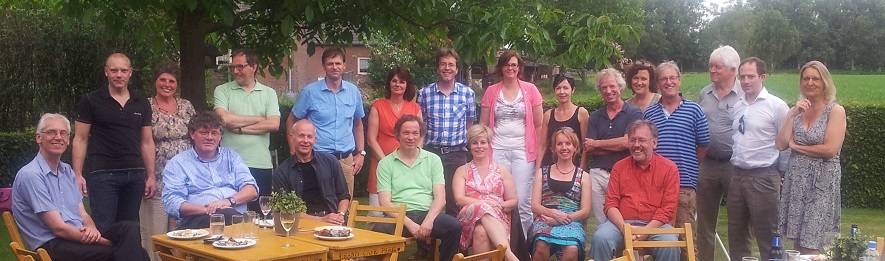
Membership AiREAS
On the picture:
Local government:
- Edwin Weijtmans (Province, air quality policy)
- Hans Verhoeven (City of Eindhoven, environmental policy)
- Sandra van der Sterren (City of Eindhoven, air quality specialist)
Multinational business, technological innovation:
- Marco van Lochem (Director Imtech) – Marco is also partner initiator AiREAS
- Ronald Wolf (Director Philips Research)
- Carlo Wolff (Imtech – cross reference database specialist)
- Rene Otjes (Program manager at ECN)
- Ernie Weijers (ECN)
Scientific research:
- Nicolas Hamm – scientific researcher Geo-climate and allergies – Univ Twente
- Gerard Hoek – scientific researcher lung issues around ultra fine dust – Univ Utrecht
- Rene de Groot – medic and researcher heart and vascular around fine dust – Univ Amsterdam
Civilian initiatives present:
- Wen Spelbrink – Environmental Defense and policy influencer
- Rianne van der Zanden – Social Media
- Debbie Langelaan – Journalist and writer, AiREAS website
- Koen Kneppens – regional entrepreneurship
- Nicolette Meeder – schools and education
- Jean-Paul Close – creator of Sustainocracy and initiator of AIREAS
Also present during the encounter were partners and children of the team.
Formal cooperative memberships of all parties gave been signed for 3 to 5 years. In Juli 2013 the ILM will be installed and real time dat will be collected for cross referencing with other data for scientific research. Meanwhile 220.000 of the local population are gradually being involved through initiatives around living green, mobility, energy cooperations, awareness games, etc. This is sustainocracy in action.
Frozen and liquid egos
The ego
Ego stands for “I”. It represents the unique, living physical identity of a single living being. This ego becomes relevant in a dynamic environment where it needs to interact with the surrounding to survive, liveand develop itself. When interacting with other ego’s it becomes the “I am”, a self reflective revelation of self awareness. This “being” than becomes gradually aware of talents and skills which it needs to shown off to its surroundings in order to establish valued reconition with a social group order and potential hierarchy.
Frozen ego’s
Modern group dynamics of human beings have evolved into the type of robotics described in the previous blog. Institutionalized tasks are being populated by human beings who are serving the institutional objectives by performing specific predefined tasks without competition or open interaction. The interaction is predetermined by the hierarchy of the establishment. Such structural organization can be compared with the solidification of liquid or gassy elements. The molecules slow down their vibrating rhythm and take a static position within a fixed structure, connecting in a specific format with their neighboring molecules. They become frozen in rock like objects. That tends to happen with people in hierarchical organizations.
From a human point of view the “I am” is being largely eliminated and so is the dynamic development of the ego. The ego itself becomes frozen in a predefined fitting within a frozen context. Only the “I” counts as functional pupet in a puppetering theartre. The ego is surrounded by dogma’s that he or she adopts as truthful indisputable reality in order to remain in the structure. The surrounding enhances this by imposing the dogma’s formally by asking for loyalty in exchange. The group structure lacks flexibility and dynamics in exchange for control and predictability. The human being is not challenged to evolve, just to perform automated tasks within fixed patterns. People who manage such rock like structures tend to have frozen ego too as they fragment human abilities into functional routines without accounting for universal laws of chaos and evolutionary interaction.
A business or government hierarchy becomes an artificial being composed of many frozen egos. The people involved in such environment get disconnected from the universal reality and become dependent of the overall structure of the institution to provide certain securities. Those would otherwise have been found in a much more complex competitive interaction with other ego’s and nature. Frozen ego’s tend to adore the state of rest and lack of certain worries. Ego’s may learn rationalized patterns but lack the development of spiritual, physical and emotional awareness delaying the true evolution of the adulthood of each individual.

Frozen ego’s
When society gets over-organized through bureaucracy the frozen ego’s remain frozen also in a structured environment full of rules and control systems.
Liquid ego’s
A human being is in essence as volatile as gas, a unique complex element in a highly dynamic universe. We are excited by our surroundings and interact with it through multi-level communication in search for harmony and safety. We do not only interact with other ego’s, we also need to interact with nature to feed ourselves with energy and material composites that are life supportive and enhancing. Other species depend on us and interact with us in a similar way of interdependence and evolutionary dynamics. Human egos connect to each other for co-creation of off spring (establishment of families) and safety (cooperations), by organizing communities of self supporting groups of individuals.
The dynamics is based on open interaction and flexibility giving the community a liquid like behavior that adapts itself in shape and interaction with the environment with great ease and transparency. The ego’s in such liquid state are challenged to find and redefine harmony continuously becoming liquid also in the learning process. The inner competition is functional to the mode of self sufficiency of the group. Talents and skills are challenged to change, evolve and interact using the wisdom of adults with the volatile, explosive creativity of the younger generations. Purpose and learning become a natural process that enrich all involved in a process of sustainable adaptiveness with the environment. People who get accustomed to doing this like the excitement and challenge of change.
Education
A child develops and discovers the ego through trial and error experimenting with its physical capabilities, often under protective guidance of the parents. Through comparison with the abilities of others in one’s surroundings it enhances and challenges itself further, often asking for attention “look what I can do”. They play games that stimulate the mind and body in every possible way. This young ego can be seen as a vibrant growing and learning molecule in a huge human sea of alike molecules, each a different complex ego.
The continuous open demonstration of the ego at the growing up and competitive phases of a person are necessary to distinguish and position itself in the complex group dynamics of human beings. “Adult” in this sense has nothing to do with the physical full-grown state of a human body. That was just the protected growing up phase when the real competition starts and other types of adulthood are obtained: the emotional, rational and spiritual aging, up to the state of higher awareness. That is when an ego is in perfect harmony with its surroundings and needs not continuously expose itself anymore for recognition.
When we look at education in the societies of frozen or liquid ego’s we see big differences. The young ego’s in a frozen environment are taught (indoctrinated) to behave in a frozen state, learning certain rationalized tricks to fit into a preprogrammed format of societal evolution. In a more liquid environment we see that education evolves in a dynamic way, connecting the young rising ego’s directly with the dynamics of a changing environment. They learn to interact in a competitive way through the adventure of experimentation and feedback. In a liquid state we develop fully to the adult state of higher awareness, something that is much more difficult to reach in a solid frozen environment.
Current societies
Most societies today have evolved into frozen structures trying to control ego’s in a prefixed format. Those formats have become so rigid that they lack all flexibility to interact with a very liquid, ever changing universe. We see then that such structures break up, exposing the frozen ego to an environment that is fearfully liquid for them. Many frozen ego’s on the other hand have become aware of the unnatural state of their ego and search fearfully for a more liquid interaction with their environment.
They break loose and become the small flexible streams of new communities that further break the solid environment apart. We see this happening all over the world despite the powerful intentions of those who have interests in maintaining the solid state of control. We see the development of all kind of disorders by the blockage of the natural evolution of the ego. Without even being aware, the psychological, physical and emotional disorders produce severe instability in the solid frozen communities. People are wanting to break loose, sometimes not even knowing why, because of the sense of entrapment. The human nature is too complex and active to be locked up for a long period of time. The predominant state for sustainable progress of humankind is the one of liquid ego’s. We see different cultures, business enterprises and cooperative entities that show various degrees of frozen, liquid and gas like structures.

Breaking loose
From solid state to gas
Transformation
We are entering a natural phase of transforming from a predominant state of frozen ego’s into a new state of liquid communities. This is necessary to attend our underestimated relationship with the ever changing universe. We are part of that universe which predominantly is liquid, evolving in a spiral dynamic process that challenges new connections to appear and old ones to disappear. Our human awareness is an excellent evolutionary instrument for self protection through adaptiveness. When we block this we eliminate our adaptability and make ourselves vulnerable to unexpected circumstances.
The frozen state of human ego’s has however taught us many things too. It helped us to reach an average age expectancy that allows many to experiment life within the safe dynamics of singular gassy adventurous life styles, liquid adaptive communities and specialized frozen ego formats for highly specialized complex tasks. We have learned now that the human universe should consist of all three states that interact also dynamically. To achieve this we need to develop confidence in new societal formats where the logic of all states is acknowledged and supported. Like that we can create slowly a stable global human community based on safety, health, universal ethics and sustainable progress.
Sustainocracy is a first serious attempt to achieve such awareness and guide the frozen structures into liquid dynamics. AiREAS is a multidisciplinary community that combines structures of frozen ego’s with free individuals in a gas state of volatile interaction, creating a semi-liquid, purpose driven organization of thousands of people without any hierarchy or prefixed structure.

AiREAS is world’s first liquid ego structure for sustainable human progress
 Sustainocracy, the new democracy