Home » Posts tagged 'awareness' (Page 25)
Tag Archives: awareness
Europeans are not Euros
Since the introduction of the single European currency about 10 years ago we are now “saving” European countries one after the other from financial disaster. As this process of salvaging is going on we see the poverty and despair rise in the entire European community, not just in the countries “saved” but also in all the others. As it seems now the Euro is living a billionaire’s life of its own with a powerful group of people who believe that centralized banking and money based governance are the key to the stability of Europe. Meanwhile we see the system collapse in front of our eyes with the incompetence of those so called leaders to reinstate stability, no matter how hard they try. We also see the blind dependence of all people of an entire continent on the availability of the Euro for the fulfillment of their daily needs. Without the necessary personal Euros chaos enters the individuals life. But access to Euros is increasingly difficult even though the billions flow from here to there. At individual level nothing of this money can be seen and even worse, people are expected to contribute to giant evaporation of wealth through their saving and extra taxes. The argument of politicians is that the ones that enjoyed the boom of speculation should now pay for the disaster. The problem is in this argument that the general crowd has no clue what happened above their heads in macro economics and have no clue either why their lives have suddenly entered in hell with debts, obligations, lack of jobs and a sense of guilt that we are all to blame. Meanwhile the real criminals that thought this over and expanded it to proportions beyond control remain gathering interests and bonuses as if nothing has happened. Two worlds have appeared, the sucked and the suckers. The Europeans and the Euro managers, not just the managers of today, the managers of the last 4 decades. They are all to blame one by one. The general public can be blamed for their lack of awareness and blind following the herd. Most people don’t even know what economics is and went along with hard work to pay mortgages for the house of their dreams and a daily living. They were proud if they could have a bit of luxury and believed it was achieved by labor, not theft. So much looked and felt “normal” because the manipulating managers made it look and feel that way. The theft of these people was not just money over debt and taxes. They robed us from our dignity, morality and ethics making believe that we did alright. The wake up call reaches the Europeans hard but between waking up and understanding there is a large and complex process that not everyone will follow. People do not want to understand, they want their daily bread and butter, a house to live in and the sense of personal achievement that now is being taken away. People who worked hard to pay their monthly fees now see their perceived property being taken away after 25 years of payment out of 30. With just 5 years to go it is immoral and without any respect to apply the laws of the money driven system instead of the universal laws of human and natural ethics. The same happens with everything that surrounds us. What do the Europeans do now that we realize that we are not the Euro? It is not a financial discussion anymore but one of human ethics, imposed dependence and right of independence, freedom of self determination and self sufficiency, morality of debt and guilt, manipulation of the unaware and criminality against humankind.
We are facing a huge historical step, a quantum leap for humankind, in which the clash between good and evil will open us to a new society. To see this we need to step back into history. We will then understand the future and also what needs to be done today.
Europeans
Despite the fact that we discovered the same genetic origins as a single human species we created Europe as a patchwork of conflicting human tribes around the fertile river deltas of this continent, rich in natural resources s.a. sweet water, land for agriculture and animal farming. The continent is also 3/5 surrounded by sea, making trade and fishing another source of development of societies. Water in general has been the motor of societal development. Historic confrontations between growing and migrating groups of people in search for stability and prosperity shaped our history.
The local climate, resources and geographical location of the Mediterranean showed the rise of our very first so called “civilizations”. According to our current standards of diplomacy and growing awareness around ethics we would most certainly disapprove of the way these societies evolved, grew and nurtured themselves through plundering and warfare. Even their political differences were settled with intrigues and murder. The word “civilized” refers more to the political debate and development of democracies than the way abundance or power was achieved over the back of others. The Roman empire may inspire us still in many ways but we would certainly not want to reinstate its speculative working principles. Still our current systems of laws and constitutions are based on the heritage from that particular era. And they cause the same problems today as the ones that finally ended the Roman empire. It is time for new constitutions, not based on the human having but on the human being.
The Europeans are people that developed multiple cultures around their unique geographical locations, with their own language, manners and beliefs. The many conflicts have also taught the people to become tolerant to differences and use these in a social interaction that benefits the entire European community. The Europeans see the local differences generally as a virtue not a threat. For thousands of years we fought our shortages and traded our surpluses. The rise of the Catholic church in the middle of the Roman collapse has become a symbol of the power of morality versus immorality that developed side by side on the continent. Each had its own infrastructure and hierarchy and both dealt in a similar currency: debt and guilt. This duality has both split and united the cultures in cycles of dominance and crises. Despite the periods of violence and attempts to piece together a single European unity the true identity of Europe is based on diversity in the European commonality. We are all equal yet totally different. It has been our continuous inner conflict to deal with this apparent paradox until we discover that it is not a paradox at all but a virtue of unity. It is like a field of summer flowers that is only a field of summer flowers because of the beautiful diversity of its colorful population.
Influences from outside Europe
Certain influences from outside Europe try to disturb the flower-bed. This should of course be no problem if these influences contribute to the diversity and stability, even in its flexible changes over time. Yet these influences, being financial (American consumer economics and single currency), religious (Islam) or natural (new flora and fauna), disturb at first but finally adjust to these European origins and roots too. As these foreign influences try change the nature of Europe the deeply rooted character of Europeans reacts back to try again find harmony and balance in its diversity. Europe is in climate, geography and history different from America, Middle East, China, Russia, etc. You cannot unify what has always been a kaleidoscope or put old religious norms and rules in that have long before already been suffered, dealt with and eliminated by this community. Not because these norms are wrong in its abstraction but because they do not fit the historical and geographical evolutionary context anymore of this part of the world. To survive and create a sustainable human context the lessons from our local history can not just be eliminated because of some over flying success story from elsewhere. Influences from outside Europe temporarily disturb our community and may create a crisis but in the end a richer, stronger Europe comes out. It has absorbed the influences, learned to take the best out of it and integrate it all in an evolutionary step forward using the intrinsic flexibility and stability of this multicultural adaptive and experienced population. Today the disturbance is very large and the impact extreme but the European reaction will be equivalent.
Single currency
A single currency was copied from the American dollar that had grown strong in a unified open consumer market of 220 million people last century. It was the American recipe for success and made American industries and risk driven capitalist entrepreneurship extremely successful world wide. The large unified home market provided a rapid commercial basis for initial growth that could back the global proposition and rapid expansion. The Americans became true artists in globalized business processes. Many American local business gurus developed leadership and marketing tools around it trying to explain and coach the working of this powerful functioning. They were of course popular also elsewhere.
Europe was lagging behind because of its patchwork of countries, borders, currencies, local protectives rules, etc. The American way seemed lucrative and dominant, it demanded a new competitive mindset of Europe. Instead of being creative with the historical basis of the Europeans, the local politicians adopted the American way. Europe had to become a single open market fast too, larger than the USA, with an equivalent consumer driven, money based system and a single currency. What the USA had done we would do bigger and better. It was successfully initialized by the creation of the Benelux. Soon it expanded across the continent in Euro based steps, not based on Europeans that needed to adjust too to this new Europe of financial speculation and consumption.
Now we see that Europe cannot be standardized into generalized terms such as a single value system. The single currency that had worked so well for America is disastrous for Europe and in competition eventually also for America. The open markets are excellent for the traditional interaction between local cultures and the single currency makes it easier. But the true value creation, that made each region of Europe strong and potentially unique in its positioning, was eliminated through standardization and centralization. Europeans need their differences to be strong together. The unification took the attention away from value creation and placed it on speculation. This slowly separated the financial world from the real world. Self sufficiency of the past became a financial dependence of today. Value creation based on local virtues became value evaporation due to speculation and generalized optimalizations around debt systems. Consumption became the key, standardized across all human cultures, making every human being an eating puppet in the standardize system of the Euro. The Euro rules, not the European.
China benefited when all big industries started manufacturing in the East. Low wages were key in de speculative process for growth in volume of consumption. Local added value in the consuming countries was based on logistic and retail processes with tax on the consumer end. A larger local content was needed in macro economics. Risk avoidance in Europe and risk taking in America both discovered the real estate market to grow the local financial economies by creating shortages and compensate it with a flexible debt system through liberated banking. Housing and consumption became the Euro world of debt with energy as power position to connect it all together. The financial bubbles were created through a flexible banking system with a tax collateral over the speculative future of unlimited financial growth. Now all Europeans had become the same in the Euro world, a bank account and social security number to exchange loyalty to the Euro through labor for food and housing through money. The human being had become hostage of the organized human having.
Internet fueled in America still some speculative volume business opportunities with wizzkids that created genuine value such as Google, YouTube, Facebook and the rest of social media. That was the only remains left of an American culture of creativity and value creation that had made the continent so powerful. Even Apple noticed that their creativity was cashed in China where the final value was created through labor in manufacturing.
Apart from those remaining value creations, the focus on creativity had disappeared from all cultures. All that was left were decades of value destruction in favor money, private banking and growing national debts to keep consumption going.
The cannot society
The financial debt imposed on the population also increased the bureaucracy needed to get it back. At the same time the consequences of a consumer driven society became evident in the growing secondary economies on health care, police. Pollution, illness, behavior disorder etc became a burden in all societies and grew in costs faster than the benefits of consumption. New creative vultures appeared in the immorality of societies, addressing the secondary economies of consequences. Pharmaceutical industries started the lobby to create public dependence through money based lawful impositions. Self sufficiency in nature based health exchanged into manipulated scientific pharmaceutical services with Euro interests. The extreme costs of the consequence driven economies tend to become dominant in all society. Health care has become another instrument of power over people with a pure financial speculative focus. Ethics, morality and trust evaporates. People have no choice anymore. The system wants cash no matter what and eliminates any initiatives that step out of the system. We have entered the “cannot, may not society” where every step and actions is valued against financial prosperity and taxability. A large control system is in place to manage society and eliminate leadership. Meanwhile humankind gets sicker and sicker in many aspects creating a unified Euro with unified Euro dependent Europeans. The European flower bed for once looks the same. All weak flowers with the head down, fearful, sick and in debt, affected by the Euro virus of system greed that sucks life out of them.
What comes next
We already see many reactions in the flower bed. Americans get back into their culture of speculative freedom and discover “sustainability” as a new impulse for local value creation, away from poverty. The nation is still developing debts and intents to exert further system power by creating health care systems instead of providing a healthy environment. The system and the people are not the same anymore, not even in America. But America has not reached yet the point of ethical constitutional dispute, Europe has. Our awareness has reached a point of culmination thanks to the American external capitalist influence. The undercurrent of the medieval religious discussion of the islam from the middle east is doing the rest. We are reminded again of the struggles we had ourselves in the Christian world and the atrocities that we organized in name of God for the sake of power and control. Also this is opening up the evolutionary step of morality and ethics, not by eliminating religions from our lives but placing them in the right learning perspective. It is a final quest for understanding our external and inner securities by believing in our holistic selves as part of a universe of matter, energy and conscious life.
In Europe we observe that smaller communities step out of the Euro and create local value systems of their own. Europeans discover again their own authentic nature and when the wake-up call reaches their awareness the reactions are two fold: aversion against the immorality of the Euro system and a search for ethical dignity again of European sustainable human progress. The flower bed is showing again single flowers in diversity rising up and spreading seeds of a new society. While the ethical incompetent forcefully try to uphold the dying system a new public discussion arises about constitutional ethics and moral structuring of societies. The power is building up. Europeans are not the Euro because of the difference between the power of human awareness when it awakens against the human greed that systemized our lives. Europeans want an acceptable life and future not an unacceptable Euro and past. This difference will result in a new tough step in human evolution that will shape a new Europe with a new European constitution based on diversity and high level human ethics through holistic conscience. This society is based on universal truths that we discover and adopt together, and which eventually reach out to all corners of the universe. The human being, starting with the European, will become dominant over its Euros ( Dollar, Yen or RMDs), whatever the currency will then mean in terms of true human values.
Purpose driven economy
With the kickoff of the first sustainocratic initiative in the city of Eindhoven (the Netherlands) the first step is made to create a “purpose driven economy”. What is the difference with what we have today? And why is it important for the rest of the world to follow the experiment in Eindhoven and, better still, start one of their own?
Current economies
Our current economies are not purpose but consequence driven. The human being is positioned as compulsory consumer. The entire institutionalized society is focused on creating a mountain of wealth around this consumer that gives a sense of abundance at all times. The only way to access this abundance is through financial means. Some of these means are individually obtained through the production, logistics and sales infrastructure necessary to maintain this mountain of abundance. Other get paid out of the hierarchies funded through taxation on this consumer organization. Or through speculation on material resources contained in this “having” type of culture. And finally also debt.
The consequences of such consumer economy show a growing tendency of (negative) influences that need attention through investments. Think of infrastructures, healthcare organizations, police, etc attending the attitude of greed and its effects on the human being, physically and mentally. This also shows an exponential growth which is equally reflected in the world economy through the costs of societies. At the same time we see our environment and human behavior deteriorate fast.
The model of economies of growth purely based on unlimited consumption and the consequences thereof, is obsolete because we use our natural resources wrongly, destroy our environment, sicken ourselves and eventually eliminate our evolutionary chances.
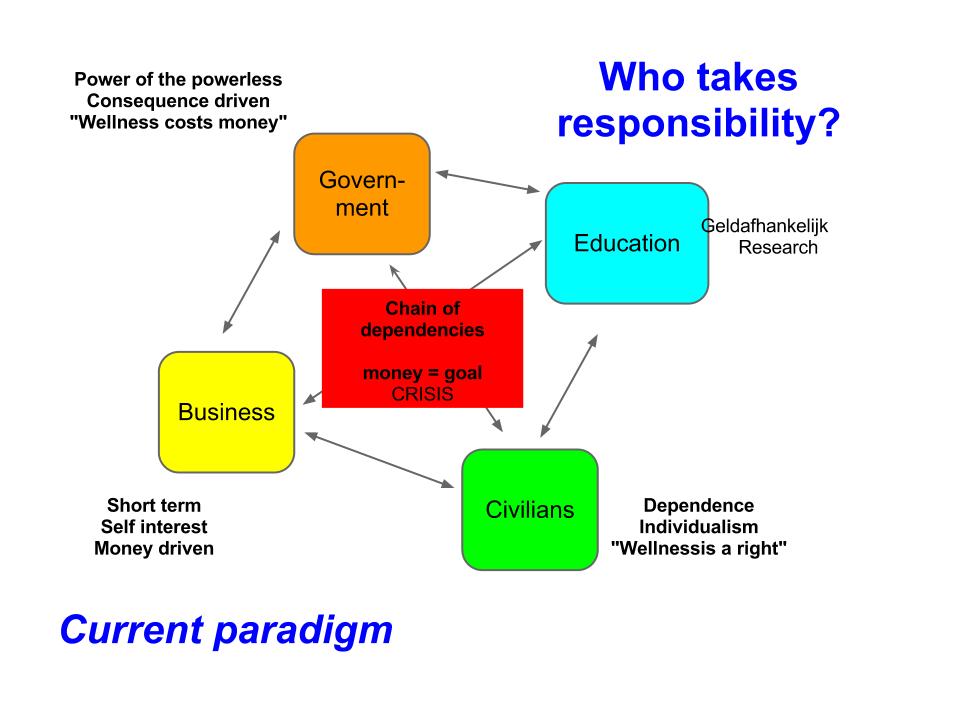
The consumer economy grows while destroying our selves and our habitat
Fragmented complex society
We know this now, including scientific proof, but have difficulties in changing the course of society. We created a very complex mesh of fragmented financial entities with dependencies and interests among each other on which powers and influences are being based. Each institutions has a perceived right to exist and defend its own interests. There is not one single institution that takes full responsibility for sustainable human progress. The institutional mesh is based on fragmented self interest and competition.
Key is the understanding that no institutional specialization can take holistic responsibility for human safety, health or sustainable progress. It is the human being itself that needs to take this responsibility. What went wrong in the consequence driven consumer economy was that the human being delegated its wellness through fragmented institutionalized structures that grew into tremendously inflated organs like an abscess or cancer would do on a sick body. Instead of serving humankind they try to serve themselves. This fragmented type of human organization is institutionally sick with the risk of the cancers to develop themselves further and destroy our evoutionary chances.
Purpose driven economies
The big difference with the old consumer economy is that it is not based on consumption and growth but on true value creation (purpose). It is not based on massive productivity and distribution but on local content. It is a circular type of economy where “purpose” is defined according local human needs, obtained through local effort and using local resources in a circular way.
To achieve a purpose driven economy an intense transformation is needed. But it can be done using the same institutional instruments of the old society. Each participant needs to cure its cancer like development and abuse and become functional again within the scope of local for local requirements. It requires a different mentality and true transformative leadership in each institution involved.
Abundance is not presented through logistic channels from around the world, it is created by local cooperative efforts. In such local cooperation we see the four traditional human values come together: attitude, creativity, environment and wisdom. Those values in the old economy were split into separate institutions that do not act locally but globally, not in an integrated way but based on self interest, greed and fragmented excellence. Now we bring this global expertise back to the local context.
Using what we have learned
The great advantage of today is that the old consequence driven consumer economy has left us with a huge amount of accumulated experience and material knowledge thanks to the concentrated specialized, fragmented functions of expertise that developed over time. This would never have occurred if this phase of humankind had not taken place. For a long time it was very constructive. Now it has become destructive.
We hence do not criticize our past but use the best of its elements in our new progress. We can of course be critical to those old time forces that try to prevent us from creating purpose driven progress. It is just a matter of time for that opposition to disappear. Eventually the purpose driven economies will develop there where the old one has become obsolete, entered into a crisis, providing room for renewal, not just in a physical, organizational sense but especially emotionally, spiritual and rationally when people become aware.
Complex transformative process
It is a complex process that is typically developed locally and bottom up with executive support to make it happen. The reason that it happened in Eindhoven first and not yet in another region is simply because this small Dutch town unites the essential ingredients to make it happen. What are these ingredients:
- Awareness at executive level
- Open democracy of true equality
- Level of education and experience
- The right people at the right time
These qualities produce the necessary flexibility that can address the future with adaptive determination in a complex modern world. People take responsibility individually, convince their surroundings to support change and find ways to make it happen. The purpose is found in the essentials of human existence: food, health, security, wellness (housing, energy, etc) and knowledge. When it becomes clear that the global consequence driven consumer economy is obsolete speed is required to create a new sense of reality and responsibility, including a change in behavior. When the time of old abundance is over, new abundance needs to be created, preferably on time.
Wellness is not a cost or right but the result of a responsibility and hard work (purpose) together. When circumstances change stability is found in change too. In a sustainocracy the purpose driven economy is initiated together. We do this by making human wellness a purpose driven issue of the local population with the support of the accumulated institutional excellence and enhancing potential.
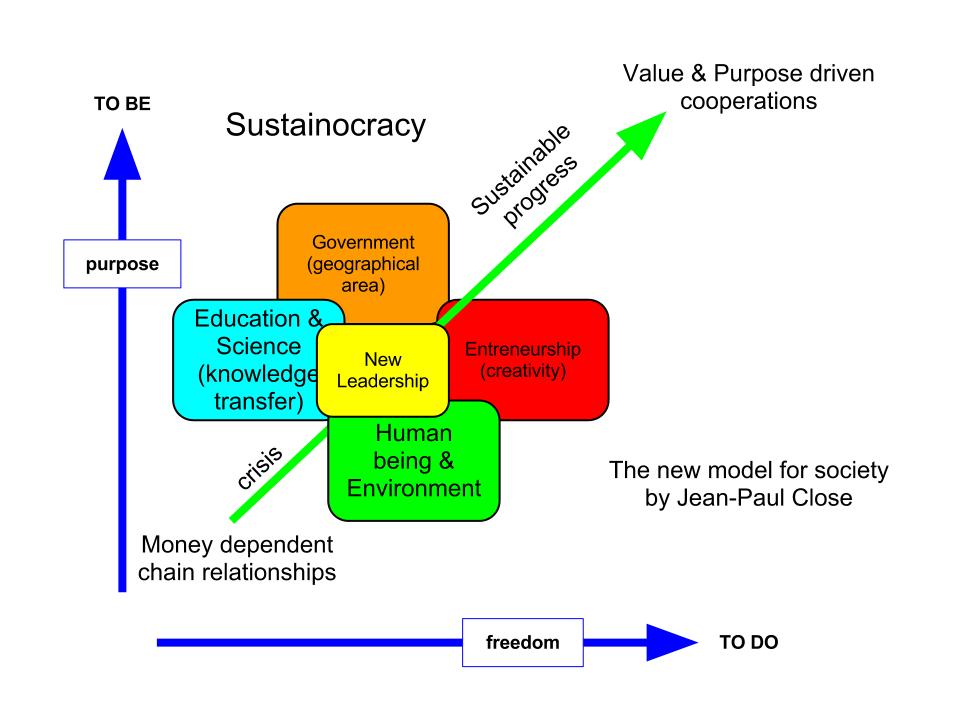
The purpose driven society develops local for local using the institutional excellence of the old paradigm
Conclusion:
Purpose driven economic development based on sustainocratic complexities is needed to save humankind from the present day destructive expectations caused by the consequence driven consumer economy. If not we will face disaster. Yet if we assume responsibility individually and institutionally we also face a huge transformative challenge that will upset everything that we have known so far. The choice between destruction or working together on a healthier perspective is easy for me. I have become self aware and dedicated more than a decade to come to these views and initiatives. It is a start, giving comfort that humankind has a choice indeed. A choice that simply depends on one own and not someone else. But I realize that it is a difficult one, not only when one has to make it, but also for me to reach out to the world and make the choice known to all. If one does not know than no choice will be made. My personal challenge is hence multiple. Make it happen for myself, provide proof to my surroundings and reach out to all of you with sufficient clarity that you take sufficient confidence in the course that I have taken in order to let go of old securities and create new ones for yourselves and your direct surroundings.
Ethics is human, not institutional
Much is being discussed about “ethics” in business, finance, government, education, etc. The biggest misconception of all is to attribute ethics to institutions. Ethics is human, not institutional. An institution cannot be blamed for unethical behavior, their leaders and employees can.
Definition of Ethics:
Many people confuse ethics with social morality, as in religion, belief or cultural behavior. One of the more useful definitions of ethics is provided by wikipedia in the names of members of the foundation of critical thinking: “a set of concepts and principles that guide us in determining what behavior helps or harms sentient creatures”.
If fact ethics refers to “the conscious way we interact with our environment, human and living nature, in a constructive or destructive way”. Ethics is complex as it demand from us the conscious reflection about our progressive behavior and its consequences. Progress has always a destructive and constructive element, when initiated by human beings as well as evolutionary progress within nature. It opens up a large array of philosophical thinking on the extend of responsibility of the human impact on its environment. How ethic is it to destroy a certain natural landscape for our infrastructures, housing, industrial processes or even agriculture? Where does human progressive dominance end to allow room for other species to evolve or is human dominance and its effects on other species part of their own evolutionary challenge? Hasn’t the competitive crises in the human species stimulated our self-awareness in such a way that we became more creative and competitive? Hasn’t the anthropocene affected life of other species in such a way that new genetic variations have appeared that adopted perfectly well to the human dominance and even to human pollution? Isn’t humankind on its own a challenge for nature to react with destructive force to create balance again in living progress? How ethical must the human species be with its environment and what ethics can we expect from our environment?
When we look at the effects of humankind on its environment then this can be considered very high, especially now, in the era that we live in today. On the other hand we see that these effects are lethal for the long term human sustainability. It is expected that climate changes and pollution will eventually reduce humankind to a much smaller population then we count today. Within 40 years humankind may well implode to a size of little more than 1 billion people (as opposed to more than 7 billion today).
Ethics has hence nothing to do with the way we influence nature itself. This will bounce back to us with equal force as what we did to nature. Nature has this unique ability to find balance in all kinds of extremes, even against humanity. So when we refer to ethics we need to reflect on the way we affect nature in the short and long term to produce effects on us. With this type of ethical consideration we place human evolution within the meaning of sustainable human progress. In this sense we do not dominate nature as we affect our surroundings but assume an adaptive attitude around the effects of nature on us. Nature seeks natural balance no matter what effects this has on humankind. We however seek balance with our consciousness (learning process) about our surroundings to provide us infinite evolutionary chances using the environment properly. We become adaptive partners with our environment for our own benefit. Ethics then refers to the level of reciprocal balance we create with our universe in which we assure our health and security at all times by respecting nature for what it is.
So when people debate on institutional ethics we need to get to terms what an institution really is? From an operational point of view an institution is a specialized group of people performing to reach some predetermined team objective. There are many types of institutions that all perform different types of tasks in a human community. From an ethical point of view we can now look at the institution and determine what impact it has on our sustainable human progress from an environmental point of view? The problem we face is the paradigm in which such evaluation takes place.
Institutions have been traditionally registered and founded to become a legal entity that behaves according human, not natural laws. An institution is a legal instrument that allows the grouping of people around certain objectives protecting the integrity of the people against failure of the institution, while allowing the people involved to share the benefits of it. The institution can hence do things that people would maybe not do themselves from a moral point of view. What motives would an institution have to do what it does and can ethical values be attributed, and by who? Yes, we can, but not to the institution, to the people giving direction to the institution. Why?
The institution is a piece of paper. When no-one does anything with that piece of paper it will not do any harm or good. It is just a number. An institution becomes instrumental in the hands of the human being. It is the human being that deals with the institution that needs to be confronted with the ethics of this usage. The fact that an institution is constituted according to certain human laws does not liberate the user of the instrument from applying moral awareness and consider the ethics of its positioning or functioning. In our current society based on capitalist economics the morality of human progress is expressed in financial means. Within this paradigm ecology and human progress are considered a cost. Ethics are valued against the price one needs to pay and the material benefit one gets in return. The overall holistic picture of a universe reacting back to us is not considered tangible enough to be attributed to the ethics of a single institution nor of its leadership. It is the human system that is unethical because it shows a scientifically proven damaging track record against nature itself and especially our own expectations for a healthy future. What is then unethical? The financial system? Money? Capitalist economics? Consumption? Industrialization? Manufacturing?
None of this is unethical because for every system an alternative system can be chosen. The fact that humankind has self-aware choices makes the usage of instruments that have an unethical impact on our environment unethical. It can be compared with a word. The word itself can never be attributed an emotion or value. It is the context in which the word is being used. The same goes with money. Money has no value, it is the value we attribute to it in a certain context. We can compare it with a hammer. The hammer is a tool that can be used in a constructive way to create a chair. It can also be used to kill. In both cases ethics can be applied, not to the hammer but to the hand that uses it and the purpose it is used for.
So instruments like words, coins, hammers or registered pieces of paper have absolutely no ethical meaning until they are used by human beings for one or another purpose. Right now the ethics of humankind is extremely off course. We are all to blame but those who claim leadership and intentionally keep up the system that is so destructive, should be brought to justice. The problem we have is that ethics has not found its way yet sufficiently in our systems of human laws and that is what is urgently needed. Sustainocracy can be help because it provides the tooling necessary to make a natural selection. It also helps institutions to transform while they still can. The excuse is still that they did not know better, had no choice and were not aware of a new paradigm. Soon no-one will be able to hold with such excuse because new standards are being set. These standards are based on true ethics. When people have a choice they immediately are at fault when their choice is contrary to a true ethical paradigm such sustainocracy. At this stage humankind can not afford to accept unethical leadership or behavior anymore whether we like it or not.
 Sustainocracy, the new democracy