Home » Posts tagged 'economics' (Page 3)
Tag Archives: economics
Purpose driven economy
With the kickoff of the first sustainocratic initiative in the city of Eindhoven (the Netherlands) the first step is made to create a “purpose driven economy”. What is the difference with what we have today? And why is it important for the rest of the world to follow the experiment in Eindhoven and, better still, start one of their own?
Current economies
Our current economies are not purpose but consequence driven. The human being is positioned as compulsory consumer. The entire institutionalized society is focused on creating a mountain of wealth around this consumer that gives a sense of abundance at all times. The only way to access this abundance is through financial means. Some of these means are individually obtained through the production, logistics and sales infrastructure necessary to maintain this mountain of abundance. Other get paid out of the hierarchies funded through taxation on this consumer organization. Or through speculation on material resources contained in this “having” type of culture. And finally also debt.
The consequences of such consumer economy show a growing tendency of (negative) influences that need attention through investments. Think of infrastructures, healthcare organizations, police, etc attending the attitude of greed and its effects on the human being, physically and mentally. This also shows an exponential growth which is equally reflected in the world economy through the costs of societies. At the same time we see our environment and human behavior deteriorate fast.
The model of economies of growth purely based on unlimited consumption and the consequences thereof, is obsolete because we use our natural resources wrongly, destroy our environment, sicken ourselves and eventually eliminate our evolutionary chances.
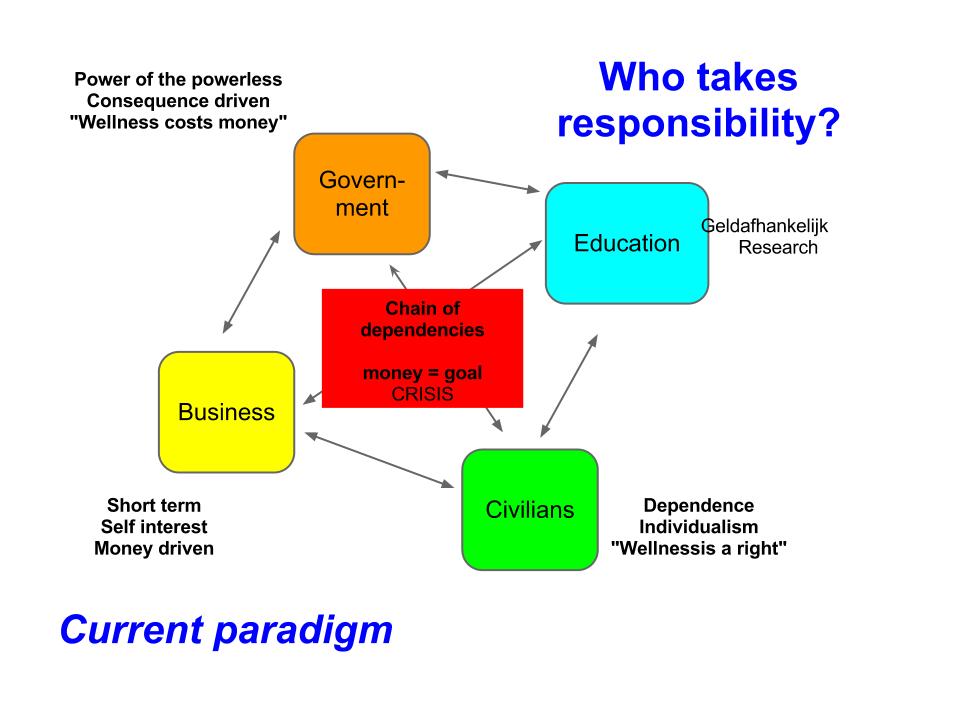
The consumer economy grows while destroying our selves and our habitat
Fragmented complex society
We know this now, including scientific proof, but have difficulties in changing the course of society. We created a very complex mesh of fragmented financial entities with dependencies and interests among each other on which powers and influences are being based. Each institutions has a perceived right to exist and defend its own interests. There is not one single institution that takes full responsibility for sustainable human progress. The institutional mesh is based on fragmented self interest and competition.
Key is the understanding that no institutional specialization can take holistic responsibility for human safety, health or sustainable progress. It is the human being itself that needs to take this responsibility. What went wrong in the consequence driven consumer economy was that the human being delegated its wellness through fragmented institutionalized structures that grew into tremendously inflated organs like an abscess or cancer would do on a sick body. Instead of serving humankind they try to serve themselves. This fragmented type of human organization is institutionally sick with the risk of the cancers to develop themselves further and destroy our evoutionary chances.
Purpose driven economies
The big difference with the old consumer economy is that it is not based on consumption and growth but on true value creation (purpose). It is not based on massive productivity and distribution but on local content. It is a circular type of economy where “purpose” is defined according local human needs, obtained through local effort and using local resources in a circular way.
To achieve a purpose driven economy an intense transformation is needed. But it can be done using the same institutional instruments of the old society. Each participant needs to cure its cancer like development and abuse and become functional again within the scope of local for local requirements. It requires a different mentality and true transformative leadership in each institution involved.
Abundance is not presented through logistic channels from around the world, it is created by local cooperative efforts. In such local cooperation we see the four traditional human values come together: attitude, creativity, environment and wisdom. Those values in the old economy were split into separate institutions that do not act locally but globally, not in an integrated way but based on self interest, greed and fragmented excellence. Now we bring this global expertise back to the local context.
Using what we have learned
The great advantage of today is that the old consequence driven consumer economy has left us with a huge amount of accumulated experience and material knowledge thanks to the concentrated specialized, fragmented functions of expertise that developed over time. This would never have occurred if this phase of humankind had not taken place. For a long time it was very constructive. Now it has become destructive.
We hence do not criticize our past but use the best of its elements in our new progress. We can of course be critical to those old time forces that try to prevent us from creating purpose driven progress. It is just a matter of time for that opposition to disappear. Eventually the purpose driven economies will develop there where the old one has become obsolete, entered into a crisis, providing room for renewal, not just in a physical, organizational sense but especially emotionally, spiritual and rationally when people become aware.
Complex transformative process
It is a complex process that is typically developed locally and bottom up with executive support to make it happen. The reason that it happened in Eindhoven first and not yet in another region is simply because this small Dutch town unites the essential ingredients to make it happen. What are these ingredients:
- Awareness at executive level
- Open democracy of true equality
- Level of education and experience
- The right people at the right time
These qualities produce the necessary flexibility that can address the future with adaptive determination in a complex modern world. People take responsibility individually, convince their surroundings to support change and find ways to make it happen. The purpose is found in the essentials of human existence: food, health, security, wellness (housing, energy, etc) and knowledge. When it becomes clear that the global consequence driven consumer economy is obsolete speed is required to create a new sense of reality and responsibility, including a change in behavior. When the time of old abundance is over, new abundance needs to be created, preferably on time.
Wellness is not a cost or right but the result of a responsibility and hard work (purpose) together. When circumstances change stability is found in change too. In a sustainocracy the purpose driven economy is initiated together. We do this by making human wellness a purpose driven issue of the local population with the support of the accumulated institutional excellence and enhancing potential.
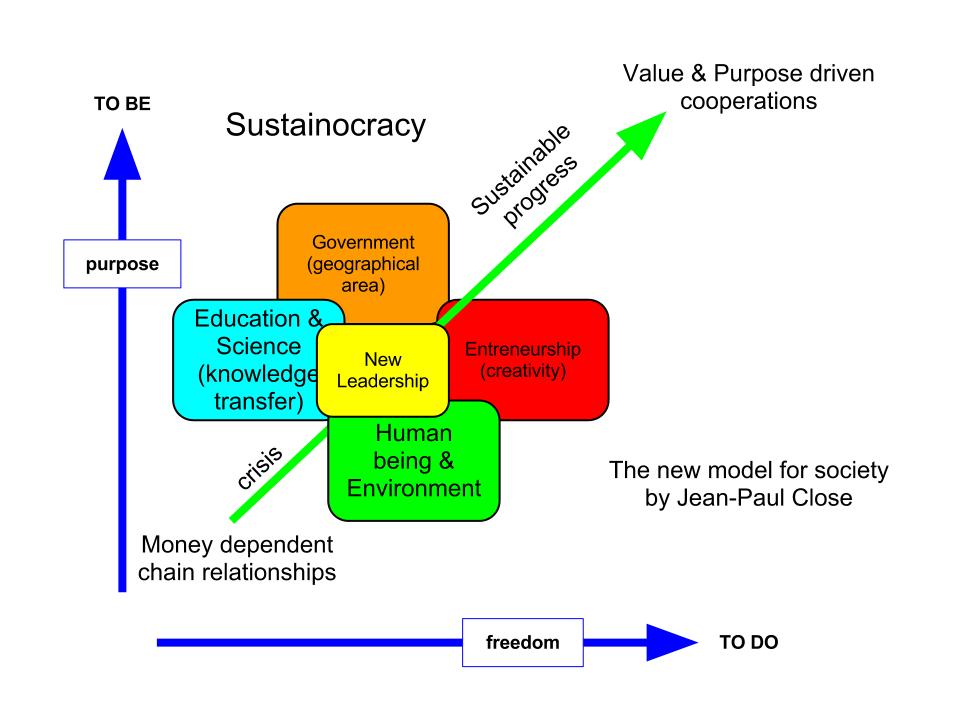
The purpose driven society develops local for local using the institutional excellence of the old paradigm
Conclusion:
Purpose driven economic development based on sustainocratic complexities is needed to save humankind from the present day destructive expectations caused by the consequence driven consumer economy. If not we will face disaster. Yet if we assume responsibility individually and institutionally we also face a huge transformative challenge that will upset everything that we have known so far. The choice between destruction or working together on a healthier perspective is easy for me. I have become self aware and dedicated more than a decade to come to these views and initiatives. It is a start, giving comfort that humankind has a choice indeed. A choice that simply depends on one own and not someone else. But I realize that it is a difficult one, not only when one has to make it, but also for me to reach out to the world and make the choice known to all. If one does not know than no choice will be made. My personal challenge is hence multiple. Make it happen for myself, provide proof to my surroundings and reach out to all of you with sufficient clarity that you take sufficient confidence in the course that I have taken in order to let go of old securities and create new ones for yourselves and your direct surroundings.
Reciprocal economics
Today’s human society is upset because the reciprocity in economics has been disturbed and even eliminated. If this is not restored fast balance will follow a natural and unpredictable cause of global magnitude. Nature is our best guidance in these kind of situations. Even though the human systems of economics are highly artificial, they follow similar patterns as nature’s systems of interdependence for life, growth and survival.
Economics may follow an artificial path, life of humankind is still connected to the laws of the universe, even if we neglect this openly. If reciprocity is just contained in the artificial circuit of human systems, such as personal labor versus financial reward, without relationship with the natural world, eventually the natural world will break through again, with catastophical results for humankind. An example we see in varios cities (eg Lima) around the world where clean water supplies are reaching precarious levels caused by the positioning of the urban concentration according economic interests only.
Reciprocity represents the complexity and diversity of complex balance through taking something by giving something else back. A tree takes CO2 and gives oxygen back, using the carbon for its own purpose . When a plant dies its material components return to nature for a new cycle of life providing life in the meantime to many other species.
When a bee searches honey it takes pollen along that fertilizes other plants. When an animal eats a sweet fruit it swallows the pits. The seeds use the mobility of the animal to get to new grouds and the excretion as nutrition for the early growth proces until it finds permanent nutrition in the new environment.
Reciprocity is complex and allows for diversification of relationships between species, eliminating competition for the same resources and allowing for many life forms to cohabitate peacefully together. Risks are eliminated by the diversity of relations allowing rapid new connections to be made in nature when any single reciprocal line is interrupted for some reason. Diversity in reciprocity is the source of security of life on earth and maybe in the entire universe. Simplification would enhance the risk of death and elimination.
Humankind has concentrated its entire dependence on money as only reciprocal means. Over time we even eliminated different value systems to concentrate on globalised unified currencies and organization. Nature already teaches us that this is not only risky, it is potentially lethal for the entire system and species. Any snag in the system can upset humanity all together.
The fact that the entire human structure concentrates solely on financial dependence, without hardly any reciprocity with nature (we use up natural resources but give nothing back) makes our situation even more dangerous. It is like bees depending on nectar but cutting away the flowers to build hyves. This is autodestructive. So is human behavior.
Solution: Human societies and organization forcefully need to start concentrating on reciprocity in a much larger variety and diversity within human systems and our relationship with our environment. We are taking too much as a debt on our future, not only in financial systems of debt but also in natural cycles of using without giving hardly anything back in diversity. Our waste is even unnaturally concentrated or burned, instead of spreading throughout the globe. Nature reacts in a different way than key performance indicators of centralized business and finance. Nature finds its balance in a natural way and takes back even if this ends the options of human progress.
We are individually in change of our own taking and giving when we work and live our lifestyle. Modern institutions only survive because of voluntary human (democratic) commitment. Money may be an instrument of power over human beings but only when you eliminate nature entirely from your life. If you allow nature to provide you with part of the abundance directly you will be able to bring some balance back into your own life. At the same time you shorten the usage cycle eliminating debt. Debt does not exist in nature.
If you look at your own lifestyle (what you eat, have in your house, use for holiday, your car, etc) and ask yourself what you have given nature back in return (directly or via the companies that you purchase your goods from, how much do they give back?) for it then you get a feeling of your universal liabilities and the degree you may be affected by a crash of the system.
It is a worrying aspect of current human society that reciprocity in diversity is not considered at all by us nor our human organization. We take and take more and exchange it into long term financial debts without considering our responsibility with our surrounding. Question then arises “are we capable to turn this around still?” Probably not. Least we can do is try. I try with sustainocracy, local for local but find it to be complex. Not complex in logic but in getting humankind to understand the need, the urgency and our vulnerability if we don’t.
will you eat bread today?
Just imagine a baker in a village of 100 people. Every day he bakes 100 loafs of bread that he sells to the villagers for 1 euro per bread. Every one is happy, every villager has bread to eat every day and the bakery has an economic situation of 100.
For some reason one day there is a shortage of wheat and the bakery cannot make 100 breads, he makes only 80. Due to the wheat shortage the cost price went up and the baker had to sell his bread for 1,50 euro. People were not happy but paid the difference. 20 of them came late and were left without bread. The baker did not really care. His turnover had gone up to 120. The wheat shortage continued. The local population reacted by purchasing half a bread instead of one whole. They had become conscious of the shortages of wheat and realized that they could perfectly well survive with half a loaf since they had been throwing away part of the other loafs anyway. They called their social responsibility “sustainability” but the bakery was not happy at all. He had sold 100 halfs at 75 cents = 75 euro. His economy had dropped despite the rise of the price and he had to throw 30 unsold breads away. Thinking that the market had reduced he decided to stimulate the market again with some marketing and kept the reduction of his production due to the wheat shortage. Due to the marketing costs he had to increase the price a bit more, to 2 euro.
Half the people bought half’s and half bought whole breads. So 50 halves against 1 euro = 50 euro and 50 whole breads against 2 euros = 100 euro. The baker was happy. Marketing works he said. His turnover had grown to 150 euros, double the previous sales! And he only had to throw 5 breads away this time. Market working they call that in economics, and all the consumers had something to eat.
The world market of wheat was struggling further and he had to compete to get his resources. The energy costs were rising too so he ended up reducing his average production to 50 breads against a sales price of 5 euros. Some angry people were buying bread by the slice now and some could not afford bread at all anymore. The 20 richest people of the village did not want to reduce their consumption and offered 8 euro per bread. The baker loved this deal and sold all his bread every day now with a turnover of 20 x 8 euro = 160 euro for the rich people and 30 x 5 euro = 150 euro for the normal people. The economy of the bakery had grown to 310.
The local village council was worried because a number of people had no bread to eat but happy with the growth economy. They could raise the local tax on bread to help the 50 people that were starving and gave them some social help with money. The baker was making a lot of money after all. Government treasury was doing fine as a consequence too. With all his profit the baker had bought a nice house with a large mortgage. The city council had invested in a bit more bureaucracy to assure that the growth economy was properly taxed and invested. People complained about to increase of the cost of living and blamed the baker. He blamed the increasing costs of wheat, production and marketing. But also the tax pressure. The government hammered on economy of growth to be able to tax more and cover the expenses of the socially needed. Meanwhile poverty and social unrest was rising. People were meeting to see what they could do about it and someone threw a stone through the window of the bakery. The next round of baking the baker could make only 30 breads but the population was already in front of his door claiming the entire production for equal distribution. He had no turnover that day and his bakery was damaged. The rich got no bread that day and were furious. They lobbied with the local government to see if their taxes could properly used and get bread from elsewhere. The baker went broke, couldn’t pay his mortgage anymore so the bank went broke too. The government had no one to tax anymore while the bread market got into the hands of the Chinese. After a period of economic growth the village got into a severe recession and chaos.
This simple, funny but realistic story gives a view that economic growth does not solve anything when resources are running out. The only option left for the villagers would be have been to grow their own wheat to eliminate their dependency on outside forces. But what did they know? If they can’t produce their own they have to find something else to eat. But for all they new everything was fine, the economy was growing after all, wasn’t it? How do we deal with this in the big cities around the world where money rules the systems and the dependencies of the people? How aware are people of the world wide shortages if the only point of measurement is the local supermarket and one’s own cash availability? How aware are governments when the economy of growth, tax and social welfare is their only worry?
Moral of the story: A growing economy does not necessarily get you a daily loaf of bread.
 Sustainocracy, the new democracy