Home » Posts tagged 'Eindhoven' (Page 5)
Tag Archives: Eindhoven
Psychology of change
Recent blog and internet discussion, and our practical living lab exercises of AiREAS in the Dutch city of Eindhoven, got us again going about the overall complexity of the “psychology of change”.
On the one hand there are the impressive challenges of a global shift, a true transformation of society to save our selves, demanding tremendous changes. On the other there is the powerful resistance and dominance of the world’s institutionalized economics that produces many powerful lobbies to avoid change all together. The latter brings a certain material wealth to the world and to the financial mighty. I already wrote various blog items on it but the complexity of “change” seems an endless and highly repetitive topic. Why? Because it affects us intensely on all levels of society.
The need for change has to do with ethics, sustainable human progress, in-dependencies, our environment and basic human rights, as opposed to nothing of that, expressed through individual and institutional power positions. It also has to do with awareness, responsibility, dominance, different paradigms and massive manipulation as part of the huge human complexities. Both sides of the problem, the desire and the avoidance of change, are firmly established inside the kernel of our individual and collective consciousness, self reflection, evolution and the ethical structuring of our choices. Despite everything there is always a dominant situation of overall avoidance of change.
Manipulation
Manipulation may sound unethical to you but we are being manipulated all the time. Not just through conscious manipulation of powerful institutions but also by the way we perceive our own selves in general. We react primarily to our surroundings using multiple sensory and extra sensory impulses. The way we perceive is the way we react. Within this simple action = reaction there is the “human psychology” involving fear, worry, happiness, wellness, anger, hate, education, jealousy, etc. All this can be manipulated, even by ourselves, consciously and unconsciously. In fact, it takes an intense learning process to to become aware of one’s own behavior, perception and choices, to get more or less liberated from manipulation. We call this a part of our higher evolutionary awareness. Not many people reach that state and those who do often become manipulators themselves with a large array of motives.
While I write this blog and re-read it I realize that I myself am one of them. I have grown over time mostly free from manipulation. Now (before I did not) I can see that I am being manipulated in intention by a dominant money and consumer driven system. This produces some kind of friction between me and the old generalized system. By introducing a new paradigm (sustainocracy) I also manipulate people by showing them a different truth. Despite my desire to be ethical and transparent I do create a new environment with the intention to provide people such a sense of new security that they decide to follow my views and let go of the old paradigm.
All I try to do, which justifies my motivation and passion, is to make people aware of manipulation and help them make up their own mind, without prejudice finally about their choice, not even when they decide to turn their back to me. I see it hence as a challenge to explain myself and Sustainocracy in such a way that people start believing in it, more than the other reigning system. But isn’t that what the system of capitalist consumer economics does too? And has been doing successfully for a long time? So we both compete in the psychology of manipulation presenting two different paradigms to the people. I am of course just a beginner while the other paradigm has thousands of years of experience.
Psychology of manipulation
When it is warm we buy an ice-cream when its cold we wear a pullover. We look around us and decide what we do, need, say, move, ….almost instantly. Our impressions do not just have to do with sensory perception, they are also colored by what we think is right or wrong, just, wishful, desirable, etc. In reality we have been conditioned to instant reaction right from the moment we were born and open our eyes to see the world. Normally we see the face of one of our parents at first, or a doctor or nurse. We see lights, colors, movements …. We smell and taste things….we hear noises, sounds, melodies, voices. All these first impressions reach us without giving it yet a conscious thought, they form however the basis of the big pile of sensory impressions to come that we do reflect consciously about.
After growing up in a certain environment it becomes so familiar, our own unquestionable reality, a specific truth. Every new observation and experience is being compared with circumstances we lived through before in the past. It enhances them, builds them up, or rejects them, until you feel at home right in the middle of those impulses from outside. This helps to react instantaneously on most issues of life during the day and makes you feel familiar with the way others react too. Together we form a culture, a set of values around language, beliefs, behavior, etc, that define us as a community. It gives us a behavioral identity. This gives a sense of belonging that remains united to our local natural and human surroundings. It is important to us because we need speedy adaptation and reaction when our behavioral routine is upset in any way. It is important for our mind to be able to distinguish between the normal and abnormal and react adequately, especially when in danger.
So securities are built up by ourselves and with our cultural environment to make us feel safe within ourselves. We auto-manipulate this feeling out of risk avoidance, fear control and sense of control. This can of course be manipulated also by an organized surroundings that is based on institutionalized principles. This then becomes also a paradigm, a worldview that is conditioned by certain values. Our current ruling paradigm is the one of capitalist economics. The one that I am introducing with arguments is called “sustainocracy”.
That is psychology of manipulation, the sense of providing external security to a community of people by the internal perception of security.
Psychology of change
People are of course reluctant to change when it addresses their sense of security. Nowadays we are confronted with a lot of information on climate changes, pollution, global warming, financial crises, other crises, etc. When we read such issues in the newspapers and watch documentaries on TV we become worried. We still, however live our day to day, everyday life. We are worried about the large picture and yet do what we have always done. “What do you want me to do?” you would say, “who am I to do anything?”, you may suggest. “Let the government solve it” most of us would say. And you are probably right!
Unless your name is on the list of the G7 and G20 encounter, or something like that. Which is what tends to happen. A few hundred powerful people join in global talks but fail to talk about change because they want to keep a capitalist economy going that provides perceived security to many people including the ones in power. And 7 billion people feel too small, too insignificant, too unaware, to do anything while feeling blindly secure in their day to day living experience, expecting that the big G solve it all. Until it is too late.
So if we want to change anything we have to overcome the “psychology of fear for change”. This starts with the aspect of “negation”. This feeling is normal. To accept a responsibility we have to be aware that we actually carry one. Or that we become aware that those who we think are responsible, have good reasons for themselves to avoid change and will therefor not take that kind of responsibility.
As explained above we see our direct environment as a secure cultural nest in which we were born and grew up. If we want to change we attack our inner senses of security and that creates an intense feeling of fear and insecurity. At individual level, despite the awareness that things need to change, we have the tendency of neglecting it just out of fear of the consequences. We tend to place the responsibility elsewhere, outside our own scope. You may say that this the mentality of an ostrich yet it has a strong basis of survival. If everyone would panic upon the wisdom of need for change the chaos would even be more dangerous. Human beings need some kind of leadership to address change.
The need for change grows, the negation too
Meanwhile a growing part of those 7 billion people are being incorporated into the Western example of material wealth. They feel that they have every right, just like European and Americans have enjoyed this wealth for a long time already. They are right of course. Why would they have to step back being the newcomers on the scene while the old guys made the biggest damage? Aren’t all people in the world allowed to have a TV set, a house, a car and a well stocked supermarket around the corner? Sure!
So the biggest challenge of the global shift is to change everything without changing anything. Would it be possible to keep up and expand wellness around the world without damaging it? Many scientists and business people would see a challenge in it, many local small governments also, but national large governments and bankers seem to be more than reluctant. “You can change whatever you want as long as it gives us an economy of growth” they would claim out of self interest. What they really express is their fear for loosing power, control and a financial profit. So when we introduce the need for change we also have to seriously accept the “psychology of change” as a challenge to overcome, including the powerful.
Two ways to change
There is the universal natural way, which is the traditional chaos of destruction through war, depression, recession, poverty, etc which obliges all people to change by external, non human force. When institutions keep up their opposition and negation too long they block the flexibility and adaptiveness of a population around evolutionary change and provoke a natural collapse. The human suffering is huge and so is the institutional because it collapses. It is all expressed by violence, demanding the liability of the old leaders which are prosecuted by the laws of chaos or history books.
Then there is the voluntary way, as proposed ( and demonstrated) by Sustainocracy. When we offer the current authorities the recognition of power, also in the new paradigm, then they feel secure to support change. Fear is overcome by safety, also involving the powerful. So psychology of change has much to do with communication, not just providing means for others to change but also by being the change by providing security in following. Followers show their own leadership by making choices in which we recognize the intense process of letting go of old securities. If the new securities provide a better perspective people are much more willing to open up for change, also when they have a high level position of power.

To overcome fear new securities need to be defined, also for those in power
Yes, I can
Sustainocracy builds a new society directly in a new new paradigm using the same instruments of power and authority of the old paradigm. It is interesting to see that sustainocracy offers more security to the powerful than the crumbling paradigm of consumer economics. Executives that are value (not money) driven are the very first to support the transformation, which is also becoming a transformation of securities, not just of values, economies and ethics. Now executives have a choice and when aware of their own responsibilities they can claim: “I know I can”.
Like every situation when a choice is presented between two paradigms, a new issue arises: “explain why you made your choice”. That will be subject to subject of a new blog.
What makes a government “sustainocratic”?
A sustainocratic government is one that is willing to participate in purpose driven local multi-disciplinary teams without any more authority than facilitating regional development of sustainable human progress. For many governments today this would mean an overall transformation by stepping into the pack instead of the old dominant regulatory role. This transformation is necessary to pick up the challenges that human kind faces and that are shown through the appearance of all kinds of crises.
This is the comparison between traditional (current) and sustainocratic governance:

Transforming from one governance to the other needs others to become participatory too.
Most governments today are of the traditional type. In a money driven society the institutional interests have become so fragmented into isolated self-interests that all pieces of a society live a life of their own. This results local social consequences that need to be attended by the local governance in a reactive way. Local government uses taxation and debt to finance itself. Such governance feels powerful in its regulatory and controlling authority with a risk avoiding service to its population. This type of governance has become very vulnerable due to its disconnection from an evolutionary reality which develops beyond its control due to open borders and globalization of financial interests. Just the measures that fit the local consequences are within its span of control at the expense of its limited sources of financial income. This is explosively dangerous. Governance has nothing else to draw from then regulation, financing the growing consequence driven government dominated institutions (health care, police, expensive infrastructures, etc) through distribution and consumer growth while watching its society deteriorate.
Urgent need for change
In an open border, globalized world, such governments are vulnerable for any influences from elsewhere. Self interest does not lead to any partnership among governments as all search ways to keep up their necessary level of income at the expense of the others. Since local government income is dependent on levels of local consumption the stimulus is concentrated on keeping this in tact and growing, either through volume (automotive, food, energy, clothing, retail, logistics, etc) or through speculation (housing market, fashion, shortages in commodities, etc). This situation is unsustainable, resulting a ever growing public debt, internal instability, reduced government maneuverability, etc. Although powerful in regional regulatory dominance the governance has become ineffective, reactive and out of control. Such governance unavoidably leads to war and chaos, unless sustainocracy is applied.
The above suggests the urgent need of renovation of governance in an evolutionary sense. Sustainocracy is such next step in which regulatory dominance is transformed into facilitating partnerships through regional multi-disciplinary co-responsibility on human well-being issues. Key here is that governance assumes a territorial role of purpose driven technological and social innovation focused on sustainable local human progress instead of global competitiveness.
Self sufficiency
The most significant purpose of any community is to be as self sufficient as possible. Self sufficiency reduces the vulnerability due to the reduced dependence on others. Self sufficiency also requires the intense involvement of all local participants that shape and give content to the community. This is essentially what sustainocracy is all about: awareness, responsibility, participation and local wellness.
On paper this is easy to explain but how would one change a traditionally dominant regional governance into a facilitating sustainocratic partner? The logic maybe understood by local executives but the system is based on risk avoidance, regulation and control. Even if the executives wish to partner up in a sustainocratic processes they still face the need to involve their institutional structures too. Such structure is steered around the compliance of rules not bending the rules for progress. Executives run the risk of becoming non-compliant to their own systems of law. It is not simply a re-positioning of a business or letting a state go bankrupt. It means a totally new way of organizing society including jurisprudence. In a democratic society this can hardly be done because consensus is needed in a majority to make such drastic changes and such majority will never be found unless the society is in war or chaos already. Before that the conservative voices promising continuation of the past will always win from those who promise a better future.
Step by step
Governance cannot transform organically from traditional to sustainocratic. It would have to take the seat in the center of a sustainocratic process, relinquishing all its dominance. That is impossible to conceive in today’s reality. When government is willing to step into the pack with its territorial responsibilities and commitment, the pack will need to step up to take co-responsibility too. In an environment where the other social components have been living an independent, individualistic, self interested life, this is a new complexity to deal with. None of these parties can take over because it would make them dominant in the relationship which is not logical either. Co-creation and sharing responsibility hence needs to be placed with the context of a new, modern cooperative entity. This entity is independent and represents the purpose of the venture. Various purpose driven entities can be established in this way uniting the influence and authority of the four pillars of society (government, business innovation, science/education and the local civil population) around a single complex purpose for local self-sufficiency.
Experimental starts
In Holland I started sustainocratic ventures like that on a local for local basis. The first one is AiREAS, using air (environmental) quality measurements, related directly to human health, as trigger for social and demographic innovation. This is unique in the world. In the process of setting up this cooperative venture we needed to attend all the above transformative challenges. It is only succeeding because of the commitment of highly qualified people at the center with me and within the institutions that need to be involved. The intensity of the process from fragmentation to holistic cooperation is huge and vulnerable along the entire way because of the negative forces of individual institutional self interests fighting it continuously. It is a chicken and egg situation where partners are willing to join if governance is willing to step down and join the group based on equality rather than dominance. The only way governance can do that is by letting go of its financial control system over public means, providing cash to the sustainocratic venture with a demand (reciprocity) of shared result driven responsibilities.
Investing in change rather than maintenance
The financial commitment of using public funds from local taxes to invest in purpose driven ventures with the local population as beneficiary in wellness, is of course common sense. Yet traditional governance invests billions in maintaining an obsolete system, neglecting the building up of local for local self sufficiency. With only a fraction of all the investments that have disappeared into sustaining banks and bankrupt governments sustainocratic ventures would have already changed risk into sustainable local stability.
It is of course in the interest of a few people to keep a financial dominance out of self interest but common sense, and the availability of sustainocracy as new way of solving key human issues, will get a bottom up movement going starting primarily in the smaller urban centers where human interaction between institutional powers and civil entrepreneurship is still fairly close. State governance will change bottom up, peacefully if central governance is willing to let go of its financial dominance and dependencies, allowing things to happen for the sake of long term stability. Else populations will demand attention forcefully like they did in Egypt, Libya, etc. This is not necessarily done through acts of war or civil uproar. It can equally be done by demanding liabilities and responsibilities through the wisdom of the crowd and claiming constitutional human rights where they are being violated by money based governance that causes inequality, poverty, hunger and criminality. Social media are becoming a strong alliance of people demanding openness and transparency from governments. In many places in Europe and the rest of the world we see governments giving back regional development to their own people. In this peaceful process we observe that population can perfectly well carry the responsibility, especially when ventures are co-creative and partnered up by institutional interests together with creative local entrepreneurship focused on local wellness.
“Can do” needs the freedom of purpose driven ventures without the burden of old financial blockage. Taxation creates no value, creativity does, especially if directed at common human interests with involvement of all.

AiREAS is the first sustainocratic venture in the world
Business and Spirituality – The Pyramid paradigm
Today I received the news that my paper on the “universal working model for sustainable progress” was accepted for the “Sustainability and Spirituality” conference in Hungary on Sept 21-23 2012. It is great to gain some international exposure for a method that I worked out in theory and also put into practice in my own living laboratory (The city of Eindhoven and the The Netherlands).
Many of the individual people involved in the related processes do it whole heartily. The institutions that I involve have still a strong dependence in the economic world and often lack sufficient backbone to show a sense of value driven responsibility. Here we encounter the true complexity of the paradigm shift from a money dependent society to a value driven one. The first is packed with institutions that have learned to uphold themselves artificially by the chain of financial dependencies, forgetting often the true original purpose of their existence. The value driven community of my model demands from the entities a commitment based on their true identity and contribution through application of competences and responsibility to the results we seek.
There are two moments when institutions become aware of their mismatch with sustainable progress and their confrontation with their lack of genuine and meaningful identity:
- When they fall over when their financial stakeholders withdraw their support in a crisis,
- When they get involved in value driven, co-creative processes and get blamed of incompetence due to internal bureaucracies, hierarchies and lack of capability to commit to true results.
We see this in most institutions, business, government and public services especially. In the second situation they “may” develop the awareness at senior executive level to transform into something that has a deeper meaning then just financial survival. In fact they start looking for genuine meaning and purpose, which is spiritual process. To take this executive action out of the sphere of abstraction I created the practical and measurable pyramid for multi-dimensional, value driven identity development and positioning of any institution.

Modern 21st century organizations are truly value driven along business and spiritual lines.
When a company or institution remains at the traditional ground level in the base of the bottom triangle, it will develop and maintain an old fashioned a deteriorating strategy of financial dependencies. When it starts rising into the pyramid it will include much more value driven commitments that keep the organization alive and connected to a daily reality. The company become more sustainable if it finds a meaningful link with the surroundings.
To develop a true multidimensional value driven image (i.e. moving up the pyramid) represents a complex transformative process that affects the entire structure of the organization and all people related to it, internally and externally in the surroundings. As the value driven processes reposition the organization in society it will encounter a huge amount of organizations that are trying to do the same. The shake out is intense, driving organization to the kernel of their existence with a challenge to excel in their commitment to values rather than financial growth. Money becomes no issue anymore nor profitability. Profit becomes much more relative to results than just financial benefits.
From a multidisciplinary co-creation perspective only such companies will survive and link with value driven ventures in a sustainable way. It are not the products that make the difference but the set of values the company represents. Since these values represent the multiple inner meaning providing purpose to the commitment there will no customer relationships anymore but partnerships with other competence and responsibility driven institutions compatible with one’s own ideas.
Spirituality involves the profound understanding of a cosmic reality (matter, energy, purpose, finite limitations and abundance, her and now, eternity) and an evolutionary reality (dependence and independence, leadership, adaptability, sustainable progress). Business based on profound spiritual meaning is called multidimensional entrepreneurship. The difference can be summarized as follows:
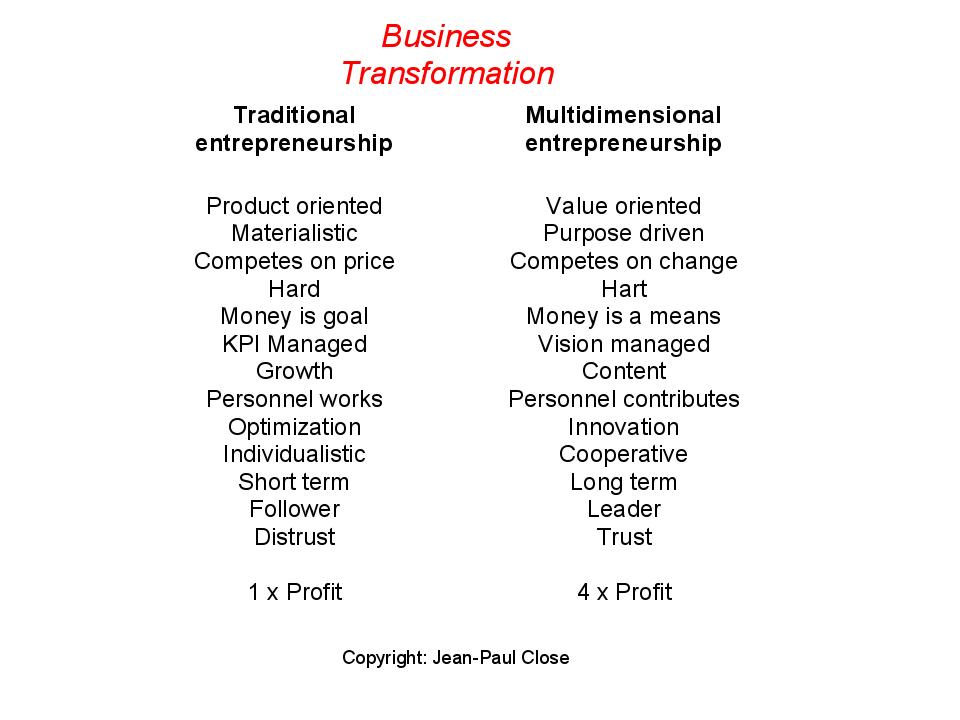
The difference between traditional and multidimensional entrepreneurship is business spirituality
 Sustainocracy, the new democracy