Home » Posts tagged 'empowerment'
Tag Archives: empowerment

Uganda refugee camp reviews sustainocracy
The review was made in his own words by Jonathan Ngangura, young leader, community builder and entrepreneur in Nakivale, Uganda.
Sustainocracy: A Model for Empowering Refugee Communities in Uganda
Sustainocracy, with its emphasis on ecological integrity, social equity, and economic sustainability, offers a compelling framework for improving the lives of refugees in Uganda. While challenges abound, the principles of sustainocracy can be adapted to empower refugee communities, enhance their resilience, and foster long-term well-being.
Key Impacts:
- Enhanced Food Security:
- Community Gardens: Sustainocracy encourages community-led initiatives like organic gardens, which can significantly improve food security, reduce reliance on external aid, and promote healthy eating habits.
- Sustainable Agriculture: Exploring techniques like permaculture and agroforestry can enhance food production while minimizing environmental impact.
- Improved Health and Sanitation:
- Access to Clean Water: Implementing sustainable water management systems, such as rainwater harvesting and improved sanitation facilities, can significantly improve public health.
- Renewable Energy: Access to renewable energy sources like solar power can improve access to lighting, cooking, and refrigeration, enhancing living conditions and reducing reliance on polluting fuels.
- Empowerment and Self-Reliance:
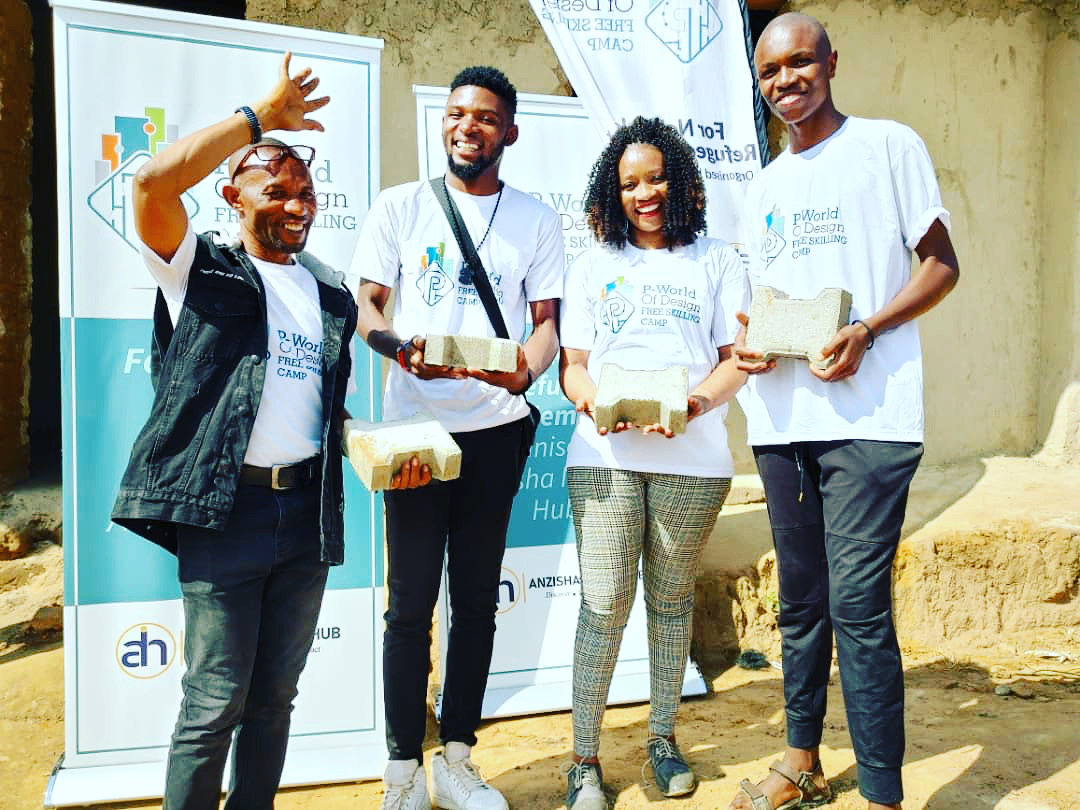
- Skill Development: Sustainocracy emphasizes skill development and vocational training, empowering refugees with the skills necessary for self-employment and sustainable livelihoods.
- Participatory Decision-Making: By involving refugees in decision-making processes related to camp management and service delivery, sustainocracy fosters a sense of ownership and empowers communities to take control of their own destinies.
- Environmental Protection:
- Waste Management: Implementing community-based waste management systems, including composting and recycling programs, can minimize environmental impact and reduce pollution.
- Conservation Efforts: Promoting awareness and engaging refugees in environmental conservation efforts can help protect the natural resources upon which the camp and surrounding communities depend.
Challenges and Considerations:
- Limited Resources: Securing adequate resources for implementing sustainable initiatives within refugee camps can be a significant challenge.
- Security Concerns: Issues like security, protection, and the potential for conflict can hinder the development of stable and sustainable communities.
- External Dependency: Over-reliance on external aid can hinder the development of self-reliance and community-led solutions.
Moving Forward:
Despite these challenges, the principles of sustainocracy offer a valuable framework for improving the lives of refugees in Uganda. By fostering community ownership, promoting environmental sustainability, and empowering refugees to take control of their own destinies, we can create more just and resilient communities within refugee settings.
Key Recommendations:
- Invest in Community-Led Initiatives: Prioritize funding and support for refugee-led initiatives, such as community gardens and renewable energy projects.
- Promote Skill Development: Expand access to vocational training programs and support refugee-owned businesses.
- Strengthen Participatory Governance: Increase refugee participation in decision-making processes related to camp management and service delivery.
- Address Environmental Concerns: Implement comprehensive waste management systems and promote environmental awareness within refugee communities.
By embracing the principles of sustainocracy, we can create a more just and equitable future for refugees in Uganda, empowering them to build resilient and sustainable communities.
Our current global mental health problems are caused by our forced addiction to money
In an overarching reality fully focused on money (financial growth), we get deprived of morality and unconsciously develop mental disorders at all levels of society. Nearly all our current global challenges can be attributed to that. Disconnecting from the financial doctrine, embracing the morality of our sustainable existence as a natural species in our natural Earth habitat, gives us again a sense of meaning and purpose. It empowers us mentally, healing old problems while developing a sustainable future together. But we need to make the disconnecting choice. The experiences, with the introduction of an alternative coined as Sustainocracy, have provided useful insights with very promising results. They were published in the global Journal of Mental Disorders (article to be released soon, available upon request).
When my article on “breaking with our heritage” was published, through the University of Urbino in Italy and the Euro-Spes community on business and spirituality, I was invited by the Journal of Mental Health Disorders to reflect on such mental turning points through their global magazine.

A mental turning point was experienced when I decided to break away from the doctrines of the financial world in order to develop certain ethical considerations that were important to me. The benefit of such breaking is that one develops a new reality, getting to compare both, the finance driven doctrine and the one based on ethical values, also from a mental empowerment point of view. The analysis remains very subjective when only related to me, a potential outcast of a mainstream functioning of society. It becomes more objective when relating it to other mental and behavioral breaking points experienced by more people, even by entire regions, such as the city of Eindhoven.
Equally I could relate to the reaction of people and institutions when invited to join the activities of the human centered “Sustainocracy”, an environment based on my own moral awareness about existential human values. For instance to develop the “healthy city” together. Especially the activities of COS3i for social inclusion became a Box of Pandora with many people carrying different kinds of old traumas. These had mostly been inflicted by the impact of a single approach to reality through doctrines (such as money or religion). Presenting people with an alternative, a second choice based on human values, gave many a mental boost. It equally showed the negative impact on mental health when people get disconnected from morality. It undermines their identity, their behavior, their wellness, while developing mental and behavioral disorders that can range from psychoses, burn-out, behavioral tunnel visions, competitive aggression up to deeply rooted narcissism.
This does not only affect people in a situation of financial disadvantage but also those that develop well in the financial competitive hierarchies. Presenting people again with morality breaks with the limiting tunnel visions, enhancing their well being with meaning and purpose. This happens in a job, in leadership positions and also in people’s private life. When they feel meaning and purpose again they equally feel the possibility to give their old trauma’s a place in their past. They develop their own breaking point and empowerment.
Only when an alternative, such as the approach of Sustainocracy, is introduced as an healing injection of morality, the old mental disorders become apparent. Before they were nasty handicaps, problems for society. They justified the appearance of all kinds of care institutions that function within the same overarching doctrine. These normally don’t solve the problem, they suppress them or try to get people to deal with them through denial or minimization. The mental disorders also develop into political and financial hierarchical clusters, deprived of morality and with biased self interest as their only motivation. The people involved don’t see themselves as mentally disturbed because of the lack of a moral counterweight. This explains why we have arrived at a global situation referred to as the “Anthropocene” or “the human being as the 6th cause of destruction of life on Earth since its existence”. These indicators already allude to the collective mental disturbance that leads to self destruction. It reminds of my article “How stupid can smart be“, reflecting about the denomination of the region of Eindhoven as “the smartest of the world”. How smart is a region when it pollutes itself out of financial self interests, causing severe physical and mental disorders among its citizens? Is smartness only measured in financial terms or patents? Or in our capacity to sustain our species in a healthy, mature and progressive way? With Sustainocracy we decided for the latter.
We all have a choice. We only have to make use of it and reap the benefits. The invitation to develop it will always remain, with or without our help.
Mental health empowerment
At the request of the global magazine “Mental health” I wrote a scientific article about this. This is based on another article of mine about the phenomenon of a mental “breaking point” or a change in thinking and acting that is motivated by moral meaning. This means that someone questions his or her own behavior, often pushed by the imposed norms of society or old personal ways of thinking (traditions, trauma), and decides to completely change course. A special side effect is that mental health is given a strong boost through meaning and a strong commitment to the moral values on which decision-making is based. In my case, this became the basis for the emergence of Sustainocracy as an evolutionary proposition for human societies. Over time, I came into contact with many people who walked with me on this path of Sustainocracy for some time. They often carried a mental backpack of old traumas, negative self-image, fears, insecurities, etc. that all in one way or another arose from the current money-driven and strongly hierarchical society. Due to the lack of an alternative, these people continued to have mental health problems. When they came into contact with Sustainocracy and the associated human values, a new perspective emerged, a form of meaning that contributed to a form of healing and empowerment for all kinds of people. This was often still hampered by the pressure of the system authorities and associated expectations, but the relativism had planted the seeds.
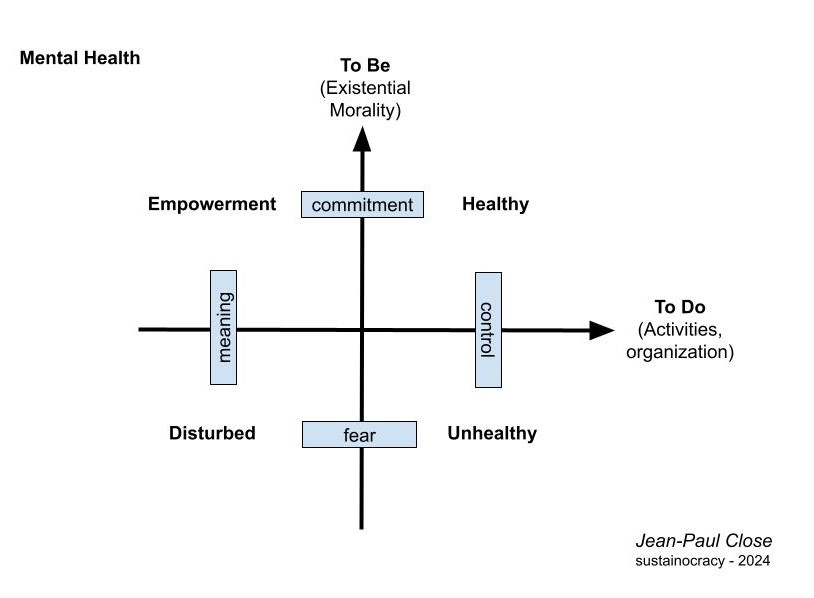
The current uni-dimensional money-driven society is structurally unhealthy and produces mental ill health as can be seen in the culture of fear that is also fueled by the polarization of political parties. The entire financial political structure is located in the unhealthy, immoral quadrant of the drawing. This is reflected in the many problems in the world that are often caused by this competitive control politics. We are all part of that, partly due to the forced dependency imposed by the system. My own personal turning point brought me to the point of commitment to human values. At that time I had no idea of the impact of this on the mental health of me and my environment in general. This is because I first had to let go of forms of unhealthy control and fears. I was able to do this with confidence because of the meaning that had invaded me. In all the activities that I subsequently developed, healthy, warm interpersonal ties were created, also with people in hierarchical positions of all kinds of companies and institutions, including governments. The shared commitment to, for example, the “healthy city” approach in Eindhoven and the surrounding area provided a healthy mental dose of meaning, creativity, mutual connections and goal-oriented motivation. These are all building blocks for mental health, in contrast to fear, uncertainty, competition, hatred, judgment, jealousy, etc. that are caused by our one-sided social management based on money, dependency, performance, political interests, competition, inequalities, control, meaningless growth (with many negative impacts), etc. We are often unaware of the mental ill-health that this form of society causes because we are completely mentally absorbed in the activities (work, consumption, entertainment) that are expected of us or have become part of our blind comforts. We often feel the symptoms of mental disturbance and unrest but do not make conscious connections because of the culture in which we live. We only notice the real difference when we let go of this, experience the turning point ourselves and let the meaning do its work. With Sustainocracy everyone has a choice. But the choice has a price. That price is not expressed in money but in letting go of control and fear, and embracing human values and cooperation. Mental health is a result.
 Sustainocracy, the new democracy