Home » Posts tagged 'global shift' (Page 3)
Tag Archives: global shift
Pioneers of a new world
Introduction
This has become a long blog again. I introduce a solution for all humanitarian problems in the world and all related crisis. It requires a lot of explanation because it involves all current institutional powers in a new setting. And finally comes back to the power of our individual selves. Soon I will publish a booklet on the issue but my sense of urgency is so big that I cannot wait to reach out to those of you who can become already changers of the world after reading this. For humankind it could be the most important blog ever as long as I can reach out to you soul and make you aware. Please take some time to absorb the information and place your own self in perspective. See what happens when you suddenly realize that humankind could get to depend on your own next steps. It is fun AND a huge responsibility. Can you handle it? That is up to you. I am ready to help you when you are.
The destructive force of our institutions
Over the years we have grown dependent on institutional activities because of the impact they have on our lives. The unique capacity of an institution is that it can enlarge a single activity into huge proportions. A single human being cannot do that. We have grown to depend on the institutions because they provide us luxury articles, financial means, governance, jobs with related salaries, scientific knowledge, etc.
Most current institutional structures of today were born already some 150 to 100 years. The conditions in the human world were right back then to allow such fragmented focus to occur with the related growth of institutionalized power. Still now the discussions in this world only talk about growth and more growth as a single sign of strength. Due to this fragmented focus these organizations can only take responsibility for their own small field of highly specialized attention. They started to relate via this specialization to compliment each other in their objectives. A manufacturing company in the 19th century would have its own transportation system, energy supply, uniform making unit for their personnel, etc. But gradually in the 20th century the further specialization allowed institutions to focus on their core business and select suppliers to outsource their surrounding needs. In the middle of the 20th century the patchwork of specialized institutions because so large and so competitive in their mutual interaction that a chain of dependencies appeared and with it new techniques of managing the chain.
Due to the focus on fragmented institutionalized interests the awareness for “the whole” disappeared entirely. Things like pollution, usage of natural resources or humanitarian issues became subject to competitive policies. Institutional survival became more important than the consequences of such survival decisions. Non of these consequences could be challenged by any single authority. What authority should do that? A local government has no global authority to regulate. Yet they do have a dependence for economic growth, imports and exports as well as labor and tax perspectives. Global authorities on the other hand have no formal jurisdiction in the countries or in the institutionalized business enterprises and banking policies. They may have a bureaucratic influence on awareness (like VN resolutions) and certain fragmented authority on addressing common institutionalized interests (like military actions in Afghanistan or embargos on certain countries).
As fragmentation of power grows further, the chain of interdependence becomes more complex. Despite the competitive fragmentation and specialization each individually could grow due to globalization of markets. The competitive shakes outs would start the intense optimization processes in each of the institutions to remain competitive and attractive in the chain. As time went by we see each of them weaken in quality and strengthen in financial speculation. CEO’s and Country presidents became bankers and debt managers rather than protectors of value driven identities.
The overall shortage of resources started to demand its toll on the global organization of giants that could not feed themselves anymore on natural value creation. The liberalization of money from a valuable collateral (s.a. gold) allowed speculation to flourish as only remaining resource to sustain institutional fragmentation and growth. Access to the available resources became available to the highest bidder. Countries who wanted their populations to survive while active with some labor and high debt programs had to grow their debt themselves. The growth of institutions is still the blind common culture of executives and politicians but growth is already for a long time not possible anymore. Not as a natural process of value creation anyway. The only financial growth that can be achieved is through speculation around shortages but this is controlled only by the powerful and has nothing to do with the general public anymore. They are just manipulated to accept a debt they did not ask for and that solves nothing. Humanity is in the hands now of institutionalized, destructive, fragmentary focused financial robots that have no morality nor sense of responsibility except their own self interests, creating crisis after crisis, chaos upon chaos.
The pioneer
Now we go back to the beginning of this blog. The true power of an institution is its possibility to enlarge any fragmented specialization to huge proportions. Their handicap is that they cannot take responsibility other than for their own piece of specialized power. That goes for regional governments, business enterprises, educational institutions, etc, etc. None can take responsibility for true human values yet they all have interest in it because they are part of the institutional survival. Without consuming, demanding, debt creating, voting or working public the institutions will eventually die.
So in one way or another any institution has the intrinsic need to connect again to integral human values but cannot do that for the whole, just for a small part of it, competing for it. So when we talk about the taking of responsibility for human sustainable progress no one can or will stand up to take responsibility other than maybe some local politicians. They tend to promise responsibility that they cannot handle because it s beyond their control. They try to solve it in four year periods which many do not complete, by raising taxes and public debt with solving anything.
Only one can take responsibility and that is the pioneer. It seems funny that with all those incredibly big and seemingly powerful institutions the sole responsibility of human progress could lie in the hands of a bunch of pioneers. But it is true and makes perfect sense.
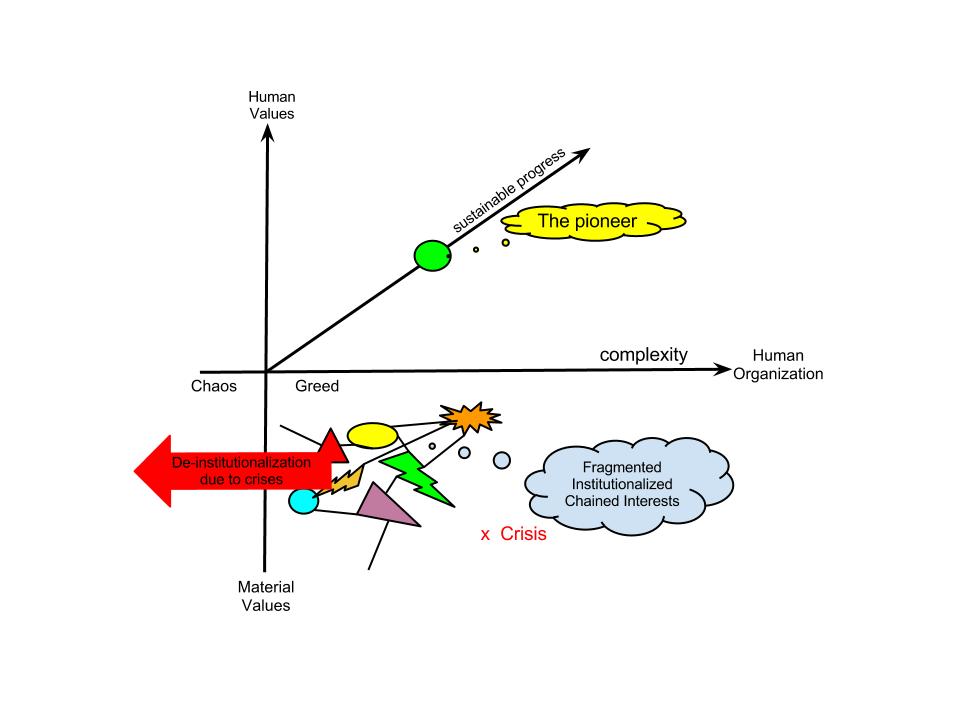
The pioneer positions him/her self in the field of sustainable human values and progress
The robotic institutions can be our enemy when we see their unconscious destructive force while preserving their self interest in their fragmented world of material power, but they can become our friends when we can get to use their institutional powers of expansion in a proper way.
Thanks to the de-institutionalizing powers of a crisis, in which the organizations need to go into survival mode, decreasing in size due to the lack of resources to draw from, they become also often sensitive for new ventures and responsibilities in which their field of expertise can excel. This is an opportunity for the pioneer but also for the institutions. How does it work?
The pioneer takes responsibility for a complex humanitarian progressive proposition. He or she subsequently invites all necessary institutional powers to help enlarge it.
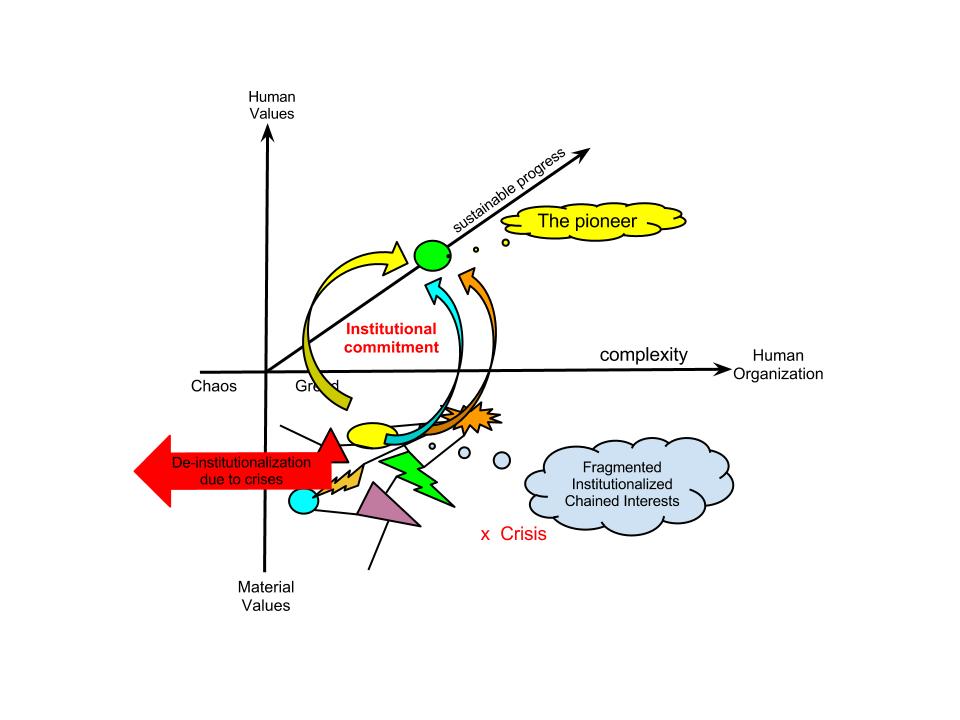
Institutional powers can be used to enlarge humanitarian interests
The role of the pioneer is to define complex progression based on human values. When inviting the institutional powers to join the pioneer they are asked to enhance the responsibility with their own institutional powers. To make a holistic proposition of human values one cannot just rely on a single empowering institution. If that were the case the institution would have done this already by itself. The complexity of the whole is that it needs the entire mix of authorities of a society to become effective, with the pioneer sitting bang in the middle.
Sustainocracy
In sustainocracy the pioneer takes the lead and invites the four key authorities that are needed to expand the human values into common wellness and progress:
- Local government
- Technological innovators
- Educators & scientific researchers
- The local public itself
Drawing all these authorities from the field of fragmented interests, they unite in the field of common responsibilities together with the pioneer. Seemingly contradicting interests suddenly start complementing each other as the focus lies on progressive goals outside the scope of self interest. The self interest can be complied with only if the common interest is achieved. This forces the authorities to enter into co-creative processes by trying to understand each other and join forces. The pivot is the pioneer who safeguards the humanitarian interests in a battle field of institutional giants.
In the Netherlands I have started experimenting with this pioneership. It resulted into a series of initiatives that are proving their value from a humanitarian perspective but also the institutional positioning into a new world. Each of the authorities has a chance to excel in its own field of competence, not by competing or creating interdependence but by combining the individual competences into a common goal. Since executives and personnel in such institutions are human beings too we find that the sensitivity of the hard material robotics become more soft to address human wealth issues through new types of policy makings.
The institutions change slowly into supportive and facilitating identities that gather new public admiration. They truly become extenders of human progress to which they attached their fragmented by highly specialized competences with new perspectives of survival first but institutional sustainability in the long term. The field of chaos can now be managed with the perspective of an institutional alternative, not just to create value but to contribute to a greater cause, enhancing it and expanding it.
Training school
To extend these finding globally I have started a training school for sustainocracy, training pioneers as well as institutional executives on their new age responsibilities and challenges when entering the field of sustainable progress and all related differences with the old paradigm.
http://www.eventbrite.com/myevent?eid=3558815513
Pass the word and help change the world.
-Belief- is essential for progress
Why don’t politicians support the transformation of society? Why do banks not change their bonus culture? Why do people go to church when they encounter a crisis?
When I try to get overall scientific, business, political or financial support for the transformation of human society into a state of sustainable progress (referred to as the Global Shift) I do not get it. Why? All the crises in the Western world seem to cry out for change yet people only focus to get more of the same. New economies develop based on those that are now in crisis hence knowingly develop their own problems. Why? Why are all these human structures so reluctant to change and destined to repeat their mistakes over and over again? Because all these institutions are not based on “belief”.
It is necessary to be a believer to open up for new realities and hence accept and even conduct progress through the acceptance of change. To understand what I am saying we need to first define “belief”. According Wikipedia belief is:
“Belief is the psychological state in which an individual holds a proposition or premise to be true.”
This definition refers to a “psychological state”, not a proven truth, hence it is subjective to the individual. What do you believe that is true? Proven truth or suspected truth? We tend to accept only what is touchable or commonly accepted as truth. A believer tends to visualize a truth that does not exist yet in the physical or proven world. All our current human surroundings are organized in complex human structures, institutions. These are known, hence true. Anything else, that is not yet included in the human organizational structures is hence unknown and does therefor not exist.
Or it exists when you believe it exists, or could get to exist. True believers open up to things that do not exist yet in our regular life. Everyone who has a hired position inside an institution can only sustain what is known and stops believing. If one would believe he/she would probably question what is served. The only option such people, even so called world leaders, have is to keep in place what has been organized, because it is known. Even when it is in crisis. If they are visionary and see the problems they cause by keeping up the unsustainable they would have to step out of the system to change it. But then they loose their position of power.
From an operational point of view this is logical simply because every human institution is a structure with a particular purpose. It would only change if the purpose of the structure would change or when it goes broke. If those institutions are as significance as a political organization, a financial system of power or a business monopoly, everything will be done to avoid its collapse, not by changing it but by maintaining it, no matter what.
One could expect that common sense would prevail when we see the suffering of so many people caused by this lack of flexibility. But common sense is only based on the same knowledge that is commonly accepted as truth, hence within the same dynamics as where the problems occur.
Science does not help
If we look at the definition of belief why would science then not be a believer? Doesn’t science believe in its own studies to obtain progress in knowledge? Of course it does and that is also the essence of the difference. Science is a non-believer because it looks for proof through commonly, already accepted knowledge. Science does not want to “belief”, it wants to “know”. This interesting paradox of science is that it is continuously searching for knowledge so needs to accept belief to understand that it still has a long way to go to accumulate all knowledge. We still do not know everything. This automatically means that science needs to accept that new knowledge can dispute any old knowledge. We can therefore know for sure that all knowledge is only believed to be true until is proven not to. A crisis is not enough to prove something wrong. Only something different would prove something else to be more truthful. The problem we face is that science does not easily accept this scientific belief. It claims the truth by accepting proof and then holds on to it. If you do so you block yourself from the possibility that what was proven true can also be proven untrue in time. So science accepts the state of belief to motivate the search for knowledge through guided research but does not accept belief to question knowledge that has been accepted as truthful. Science therefor tends to try to prove the known and tends to avoid the unknown. In the process of providing proof to the known we stumble across new knowledge to be proven. Science seems only to advance by further analyzing the known. It is fixed to a particular track. This means that in essence science is not a believer, just a proof provider to perceived knowledge.
So for change we cannot rely on science and hence find that universities only teach science but not belief or the potential of change. They can’t, even if intellectuals inside the university suspect new tracks of knowledge they find difficulties in their institutions to support deviation to the unknown. Universities depend on the resources provided by the structures that do not belief and hence serve the known, not the unknown. Only a very small part of research funds are invested in finding new realities and these even need to be covered up by arguments that the common structures can understand and support.
The world of statistics
Business and politics do not even worry about belief. They reason from the influence of the masses of people either by exerting power on them or by offering external securities in the shape of goods. There is only one certainty and that is the one of proven support in the shape of votes. In essence any purchase is a commercial vote too. From that point of view all of the world of politics and business is measurable and conducted through statistics rather than belief. The statistics are translated into a standardized system of values, often called money. Financial systems manage money and hence manage statistics, nothing else. By speculating with shortages the statistics move and become measurable instruments of economies that live eventually a virtual life on its own without considering the human being or our natural universe itself. In fact, the way statistics move through artificial intervention of politicians and business people have created a simulated reality that interacts with our true reality and is even perceived to be real through the importance we give to money and material valuable. But it is all fake, even the poverty we see around us is fake simply because the statistics of our robotized systems do not allow people to create a new, self sufficient reality.
Belief means acceptance of change
None of the above provides any true progress because it is all based on commonly accepted truth and knowledge, but no belief in alternatives, simply because they do exist yet. That is why the quantum leap of human evolution will surprise us as it comes. When it happens it will extensively be studied by scientists and even open up new channels of knowledge development, just like financial analysts now know why the credit crisis occurred but back then never saw it coming.
Becoming a believer
People in a state of crisis experience the lack of support of the commonly accepted truth of the obsolete systems but cannot embrace change yet because it does not exist yet. They experience a crisis because securities are falling apart and are not replaced by new ones. They are challenged to think for themselves and accept change by stepping out of the structures in crisis and start deciding for themselves. Since this is extremely difficult for individuals who have taken the old truth for granted they tend to go to church and ask for a miracle. In reality people ask the universe to react by creating a renewal of the universal truth. They ask God but in fact they ask themselves to accept change. We are so used to external securities that we have learned to distrust our selves. People in search for spirituality are opening up for renewal of their faith in humankind and especially in themselves. They experience suddenly the warmth of friendship and social support, self leadership and significance. They become believers, not just in God, but especially in themselves.
I can describe the Global Shift, the transformation of humankind, and find opposition from all common human structures. If it does not exist it is not true. People fight collapse of existing systems simply because they do not have “belief” in letting go. The old systems are known, scientifically analysed and hence true. The new systems are in the world of beliefs without and proof of truth and hence without any guarantee for security. That is also why true progress is made by people who are only considered a genius when reality changes, proving them right in hindsight. Meanwhile they are always seen as a risk to the established truth and crazy, weird or clowns, despised by the systems and laughed at by the masses.
But only believers are truly progressive. They are prepared to see the invisible, to accept that truth is relative to our common acceptance but not at all reliable. Believers accept that other realities exist and set out to find them. They accept to be despised by the masses and ridiculed by the knowledgeable realizing that all those who react that way are locked up in their own prison of disbelief and a reality conditioned by their own limitations.
Even religious believers tend to create dogma’s around the unknown to enable to speak in name of God by creating limitations proper to the human world of “knowledge” rather than abundance of the miracle of the Universe and our adventure as a true believer in progress. If we belief in God we should accept the unknown as our evolutionary challenge to progress and science as simplified form of registering perceived truths until they prove wrong or reconfirmed. We are getting to a point that sustainable progress does not accept anymore virtual statistics as a reality nor scientific proof as absolute truth of knowledge.
Soon we enter an era (the quantum leap) where we accept the unknown as the only constant for our progress. The amount of crisis of the world of knowledge and statistics will be so big that the world will turn around believers who show a new reality, the reality of a humankind based on spirituality, on the belief in our evolutionary quest and eternity. Science will not be proof anymore of knowledge but a reflection of our progress by accepting the stepping up of our adventure by challenging knowledge against the unknown.
When we do that business, finance and politics will cease to exist because they will not be necessary anymore as fragmented human institutions. They will transform into key area of responsibility and related competences that interact to provide sustainable progress by addressing the unknown on a continuous basis. When that has happened we will refer to this a the quantum leap and even give it a scientific understanding leaving it in out past as a significant moment in time when humankind opened up to its own universal destiny.
Sustainable progress is hence assured by believers.
How the Content Economy affects you
The very basic, key requirement in a content economy is that every individual human participant becomes self-aware, self-conscious of sustainable progress and self-sufficient through auto-determination, self-leadership and independence from centralized structures.
That is a lot of responsibility for a single person! How can you cope with self-sufficiency when the entire world seems to be attached to the strings of centralized controls? If you cut those strings where would you live? Get your food? Your water or energy supplies? Health care? Clothing? How would you get rid of your waste or move from A to B?
The transformation from a growth economy of centralized dependencies to a content economy of self-sufficiency in sustainable progress is not just a simple ideological decision, it is a personal commitment to turn your entire life upside down.
Even on the individual level such new type of society would require a structural renewal of the way you address your life on a daily basis. It would take various years of learning new skills and integrating them into your existence in such a way that you get again a feeling of abundance. The learning period will be tough because your self sufficiency would not produce enough yet for you to adequately survive. You are forced to work together with others who are in a similar process.
In essence we see the following happening on the individual level but also in business, local government and institutions. The whole thing boils down again into four phases:
1. Acceptance of the new paradigm: This element is key to understand and commit to the process you go through and find the motivation to endure the tough transition period.
2. Personal leadership: Someone only decides to depart from situation A towards a new situation B if the latter provides better perspectives than the first. For may it is a tough decision to make, requiring reassurance through a growing awareness and consciousness as the local, personal or global crises clarify the ideas. Once the decision has been taken you are ready to address to future with determination keeping that desired new situation in mind during the entire process.
3. New professional skills: gradually you will find what skills are required to address your new challenges. We all have many skills already and today, with the usage of internet we have access to a large diversity of knowledge without having to move from our chair. Applying new skills to produce abundance will totally depend on the environment in which you develop your independence. Nowadays technology is very much advanced to produce abundance in nearly any environment on the planet and beyond. It is up to our creativity and adaptability to implement it for our benefit. Some may argue that access to technology costs money and indeed this may be true in the transition phase. But when we look at the abundance of tools that have grown obsolete in the last few decades, or even now due to the crises, we have plenty to pick from at nearly no other costs than that what we need to get the materials to us. Creativity, wit and guts is much more valuable than the tooling that is lying around us unused.
4. Purpose driven cooperation: when we consider true abundance, with the use of modern technology and our own talents and energy we can and maybe need to work together with our neighbors. For certain requirements we need a certain productivity scale to be auto-sufficient. Combining these interests with those who face the same problem will add up 1+1 and make 3.
Such cooperation is even possible on a larger urban scale involving self aware institutions and governance. Dealing with result driven self sufficiency through applied technology one may find the need to involve such institutions even if they still operate in the old paradigm. Consider the challenge of people living in dense urban city environments. How would they be able to cope with content economy if the only way to access food production is by applying the most modern views on urban vertical and spatial agriculture. And even such fragmented self sufficiency would necessarily be combined with innovative usage of water, waste management cycles, energy production and usage.
Such techniques would become multi-disciplinary and multi-functional requiring the cooperative participation of people with a large diversity of skills. Over 50% of the global human population now concentrate their lives in dense urban environments due to the effects of hundreds of years of economic based paradigm. And this amount is only growing. Even if we wanted we could not turn this clock back fast. So a very intense local small scale urban cooperation will need to develop rapidly to create sufficient output to provide the participating people with a minimum amount of life support in the transition phase to avoid an exodus into the country side or total urban anarchy.
It is a totally new area of development that is still in its teens from an expertise point of view but key for the survival of massive amounts of people who have nothing else than their 26th floor, 80 m2 apartment to deal with when the old paradigm collapses further. The current centralized power positions around food, water, energy and other basic supplies have fragmented the local available productivity into single massive product production lines for global distribution. The diversity of products surrounding the cities is extremely limited and scarce, in such a way that it would never be able to help the starving city population in case of disaster. Sufficient local diversity for self sufficiency would take decades of focused transformation to develop. Eg. With the current footprint the nearly 17 million people counting population of Holland would need a territory of 20 stories to supplies its needs. This is of course impossible so we have two options: reduce drastically our consumptive life styles while trying to use space as well as possible or allow the unthinkable the reduction of the population to sustainable levels by allowing them to perish or move to other places….A reversed migration away from the cities would create such devastation in the encounter of the travelling masses that it would represent a human disaster of unknown precedence. The best option we truly have today, while the old paradigm is still holding up, is to do our best to implement the content economy where ever we can right now, taking individual responsibility while we can, having access to resources and knowledge without yet the stress of surrounding chaos.
Right now the STIR Foundation has already started to work with small scale local new cooperative initiatives to at least create sufficient experience in working with new result driven models based on equality and competences, rather than hierarchy and speculation. Many of the human interests cannot be addressed comfortably in this way because they are still trapped in the economized hierarchies. These old power positions will try to milk their cash cows as long as they can before they fall over, even if this finally means that the transformation will come too late or at the expense of huge sacrifice.
All that people like you and me can do today is to accept the fact that we need to take responsibility sooner or later. The sooner we take our first steps at picking up the right skills, establishing the network of contact for early experiments, the better it is. I personally did and know now how painfully difficult it is. By keeping our initiatives low key or outside the reigning systems we remain at a safe distance to experiment at will. When the openings come due to the recessions and massive crisis we can try to expand expertise fast like fractals. Via twitter, blogs, social media we can share experiences in an open way and stimulate more and more people to start developing their own initiatives and join the movement.
Meanwhile remember the psychology of change that affects most people. For some time to come the largest part of the population will laugh at you while you are at it while the systems will try to do what they can to stop you, uphold themselves at the expense of everything or get you back into the old systems through tricks backed by the reigning laws. That’s the name of the game. At the end the content economy will of course affect you positively and provide you and the surroundings with sustainable progress. But before that it is the process of letting go and diving into the in depth transformation that produces all the pain and challenges. It is up to you if you want to take the leap or wait if the whole thing solves itself.
 Sustainocracy, the new democracy