Home » Posts tagged 'government'
Tag Archives: government
Open Access Government magazine Januari edition
This peer reviewed online magazine contains a huge amount of interesting articles within a large range of topics. I was invited to participate with Sustainocracy. The pages 374 – 375 are dedicated to this for anyone interested. But by all means have also a look at all the other contributions that provide significant inspiration for a wide audience.
Article about Sustainocracy:
Gaining power by releasing it
When I started my consultancy group of self employed coaches, and later my STIR foundation that creates purpose driven cooperatives, I came across this interesting human phenomenum: the process of letting go leadership to gain true leadership.
It all started when I wanted “to change the world” and realized that I could not do this all by myself. I defined certain objectives that needed the co-creative input of different people and even institutions. Keeping things only to myself was risky. If something would happen to me my world changing plans and the instruments that I had developed would soon be forgotten. I decided to do two things:
- I made all my instruments, models and views freely available to anyone who would want to use it. The 5K method for 21st century entrepreneurship, UNITED for effective teamwork, the pyramid paradigm for institutional positioning, the model of Human Complexities, MultiDimensional Entrepreneurship, the Index, etc and finally the new model for society: Sustainocracy. If people had open access to my toolbox they would use it and contribute to the world change, also without my involvement. By letting go of my control I could gain much more than by keeping it all to myself.
- I invited people to work together with me on the basis of equality. Since I was the source of the toolbox I had a better understanding of how we could use it. This knowhow I could pass on to partners in the process of addressing the world’s transformation. This would cost me time and I asked the people who joined to also count me in a little bit when I helped them towards successes.
We started to form groups around my initiatives. My idea was to empower people with all my tools and help them to become successful. To my surprise this did not happen. On the contrary. People who joined me kept looking at me for instructions. When I organized meetings to create team spirit and develop a group attitude I would sit in front of the group and everyone in the group would be looking at me. Every member of the group would ask me for permission to speak or act and try to find a justification of action through my approval.
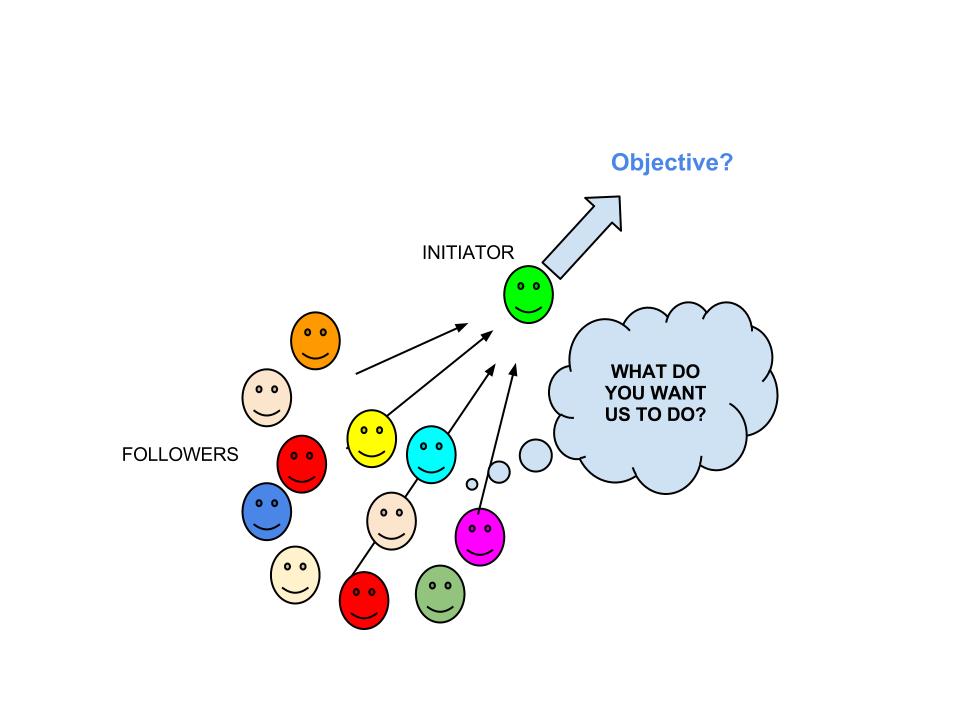
- The initiator is seen as “owner” of the objective he/she defined
How could I get the people to stand up and take responsibility by themselves? It had never been my intention to create a hierarchy but it simply occurred by de facto, even with self-employed people from whom you would expect a degree of entrepreneurship. In the group they acted like sheep in a herd, without the need to think, trusting the sheppard that he would lead the pack to green fields. It was a bit like asking the football trainer if he already had the world cup in his hands for the team even before starting the very first training.
My consultancy group eventually fell apart, teaching me important lessons.
- Even though I defined world change in a consultancy method of my own the partners that joined me saw the innovation as a new way of accessing a financial market for themselves.
- The purpose of my innovative method still belonged to me, even when giving away my tools. The partners recognized themselves in parts of the execution and expected me to do the convincing of the market of accepting the methods and purpose.
- None would take group responsibility. They considered their own relationships of their own and my relationships of the group. Group interest was combined with self interest, not the other way around. They had come just “to take” not “to bring”.
So when I started the STIR foundation I needed to put this learning curve into practice again.
At first I tried to get others to take initiative, allowing them to show leadership, and I would help them. I had attributed the falling apart of my consultancy group to the fact that leadership and toolbox were in the same person. So if I stepped aside as a leader I could provide more and more people with my tools and help them forward. This did not work either. People would stand up to take on a leadership role, even shared the idea of value driven objectives, but when a glimps of success started to appear the loyality to me and the paradigm shift would disappear. They would fall back into a money driven venture with a large degree of selfishness at the expense of the relationship with the foundation. This is fine of course when the venture contributes to change. It certainly was not my objective to keep some control over everything. The problem was that when the fundaments of an initiative were shaken by greed the initiative would rapidly fall apart, damaging the hard work that had been put in and delivering no reciprocity to anyone. This tought me another lesson:
- I had to take responsibility for the purpose and the executionm but in a different way
- I had to find a way that people would commit with me in taking co-responsibility too for the purpose
- I had to find a way that people put in effort, create value and share in the value created by defining it themselves
- In fact I had to become a leader without leadership
When you really want the team to grow and the purpose of the venture is right it is best leadership practice to step back into the pack or outside it all together. By doing so the group of followers become self-leaders again. If they believe in the objective they will go for it. If the objective is complex enough they may even work together.
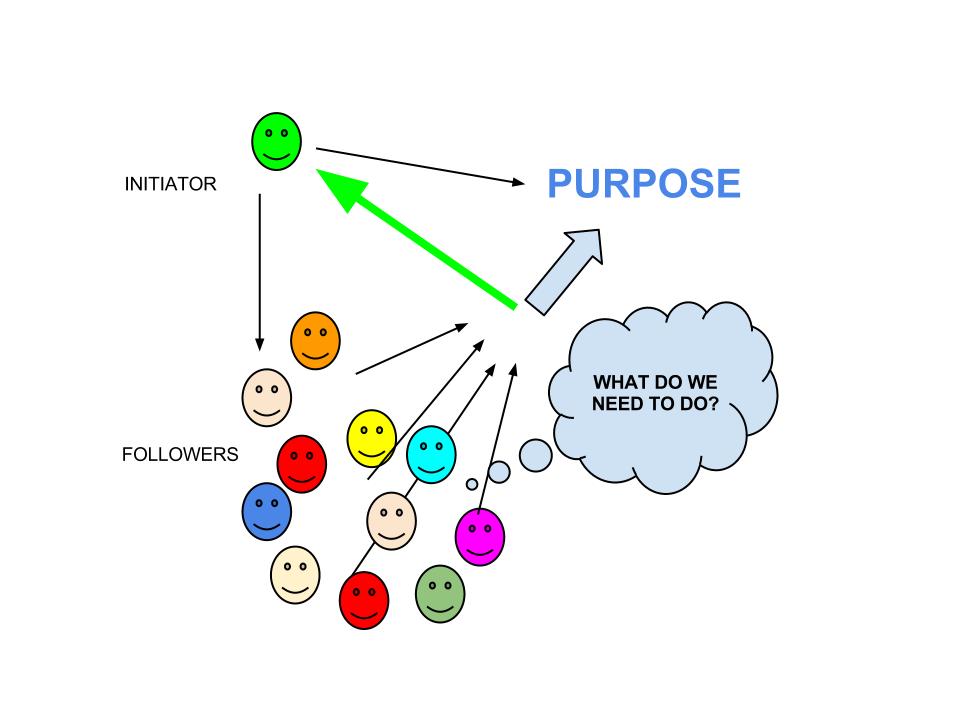
When the initiator steps aside the pack is eye in eye with the purpose themselves
By stepping into the pack the initiator of the process shows respect for equality of all the talents in the group and allows the group to define the processes themselves. Someone who is good at initiation of processes may not at all be that good in managing them with large groups of people. They are different functions.
Secondly, the definition of the objective, the purpose, defines also the profile of the followers and their desire to commit in one way or another. Giving them freedom to determine the outcome together tends to be an excellent way of improving even the expectations. The leader that steps aside and remains looking at it at a side line or steps right into the group with his/her own talents will then gain by seeing the group grow. The purpose needs to be right though, the role of each person involved also and the interest of the group should be well protected. I had discovered that when the group consists of a single discipline trying to work together on a common purpose the group would always struggle:
- A group of business people working together for more money always disagree on the sharing of the benefits
- A group of governments working together want to reduce costs yet increase bureaucracy and become less effective in their territory
- A group of football players that all play left back never wins a competition.
It is not the commonalities that make the group strong. It is the diversity in differences. That is why I defined the new age, multidisciplinary cooperation. It is purpose driven cooperation in which leadership protects the group’s purpose and interests through result driven activities proposed by the group itself. The purpose of the group is not financial, nor of control, yet human and driven by change. The results obtained can have financial consequences for members in a variety of ways yet the essential purpose is always value driven. So when I start such venture I present myself as initiator, never as director or president. The entire purpose of setting the venture up is to step aside and let the members take authority by themselves. It is interesting to see that members are capable of scaling up the expected results to much higher levels than they would have done under a management structure. Like someone once said in one of my initiatives: “Jean-Paul, here I can blow my mind freely and make it come true”.
This in particular is interesting in sustainocracy when also institutions take a seat at the cooperative table. Particularly government can gain power by releasing it.
Government in society
Government in society wants to have a dominant territorial role by establishing economies of growth and establishing rules of conduct. In a monye driven, consumer oriented society government is consequence driven and has no leadership role anymore for the same reasons as mentioned above. People stick with government if they get what they want, else they drop it. In times of a paradigm shift there is no garantee that people get what they want because the old world is in crisis. In order to fake a leadership position politicians tend to do the following things:
- Negate publically that there is a problem
- Promise improvements in the future
- Try to gain a position of elected power to be able to do what they can’t say during the elections.
Their leadership today is not based on any reality anymore but they are very good at making promises that they cannot keep. The lawfull dominance of politicians in a democracy in times of crisis is a type of leadership similar of a capitan that negates that his ship is sinking while his feet are already under water.
The problem a territorial government faces in an open, globalized market is that all people and institution come to take and bring nothing. In order to take they have to pay taxes but these taxes should come from value driven processes. When a crisis occurs the value driven processes on which the taxation was based have become unstable. A government can raise the taxes or reduce the securities that people get. In the Netherlands the government developed into a dominant care taking organization. The community is one that sees the wellness of such care taking as a right and claims it continuously. As a consequence the central government has fallen every 2 years, new political parties stand up claiming that they can do it better and the old dominant parties manipulate to remain in power where no power can be exercised properly. This is not an issue just in Holland, it is a problem all over the world. I call it the power of the powerless because the capitan is running around his ship trying to fix each hole while the sailors and passengers just try to keep their own feet dry or strip the pieces of value of the ship for themselves. Meanwhile the capitan would keep shouting “full steam ahead”, trying to keep up the appearance that everything was alright, meanwhile causing the ship to make more water still.
So when I found out the hard way that I had to take responsibility for my own life, it was not me who was to step aside but the dominant government, pictured as the foolish capitan in the metaphore. I found that I had the democratic right to take responsibility but the government would try to convince me to step back into the pack. My claims that the ship was sinking would be silenced by the political desire to keep up the appearances. Giving the territorial power back to the people was against the reigning paradigm and in a multiple party political system there were many capitans waiting for their chance to run around the sinking ship.
I could not dismiss the entire government as a single person but I could ask government to help me build a solid ship alongside, respecting even the territorial authority of governance. In fact, what I did was to invite people to a purpose that I had defined and that was within the desired situation of governance yet could not be achieved by their own leadership. I was not relating to politics but to the practical reality of providing sustainable human progress in a region. Governance in a day to day activity is not far from the crude reality. Even though the structure is highly bureaucratic and risk avoiding by common nature of fighting a crisis by turning back instead of going forward, operational people inside are often blessed with common sense. They do not see my invitation as an attack on their authority but a way to make proper use of it.
So in Sustainocracy local territorial government was asked to step into the pack by releasing their overall dominance and concentrating on their key responsibility: facilitating progress. They had to let go to receive more authority. After what I had learned in my foundation I could also deal with this process on such a large scale. The purpose became leading, I became the initiator of the process and invited institutions to take full responsibility within their own true powers of control and authority. My own role was that of initiator, connector and protector of interests. My role was also to break through that unjust hierarchy of unproductive control over anarchy. It took some time to make the very first venture happen but when people recognised that releasing power would give them back full authority, the first multidisciplinary cooperation (AiREAS) saw the light. Key in the process is that I always step aside, never asume a leadership role nor establish a new hierarchy. It is the group that puts in all its power and energy to make it happen, not me, making me the leader without leadership, a facilitator of powerful instruments to tool up together for sustainable human progress.

Every one in a sustainocratic venture is empowered with authority by adhering to the purpose without hierarchical dominance
With sustainable human progress as leading factor priorities can be choosen democratically that form multidisciplinary, purpose driven communities that work together on the line of progress. This is most affective when the territory is clearly defined. Multiple ventures can act at the same time in a self steering process of progress. Institutions, people and professionals can interact in different ventures freely as long as they contribute to the purpose driven goal.
The only reason that I had to initiate the process was that no one else could. They all adhere to the old paradigm and cannot start a new one by themselves. They are instrumental to society but society itself is leading. So all I had to do was to ask the instruments to populate my toolbox, represented by the sustainocratic society that I had defined. I defined a new paradigm and allowed powerful instruments to reconnect in a new way. We were all showing leadership by doing so, releasing a piece of control to gain authroity in the new value driven communities. All people felt that they gained in authority by letting go. A true win-win-win…..
We have still a long way to go because in a fragmented, money driven society, most institutions and people hold on to their financial position to remain in control of their dependencies. They block progress by keeping their hierarchies tightly under control. To get them to understand that this is counter productive and eventually gets them into trouble is difficult. Many executives receive bonusses to keep control, not to introduce change. It takes courage to let go in order to receive authority back. As sustainocracy shows its effects by giving th example there where people unite that take the daring step, the rest will follow.
Purpose driven economy
With the kickoff of the first sustainocratic initiative in the city of Eindhoven (the Netherlands) the first step is made to create a “purpose driven economy”. What is the difference with what we have today? And why is it important for the rest of the world to follow the experiment in Eindhoven and, better still, start one of their own?
Current economies
Our current economies are not purpose but consequence driven. The human being is positioned as compulsory consumer. The entire institutionalized society is focused on creating a mountain of wealth around this consumer that gives a sense of abundance at all times. The only way to access this abundance is through financial means. Some of these means are individually obtained through the production, logistics and sales infrastructure necessary to maintain this mountain of abundance. Other get paid out of the hierarchies funded through taxation on this consumer organization. Or through speculation on material resources contained in this “having” type of culture. And finally also debt.
The consequences of such consumer economy show a growing tendency of (negative) influences that need attention through investments. Think of infrastructures, healthcare organizations, police, etc attending the attitude of greed and its effects on the human being, physically and mentally. This also shows an exponential growth which is equally reflected in the world economy through the costs of societies. At the same time we see our environment and human behavior deteriorate fast.
The model of economies of growth purely based on unlimited consumption and the consequences thereof, is obsolete because we use our natural resources wrongly, destroy our environment, sicken ourselves and eventually eliminate our evolutionary chances.
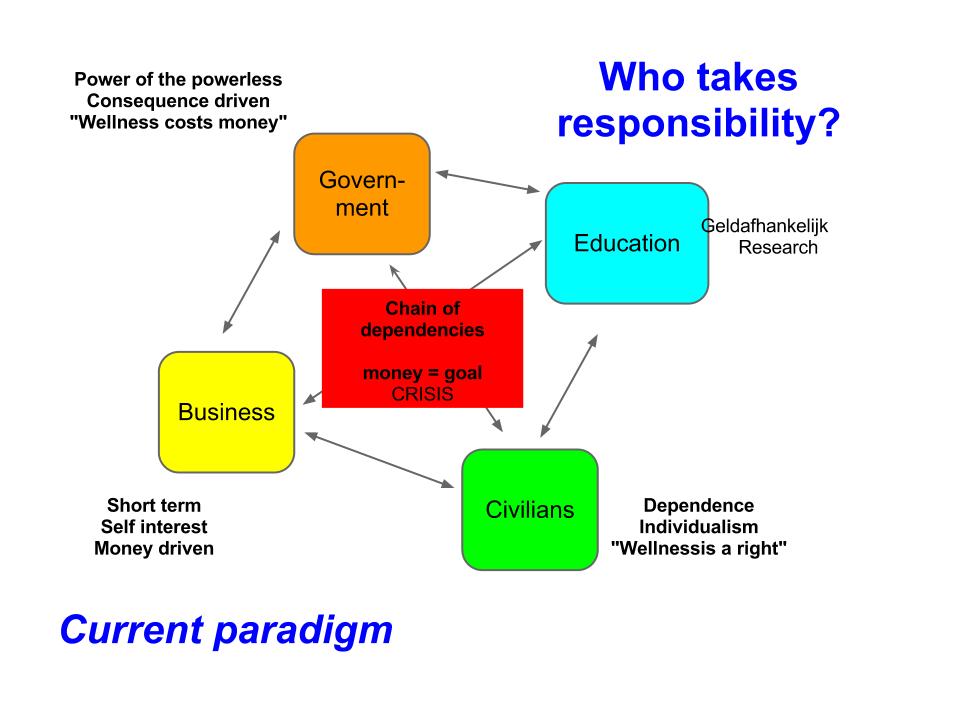
The consumer economy grows while destroying our selves and our habitat
Fragmented complex society
We know this now, including scientific proof, but have difficulties in changing the course of society. We created a very complex mesh of fragmented financial entities with dependencies and interests among each other on which powers and influences are being based. Each institutions has a perceived right to exist and defend its own interests. There is not one single institution that takes full responsibility for sustainable human progress. The institutional mesh is based on fragmented self interest and competition.
Key is the understanding that no institutional specialization can take holistic responsibility for human safety, health or sustainable progress. It is the human being itself that needs to take this responsibility. What went wrong in the consequence driven consumer economy was that the human being delegated its wellness through fragmented institutionalized structures that grew into tremendously inflated organs like an abscess or cancer would do on a sick body. Instead of serving humankind they try to serve themselves. This fragmented type of human organization is institutionally sick with the risk of the cancers to develop themselves further and destroy our evoutionary chances.
Purpose driven economies
The big difference with the old consumer economy is that it is not based on consumption and growth but on true value creation (purpose). It is not based on massive productivity and distribution but on local content. It is a circular type of economy where “purpose” is defined according local human needs, obtained through local effort and using local resources in a circular way.
To achieve a purpose driven economy an intense transformation is needed. But it can be done using the same institutional instruments of the old society. Each participant needs to cure its cancer like development and abuse and become functional again within the scope of local for local requirements. It requires a different mentality and true transformative leadership in each institution involved.
Abundance is not presented through logistic channels from around the world, it is created by local cooperative efforts. In such local cooperation we see the four traditional human values come together: attitude, creativity, environment and wisdom. Those values in the old economy were split into separate institutions that do not act locally but globally, not in an integrated way but based on self interest, greed and fragmented excellence. Now we bring this global expertise back to the local context.
Using what we have learned
The great advantage of today is that the old consequence driven consumer economy has left us with a huge amount of accumulated experience and material knowledge thanks to the concentrated specialized, fragmented functions of expertise that developed over time. This would never have occurred if this phase of humankind had not taken place. For a long time it was very constructive. Now it has become destructive.
We hence do not criticize our past but use the best of its elements in our new progress. We can of course be critical to those old time forces that try to prevent us from creating purpose driven progress. It is just a matter of time for that opposition to disappear. Eventually the purpose driven economies will develop there where the old one has become obsolete, entered into a crisis, providing room for renewal, not just in a physical, organizational sense but especially emotionally, spiritual and rationally when people become aware.
Complex transformative process
It is a complex process that is typically developed locally and bottom up with executive support to make it happen. The reason that it happened in Eindhoven first and not yet in another region is simply because this small Dutch town unites the essential ingredients to make it happen. What are these ingredients:
- Awareness at executive level
- Open democracy of true equality
- Level of education and experience
- The right people at the right time
These qualities produce the necessary flexibility that can address the future with adaptive determination in a complex modern world. People take responsibility individually, convince their surroundings to support change and find ways to make it happen. The purpose is found in the essentials of human existence: food, health, security, wellness (housing, energy, etc) and knowledge. When it becomes clear that the global consequence driven consumer economy is obsolete speed is required to create a new sense of reality and responsibility, including a change in behavior. When the time of old abundance is over, new abundance needs to be created, preferably on time.
Wellness is not a cost or right but the result of a responsibility and hard work (purpose) together. When circumstances change stability is found in change too. In a sustainocracy the purpose driven economy is initiated together. We do this by making human wellness a purpose driven issue of the local population with the support of the accumulated institutional excellence and enhancing potential.
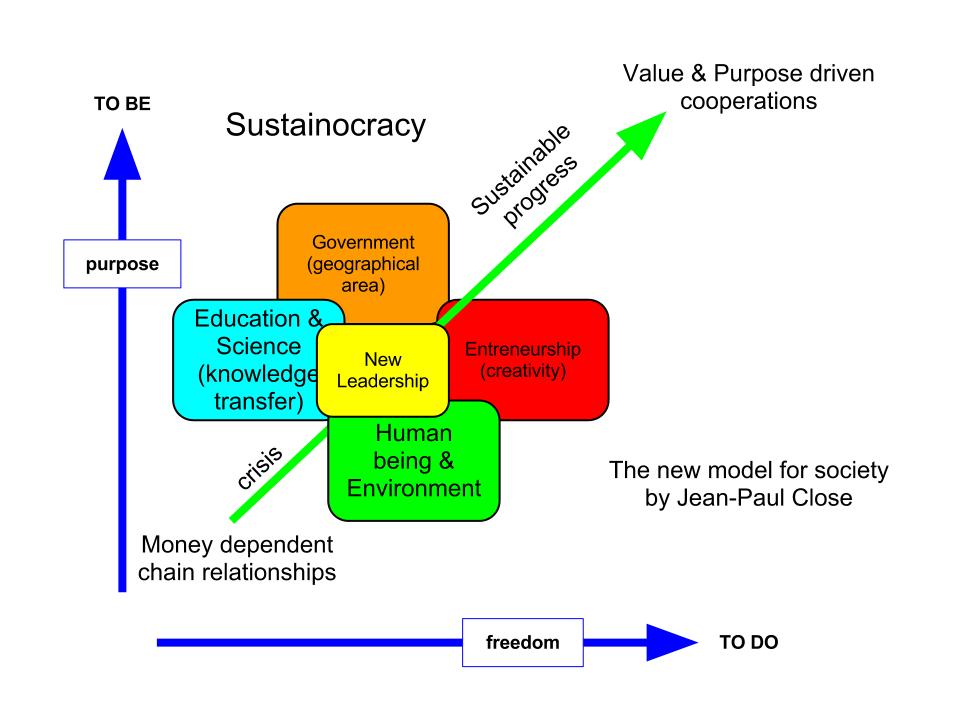
The purpose driven society develops local for local using the institutional excellence of the old paradigm
Conclusion:
Purpose driven economic development based on sustainocratic complexities is needed to save humankind from the present day destructive expectations caused by the consequence driven consumer economy. If not we will face disaster. Yet if we assume responsibility individually and institutionally we also face a huge transformative challenge that will upset everything that we have known so far. The choice between destruction or working together on a healthier perspective is easy for me. I have become self aware and dedicated more than a decade to come to these views and initiatives. It is a start, giving comfort that humankind has a choice indeed. A choice that simply depends on one own and not someone else. But I realize that it is a difficult one, not only when one has to make it, but also for me to reach out to the world and make the choice known to all. If one does not know than no choice will be made. My personal challenge is hence multiple. Make it happen for myself, provide proof to my surroundings and reach out to all of you with sufficient clarity that you take sufficient confidence in the course that I have taken in order to let go of old securities and create new ones for yourselves and your direct surroundings.
 Sustainocracy, the new democracy