Home » Posts tagged 'prevention'
Tag Archives: prevention
When does health become an issue?
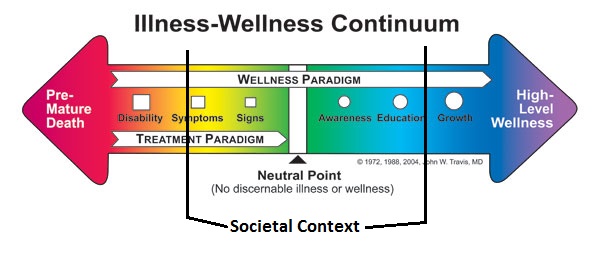
In Sustainocracy we define five core natural and human values that are a continuous responsibility of any society and its members. One of these values is health. If we look at the drawing above we see a neutral point defined. That is the point where an individual does not sense an illness and takes his or her degree of wellness for granted. Health is a matter of fact, just like breathing or a heart beat, it does not require thought or a sense of responsibility. If we place this neutral point in our Societal Context the question arises when health does become part of awareness? In general the answer is “when we become sick”.
Within the current Societal Context we have created a lifestyle and political-economic reality that produces social differences, pollution, wars, climat changes, destruction of landscapes, etc. In reality we produce an increasingly unhealthy environment. This means that the neural point rapidly moves into the wrong direction. As a consequence of our behavior we tend to become sick faster and faster. Around the treatment paradigm an huge structure of health care has been built with very large investigation institutes, control mechanisms and bureaucracy. The structure has been economized meaning that the citizens need to pay for healthcare through taxes, insurrance and direct payment. We hence pay the bill of our lifestyle and polluting societal context. Premature death is not just something that affects the individual but also the entire species. Costs of healthcare are rising exponentially and cannot be covered anymore by the majority of people. A change is needed, but how?
When we get back to the neutral point it becomes clear that we should not wait for things to go wrong with our health when signs of sickness appear, we should take proactive health measures to adopt a wellness driven lifestyle. This needs to be achieved through awareness and education. But how do you engage people to something that does not exist yet in their reality? How do we address wellness with massive amounts of people who seem to live life with a different set of priorities?
With these questions in mind 5 groups of international students of the University of Technology (Health and Technology) started to define projects in which they try to involve large groups of people in the paradigm of Wellness. Their challenge is to provide Proofs of Concept by testing their ideas in a real community and analyse the results, both of their estimates and what reality showed.


Five projects were defined:
- Smoking prevention in high schools
- Burnout prevention among teachers and students
- Lifestyle of students
- Integration of foreign students
- Clean city logistics by stimulating clean truck driving
The healthcare continuum revised
When health is recognized as core societal responsibility (Sustainocracy) the care for health approach affects the entire chain of healthcare well before the care demand starts.
My own STIR societal research foundation, together with AiREAS (air quality and healthy city) and the University of Technology of Eindhoven, apply participative learning with a group of 25 international students. We are looking for ways to use technology to affect the healthcare system within the challenges of Sustainocracy. We introduce a whole new way of thinking that can eventually transform the entire healthcare chain.

In the picture above on the “continuum of care” we see the entire healthcare chain and how it develops itself from prevention via early discovery of a health problem, all the way up to the last phases of anyone’s life.
But we miss something….
When we review our current society we notice that in terms of prevention there is little we can do since our political and economic structure, together with the lifestyle that belongs to it, contributes to our health reduction. In AiREAS for instance we look at our exposure to air pollution in relation to our lifestyle. Research revealed that 50% of the responsibility is of our own as we deal with our lifestyle and pollution in an unaware way. But the other 50% is caused by our surroundings and societal cultural management. This causes the enormous cost development of the healthcare chain, loss of quality of life, reduced productivity and millions of premature death across the world.
Before we enter the care continuum we need to ask ourselves in what societal context it is placed and how we could dispute this reality from our evolving self and collective awareness? In Sustainocracy we determined 5 leading core values for sustainable human evolution and progress, such as health and the quality of our air, food and what we drink. When we design society using those core values it will have a direct impact on the entire care chain but also the quality of our life and the related overall productivity of the community.
The students have been invited to the challenge to see how they can use techological instruments (such as games) to persuade citizens to participate in the health driven society. The students need to consider the fact that most citizens, and especially those who live their lives well before any preventive actions are considered, have totally different priorities than making time free for their health. What motivation will trigger them to participate? Are there target groups that are more inclined to participate than others?
A second part of the challenge is to find economic continuïty for the application of the technology by positioning it as proof of concept with measurable social, environmental and economic impact that is taken over by the consumer.
 Sustainocracy, the new democracy