Home » Posts tagged 'progress' (Page 3)
Tag Archives: progress
Business in a Content Economy
When we place business development in the context of a content economy and focused on sustainable progress, it develops some very unique characteristics that are very different from what we know from business today. The era of industrialization has taught us how to produce products in standardized manufacturing processes in local competition. Globalization has made us efficient in these processes adding supply chain management, open border competition, cost optimization and consumer marketing to our business processes. Modern communication techniques with the end users has changed our life with constant consumer information on choices that we can make among seemingly equal products. The global productivity and consumption has eventually become so speculative that it has crossed some natural lines of the acceptable introducing a totally new paradigm for business too: business that does not use humankind and our planet but starts serving it meaningfully.
It is very interesting and logical that the transformation of business and society both coincide in time and space. They both depend on each other and both enter in crisis together, even influencing each other in that. So far they evolved together in the era of material growth to support the money driven processes of centralized power structures. For many years the financial balance of consumer growth was higher than the consequences of overconsumption in society but this has changed drastically. The costs of our imposed lifestyle have become structurally destructive for our health, vitality and stability affecting directly the stability of the economies as we have all been able to witness for years now, not to mention the climate and resource issues that keep us busy too. When an economy cannot grow anymore it will have to base its existence on different parameters. When we start working on a content economy based on sustainable progress business necessarily has to reposition itself as a consequence. It has become a chicken and egg issue. What transformation comes first? Business or Government?
When I started to become aware about all this back in 2001 I was convinced that business would have to take the lead in the process of change. Entrepreneurship is in my view the creative spirit of humankind, the type of institution that is always ready for change to outwit competition and position itself on a winning track through foresight and proactive vision. So why hadn’t they reacted long before the credit crisis created the first chaos? Well maybe they were not so entrepreneurial after all.
And I did not see democratic government to become the motor of change either because they are elected by a population that want the same as before and no change. Sustainability is a great hype but far away from the individual who may feel responsible but not really powerful enough to make a difference. If you ask a people to choose between a tree in the rain forest of Brasil and a pack of money they will go for the money. The tree is far away and the money can be touched and used. Politicians that promise the sky in financial stability and conservative continuity have everything to win in elections by manipulation of the public conservative mind, placing the responsibility of disaster on individual lifestyle and not on the system that they try to keep up with capital injections.
But now things have changed. In the money driven economies business entities became like speculative banks run by financial experts rather than creative entrepreneurs. For decades they would have had an opportunity to position themselves in a global shift and take the lead. But now the consequences of the money system have dug so many holes in the governmental budgets that it is politics that is taking the lead in looking for change while everything seems to crack under their manipulative feet. While capital injections are still being used as main instrument to keep processes going, the public is increasingly becoming aware of the giant flaws in the system and governments are frenetically looking for alternative solutions behind the scenes. Europa has every chance to fall apart temporarily due to the budgetary crises of all the members of the union and the deep debts they get into over the backs of their populations. They are forced now to look at the other values that keep the European Union together, other than the financials. How about social cohesion? Security? Immigration? Wellness? Partnership or Competition between the members? But nothing can be done to avoid the bursting of the large economic bubbles and governments need to react now by taking proactive actions for the first time thinking of true values rather than fake money. How to compensate with 80% speculation in the currencies that hold up the old economies? You cannot let go and cannot hold them up.
We still hear calls for economies of growth but they do not grow anymore, they deflate under our noses because there is nothing anymore to sustain them. Governments are not ready yet to adopt the strategy for developing a content economy but they are close. They will have to open their eyes to reality and place a big cross through their finances and concentrate on social and government innovation. Banks and stock exchange represent no value anymore just insecurity and speculation. They should not be listened to anymore.
Meanwhile the business executives are still concentrating on squeezing their financial sponges trying to make a short term positive impression on their greedy and blind stakeholders. They lost the opportunity to take the lead when they still had a comfortable financial basis. Now they get to deal with rapid declining public spending and a rapidly changing consumer attitude to personal safety measures. Sustainable progress is not a competitive issue but one to take corporate responsibility and reposition the company accordingly. That takes time and above all, it takes the shaking off of the short term pushy attitude of speculation to start concentrating on true meaning. Large corporate entities are expected to fall fast and have no executive backbone to deal with it. We are facing a fast shake out of old executive power positions by real entrepreneurial new comers in the field. The credit crisis brought a financial crisis to the markets and a collapse in business that produced in turn a collapse in government finances. Now the government instability and remaining bubble in all financial institutions create the next business collapse which will again have a domino effect on everything else. Our economies of growth have ceased to exist. It is over. Back to the drawing boards, not just business or government, everyone.
As explained in my previous blogs the content economy is based on a society that has no economic growth but a quest for the highest (100) level of public wellness in which the population (business and public) is challenged to maintain it through constant meaningful modernization, experimentation with sustainable progress and adaptation to external influences and (un)expected natural challenges (s.a. climate change, lack of resources, natural disasters, etc). In such a community the business development is not related to product sales or competition on price, availability or quality. In a content economy people tend to search ways of being independent of external power positions through a high level of self-sufficiency in their own productivity for their own needs. Lessons learned from the centralized power positions of the old business paradigms were that they had the power to speculate with shortages to raise the cost price or even cut people off from supplies all together. This was in cases immoral and even lethal for large groups of people living in poverty around the world. The morality could not be questioned when the culture and paradigm justifies such behavior. The only natural counter reaction of populations in fear of being cut off from supplies or perceived abundance is to become either angry, invest in self-sufficient or search for alternatives that are abundantly available. This is a natural process that eventually turns into a content economy where the population has the higher purpose to assure their own living standards by being productive and inventive themselves. People have no problem in laying off excess external material wealth if they can keep control of the basics of their own quality of life. They tend to take responsibility fast. We have seen the capacity of organization of populations against their dictators. There is no reason to assume that they will not do the same against financial or other dictatorship when the time has come.
Such a population is entrepreneurial through all their members as all interact together to produce sustainable progress for their ongoing wellness. The satisfaction of being able to decide for oneself is of course very high and the social interaction makes progress a challenge for the entire community. This works fine for the productivity that requires average knowledge and physical abilities. Social innovations are introduced through the free, purpose driven interaction within the community but when we wish to introduce technological innovations it has to be related to the results that we want to achieve.
The very first thing for technology to evolve is that there has to be a motivation to invent anything new, meaningful. Military encounters have mostly been the trigger for the inventiveness of humankind creating tooling to kill or defend. In ancient times the worshiping of Gods has also been a stimulus to find solutions to the challenges of building huge monuments. So our fear for shortages, for each other or for the unknown has been an ancient engine for innovation and technological progress. Now that we have reached a point that we can eliminate fear by using and implementing technology for abundance in all content driven wellness communities there is a potential lack of motivation to invent anything new. This in my view is not entirely true. Also now we face sufficient challenges to innovate and implement it:
1. Result driven entrepreneurship. The entrepreneurship that is developing is one that concentrates on the effects of innovations on human wellness, not the innovations themselves. Within a holistic approach any change would have to be positioned within the local complexities of the human organization. This means that the technological supplier will have to become so adaptive as to include the ability to modify the innovations to suit the integration in an unique local situation. Every change induces new changes and this works both ways. The challenge of the innovator is to become as motivated to change as the community introducing new wellness aspects all the time. They become local partners and learn to work together.
2. The sustainability issues of a growing human population in a content economy are not related to sales of novelties but the modification of the existing within the context of environmental challenges. The competition is going to change into the level of access to natural resources to sustain the content economy. Even self-sufficiency is an entrepreneurial challenge that requires the wit and innovative powers of a community to enable them to maintain a high level of wellness. There is no reason anymore to produce goods and services in a globally centralized way because this leads to speculation and vulnerability for all involved, even the power position. But producing local for local self-sufficient securities is to be learned and needs modification of national and regional jurisdiction and mentality. Getting the public involved again in producing their own needs creates commitment and investment of local talents and energy but also a new business elan that helps community to become self-sufficient instead of selling them the goods. Business that serves people and our planet will become booming positioning themselves as partners of local government and the public rather that self-centered structures driven by their dependence on obsolete money and sales of products. The latter are facing a hard time to come. It is all a matter of attitude.
3. Technology is abundantly available to challenge us to look beyond the horizons and confinement of our planet Earth. We are already undertaking exploratory voyages to nearby planets for scientific purposes but in reality we are looking to see if we can expand beyond the confinement of planet Earth. We can become much more ambitious when we decide to work globally with the content economy as driving force. Wellness and sustainable progress has also an evolutionary component and our fear of disappearing as a species because of our local vulnerability by our cosmic dependence on a small rock in space can get us to invest in such purpose driven progress too. We would not need a war or confrontation to advance but the sense of responsibility to prove to ourselves that we can live and work properly and in peaceful progressive harmony in a small place (Earth) to validate our journey into the vastness of the universe with the highest awareness and wisdom of a conscience.
Key in any ambitious content economy is that entrepreneurship is a way of progressive life with genuine, sensible purpose as key motivators. There is no need for money in such environment since value is measured in wellness and abundance that is maintained through the investment of talent and energy of the population itself. If therefor these ambitions are raised it is the population itself that gathers the talents and means to achieve it. Creativity, intelligence and purpose driven energy of the human being in teamwork is endless and the most important asset of humankind. Being paid back with wellness and evolutionary progress is probably the most satisfying salary that one can achieve simply because it is the direct fruit of one’s own efforts. If a value system needs to be put in place then it would most certainly have different characteristics that what we know today. It would value our talented contribution to the end result.
From a business point of view the human world is wide open for those who are willing to join in with no strings attached to the old hierarchical formats. A new era of cooperative, result driven, innovative entrepreneurship has started and governments are opening up to partner up, not for the sake of economics but for sustainable human progress. No one is in the lead now, we are all in the same mess and share the same opportunities. Let’s go for it.
Feminising masculine cultures in crisis
For many decades emancipation has claimed equal rights for women but meanwhile the global cultures have totally defeminised. Even the most emancipated countries have hardly any feminity left in them despite equality among the sexes. This may sound like a contradiction but it is not. Women and men are equal but not at all the same. Cultures that center around money and the material independence of individuals show a systemised masculine culture based on external securities, excessive tooling, competition, hierarchies of power and a lot of individualism. The cultures grow cold, materialistic, authoritive and bureaucratic. Such masculine culture has nothing to do with any discimination of women. Even the women learn to behave with an independent masculine nature in an emancipated way. This excessive masculinity has been caused by our growing dependence on money based structures that have taken all feminine sensitivity out of our human organisation. These masculine cultures, resident in large corporate multinationals, money based democracies and social communism are all in severe crisis. The only solution here is to feminise the cultures again.
What then is a feminine culture?
Connected to the unique ability of women to give birth a feminine culture is based on identity, family warmth and evolutionary long term reasoning around survival, protection, safety, health, stability and quality of life. A femine culture is more holistic, spiritual and emotional than purely rational. In a feminine culture our relationship with our environment makes sense, our self-sufficiency and self-preservation within the mistique of eternal life itself. The morality of our choices become an important measure for our actions, just like equality, respect and trust.
Such feminine culture is not just exercised by women of course, also by men, just like the masculine cultures. It is a way of life, an acceptance of certain values above others that have to do with inner feelings instead of external wealth. The current world is in crisis due to the excessive masculine structures that have gradually eliminated emotions, warms and community feeling. There is no relationship anymore between what we contribute to life and what we get. We have endebted ourselves for values that we have not yet contributed in with our creativity or supportive energy. It is going to be increadibly difficult to get our lifes back to a true reality in which we enjoy prosperity from our personal initiatives. A purely feminine culture will not do the trick either….
Pure masculine societies will always enter a crisis while pure femine societies will never progress. Both mentalities always require to interact to produce sustainable progress as shown in the drawing below. Together they form a Whole….
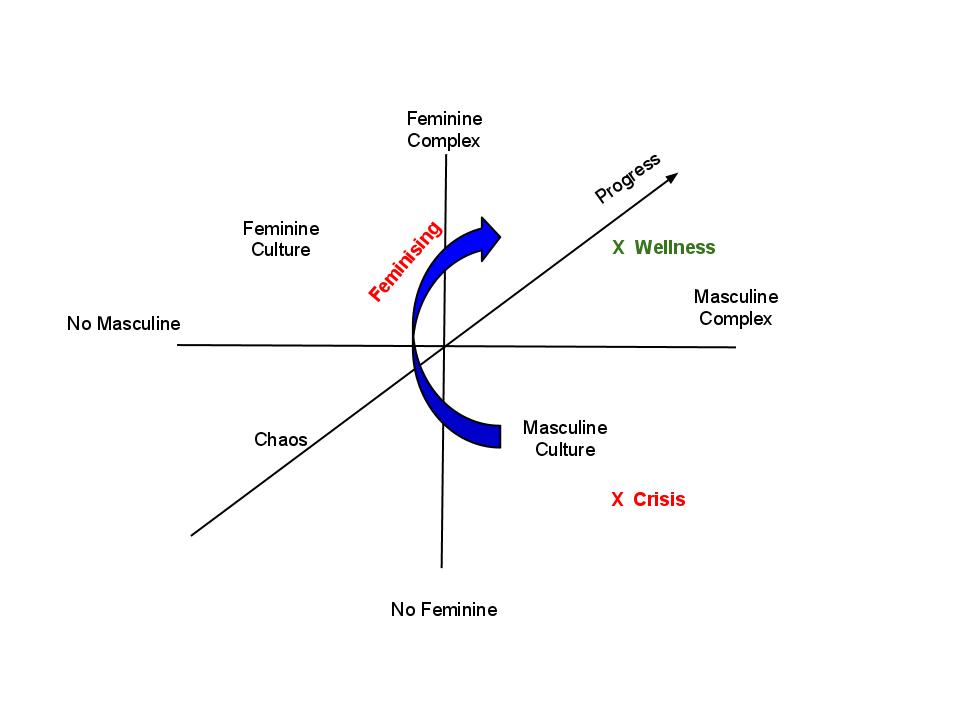
Feminising the masculine culture in crisis
There is nothing wrong with a masculine organisation as long as it is lined up with a feminine equivalent too. The key of wellness can be found in the warmth and depth of emotions feeding and guiding the rational awareness and organisation. The femininity makes us aware of our relationship with our environment, the need for human interaction and true equality among all people. The masculinity will get us to understand, learn how to organise ourselves and get scientific insight. Together the feminine and masculine nature will interact to apply knowledge with true meaning to human progress in a complex creative manner (not destructive as we suffer now). The feminine culture will avoid the masculinity to grow above sustainable proportion while the masculine drives pull the feminine morality into progressive action and permanent change for new balans.
To achieve this we need to feminise our masculine cultures. The current huge masculine outsized complexities (banks, multinationals, political organisations) will crumble into chaos as the crises do their work, creating room for feminine awareness to develop and take a position in our minds. This process shapes a new future for humanity based on smaller, purpose driven communities that use high level knowledge and technology to progress in a constructive, evolutionary way. The day that this has happened humankind can look back at a brief period in our evolution when we were about to distroy everything and thank our wit and consciousness to have reacted on time, voluntarily or not, to get back to sustainable wellness and progress for all. Men and Women meet again in the garden of Eden called planet Earth with the knowledge and understanding that beauty, abundance, love, eternity and wealth is not found in the apple we take but the tree that we sit under.
Alternative definition for Sustainable Progress
The current and most widely used definition for sustainable development dates from 1987 (Brundtland) and is totally useless for sustainable progress. It says:
“sustainable development is development that meets the needs of the present without compromising the ability of future generations to meet their own needs.”
This statement is not sustainable itself as it cannot pinpoint individual responsibility to anyone or current generations let alone future generations. Consider for instance what the definition of needs is of today? Needs of who? The material wealthy or the poor in Africa or Asia? Your needs? My needs? Do they refer to the needs of business or political economies, luxury or primary needs? Business needs maybe?
How about the needs of future generations? How would we know what these future generations will need? They might for all we know require massive amounts of oil for medical purposes, yet we burn it all up right now. How can we take responsibility for the abilities of future generations if they are not just dependent on our left overs but also on important other variables that have nothing to do with human behavior, s.a. climat changes for instance. Do we blame the human who killed the last Dodo because he was hungry? Or do we blame ourselves for not creating responsible alternatives for nutrician before the Dodos were made extinct in the first place. How many species have to perrish before we take responsibility for the current generation?
In fact, who would control what we use, how we use it and determine if it affects future generations at all? Is this control our individual responsibility? How can we measure this? Who is to blame if we judge incorrectly and who judges? And how can I worry about compromising future generations if we already compromise current generation around our globe? In fact, this most popular definition is a open letter that allows us and anyone to do what we please without taking any responsibility. As it stands it has been insignificant since the definition appeared and introduced a green washing wisdom in industrial and government policies around the world. It may have made us a little more aware but certainly not more sustainable in development or progress, on the contrary, and not at all responsible towards future generations as we wouldn’t know how. And really, who in command cares?
In my own foundation we work on the development of workable cooperative organizations around projects that address sustainable progress of humanity itself, segmented into key issues. Interestingly we could do absolutely nothing with the definition. We found it perfectly viable to introduce some basic environment awareness in capitalist industries but totally useless when projected onto the complexity of current humanity itself.
This motivated me to come up with one of my own, just like probably hundreds of other responsible people around me over the years. My definition for sustainable progress is:
“Sustainable progress is the development that continuously improves human health, vitality, safety and dynamic progression in optimal relationship with the constantly changing environment in which we live and act.”
I found that this definition places the responsibility with each and everyone of us, as individuals as well as business and public entities, in the here and now. It became the basis of the cooperative innovative business identities that are being developped by us around real issues that concern us today, s.a. energy, quality of life, education, smart mobility, air quality and polution, food, water, etc…
The definition helps us to define our visions away from material goals and determine specific higher purposes that matter and have a positive effect on our selves, our current generations and our environment. We feel it contributes to true sustainable progress in a measurable and accountable way with the satisfaction that whatever we do in this context it will always serve also generations to come.
 Sustainocracy, the new democracy