Home » Posts tagged 'responsibility' (Page 33)
Tag Archives: responsibility
Europeans are not Euros – visualized
With reference to my previous blog I decided to visualize the situation of Europe by using my model of the human complexities (first published in 2008) expressed by two lines (to be + to do) crossing. These lines symbolize at their intersection the eternal conflict between our actions (to Do) and our moral ethics (to Be). This happens at individual but also at cultural and institutional levels, creating societies in cyclic situations of greed, chaos, awareness development or around wellness. In each country individual people and institutions can be in the different phases themselves yet what I show here is the dominant situation of the majority, not the minority.

Low level of ethical morality reigns throughout money driven Europe
The “saving” of countries in the chaos zone is nothing more than an attempt to pull them back into the area of institutionalized greed at the bottom right hand side. This is necessary to avoid the collapse of others in that area. It is just a matter of time for all to go down in a violent confrontation with ourselves by ending up in chaos all together. Still it is not necessary! There is another route, not by pulling back into greed but taking responsibility for wellness and sustainable human progress.
This desired European situation represents a jump along the line of ethics, responsibility and awareness. This line (To Be) consists of various levels of awareness. At the conflict crossing at the center we situate the area of self-awareness, a point where the pain of consequences are converted into knowledge and conscious understanding. We have gone through this point very often already, as individuals when we grow older and wiser through personal experiences, and as communities throughout time and the same. Chaos is often represented in society by depressions and even wars. Chaos represents a violent letting go period, painfully creating room again for renewal through awareness. Awareness often comes when the blindfold of greed and control is taken away. There is a sincere possibility that this is going to happen again, in Europe and anywhere else in the world. Enough signs are showing and can affect us at any time.
The big difference today with our past is that we can now pinpoint where we need to place society within the human complexities and act accordingly. In the past societies only knew that they collapsed or were surprised by the collapse of something else causing their own. Knowing the 4 areas in the model as a logical sequence we can also position ourselves where stability and sustainable progress occurs. This is a simple ethical choice of educated awareness. The only excuse that people can have in our current Europe is that they have not yet seen this blog. When they do, then they have no excuse anymore to make the choice and take responsibility, as an individual and as a professional. Each of us can take personal responsibility now, get educated to deal with it or we can be asked by their surroundings to do it. At first it takes guts to decide. If you do not you can be blamed in the future. What is worse? Guts now or having to give painful explanations afterwards?

A stable Europe is an educated choice of ethics and responsibility
The choice of ethics of all people involved is to let go of the Euro as the sole dominant goal and adopt European wellness as something to take responsibility for, not by creating it but by allowing it to be created by everyone together. This can only be achieved by working in purpose driven processes in which money is a means, just like anything else needed for this process. It is a choice but once the choice is made the complex process starts to make it happen, based on the new ruling of such wellness based self sufficient European society. This is where the need for a new European constitution comes in. Our current constitutions are based on managing greed and avoiding chaos. We need to work on new constitutions that develop and protect ethical awareness and co-create wellness, avoiding greed.
This cannot be done in the fragmented jobs and self interests of politicians, civil servants, business people, bankers, individual consumers, scientists, educators, etc. In our current society they interact through money based systems and dependencies. None of these institutionalized individuals can take the initiative, if they are aware at all at professional level. Professional blindness tends to rule making people incompetent to ethics and responsibilities beyond their professional position. The only one that can take responsibility is the human being itself, liberated from all previous dogmas, professional limitations and dependencies. This person, any person, on the verge of absolute material poverty in the old world, but totally free from burdens, can invite all the powerful fragmented authorities to come over to the new world together and become instrumental to it.
That is what I did when I created Sustainocracy. I invited all people whom I had made aware through my personal interaction and explanation. They were invited to take that personal choice to position themselves in the new wellness based society and come join me in purpose driven human co-creation processes. In these sustainocratic processes all fragmented responsibilities of the old world are represented together, in equality, without dependence of each other but through the authority they represent (entrepreneurial creativity, regional government, knowledge based science and education, and behavioral cultural populations). They come from a fragmented structure of self interest into a holistic environment of common purpose.
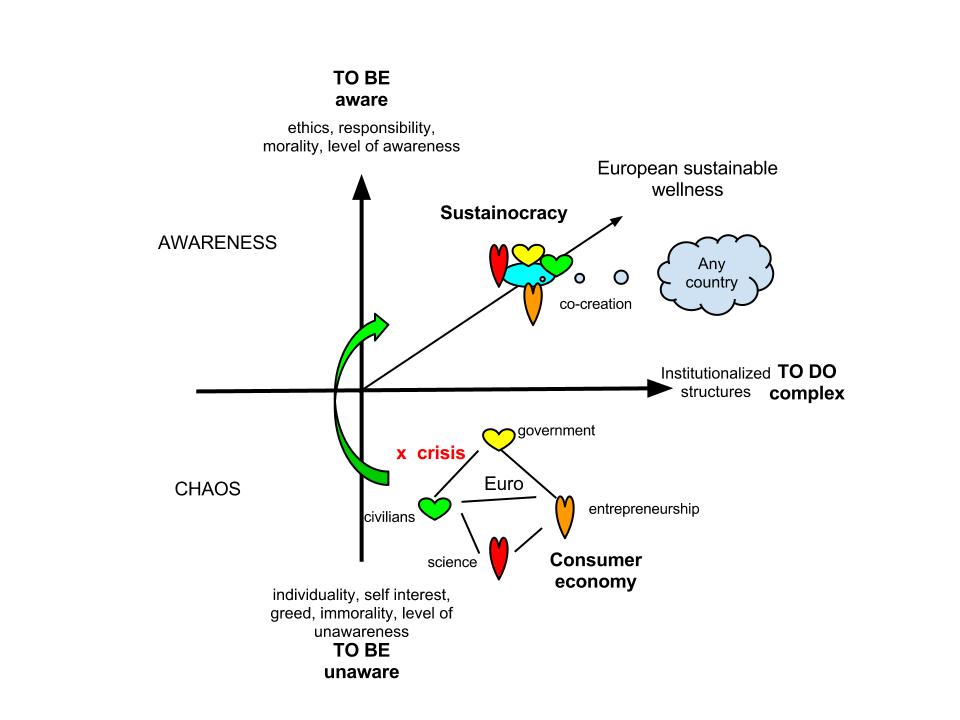
Only people who can actually take responsibility are invited to Sustainocracy, the rest follows through leadership
The city of Eindhoven and province of Noord Brabant is the first place where Sustainocracy is applied in the world of complex societies. The combination of the right people with the right ethical attitude and awareness, on the right levels of authority, were found to make it happen in AiREAS (health & environmental quality), VE2RS (self sufficiency) and other initiatives. It is first step and still far from getting the entire nation or Europe to adopt the process. But with the precedent in Eindhoven en Noord Brabant I expect that more and more will follow.
Of course, the same counts for America and China and any other area in the world.
Now that you have read this, you can choose too and take responsibility accordingly.
Students today (121212) define their own challenge for Europe
“If you can dream it, you can do it” (Walt Disney)
“Optimism is the faith that leads to achievement”
“What you do today can improve all your tomorrows” (Ralph Marston)
Eindhoven (Holland) 12.12.12 at 12.12 a small group of students, age 17 and 18, taped their own video message. It is destined at their own generation in Europe asking them to take also “responsibility for our own future” and meet in 2013 in Hungary.
A challenging call was formulated to meet in the course of 2013 and joinedly discuss and step up their vision for a strong self sufficient Europe and unite together to make the best of it. The recorded videomessage can be seen here and will be distributed across Europe. It will be used to invite students and their institutions to team up and come to a purpose driven encounter in which “our common future” will be defined and expanded further, taking this 121212 encounter as a first stepping stone.
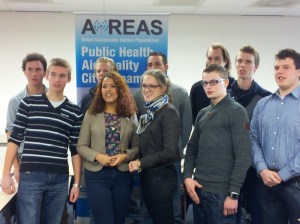
The challengers
Jason, Shari, Veerle, Randy, Bas, Koen, Willem-Jan, Simon, Bart, Arjen
The students’ encounter started at 09.00 a.m. in Fontys Highschool with scholars from both the ROC Highschool and Fontys Eindhoven. An open discussion followed on general issues that concern us individually and all together. This discussion will be summarized on video too. It was impressive, Topics that were dealt with were:
- Multicultural society – the need to adapt to a region, learn the language and show commitment to contribute to the region’s prosperity. There was a sharp disapproval of the growing aggression and a call for tougher punishment measures. Local languages and cultures should be respected even in a broader context when dealing with a united Europe. Shari suggested that we should try to understand each other better even in communication as interpretation of the same words can be different by different cultures.
- Crisis – a strong need was felt to recover stability in terms of jobs and opportunities. The lessons learned from history and our past should be taken seriously. Those who misused the system (bank and government officials) should be punished severely. Willem-Jan: “We accept to take our responsibility and even take our losses as long as we can be confident that these same mistakes and missteps are not taken again”. Banks and governments should develop an ethical responsibility and code of conduct.
- Responsibilities – every single person is him and herself responsible for their own future, not government or some institution. We should show solidarity with the Greek, Spanish and maybe consider one single European government to establish a balance with China, Russia, USA, etc. It is not about money only.
- Sustainable societies – this should be our common goal, not economies or growth. Arjen: “Sometimes one step back means that you can go forward”. Governments should not accept lobbies out of self interest from eg. oil companies but accept change and invest in using technology for our self sufficiency and sustainability.
- Willem-Jan: “We need to learn to live and work together”
The whole interchange of impressions was filmed by Hein, owner of CityTV.nl Eindhoven.
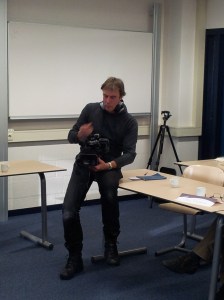
Hein filming this unique event
The openness and transparency of these students was heart warming while they all really had significant views and something to say. Their worldviews had been developed through international visits and projects.
Coach Wim Grommen added that there are 5 basic issues that need to be attended always to create a stable, sustainable community:
- Food
- Health
- Security
- Prosperity
- Knowledge
There is no money in this list and examples were given of communities that develop prosperity without using money.
One of the two girls, Veerle, proposed that the group would make their own videostatement for the 2013 event. One of the students already had one prepared. He also supplied the one-liners at the start of this blog:
**********Jason Clarke**************
“Do you want to change the world we live in today? Are you up for the challenge of making the world a better place to live in? Do you have perseverance, courage and will to reach your goals that will benefit society? The Europe of Tomorrow challenge is the event where you should show your unique talents and share your knowledge, skill and experience with others.
Playing a key role in your team and show your uniqueness that will make the difference! It’s about what you stand for, what you want and how to reach your goals. Share your belief, passion and enthusiasm with others. “Together we can change the world forever”
Making the difference starts with believing in yourself.”
***********************
The statement was received with applause and it was decided to use it here and on the forthcoming event site. Veerle took the lead in defining a shorter message specific for the video, the “call to their own generation”. After some group discussion the definite version was written on the whiteboard. Then this co-creative group decided to make the statement together in front of the camera…….
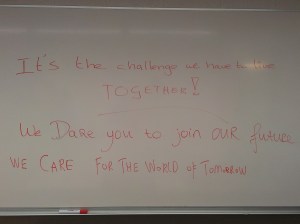
The final statement and challenge
Conclusion 12.12.12 of these students:
All:”We do not have a choice, we need to change our economies and societies into sustainable self sufficiency, applying innovative technology and vision by working together and eliminating misusage of power that blocks this progressive transition.”
This was the admirable conclusion in a morning’s debate of a small group of European 17 and 18 year old students, the “next generation”. It certainly gives the satisfying feeling that our future is in good hands with this generation. It was questioned if students across Europe would have a similar sensitivity? So the challenge was formulated for the 2013 event to check this out and get them to react and join.
The 2013 event:
In September 2013 we will all gather in Hungary. Students from all over Europe are challenged to make this happen. Students and European schools that wish to participate can ask already for the instructions for pre-subscription and preparation by mailing to:
Jean-Paul Close email: jp@stadvanmorgen.com
Thanking all those who participated today in this small but significant event, also part of the global “Day of Interconnectedness”, we certainly hope that we have created a stepping stone for a great event in 2013 and beyond.
Psychology of change
Recent blog and internet discussion, and our practical living lab exercises of AiREAS in the Dutch city of Eindhoven, got us again going about the overall complexity of the “psychology of change”.
On the one hand there are the impressive challenges of a global shift, a true transformation of society to save our selves, demanding tremendous changes. On the other there is the powerful resistance and dominance of the world’s institutionalized economics that produces many powerful lobbies to avoid change all together. The latter brings a certain material wealth to the world and to the financial mighty. I already wrote various blog items on it but the complexity of “change” seems an endless and highly repetitive topic. Why? Because it affects us intensely on all levels of society.
The need for change has to do with ethics, sustainable human progress, in-dependencies, our environment and basic human rights, as opposed to nothing of that, expressed through individual and institutional power positions. It also has to do with awareness, responsibility, dominance, different paradigms and massive manipulation as part of the huge human complexities. Both sides of the problem, the desire and the avoidance of change, are firmly established inside the kernel of our individual and collective consciousness, self reflection, evolution and the ethical structuring of our choices. Despite everything there is always a dominant situation of overall avoidance of change.
Manipulation
Manipulation may sound unethical to you but we are being manipulated all the time. Not just through conscious manipulation of powerful institutions but also by the way we perceive our own selves in general. We react primarily to our surroundings using multiple sensory and extra sensory impulses. The way we perceive is the way we react. Within this simple action = reaction there is the “human psychology” involving fear, worry, happiness, wellness, anger, hate, education, jealousy, etc. All this can be manipulated, even by ourselves, consciously and unconsciously. In fact, it takes an intense learning process to to become aware of one’s own behavior, perception and choices, to get more or less liberated from manipulation. We call this a part of our higher evolutionary awareness. Not many people reach that state and those who do often become manipulators themselves with a large array of motives.
While I write this blog and re-read it I realize that I myself am one of them. I have grown over time mostly free from manipulation. Now (before I did not) I can see that I am being manipulated in intention by a dominant money and consumer driven system. This produces some kind of friction between me and the old generalized system. By introducing a new paradigm (sustainocracy) I also manipulate people by showing them a different truth. Despite my desire to be ethical and transparent I do create a new environment with the intention to provide people such a sense of new security that they decide to follow my views and let go of the old paradigm.
All I try to do, which justifies my motivation and passion, is to make people aware of manipulation and help them make up their own mind, without prejudice finally about their choice, not even when they decide to turn their back to me. I see it hence as a challenge to explain myself and Sustainocracy in such a way that people start believing in it, more than the other reigning system. But isn’t that what the system of capitalist consumer economics does too? And has been doing successfully for a long time? So we both compete in the psychology of manipulation presenting two different paradigms to the people. I am of course just a beginner while the other paradigm has thousands of years of experience.
Psychology of manipulation
When it is warm we buy an ice-cream when its cold we wear a pullover. We look around us and decide what we do, need, say, move, ….almost instantly. Our impressions do not just have to do with sensory perception, they are also colored by what we think is right or wrong, just, wishful, desirable, etc. In reality we have been conditioned to instant reaction right from the moment we were born and open our eyes to see the world. Normally we see the face of one of our parents at first, or a doctor or nurse. We see lights, colors, movements …. We smell and taste things….we hear noises, sounds, melodies, voices. All these first impressions reach us without giving it yet a conscious thought, they form however the basis of the big pile of sensory impressions to come that we do reflect consciously about.
After growing up in a certain environment it becomes so familiar, our own unquestionable reality, a specific truth. Every new observation and experience is being compared with circumstances we lived through before in the past. It enhances them, builds them up, or rejects them, until you feel at home right in the middle of those impulses from outside. This helps to react instantaneously on most issues of life during the day and makes you feel familiar with the way others react too. Together we form a culture, a set of values around language, beliefs, behavior, etc, that define us as a community. It gives us a behavioral identity. This gives a sense of belonging that remains united to our local natural and human surroundings. It is important to us because we need speedy adaptation and reaction when our behavioral routine is upset in any way. It is important for our mind to be able to distinguish between the normal and abnormal and react adequately, especially when in danger.
So securities are built up by ourselves and with our cultural environment to make us feel safe within ourselves. We auto-manipulate this feeling out of risk avoidance, fear control and sense of control. This can of course be manipulated also by an organized surroundings that is based on institutionalized principles. This then becomes also a paradigm, a worldview that is conditioned by certain values. Our current ruling paradigm is the one of capitalist economics. The one that I am introducing with arguments is called “sustainocracy”.
That is psychology of manipulation, the sense of providing external security to a community of people by the internal perception of security.
Psychology of change
People are of course reluctant to change when it addresses their sense of security. Nowadays we are confronted with a lot of information on climate changes, pollution, global warming, financial crises, other crises, etc. When we read such issues in the newspapers and watch documentaries on TV we become worried. We still, however live our day to day, everyday life. We are worried about the large picture and yet do what we have always done. “What do you want me to do?” you would say, “who am I to do anything?”, you may suggest. “Let the government solve it” most of us would say. And you are probably right!
Unless your name is on the list of the G7 and G20 encounter, or something like that. Which is what tends to happen. A few hundred powerful people join in global talks but fail to talk about change because they want to keep a capitalist economy going that provides perceived security to many people including the ones in power. And 7 billion people feel too small, too insignificant, too unaware, to do anything while feeling blindly secure in their day to day living experience, expecting that the big G solve it all. Until it is too late.
So if we want to change anything we have to overcome the “psychology of fear for change”. This starts with the aspect of “negation”. This feeling is normal. To accept a responsibility we have to be aware that we actually carry one. Or that we become aware that those who we think are responsible, have good reasons for themselves to avoid change and will therefor not take that kind of responsibility.
As explained above we see our direct environment as a secure cultural nest in which we were born and grew up. If we want to change we attack our inner senses of security and that creates an intense feeling of fear and insecurity. At individual level, despite the awareness that things need to change, we have the tendency of neglecting it just out of fear of the consequences. We tend to place the responsibility elsewhere, outside our own scope. You may say that this the mentality of an ostrich yet it has a strong basis of survival. If everyone would panic upon the wisdom of need for change the chaos would even be more dangerous. Human beings need some kind of leadership to address change.
The need for change grows, the negation too
Meanwhile a growing part of those 7 billion people are being incorporated into the Western example of material wealth. They feel that they have every right, just like European and Americans have enjoyed this wealth for a long time already. They are right of course. Why would they have to step back being the newcomers on the scene while the old guys made the biggest damage? Aren’t all people in the world allowed to have a TV set, a house, a car and a well stocked supermarket around the corner? Sure!
So the biggest challenge of the global shift is to change everything without changing anything. Would it be possible to keep up and expand wellness around the world without damaging it? Many scientists and business people would see a challenge in it, many local small governments also, but national large governments and bankers seem to be more than reluctant. “You can change whatever you want as long as it gives us an economy of growth” they would claim out of self interest. What they really express is their fear for loosing power, control and a financial profit. So when we introduce the need for change we also have to seriously accept the “psychology of change” as a challenge to overcome, including the powerful.
Two ways to change
There is the universal natural way, which is the traditional chaos of destruction through war, depression, recession, poverty, etc which obliges all people to change by external, non human force. When institutions keep up their opposition and negation too long they block the flexibility and adaptiveness of a population around evolutionary change and provoke a natural collapse. The human suffering is huge and so is the institutional because it collapses. It is all expressed by violence, demanding the liability of the old leaders which are prosecuted by the laws of chaos or history books.
Then there is the voluntary way, as proposed ( and demonstrated) by Sustainocracy. When we offer the current authorities the recognition of power, also in the new paradigm, then they feel secure to support change. Fear is overcome by safety, also involving the powerful. So psychology of change has much to do with communication, not just providing means for others to change but also by being the change by providing security in following. Followers show their own leadership by making choices in which we recognize the intense process of letting go of old securities. If the new securities provide a better perspective people are much more willing to open up for change, also when they have a high level position of power.

To overcome fear new securities need to be defined, also for those in power
Yes, I can
Sustainocracy builds a new society directly in a new new paradigm using the same instruments of power and authority of the old paradigm. It is interesting to see that sustainocracy offers more security to the powerful than the crumbling paradigm of consumer economics. Executives that are value (not money) driven are the very first to support the transformation, which is also becoming a transformation of securities, not just of values, economies and ethics. Now executives have a choice and when aware of their own responsibilities they can claim: “I know I can”.
Like every situation when a choice is presented between two paradigms, a new issue arises: “explain why you made your choice”. That will be subject to subject of a new blog.
 Sustainocracy, the new democracy