Home » Posts tagged 'sustainability' (Page 13)
Tag Archives: sustainability
Business and Spirituality – The Pyramid paradigm
Today I received the news that my paper on the “universal working model for sustainable progress” was accepted for the “Sustainability and Spirituality” conference in Hungary on Sept 21-23 2012. It is great to gain some international exposure for a method that I worked out in theory and also put into practice in my own living laboratory (The city of Eindhoven and the The Netherlands).
Many of the individual people involved in the related processes do it whole heartily. The institutions that I involve have still a strong dependence in the economic world and often lack sufficient backbone to show a sense of value driven responsibility. Here we encounter the true complexity of the paradigm shift from a money dependent society to a value driven one. The first is packed with institutions that have learned to uphold themselves artificially by the chain of financial dependencies, forgetting often the true original purpose of their existence. The value driven community of my model demands from the entities a commitment based on their true identity and contribution through application of competences and responsibility to the results we seek.
There are two moments when institutions become aware of their mismatch with sustainable progress and their confrontation with their lack of genuine and meaningful identity:
- When they fall over when their financial stakeholders withdraw their support in a crisis,
- When they get involved in value driven, co-creative processes and get blamed of incompetence due to internal bureaucracies, hierarchies and lack of capability to commit to true results.
We see this in most institutions, business, government and public services especially. In the second situation they “may” develop the awareness at senior executive level to transform into something that has a deeper meaning then just financial survival. In fact they start looking for genuine meaning and purpose, which is spiritual process. To take this executive action out of the sphere of abstraction I created the practical and measurable pyramid for multi-dimensional, value driven identity development and positioning of any institution.

Modern 21st century organizations are truly value driven along business and spiritual lines.
When a company or institution remains at the traditional ground level in the base of the bottom triangle, it will develop and maintain an old fashioned a deteriorating strategy of financial dependencies. When it starts rising into the pyramid it will include much more value driven commitments that keep the organization alive and connected to a daily reality. The company become more sustainable if it finds a meaningful link with the surroundings.
To develop a true multidimensional value driven image (i.e. moving up the pyramid) represents a complex transformative process that affects the entire structure of the organization and all people related to it, internally and externally in the surroundings. As the value driven processes reposition the organization in society it will encounter a huge amount of organizations that are trying to do the same. The shake out is intense, driving organization to the kernel of their existence with a challenge to excel in their commitment to values rather than financial growth. Money becomes no issue anymore nor profitability. Profit becomes much more relative to results than just financial benefits.
From a multidisciplinary co-creation perspective only such companies will survive and link with value driven ventures in a sustainable way. It are not the products that make the difference but the set of values the company represents. Since these values represent the multiple inner meaning providing purpose to the commitment there will no customer relationships anymore but partnerships with other competence and responsibility driven institutions compatible with one’s own ideas.
Spirituality involves the profound understanding of a cosmic reality (matter, energy, purpose, finite limitations and abundance, her and now, eternity) and an evolutionary reality (dependence and independence, leadership, adaptability, sustainable progress). Business based on profound spiritual meaning is called multidimensional entrepreneurship. The difference can be summarized as follows:
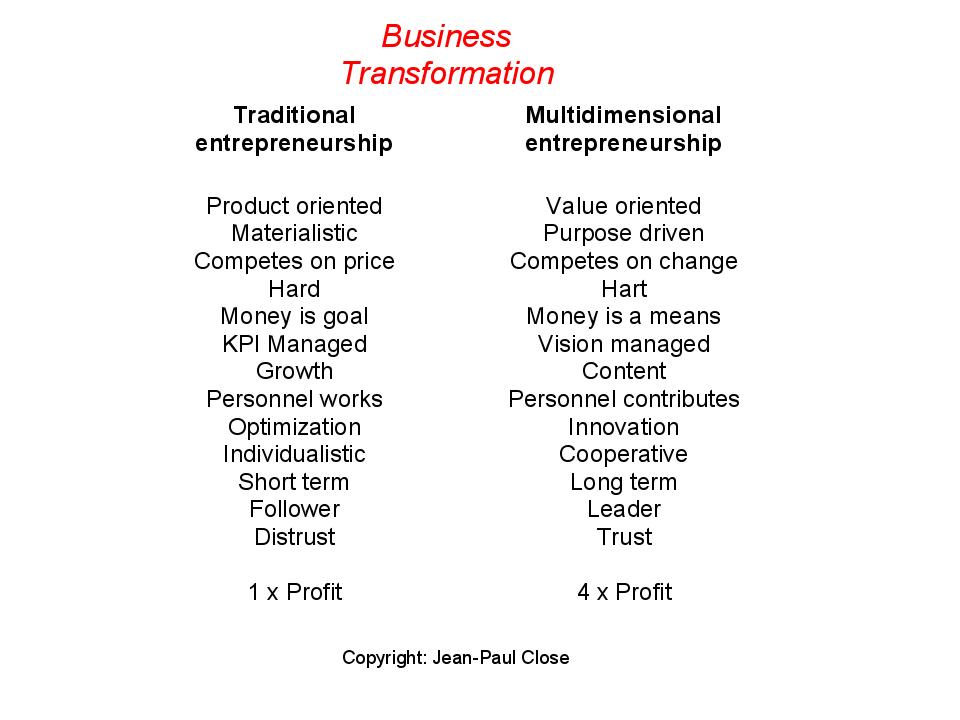
The difference between traditional and multidimensional entrepreneurship is business spirituality
Food
Introduction:
We need food on a daily basis but do not generally produce it ourselves. We rely on the supply system to provide it with abundance. We access this abundance with money which is achieved through labor, sales of property, a gift or debt. There are three mayor issues that make food a huge challenge with tremendous risks for billions of people. It is of key importance to take food seriously urgently.
1. Urbanization
As mentioned in my previous blog “life is…” the growth of human populations in cities is enormous. The city the place where the money systems concentrate which in turn produces human concentrations, attracted by the perceived wealth of such systems. It is a basis of economic growth for the city by making space available for construction of homes and optimizing concentrated distribution of goods and services. Yet from a sustainability point of view the cities are deadly traps for people when humankind reaches its point of singularity, the moment of total collapse of the robot systems that provide us with all kinds of securities, including our daily food.
Cities are speculative centers for financial services. The 3.3 billion people now living in those areas leave no local room for self-sufficiency. The soil is crammed with people, housing and infrastructures. Food has to be grown and transported to the cities and distributed to the people. People who have no access to financial means get their food through the waste of the ones who do have access. But the financial system is under pressure and so are the systems based on financial speculation. Inflation on food is likely to grow as shortages become higher while populations find less and less work in industrialized processes. It all will get more expense while people get less to spend. We are talking about 50% of the world population now that is totally depending on a complex series of (robotic financial) systems.
The tremendous pull of the desperate and concentrated need for large quantities of food is a huge market for the food industry. The fact that people are not active in self sufficient food productivities drives them into the hands of commercial and economic speculation. Being at the end of the supply chain the consumer will pay the ultimate price.
On the other side of the supply chain are the people who live and work in the countryside. The productivity will be concentrated as much as possible in large volumes destined for the mass consumers in the cities. No supply chain will have any interest in the wide spread other, decreasing half of the human population which is outside the huge financial markets. These people have to rely on themselves and produce abundance in places where this is impossible without modern technologies. The cold commercial systems have no moral sensitivity to these populations which will starve, or depend on charity, pay the highest price or are forced to move to the cities too. That is the economic effect that may cause economies to grow but in fact produce humanitarian and ecological disasters.
2. Chain inefficiencies
The supply chain of food is full of inefficiencies. International studies reveal that between 50 and 70% of good food gets lost in the process. Due to the enormous distance between the centralized production and consumption of the food products we see that:
- offer and demand often do not match in which case good food has to be dumped as it does not get to the consumer
- massive production units are growing even more to remain profitable under pressure of economics
- places where massive productivity takes place do not create more labor due to automated processes but do cause local issues like sound, air and other environmental pollution. Local regulation tries to hold this massive centralization process, especially in cattle.
- the transport lines are so long for fresh fruit that the reaping process has to be done on route and artificially at the expense of the quality
- the lifestyle of city consumers is getting more and more demanding asking for pre-cut and pre-prep food in which lots of consumable waste is produced and thrown away. Waste is included in the sales price.
- supermarkets are expected to have a broad selection of fresh and non fresh goods at every time of the day. A lot is not consumed and thrown away when dates become overdue. For the chain it is not important because the consumer pays the price for it. The immorality of good food being lost due to economic life style is huge when considering the hunger and death caused at the other end of the chain.
- modern economies consume more and more “composed” food in which only a smaller percentage is real food and the rest are additives. The consumer looses sight on what he/she eats.
- The chain of global distribution goes through the focal point of huge purchasing entities that act on behalf of the retail chain. All the profitability is placed at the end of the line leaving near to nothing at the side of production. Farmers go broke, investors have no interest in that end of the chain and producers are forced to find ways to increase production through “whatever” means.
The above are the effects of “growth economics”: massification, concentration of power and speculation with shortages along the entire line, at the expense of quality, sustainability, climate, soil, environment, etc. An efficient chain with less loss and shorter distances would certainly solve a great deal of the hunger in the world yet lifestyle and economics stand in the way. This situation is not only immoral, it is unsustainable and will eventually cause a bigger humanitarian crisis than the credit crisis, also in the welfare regions.
3. Climate changes
The above profit centered global food construction have caused landscapes to change in such a way that climate changes have resulted as well. Desertification, extreme droughts, extreme rainfall, floods and other natural disasters are increasingly affecting harvests causing death and disaster across the world with people who have no means to sustain themselves in the speculative world.
But this is only a start. With the growth of the world population and concentration of people in cities we see that food is:
- increasingly difficult to produce,
- increasingly uninteresting to produce due to the financial pressure and risks at the production end
- increasingly manipulated to provide city people with what they want at the expense of public health
- getting more and more expensive due to the speculation of dealers around global shortages
Economics plays a dangerous game over the back of humankind. The focus is to get the money stream towards the focal point of dealership without morality around human needs or rights. It is all called economy of growth but needs urgent reflection (read “killing the robot“) because we are facing humanitarian disaster.
Urgent solutions:
- Eatable cities: we need to get food productivity urgently into the cities. With modern technologies we can create urban farming in a great diversity even utilizing space and vertical surfaces. The positive side effects are that living green uses up the excess CO2 of the cities and cools down the environment making the place more healthy for human activities. “Negative” side effects are the need of a diversity of biological life forms to support pollination and other natural cyclic processes involved in natural food chains. City people have grown psychologically and physically allergic for pollen and insects. We will have to learn to deal with our environment again.
- Reducing the chain’s distance between production and consumption. This will improve the quality of food and reduce the waste production. Waste can be used in local processes, s.a. energy production. Volumes are less large reducing the power position of the intermediaries. Human health will improve while labor related to food production will come back into the local 4 local circuits.
- Improving the climate by creating local 4 local bio-diverse activities proper of the local circumstances. When production and consumption gets close to each other, practically at self-sufficient level the footprints will decrease and logistic chains, with all the negative environmental effects of transportation, will diminish.
- Food innovations to see what else humans can consume than the unbalanced life style diets of today, and how 100% of the food can be used without loss.
All together we will reduce the risks for the human population and improve our relationship with our environment for better health and vitality. The above requires a total transformation of our human organization placing sustainable human progress above economics. Anyone can start to take responsibility right now by trying to address the issue within his/her circle of influence and personal authority. Only then we may be able reverse the Titanical course towards disaster that humanity is heading for right now.
Life is….
Summary
In this blog article I will show that we have made ourselves vulnerable to an evolutionary crisis of our human species by eliminating nature from our daily lives. Especially people living in cities do not stand a chance. The deterioration for us goes so fast that extreme urgent actions are required, especially in the field of bring green life forms abundantly back into our direct surroundings for food, environmental and energetic support. We already suffer the severest consequences and these will reach extreme peaks the coming decades. Key to it all is awareness and then strong action, fast. The good thing about it all is that we (who are left over after it all) come out stronger as a species with a leap in our higher consciousness that will affect the evolution of our species for ever. Chance is that after all that we will not be the most dominant species on Earth anymore but we will not see it as a problem either.
The article
On twitter (@jpclose) a brief discussion developed on the need of a circular economy and the symbiotic values of an energetic society. Now this may be gibberish for most of us but it all started when I suggested that local self-sufficient communities should use the following formula:
Talent + Energy + Purpose = Sustainable Progress + Abundance (Reciprocity)
The “energy” part that I refer to is the labor capacity, motivation and personal contribution of any member of our community. I did not refer directly to the origin of such living energy. But when the word “symbiosis” was used in relation to a “circular economy” I was challenged to put things into perspective, not just for me but also for all those people who were looking at a chain of remarks on twitter within the confinement of 140 characters. Who would make sense?
Symbiosis refers to a relationship between a host and user often also referred to as a parasite. But who or what would be a parasite? Is the human being a parasite of our planet Earth? We would be if we were some alien species that was mining resources away from the planet with the possibility of emptying it. But we have originated (for all I know) on this planet as a species and everything we have done so far (except some minor adventures into space) has been confined to our planet. So we cannot be referred to as a parasite from a material existential point of view. But this is maybe not entirely true. We do use material in a way that it is not circular to its origins. In that sense we would be a parasite, but does it matter? Yes, it does.
Let us look at the definition of “life” in the first place. Life (in a physical body) is built up out of matter (which comes from the planet Earth) and burns up energy to grow and remain alive. So the energetic part is symbiotic because it is used to grow and stay alive and is not given back to its origins. The material composition of a living being is given back in a circular manner to our surroundings when it dies. That material can be reused again, the energy used for life cannot. Not by that species anyway. It does have an importance in the chain of consumable dependencies, as we will see.
That is interesting. So if all life on Earth uses up energy without giving it back where does all this energy come from to keep us going? From the Sun of course.
But the sun throws her energy away anyway and we merely use it to become and stay alive as long as the Sun provides us with energy. This is hardly a symbiosis, it is an interesting usage of the waste of the sun yet we depend on it for life. The Sun is key to our existence from an energetic point of view and the Earth from a material point of view.
Yet we all know that just some sunshine and a heap of material does not come alive just like that. That would be a miracle. Yet at one time it did. Life was injected somehow to make odd combinations of material compositions that had unique living properties: the capacity to reproduce similar shapes and evolve into more complex forms eventually reaching the complexity of the human being. This is an extra-ordinary chain of events that was sparked off with the following formula:
Life = Matter (from Earth) + Energy (from the Sun) + Purpose (the “Why”?)
The energy of the sun is provided to us on a daily basis for at least a few billions years to come which gives us some guarantee of expectation for life to come. About the “purpose” of life we can speculate a lot of course, especially about that one single moment that energy and matter decided to come together with a pre-established and reproducible purpose. Once that had happened “reproduction” became one of the main evolutionary driving forces that eventually started causing the differentiation into different species.
From a mathematical point of view the expansion of matter through the absorption of energy of any source shows fractal patterns. This means that the same shape in phase of expansion reaches a point of collapse and, instead of disappearing, it reproduces itself in the same shape again but smaller. This means that material shapes in particular formats keep the same format by duplicating themselves into replicates. We see this happening in coastal lines, snow flakes, plants, etc. It is a natural process with a great deal of logic from a material point of view but it is not “life” yet, yet it may well be have been the basis for life. The step from fractal expansion (energy + pre-structured matter) to life can be explained by the appearance of a (sub)conscious “purpose” of reproduction.
Here we stand, Human Beings, at the end of this evolutionary line in what we call “today”. We are individually alive by the union of matter and energy and remain alive by feeding ourselves with matter and energy stored around us in nature. We consider ourselves to be the “end of the food chain” and the “most modern version of an extraordinary line of evolution”. From an individual point of view our life is finite because for some reason we die. From an evolutionary point of view we do not die because we reproduce ourselves. So the purpose of our lives is still to remain alive through reproduction.
The human being has evolved with an extra quality added to the formula: Self-consciousness. The consciousness is a condition that made life create forms of matter + energy that reproduce in a conscious, preprogrammed way. This consciousness plotted in earliest genetics is complex and subject to intense studies of science. Yet the human being made it even more complex by enhancing the automation through self-reflection and self-consciousness. We are unique in asking ourselves “why”? Our purpose may still be reproduction but also adds to it the big question why we do this in the first place? So in essence we ask ourselves what life is?
From a simple biological point of life is the capacity to reproduce the same species over and over again. In the diversity of evolutionary patterns this ability has gradually differentiated itself into different species that compete with each other to find enough matter and energy to sustain its diversification. The purpose of reproduction enhanced itself with competition and with competition the quality of adaptiveness was introduced in the genetic coding of the consciousness. Life was getting more and more complex and so was the evolution of the composites in different types of species until we reach the human being today.
The self-conscious reasoning abilities of this species got it to become dominant over other species. Self-consciousness is for that matter a logical consequence of the evolution from a self-preservation point of view through conscious reproduction. It simply enhanced our options in a competitive, highly diverse, living world. It is not strange to assume that over time more and more species will cross the line of self-consciousness and in fact many already did. The competition continues and so does the natural selection through diversification and adaptiveness. So far so good. But now we have reached a point of important reflection. Our species has outgrown itself so much that it has become a competitor to itself. We have reached a point that we do not improve our chances for survival through our consciousness, we diminish it through over-competition and dominance. We are about to reach the end of our own evolution and disappear unless something else happens.
Let us go back to the formula of life: Matter + Energy + Purpose to become aware of the importance of it for our own sustainable progress as a species. What does the formula mean in our practical lives today?
Matter refers to the material building blocks of life. We need matter to grow, survive and reproduce ourselves. If we destroy matter in industrial processes that are not cyclic with our natural environment we gradually destroy our own building blocks of life. It is of key importance to use material for our sake in a reciprocal way with nature. In fact, our surroundings work that way already for billions of years and successfully. We, the human beings, have used materials for the benefit of our tools and wellness but forgot that we need it to survive ourselves. We have reached a point in our global size and lifestyle that this mis-usage of materials is causing stress in our quest for survival. In a circular relationship with our environment we would never pollute our habitat yet we have no circular relationship. We know from other species that over consume or destroy their habitat that they eventually kill themselves. We are in the process of rapidly doing so now.
Energy is needed to keep life together, grow and reproduce. The human being is not capable of producing energy itself so we rely on our surrounding for it. Sunlight is important but the living species surrounding us are even more. They are containers, storage places of sunlight as they transform the light into elements that we can eat and convert back into energy again to sustain our life. So when we destroy our habitat by building cities we in fact take away our natural conversion and storage of solar energy. Living green is important for our survival and we are eliminating it from our lives. People in cities have become totally dependent from energy sources outside the city. This does not just arrive through distribution of fossil energy (which is nothing less than solar energy stored through plants that transformed in a particular confinement where the energy could not escape into the environment) but also through the food distribution and supermarkets. The soil that is used for building dead cities cannot be used for natural energy capturing processes unless we do something about it. The cities tend to overheat causing deceases and behavioral problems among the human beings and lack the natural cyclic ability to sustain life in the cities through capturing and eating of energy. Everyone living in a city has made itself vulnerable from an evolutionary point of view by becoming dependent on energy from outside the city. Current cities hence will never be the basis of sustainable progress, yet will be the source of many humanitarian crises that people in cities will suffer. Placing solar panels in the cities will not help overcome the need we have to feed ourselves with living matter for the sake of the energy contained in it. Urban agriculture is far more important than solar panels.
So while we destroy the habitat of other species we also destroy our source of natural energy for nutrition. We cannot survive with artificial food because we need also the energy contained in the living food that sustains our chain. We have a huge dependency on our environment and need to learn how to sustain a good balance with it. This introduces our next step in our evolution.
Purpose refers first to the micro formats of matter that became alive from a fractal expansion of matter + energy to some early genetic consciousness for the sake of conscious reproduction. The evolutionary pattern not only developed the format of the species into a diversity through competition and natural adaptiveness to new circumstances, it also got “purpose” to evolve. We started with a conscious drive to reproduce and gradually evolved into a state of competitive self-consciousness. Self-consciousness improved the chances of survival for those species that enhanced itself with conscious decisions on life expectations, the creation of tools and dominance over other species which evolved without self-conscience. We increased our chances with self-consciousness as we have seen over time, until we crossed the line of self-destruction.
The next step in the evolution of purpose is self-awareness. Dominance over other species is excellent for improved reproduction of a species but eventually one becomes dominant over itself. There is a point in time that dominance to sustain oneself crosses a line in which dominance needs to be combined with wisdom. We tend to have become so dominant that we cannot sustain ourselves anymore. Purpose hence enhances from competitive self-consciousness to awareness on sustainable progress in which we learn to value matter and energy in a new way for the sake of survival of the species.
Life is important to us and we have now all the understanding we need to sustain ourselves. We simply need to accept the new condition of our evolutionary state: higher awareness, and change our way of organizing ourselves from a competitive way into a adaptive way. This we see happening now around us. All the crises that the human being suffers in material and energetic sense only show us the way to a next evolutionary step in our self-consciousness. Our purpose in life is enhanced by understanding matter and energy for the sake of life itself to sustain our own life. Bringing back nature into our direct local lives is key in this process, redesigning our cities and lifestyles in line with our growing awareness of the need to balance our existence with our universe.
We now know what life is and simply need to learn how to live it to the full, including the next necessary evolutionary step. We need to change to live which brings us back to the newest definition of human progress:
Talent (awareness) + Energy (motivation) + Purpose (our evolution) = Sustainable Progress + Abundance (Reciprocity)
 Sustainocracy, the new democracy