Home » Posts tagged 'sustainability' (Page 9)
Tag Archives: sustainability
YES / Youth Europe Self employment
Through our partner http://globalvisionsharing.net/ we were connected to this YES initiative. We are glad to share it through our network.
The YES Initiative
YES = YOUTH EUROPE SELF EMPLOYMENT
Building a network of cooperative enterprises for empowered employment and sustainable
More than 10 million young people in Europe are unemployed.
With 50%-60%, the rates are the highest in Spain, shortly followed by Greece, Portugal, Italy, France, UK. Traditional concepts fail to bring them into work and so a lot of our generations’ potential remains unused.
On the other hand, the way we work and live changes quickly and profoundly. More and more people are looking for jobs where they can involve all their creative potential and have a sense of purpose in their work. But still, a lot of young people are bound in jobs that restrict their potential through strict hierarchies and old-fashioned working styles, while others are pushed to work towards an early burnout in corporations serving profit as their only goal.
Creating entrepreneurial cooperatives can serve to combine the power of entrepreneurial drive to shape and change the world, and create employment, with the wisdom of co-creation and collective. The YES Initiative aims to inspire and support young people across Europe to join forces, and support each other to start founding cooperative enterprises to reshape the way we do business and work together, creating an economy actually serving society’s needs in a sustainable way. We aim to contribute to an ultimate vision of youth self-empowerment across Europe, e.g. through forming a network of self-governed initiatives or an umbrella cooperative to join the forces of ‘our’ generation.
1.
Apply now for the YES Initiative Gathering in April 2016!
On 7-10. April 2016, the first YES Initiative Gathering will take place at Schloss Tempelhof Community, South-West Germany.
Be invited to embark on a learning journey together with us and set up a four-day laboratory for collaboration, developing concrete projects and a network of mutual support. We are looking for participants (age 18 to 30) from across Europe who are interested to start or support a cooperative and entrepreneurial project in their country, or internationally together with other participants.
Room and full (organic) board costs: 125 EUR for 4 days.
The YES Initiative Gathering is supported by the inspiring Swiss foundation Stiftung Wegweiser, which enables us to offer travel and accommodation stipends to our international participants, where needed.
Please visit www.stiftungwegweiser.ch to learn more about their work.
What to expect from this gathering:
• First of all, an open process with space for everything you bring – your questions, experiences, and ideas – and for deeply connecting with each other to seize the highest potential of the present moment together in a co-creative way;
• Applicable knowledge and experience shared by the YES Initiative Team, other expert contributors and all participants about cooperative entrepreneurship, social business and collaborative decision-
• Insights into the organizational structure, growth experience and daily life of the Schloss Tempelhof community, which has grown into a cooperative of almost 100 members over the past 5 years and employs about 40% of these in a number of small businesses and organizations within the
• Meet inspired people from all over Europe and more and form lasting personal connections to build a network of ongoing mutual support and inspiration.
You should apply to be part of this, if:
• You are actively interested or already engaged in founding an enterprise or cooperative to empower and employ yourself and other young people in your home country or country of residence, or would like to support such a project;
• You want to contribute your talent and energy into such a project going beyond old school hierarchical structures of organization and releasing the power of co-creation and collective
• You have experience with, or want to learn more about, how to co-create such a self governed, values-based cooperative enterprise with a social purpose;
• You are inspired by the vision of an international network or umbrella cooperative to bring together the energy and voices of ‘our’ generation while supporting local projects;
2
• You are between 18 and ~30 years old, from any European Union country, fluent in English language and can cover or fund-raise your travel and accommodation independently. (We have some funding support available for those who need it, please contact us as soon as possible.)
We strongly encourage teams to apply, who aim to create a project together in their home country.
Stay Connected: follow our regular news and updates:
https://www.facebook.com/YES-Initiative-595220683952570 , and get in touch via email: yes.europelnitiative@gmail.com
Our twopence:
Different interpretations of “sustainability”
Approached in 2014:
Somewhere in 2014 I was approached by our Italian partners, the PLEF Foundation, with the question to help the student Caterina Dada by answering some questions on our interpretation of the word and concept of “Sustainability”. The line of questioning was very much based on the old Brundlandt definition of sustainable development.
My own definition
I answered from the perspective of my own definition of sustainable human progress as used to define complex Sustainocratic ventures to “sustain humankind” as a wellness seeking species. Her research was looking at mediterranean countries and the interpretation of the concept in the different cultures. She also had a closer look at the precize meaning of the word used in each culture. The Netherlands is of course not mediterranean but we were a welcome addition to the list.
My own practical approach in the Netherlands is to see Sustainable human progress as an innovation driver, a leadership opportunity for (co) creation of new values for global expansion. The Dutch authorities have been seeing sustainability issues as “a cost” with a challenging demand for change of everything that the Netherlands has grown into and that could now be questionable in terms of sustainable progress. My own approach turns things around and sees the development as an evolutionary chance.
The thesys
Recently Caterina presented us with her summary of conclusions and allowed me to blog them. With great pleasure I share it with you. It is of importance to me too because we look into the expansion of our citizen driven ventures, s.a. AiREAS for the co-creation of healthy cities. The way cultures and demographic, historical differences react around individual and collective responsibility, authority and ethics in value driven progress and innovation, including the effects of technology and communication on behavior and change, will be subject for research and growth development of our concept of “Global issues, local solutions, global expansion”. The thesis of Caterina shows that interpretation of the concept is not uniformly developed around the world, adding an interesting dimension to our own drive for expansion of Sustainocracy.
Conclusion of the thesis
“The different interpretations of the concept of sustainability
in the Mediterranean area”
by: Caterina Dadà
From the research on the concept of sustainability in the Mediterranean area conducted through the survey that you kindly filled in, several agreements, several disagreements but also a wide range of shades. From the analysis of the answer to the question about sustainable development definition (a topic that is implicitly given for granted in a project about sustainable touristic development) almost every association answered in a different way. Some associations consider sustainability as an answer to current world issues, some as a natural evolution of humanity, some others look at it as a method to enhance local territory. Furthermore some associations link sustainability to a decrease of consumption, some others to a transformation of consumption and the Italian one even with a growth of this phenomenon. There is also an association, the German one, who even does not give any definition because it considers sustainability a subjective topic.
This disagreement on the concept of sustainability is well shown in the language. Two different roots at the base of the translation of the term sustainability are used: on one side the root at the base of the Arabic term التنمية المستدامة o “Istidameh”, or of the French one “développement durable” is related to the underlying concept of duration and renovation; on the other side languages such as Italian, Spanish and English translate the concept using the root “sustain”, from the Latin “sub teneo”, which is related to the semantic field of conserving, preventing one thing from changing.
However from the analysis of the remaining answers important agreements also emerge. Every association, for example, agrees on the fact that the present generation has responsibilities towards the coming generations. Another common point is that sustainability concerns the environmental sphere as well as the economic and social one. Finally, all the associations of the Mediterranean area link sustainability with the promotion of local areas and with community engagement.
As already mentioned, there is also a wide range of affinities and slight differences that allows the enrichment of intercultural communication: if, on one hand, common values are needed in order to build up the common ground upon which establishing the dialogue, on the other hand, small subtleties of interpretation allow “contamination” with other points of view without feeling one’s own believes threatened. We could say that these small differences build up a bridge that prevents diversity to become. As a consequence of what stated before, the existence of different interpretations of the concept of sustainability within the countries of the Mediterranean area should not be a concern: once a common vision on some basic agreements has been established, the existence of a wide range of big and small differences in the interpretation of the concept of sustainability, if accepted with awareness, does not make the concept of sustainability too loose or too wide, but it make the concept deeper, richer and adaptable to the different contexts of the real world. And this seems to be the situation of ONMEST2.
Although some disagreements about the concept of sustainability and differences in the organisation and management of projects, associations are brought together by the will to develop their region in a way that is lasting, effective and inclusive: a common view on some aspects of sustainability that offers an excellent. Finally, this enrichment deriving from diversity would be lasting and effective if, at the end of the project, participants will make a formal reflection on the differences they have run into during the collaboration: this would make every association aware of the acquired knowledge about other participants’ values, interpretations and habits, thus facilitating future potential dialogues.
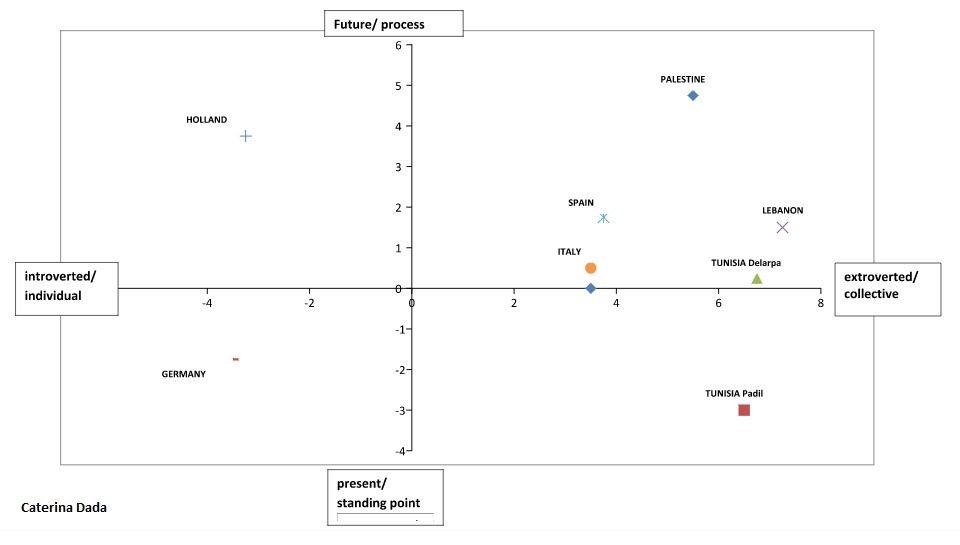
Positioning the interpretation per country input
Europeans are not Euros – visualized
With reference to my previous blog I decided to visualize the situation of Europe by using my model of the human complexities (first published in 2008) expressed by two lines (to be + to do) crossing. These lines symbolize at their intersection the eternal conflict between our actions (to Do) and our moral ethics (to Be). This happens at individual but also at cultural and institutional levels, creating societies in cyclic situations of greed, chaos, awareness development or around wellness. In each country individual people and institutions can be in the different phases themselves yet what I show here is the dominant situation of the majority, not the minority.

Low level of ethical morality reigns throughout money driven Europe
The “saving” of countries in the chaos zone is nothing more than an attempt to pull them back into the area of institutionalized greed at the bottom right hand side. This is necessary to avoid the collapse of others in that area. It is just a matter of time for all to go down in a violent confrontation with ourselves by ending up in chaos all together. Still it is not necessary! There is another route, not by pulling back into greed but taking responsibility for wellness and sustainable human progress.
This desired European situation represents a jump along the line of ethics, responsibility and awareness. This line (To Be) consists of various levels of awareness. At the conflict crossing at the center we situate the area of self-awareness, a point where the pain of consequences are converted into knowledge and conscious understanding. We have gone through this point very often already, as individuals when we grow older and wiser through personal experiences, and as communities throughout time and the same. Chaos is often represented in society by depressions and even wars. Chaos represents a violent letting go period, painfully creating room again for renewal through awareness. Awareness often comes when the blindfold of greed and control is taken away. There is a sincere possibility that this is going to happen again, in Europe and anywhere else in the world. Enough signs are showing and can affect us at any time.
The big difference today with our past is that we can now pinpoint where we need to place society within the human complexities and act accordingly. In the past societies only knew that they collapsed or were surprised by the collapse of something else causing their own. Knowing the 4 areas in the model as a logical sequence we can also position ourselves where stability and sustainable progress occurs. This is a simple ethical choice of educated awareness. The only excuse that people can have in our current Europe is that they have not yet seen this blog. When they do, then they have no excuse anymore to make the choice and take responsibility, as an individual and as a professional. Each of us can take personal responsibility now, get educated to deal with it or we can be asked by their surroundings to do it. At first it takes guts to decide. If you do not you can be blamed in the future. What is worse? Guts now or having to give painful explanations afterwards?

A stable Europe is an educated choice of ethics and responsibility
The choice of ethics of all people involved is to let go of the Euro as the sole dominant goal and adopt European wellness as something to take responsibility for, not by creating it but by allowing it to be created by everyone together. This can only be achieved by working in purpose driven processes in which money is a means, just like anything else needed for this process. It is a choice but once the choice is made the complex process starts to make it happen, based on the new ruling of such wellness based self sufficient European society. This is where the need for a new European constitution comes in. Our current constitutions are based on managing greed and avoiding chaos. We need to work on new constitutions that develop and protect ethical awareness and co-create wellness, avoiding greed.
This cannot be done in the fragmented jobs and self interests of politicians, civil servants, business people, bankers, individual consumers, scientists, educators, etc. In our current society they interact through money based systems and dependencies. None of these institutionalized individuals can take the initiative, if they are aware at all at professional level. Professional blindness tends to rule making people incompetent to ethics and responsibilities beyond their professional position. The only one that can take responsibility is the human being itself, liberated from all previous dogmas, professional limitations and dependencies. This person, any person, on the verge of absolute material poverty in the old world, but totally free from burdens, can invite all the powerful fragmented authorities to come over to the new world together and become instrumental to it.
That is what I did when I created Sustainocracy. I invited all people whom I had made aware through my personal interaction and explanation. They were invited to take that personal choice to position themselves in the new wellness based society and come join me in purpose driven human co-creation processes. In these sustainocratic processes all fragmented responsibilities of the old world are represented together, in equality, without dependence of each other but through the authority they represent (entrepreneurial creativity, regional government, knowledge based science and education, and behavioral cultural populations). They come from a fragmented structure of self interest into a holistic environment of common purpose.
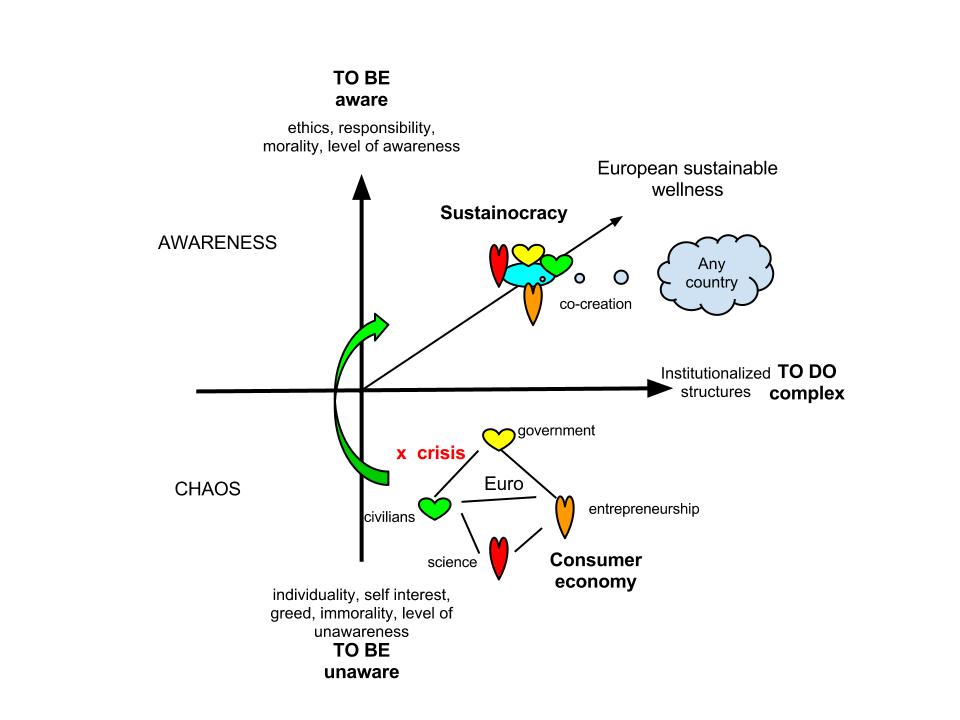
Only people who can actually take responsibility are invited to Sustainocracy, the rest follows through leadership
The city of Eindhoven and province of Noord Brabant is the first place where Sustainocracy is applied in the world of complex societies. The combination of the right people with the right ethical attitude and awareness, on the right levels of authority, were found to make it happen in AiREAS (health & environmental quality), VE2RS (self sufficiency) and other initiatives. It is first step and still far from getting the entire nation or Europe to adopt the process. But with the precedent in Eindhoven en Noord Brabant I expect that more and more will follow.
Of course, the same counts for America and China and any other area in the world.
Now that you have read this, you can choose too and take responsibility accordingly.
 Sustainocracy, the new democracy