Home » Posts tagged 'sustainable progress' (Page 20)
Tag Archives: sustainable progress
Business and Spirituality – The Pyramid paradigm
Today I received the news that my paper on the “universal working model for sustainable progress” was accepted for the “Sustainability and Spirituality” conference in Hungary on Sept 21-23 2012. It is great to gain some international exposure for a method that I worked out in theory and also put into practice in my own living laboratory (The city of Eindhoven and the The Netherlands).
Many of the individual people involved in the related processes do it whole heartily. The institutions that I involve have still a strong dependence in the economic world and often lack sufficient backbone to show a sense of value driven responsibility. Here we encounter the true complexity of the paradigm shift from a money dependent society to a value driven one. The first is packed with institutions that have learned to uphold themselves artificially by the chain of financial dependencies, forgetting often the true original purpose of their existence. The value driven community of my model demands from the entities a commitment based on their true identity and contribution through application of competences and responsibility to the results we seek.
There are two moments when institutions become aware of their mismatch with sustainable progress and their confrontation with their lack of genuine and meaningful identity:
- When they fall over when their financial stakeholders withdraw their support in a crisis,
- When they get involved in value driven, co-creative processes and get blamed of incompetence due to internal bureaucracies, hierarchies and lack of capability to commit to true results.
We see this in most institutions, business, government and public services especially. In the second situation they “may” develop the awareness at senior executive level to transform into something that has a deeper meaning then just financial survival. In fact they start looking for genuine meaning and purpose, which is spiritual process. To take this executive action out of the sphere of abstraction I created the practical and measurable pyramid for multi-dimensional, value driven identity development and positioning of any institution.

Modern 21st century organizations are truly value driven along business and spiritual lines.
When a company or institution remains at the traditional ground level in the base of the bottom triangle, it will develop and maintain an old fashioned a deteriorating strategy of financial dependencies. When it starts rising into the pyramid it will include much more value driven commitments that keep the organization alive and connected to a daily reality. The company become more sustainable if it finds a meaningful link with the surroundings.
To develop a true multidimensional value driven image (i.e. moving up the pyramid) represents a complex transformative process that affects the entire structure of the organization and all people related to it, internally and externally in the surroundings. As the value driven processes reposition the organization in society it will encounter a huge amount of organizations that are trying to do the same. The shake out is intense, driving organization to the kernel of their existence with a challenge to excel in their commitment to values rather than financial growth. Money becomes no issue anymore nor profitability. Profit becomes much more relative to results than just financial benefits.
From a multidisciplinary co-creation perspective only such companies will survive and link with value driven ventures in a sustainable way. It are not the products that make the difference but the set of values the company represents. Since these values represent the multiple inner meaning providing purpose to the commitment there will no customer relationships anymore but partnerships with other competence and responsibility driven institutions compatible with one’s own ideas.
Spirituality involves the profound understanding of a cosmic reality (matter, energy, purpose, finite limitations and abundance, her and now, eternity) and an evolutionary reality (dependence and independence, leadership, adaptability, sustainable progress). Business based on profound spiritual meaning is called multidimensional entrepreneurship. The difference can be summarized as follows:
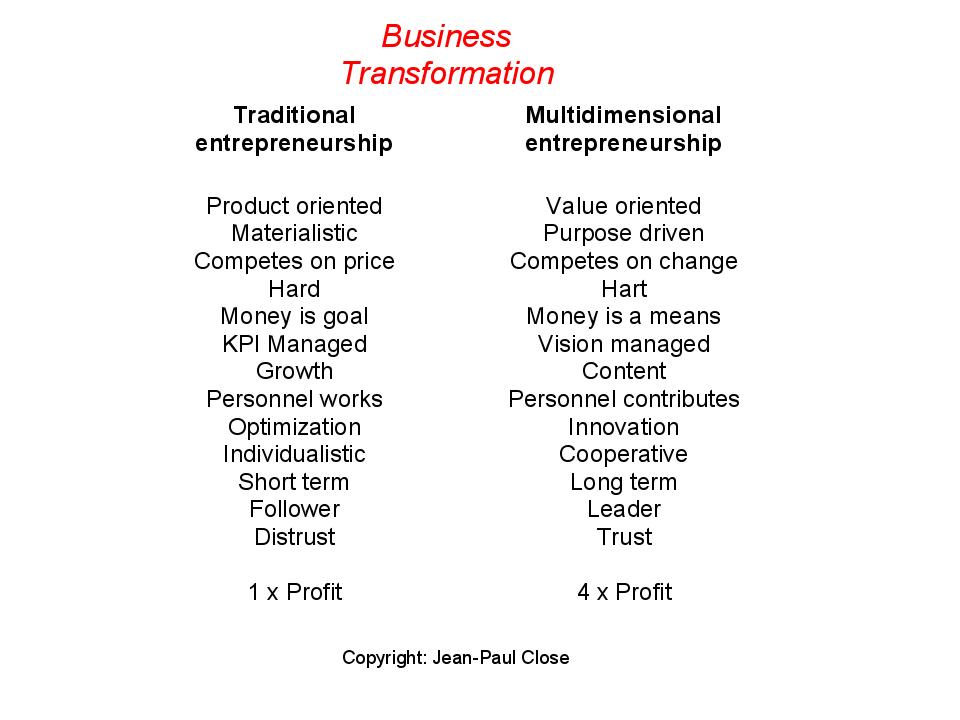
The difference between traditional and multidimensional entrepreneurship is business spirituality
Food
Introduction:
We need food on a daily basis but do not generally produce it ourselves. We rely on the supply system to provide it with abundance. We access this abundance with money which is achieved through labor, sales of property, a gift or debt. There are three mayor issues that make food a huge challenge with tremendous risks for billions of people. It is of key importance to take food seriously urgently.
1. Urbanization
As mentioned in my previous blog “life is…” the growth of human populations in cities is enormous. The city the place where the money systems concentrate which in turn produces human concentrations, attracted by the perceived wealth of such systems. It is a basis of economic growth for the city by making space available for construction of homes and optimizing concentrated distribution of goods and services. Yet from a sustainability point of view the cities are deadly traps for people when humankind reaches its point of singularity, the moment of total collapse of the robot systems that provide us with all kinds of securities, including our daily food.
Cities are speculative centers for financial services. The 3.3 billion people now living in those areas leave no local room for self-sufficiency. The soil is crammed with people, housing and infrastructures. Food has to be grown and transported to the cities and distributed to the people. People who have no access to financial means get their food through the waste of the ones who do have access. But the financial system is under pressure and so are the systems based on financial speculation. Inflation on food is likely to grow as shortages become higher while populations find less and less work in industrialized processes. It all will get more expense while people get less to spend. We are talking about 50% of the world population now that is totally depending on a complex series of (robotic financial) systems.
The tremendous pull of the desperate and concentrated need for large quantities of food is a huge market for the food industry. The fact that people are not active in self sufficient food productivities drives them into the hands of commercial and economic speculation. Being at the end of the supply chain the consumer will pay the ultimate price.
On the other side of the supply chain are the people who live and work in the countryside. The productivity will be concentrated as much as possible in large volumes destined for the mass consumers in the cities. No supply chain will have any interest in the wide spread other, decreasing half of the human population which is outside the huge financial markets. These people have to rely on themselves and produce abundance in places where this is impossible without modern technologies. The cold commercial systems have no moral sensitivity to these populations which will starve, or depend on charity, pay the highest price or are forced to move to the cities too. That is the economic effect that may cause economies to grow but in fact produce humanitarian and ecological disasters.
2. Chain inefficiencies
The supply chain of food is full of inefficiencies. International studies reveal that between 50 and 70% of good food gets lost in the process. Due to the enormous distance between the centralized production and consumption of the food products we see that:
- offer and demand often do not match in which case good food has to be dumped as it does not get to the consumer
- massive production units are growing even more to remain profitable under pressure of economics
- places where massive productivity takes place do not create more labor due to automated processes but do cause local issues like sound, air and other environmental pollution. Local regulation tries to hold this massive centralization process, especially in cattle.
- the transport lines are so long for fresh fruit that the reaping process has to be done on route and artificially at the expense of the quality
- the lifestyle of city consumers is getting more and more demanding asking for pre-cut and pre-prep food in which lots of consumable waste is produced and thrown away. Waste is included in the sales price.
- supermarkets are expected to have a broad selection of fresh and non fresh goods at every time of the day. A lot is not consumed and thrown away when dates become overdue. For the chain it is not important because the consumer pays the price for it. The immorality of good food being lost due to economic life style is huge when considering the hunger and death caused at the other end of the chain.
- modern economies consume more and more “composed” food in which only a smaller percentage is real food and the rest are additives. The consumer looses sight on what he/she eats.
- The chain of global distribution goes through the focal point of huge purchasing entities that act on behalf of the retail chain. All the profitability is placed at the end of the line leaving near to nothing at the side of production. Farmers go broke, investors have no interest in that end of the chain and producers are forced to find ways to increase production through “whatever” means.
The above are the effects of “growth economics”: massification, concentration of power and speculation with shortages along the entire line, at the expense of quality, sustainability, climate, soil, environment, etc. An efficient chain with less loss and shorter distances would certainly solve a great deal of the hunger in the world yet lifestyle and economics stand in the way. This situation is not only immoral, it is unsustainable and will eventually cause a bigger humanitarian crisis than the credit crisis, also in the welfare regions.
3. Climate changes
The above profit centered global food construction have caused landscapes to change in such a way that climate changes have resulted as well. Desertification, extreme droughts, extreme rainfall, floods and other natural disasters are increasingly affecting harvests causing death and disaster across the world with people who have no means to sustain themselves in the speculative world.
But this is only a start. With the growth of the world population and concentration of people in cities we see that food is:
- increasingly difficult to produce,
- increasingly uninteresting to produce due to the financial pressure and risks at the production end
- increasingly manipulated to provide city people with what they want at the expense of public health
- getting more and more expensive due to the speculation of dealers around global shortages
Economics plays a dangerous game over the back of humankind. The focus is to get the money stream towards the focal point of dealership without morality around human needs or rights. It is all called economy of growth but needs urgent reflection (read “killing the robot“) because we are facing humanitarian disaster.
Urgent solutions:
- Eatable cities: we need to get food productivity urgently into the cities. With modern technologies we can create urban farming in a great diversity even utilizing space and vertical surfaces. The positive side effects are that living green uses up the excess CO2 of the cities and cools down the environment making the place more healthy for human activities. “Negative” side effects are the need of a diversity of biological life forms to support pollination and other natural cyclic processes involved in natural food chains. City people have grown psychologically and physically allergic for pollen and insects. We will have to learn to deal with our environment again.
- Reducing the chain’s distance between production and consumption. This will improve the quality of food and reduce the waste production. Waste can be used in local processes, s.a. energy production. Volumes are less large reducing the power position of the intermediaries. Human health will improve while labor related to food production will come back into the local 4 local circuits.
- Improving the climate by creating local 4 local bio-diverse activities proper of the local circumstances. When production and consumption gets close to each other, practically at self-sufficient level the footprints will decrease and logistic chains, with all the negative environmental effects of transportation, will diminish.
- Food innovations to see what else humans can consume than the unbalanced life style diets of today, and how 100% of the food can be used without loss.
All together we will reduce the risks for the human population and improve our relationship with our environment for better health and vitality. The above requires a total transformation of our human organization placing sustainable human progress above economics. Anyone can start to take responsibility right now by trying to address the issue within his/her circle of influence and personal authority. Only then we may be able reverse the Titanical course towards disaster that humanity is heading for right now.
Kill the robot
“only individual human beings can take full responsibility for sustainable human progress. Institutions cannot, they are designed to excel in artificially fragmented self interest” J.P. Close (2012)
Every human made institution is a human made instrument to perform a fragmented function in the huge, global network of organized human artificial structures. Think of a political party that represents and defends a particular line of social thinking. Or a business enterprise that develops a line of productivity. A scientific institution focuses on a line of investigation. A school provides some form of education. A local government that develops a geographical region for concentration of economic benefits and residence of people. Etc. etc.
Our society is packed with such instruments that each have been given an artificial identity of their own, a name, a legal right of existence, to act on behalf of a fragmented part of human interests . They are run by people that sustain the institution for the function it has in society for those who support it. They do this either through personal conviction, to become part of a group for the particular purpose it serves (eg. left wing political parties defend the right of the working class with a particular program of human interests. A sports club unites people with the same affinity in sport), a purpose that represents a personal security in an outgrown sense. Or one joins an institution by choice to exercise labor against a (financial) standardized reward.
None of the modern institutions is fed purely by ideology or specific objectives, like the devastating conquering armies of the past. Modern enterprises are all subsidized with financial means through private or public funding in a money driven artificial society. Money is food for robots. Each organization has the objective to sustain itself through human membership or accumulation of financial means for the benefit of their members. The artificial structure is kept in place only through the unique capacity to produce some partial kind of security to its human members. If the system would disappear, the corresponding sense of security would as well.
People who are active inside such institutions get compensated through a standardized artificial reward that was invented to create open interaction between the artificial systems. It is called money, again a human invention to simulate the value of human effort to sustain the institution. Between institutions one deals with money. Robotic institutions deliver life supporting substances and the comfort of luxury to the humans and humans feed them back with money. While humans develop hunger for comfort, robots develop hunger for money.
All human needs have hence been translated into money and are organized in automated processes presented by institutions chained up in lines of interdependence and development of efficiency as well as dynamic economies of robots interacting with each other. We depend on robotic structures for our life’s resources, like food, water, clothing, shelter and securities while we have access to those life’s resources only with money. The power of money linking the biological human life form with the artificial robotics is huge due to the way human have made themselves dependent on the artificial system and therefor on money. Money is only obtained if one helps one or more of such institutions to stay artificially alive either by working in it or by making a debt. We have placed our entire existence in the hand of robots.
In a competitive money driven environment human beings do not seek arguments for human progress, just to sustain any robotic institution and even make it grow. Robots started to live a life of their own, driven by the interests of all the people who depend on it. Inside the artificial structures equally artificial hierarchies of power are developed to structure the way the institution is kept alive, by controlling its supportive community of people that sustain it. The robot leads and the human being is a slave to it. It becomes of vital interest of people to do whatever they can to sustain the robot, not question its existence.
The situation is even more complicated because such robotic institutions rule countries, establish laws over people, create relationships among each other, produce money and start competing. From a human perspective the institutions can be instrumental of a number of human securities, as if it were a huge body guard, providing all kinds of services. We call it democracy if we can vote together how the robot works. It is quite logical that we want the robots to provide us with abundance of everything and if it does we will sustain the robot with great pleasure. We do not have to take responsibility anymore, the robot does and we just have to make sure that it keeps serving our benefits.
Now all countries have their own robots and there are so many different robots serving all kinds of human interests that the robots have started to absorb everything they need to keep fulfilling our demanding needs. Robots do not think, they just perform their tasks as efficiently as possible because that makes it sustain itself through the human reward it receives. The robots provide abundance at the expense of overall environmental destruction in the name of lifestyle.
We see it now happening but our dependence on the robots is so large, our greed so big and our inability to become self sufficient in basic needs so large, that we cannot turn it around anymore. It has been all so common and easy to serve the system, justified by perceived luxury of its rewards. Now it seams too late. Three quarters of the global human population is so extremely vulnerable that the robots need to be kept in place to avoid a humanitarian disaster. But the robots cannot be kept in place because they have damaged the natural cyclic resources needed for organic survival. The consequences can be seen around us in the form of pollution, shortages, etc. Robots are likely to stop functioning and we perceive that as a crisis. Every time a robot malfunctions we feel the securities that it provided disappear instantly. That is what is happening now. Massive amounts of money will not solve the problems.
Since money is the artificial means to have access to the services of the robots one will need more and more of it to receive a share of the ever decreasing functionality of the robots. When money is not available anymore the robots will be asked to fight among each other for the sake of the little remaining resources. Human beings are asked to manage and conduct those fights supporting their own robots at the end of their mechanical life cycle and this will go at the expense of human life again. The peak of comfort that we have achieved by entrusting our lifestyle to robots is likely to be compensated by a deep valley of human suffering due to the blindness to the consequences.
We have grouped ourselves around the robotics of our human organization by centralizing our living environment in cities and working environment in factories and office buildings. Now we find out that these huge concentrations of people become the hot spots of human disaster when the robots fail to serve them and they face the need to take care of themselves, humans serving humans, having to rely on the natural resources that we banned out of our vicinity.
What can we do about it? The first thing to do is wake up and become aware of our own vulnerability when we look at the distance between our current lifestyle and self sufficiency? Secondly we can look at ways on how we can bridge the gap by letting go of dependence and working on self sufficiency by taking personal responsibility. You could even decide to move to the countryside and learn how to provide yourself with your basic needs. You can decide to stay in the city and apply modern technology to your surroundings that helps you become self sufficient in a more complex environment, such as a city center (urban farming is growing in popularity), etc.
But the most important thing you need to do is to stop supporting the robots. Kill the robots by letting go of your dependence on them. Without human support the artificial system die, no war needed. Start believing again in your own human strengths and capabilities, and stop feeding your reliance on some external artificial self-sustaining power structure. Start working together with your fellow people on a self supporting attitude with the resources you have at hand locally. The more you depend on the system the more vulnerable you are to be surprised by the circumstances. Become owner of your own life and act accordingly. You cannot eat or drink money.
You may find that by taking this decision the systems will try to capture you back into the robotics, even with legal means that have been created to support them. It is up to you to fight the system. The robots are now a threat to humankind while humankind is dependent and all those who support or manage them should reflect about the moral justification of their actions.
As soon as you have stepped out of the system and made yourself in charge of your own life a next step will become an option: how to use the robots for humankind’s sustainable progress. But that will only be an option for those who seek no power nor dependence, with humble willingness to become the center of true human sustainable progress. That I will explain in a next blog.
 Sustainocracy, the new democracy