Home » Posts tagged 'sustainocracy' (Page 106)
Tag Archives: sustainocracy
It’s like playing football
Sustainocracy is like playing football. You need four things: a ball, a goal, results through some sense of competition and room to play. This metaphore is surprisingly accurate to get different disciplines of people to work together in a result driven way. Sustainocracy is about results in human based progress, defined by sustainable progress placing the interests of human beings at the kernel of the activities. It requires team work of different disciplines. This can only be achieved if the practicality of the four football needs are respected.
Putting together a successful sustainocratic team requires therefor a bit more than an abstract humankind saving mission. The humanistic overall goal may be clear but what makes a team come together to play and eventually score?
The ball is the clear priority that the team needs to work with, a reason. Throw a ball in a court, a garden or field and people will come to kick it around. In the sustainocratic team of AiREAS the ball is represented by the environmental quality of a city. What is needed to make the city environmentally healthy for human interaction and residence? This defines the game and goal but the ball needs to be something touchable, something that can be passed between the players. In the case of AIREAS this became the highly specialised measurement system of fine dust making the “invisible visible” for all. Certain types of people appeared to play.
The specialised network of high tech hard and sofware is indeed already a mission that excites certain institutional people. But having a ball to play with what will make them win the environmental battle? After all, environmental quality is not just achieved by implementing technology and introducing new regulations. This usually gets people to kick the ball around without ever scoring. Bureaucracy we call that.
It also needs public awareness and behavioral changes. The competition is created by asking the institutional and civilian world to come up with solutions and work together. We have now two teams that interact by playing the same ball, with the same objective but with different talents and tactics. The institutional players with power, products, systems and regulations, the civilian world with awareness, behavior and adaptive creativity. Which will achieve the most goals? And will they compete or play together? Both worlds fear eachother but get excited when challenged to play the environmental game together. In the end everyone wins of course as the game will be never ending while success and bad play will show through the measurement system with me as independent judge.
******
Another example is performed by a colleague trainer and friend. He invites parents with their children to workshops and gets them to work together on some design made of wood. They follow the same learning routine as in AiREAS to gain teamspirit by playing the metaphorical game. The hamer represents the ball (instrument) and the object they have to make represents the goal (a table, bird house, chair…..). This is fun to do but gets exciting when father and child try to excell eachother in dispute how to do the work best. Or when they work with other parent/child combinations at the same time. There is no need or desire to create a formal competition because the human spirit does this itself, simply by comparison. “How did you do it?” “Show me yours”, “No dad, if you do it this way you achieve this”…..”Wow, yours is great”.
Admiration, comparison, positive feedback, recognition, celebrating accomplishments are positive triggers of human interaction and teamwork. Using the football metaphore in team building is useful to determine what is needed to get to great accomplishments. And if those goals are value driven for humankind then you play the City of Tomorrow game, the Sustainocratic way, improving the world with every play.
The last issue needed to succeed is “space”. When playing football you indeed need a field or play ground to kick the ball safely with out hurting or damaging anything. In the metaphore space also refers to the freedom to bring people together to play. In AiREAS it is made possible to play but other sustainocratic ventures have failed because of some old financial interest blocking it. In case of the parent/child relationship real life often does not automatically create space for parent and child to interact as a team and become constructive. Parents re often too occupied with work and other worries.
In all cases it is necessary to create or demand the space necessary to allow the team to assemble and play when a ball is there. Once room is created others may join in making the game more fun still.
Remember these four football issues (reason, objective, results and space) when in need of a team to tackle any issue. You may even become a champ by doing so. Then the game becomes even more fun as it will attract an audience. When people get applauded by the surroundings not even the sky becomes the limit.
How does Sustainocracy work?
Sustainocracy combines the uniform institutional and personal goal of sustainable progress with the democratic process of how to get there. This simple definition implicates a global change in dealing with complex human issues. Sustainable progress cannot be achieved by any single authority. It forcefully needs the value driven cooperation of all institutional authorities together, not in a business economics setting but one of multidisciplinary responsibility sharing.
In our current society of economic, money driven relationships between institutional identities (sales of products, taxation, subventions, contributions, loans, debts, pensions, insurance, etc) such multidisciplinary ventures can only be started by new age pioneers. The reason for this is that Sustainocracy forcefully needs to break through the current change of relationships, dependencies and hand over of fragmented responsibilities to a setting where the human authorities take on the same responsibility together.
Sustainocracy hence has therefor a few characteristics that are strongly different to current complex way of structuring society:
- Institutional power is used to enhance and expand Sustainocratic initiatives to cause greater affect in the community,
- But institutions do not lead the initiatives because they cannot. Institutions are instruments to progress not the cause of progress,
- The pioneer is responsible for defining the complex goal of a Sustainocratic pool of institutional powers. The definition is necessarily related to sustainable human progress because any other objective would not get institutions to work together in an open, transparent and long term format. They have normally differentiated interests that can only be shared and combined in settings of sustainable progress. Examples of a Sustainocratic definition:
- Local air quality, public health and regional human dynamics,
- Local graying/ aging population, self sufficiency, health care and housing,
- Education, social cohesion, cultural diversity and neighborhood development,
- Local energy and food, public participation, self sufficiency, housing and quality of life,
- etc
- A Sustainocratic process is necessarily local 4 local, involving all local citizens,
- Therefor a sustainocratic initiative always involves five elements:
- The pioneer
- The local government (geographic design and public money)
- Creative entrepreneurs (local as well as multinational)
- Educators (science and school)
- The local population (behavior, contribution, participation)
Sustainocratic processes are always purpose driven. They are labeled with an identifying name (s.a. AiREAS, The STIR Academy, VE2RS, etc) to which people and institutions can relate with motivation and commitment. The initiatives are formalized a s new age cooperative entities established for the measurable humanitarian local progress.
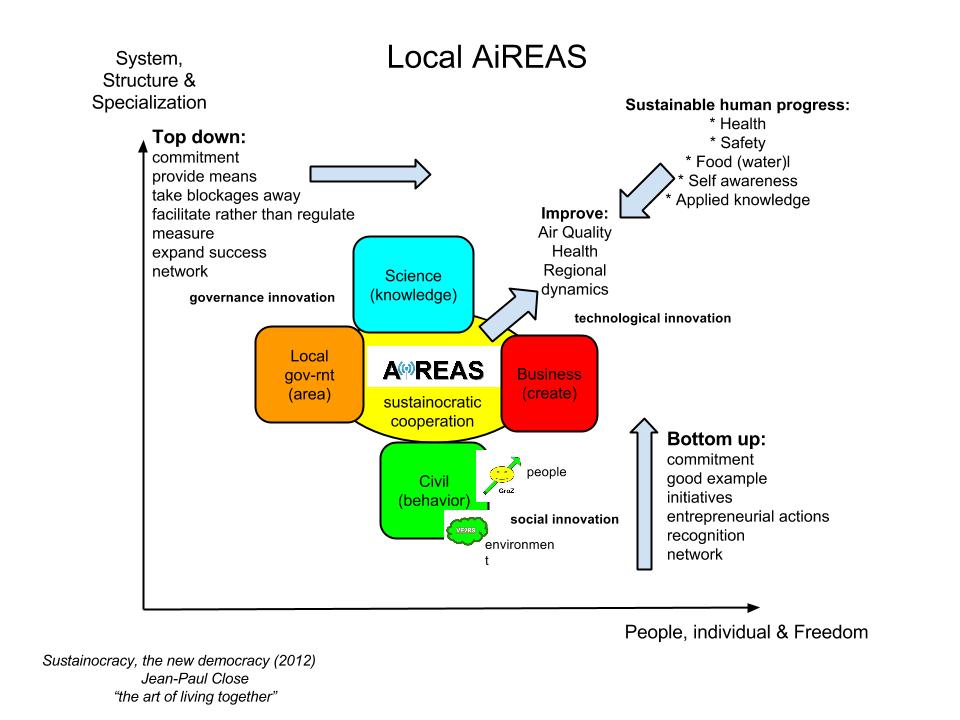
Example: AiREAS as first sustainocratic venture
Advantages of Sustainocracy:
Any key local humanitarian complex issue can rapidly be addressed and solved due to the multidisciplinary format of the coalition, involving directly all necessary authorities who can be called upon their unique competences and authority.
A Sustainocratic group is purpose driven, not money driven.
Sustainocracy eliminates all bureaucracy out of decision making since all parties are directly involved in instant decision making.
Sustainocracy is not a separate institution. It is a purpose driven multi-disciplinary partnership. When the complex objectives have been achieved the partnership will dissolve again.
Sustainocracy demand the general public and scientific know how to take responsibility too, not just the traditional operational parties of government and business. These two authorities are important to avoid the traditional tunnel vision of government (cost saving and bureaucracy) and business (volume sales).
Sustainocracy is result driven within the context of its purpose. That means that reciprocity for all partners is shared when value has been created, not before. One wants money, the other recognition or savings. Reciprocity is not just an economic element but much more complex and varied allowing a diversity of partners to work together without competition.
Problems of Sustainocracy
The problems we encounter are:
Pioneers need to be well trained in their role of connectors of many disciplines. They play a key role to maintain equilibrium between the participants but have no directive power position, yet are extremely influential. They are equally purpose driven and not “paid” as consultant or director. The pioneer are included in the reciprocity program claiming time and responsibility from an individual that is only compensated if results are obtained. Not many people have the talent nor the drive to take this responsibility.
The institutional parties need to adjust their mentality and commitment to a totally new mindset. Government used to be the powerful party “in charge” because of their authority and governance over public money. They need to step back and accept the authority of the team. Business needs to learn to take responsibility with products, services and development for the end result, not just the sales of products. And so on for each of the parties. It takes a lot of “getting used” to this way of working and set aside the old way of behaving in a group.
“Money” is always an issue because of its standardized importance in our current society. It is a very big step for all involved to learn to see real value as something different than money. In the reward we also need to learn that pay back is sometimes not expressed in money but in different values.
The above difficulties are very demanding for the people involved. They can be partly overcome by defining short term results that show each involved what real reciprocity means. The longer it takes to come up with results to easier it becomes for the group to loose faith and fall apart. The difficulties can also be overcome by getting institutional people (executives) on board who know what they are dealing with (trained). They will not have the burden of adjustment and set out the provide speed to the processes. When this happens decision making is instant and execution also. Reflection becomes an issue for progressive new decisions.
Conclusion
Sustainocracy is a unique, modern way to address key issues for human sustainable progress when crises affect a community. All institutional parties are asked to take responsibility together in true value creation. But they have to be prepared to focus on the competences and authority, not their economic dependencies. Money is not a goal but a means. The purpose is the goal and reciprocity is found in institutional continuity based on true and recognized competences.
Sustainocracry is unique because it uses the very same forces that interact in the same society in crisis however in a different format of interaction. Both worlds can co-exist perfectly in which each players decides for itself when and where to participate in economic and sustainocratic processes. In one money and growth is placed in the center of policy making and in the other the human being and progress.
Pioneers of a new world
Introduction
This has become a long blog again. I introduce a solution for all humanitarian problems in the world and all related crisis. It requires a lot of explanation because it involves all current institutional powers in a new setting. And finally comes back to the power of our individual selves. Soon I will publish a booklet on the issue but my sense of urgency is so big that I cannot wait to reach out to those of you who can become already changers of the world after reading this. For humankind it could be the most important blog ever as long as I can reach out to you soul and make you aware. Please take some time to absorb the information and place your own self in perspective. See what happens when you suddenly realize that humankind could get to depend on your own next steps. It is fun AND a huge responsibility. Can you handle it? That is up to you. I am ready to help you when you are.
The destructive force of our institutions
Over the years we have grown dependent on institutional activities because of the impact they have on our lives. The unique capacity of an institution is that it can enlarge a single activity into huge proportions. A single human being cannot do that. We have grown to depend on the institutions because they provide us luxury articles, financial means, governance, jobs with related salaries, scientific knowledge, etc.
Most current institutional structures of today were born already some 150 to 100 years. The conditions in the human world were right back then to allow such fragmented focus to occur with the related growth of institutionalized power. Still now the discussions in this world only talk about growth and more growth as a single sign of strength. Due to this fragmented focus these organizations can only take responsibility for their own small field of highly specialized attention. They started to relate via this specialization to compliment each other in their objectives. A manufacturing company in the 19th century would have its own transportation system, energy supply, uniform making unit for their personnel, etc. But gradually in the 20th century the further specialization allowed institutions to focus on their core business and select suppliers to outsource their surrounding needs. In the middle of the 20th century the patchwork of specialized institutions because so large and so competitive in their mutual interaction that a chain of dependencies appeared and with it new techniques of managing the chain.
Due to the focus on fragmented institutionalized interests the awareness for “the whole” disappeared entirely. Things like pollution, usage of natural resources or humanitarian issues became subject to competitive policies. Institutional survival became more important than the consequences of such survival decisions. Non of these consequences could be challenged by any single authority. What authority should do that? A local government has no global authority to regulate. Yet they do have a dependence for economic growth, imports and exports as well as labor and tax perspectives. Global authorities on the other hand have no formal jurisdiction in the countries or in the institutionalized business enterprises and banking policies. They may have a bureaucratic influence on awareness (like VN resolutions) and certain fragmented authority on addressing common institutionalized interests (like military actions in Afghanistan or embargos on certain countries).
As fragmentation of power grows further, the chain of interdependence becomes more complex. Despite the competitive fragmentation and specialization each individually could grow due to globalization of markets. The competitive shakes outs would start the intense optimization processes in each of the institutions to remain competitive and attractive in the chain. As time went by we see each of them weaken in quality and strengthen in financial speculation. CEO’s and Country presidents became bankers and debt managers rather than protectors of value driven identities.
The overall shortage of resources started to demand its toll on the global organization of giants that could not feed themselves anymore on natural value creation. The liberalization of money from a valuable collateral (s.a. gold) allowed speculation to flourish as only remaining resource to sustain institutional fragmentation and growth. Access to the available resources became available to the highest bidder. Countries who wanted their populations to survive while active with some labor and high debt programs had to grow their debt themselves. The growth of institutions is still the blind common culture of executives and politicians but growth is already for a long time not possible anymore. Not as a natural process of value creation anyway. The only financial growth that can be achieved is through speculation around shortages but this is controlled only by the powerful and has nothing to do with the general public anymore. They are just manipulated to accept a debt they did not ask for and that solves nothing. Humanity is in the hands now of institutionalized, destructive, fragmentary focused financial robots that have no morality nor sense of responsibility except their own self interests, creating crisis after crisis, chaos upon chaos.
The pioneer
Now we go back to the beginning of this blog. The true power of an institution is its possibility to enlarge any fragmented specialization to huge proportions. Their handicap is that they cannot take responsibility other than for their own piece of specialized power. That goes for regional governments, business enterprises, educational institutions, etc, etc. None can take responsibility for true human values yet they all have interest in it because they are part of the institutional survival. Without consuming, demanding, debt creating, voting or working public the institutions will eventually die.
So in one way or another any institution has the intrinsic need to connect again to integral human values but cannot do that for the whole, just for a small part of it, competing for it. So when we talk about the taking of responsibility for human sustainable progress no one can or will stand up to take responsibility other than maybe some local politicians. They tend to promise responsibility that they cannot handle because it s beyond their control. They try to solve it in four year periods which many do not complete, by raising taxes and public debt with solving anything.
Only one can take responsibility and that is the pioneer. It seems funny that with all those incredibly big and seemingly powerful institutions the sole responsibility of human progress could lie in the hands of a bunch of pioneers. But it is true and makes perfect sense.
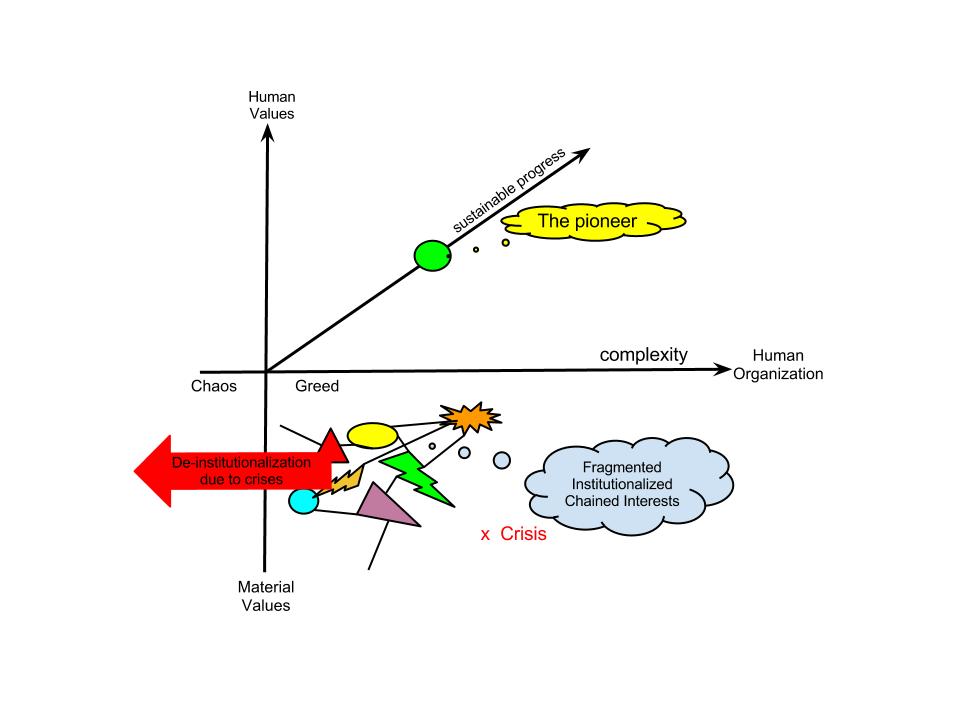
The pioneer positions him/her self in the field of sustainable human values and progress
The robotic institutions can be our enemy when we see their unconscious destructive force while preserving their self interest in their fragmented world of material power, but they can become our friends when we can get to use their institutional powers of expansion in a proper way.
Thanks to the de-institutionalizing powers of a crisis, in which the organizations need to go into survival mode, decreasing in size due to the lack of resources to draw from, they become also often sensitive for new ventures and responsibilities in which their field of expertise can excel. This is an opportunity for the pioneer but also for the institutions. How does it work?
The pioneer takes responsibility for a complex humanitarian progressive proposition. He or she subsequently invites all necessary institutional powers to help enlarge it.
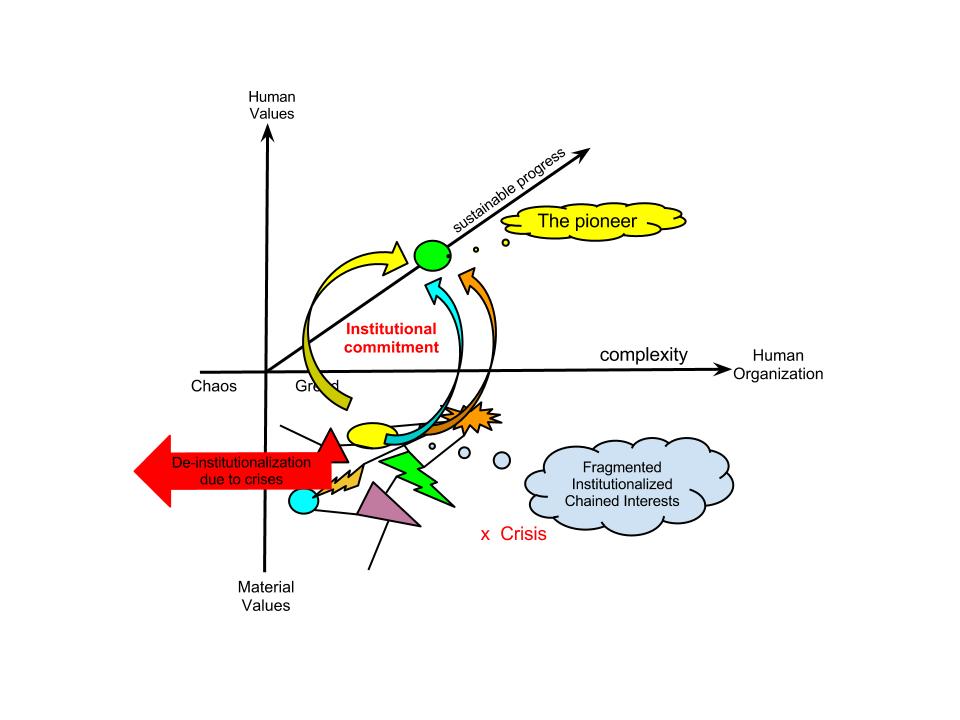
Institutional powers can be used to enlarge humanitarian interests
The role of the pioneer is to define complex progression based on human values. When inviting the institutional powers to join the pioneer they are asked to enhance the responsibility with their own institutional powers. To make a holistic proposition of human values one cannot just rely on a single empowering institution. If that were the case the institution would have done this already by itself. The complexity of the whole is that it needs the entire mix of authorities of a society to become effective, with the pioneer sitting bang in the middle.
Sustainocracy
In sustainocracy the pioneer takes the lead and invites the four key authorities that are needed to expand the human values into common wellness and progress:
- Local government
- Technological innovators
- Educators & scientific researchers
- The local public itself
Drawing all these authorities from the field of fragmented interests, they unite in the field of common responsibilities together with the pioneer. Seemingly contradicting interests suddenly start complementing each other as the focus lies on progressive goals outside the scope of self interest. The self interest can be complied with only if the common interest is achieved. This forces the authorities to enter into co-creative processes by trying to understand each other and join forces. The pivot is the pioneer who safeguards the humanitarian interests in a battle field of institutional giants.
In the Netherlands I have started experimenting with this pioneership. It resulted into a series of initiatives that are proving their value from a humanitarian perspective but also the institutional positioning into a new world. Each of the authorities has a chance to excel in its own field of competence, not by competing or creating interdependence but by combining the individual competences into a common goal. Since executives and personnel in such institutions are human beings too we find that the sensitivity of the hard material robotics become more soft to address human wealth issues through new types of policy makings.
The institutions change slowly into supportive and facilitating identities that gather new public admiration. They truly become extenders of human progress to which they attached their fragmented by highly specialized competences with new perspectives of survival first but institutional sustainability in the long term. The field of chaos can now be managed with the perspective of an institutional alternative, not just to create value but to contribute to a greater cause, enhancing it and expanding it.
Training school
To extend these finding globally I have started a training school for sustainocracy, training pioneers as well as institutional executives on their new age responsibilities and challenges when entering the field of sustainable progress and all related differences with the old paradigm.
http://www.eventbrite.com/myevent?eid=3558815513
Pass the word and help change the world.
 Sustainocracy, the new democracy