Home » Posts tagged 'transformation' (Page 20)
Tag Archives: transformation
Keeping it short when you have a lot to say

Freedom
We are in the “keep it short” kind of world. People have a short span of attention nowadays. If interest is not captured instantly we loose their interest. What if we have the tendency of writing much text to make our point? I do for I have a lot to say. Do people want to listen? Some do, some don’t. Should that worry me when blogging?
Well yes and no. Let’s try to reason through my own inner battle.
Yes, it should worry:
Churchill once wrote to a friend “sorry for writing you a long letter, I had no time to make a short one”.
Churchill is known to have been a person who had many points to make. New issues take time to explain because they are out of the ordinary. Change is never very democratic. Why would you present something out of the common understanding of your public? Because you are convinced that it is important.
In the world of the ordinary we take instant decisions. Our attention is minimized due to habits. Surrounded by impulses that want our instant attention we tend to communicate in bullets if we have something to sell. Those bullets are delivered with fast emotions such as fun, excitement or anxiety.
Our current world is based on transactions and we are the target.
But I have nothing to sell!
I invite people to a specific understanding, a new worldview and social structure that may offer better perspectives and securities than where we come from. I am asking them to join! That takes a bit of explanation. And it requires an audience that is willing to consider change. But how do I get the volatile surroundings to pay attention when it reacts instantly to anything as if it were a sales pitch? Churchill is suggesting that I should take time to describe complex issues in a concise way. He is right.
The general public is not at all interested in what I have to say unless it affects them personally. The whole secret is “the audience”, not me!
I need to attract those people who are open for change. So if I “sell change” the pitch should be short and maybe adventurous. Those who “buy” may just have that little more patience with me to try to understand where I am heading for and what’s in it for them? Then they may even tell others.
E=MC2
Einstein said: “If you can’t explain it in a short way you probably don’t understand yourself.”
Wow, that’s confrontational and a challenge. I often tell people that I write books first to see if I can put my own understanding into words in a structured way. If I can’t how on earth can I explain others? If I can then I have already a book to give away. In a way a blog is that too. A test of my own understanding. The reader is a victim of my own learning process. Can I do this to you? Well, that is up to you to decide. Some may find a morbid kind of pleasure in watching me struggle. Maybe because they recognize their own in me?
But can I shorten it?
Einstein’s E=MC2 is indeed short but do I understand? No, but that’s not the point. Einstein understands. He makes it available to us as a simple to remember formula whether we understand it or not. We only accept that it is important and can subsequently spend the rest of our lives trying to understand the meaning with or without his help.
I made one of my own:

Success is more than just “growth”
Other’s say that a picture says 1000 words, so I also make a picture that says the same as the formula:

Human complexity
Do you understand? Maybe not, maybe yes. You can trust me that I understand as I work with it on a daily basis addressing the key issues of human evolution today, the crises and how it affects business, society, politics etc.
So yes I should worry because it takes this flash second to enter a human being’s perception and remain there for ever, or never get in at all. My biggest worry, if I understand myself (thank you Einstein), should be to take time to be short and show that it is ME that understands while inviting others to figure it out too.
No, it should not worry me
Prof. Jaap Ham (University researcher and department director on “perception”) said to me: “Awareness? Nothing awareness! People do not change behavior through awareness. They massively copy behavior of others”
Who am I writing for? I have nothing to sell. My blogs are to inspire people to the new world of absolute spiritual freedom and take responsibility from there. When I describe the new world to people I just invite them to read my own adventures and experiences.
My texts tend to be long. But Jaap suggested that I have to learn to distinguish long text by considering what I want to do? Do I want people to become aware? Or do I want them to follow me?
Well, I do understand what Jaap is saying but also believe that the ones that we blindly follow do have a sense of direction through awareness. So I need both.
The 10/80/10 rule applies:
10% of the people are always in for change and follow blindly (adventurous)
10% of the people are never in for change and block with arguments and obstacles (conservatives)
80% haven’t a clue and follow the one that convinces most in the “sense of being part of something and not being left behind”.
So for me there is a bit of both, the awareness of the 10% adventurous and curious, and the 80% potential followers who think it’s a good deal. The conservatives we do not pay any attention too no matter how hard they shout. As a “changer” we always have a lot to prove, especially to ourselves. But never to the opposition who always tends to be right basing themselves on wealth from the past.
In this mix of progressive optimism there are some dangers when we apply long texts to explain what we are doing:
Preaching: the danger is that I become a preacher rather than an inspirer. People don’t get aware through preaching. Preaching is another manipulator telling people what to do. Awareness comes when they are inspired to try something out and learn in the process.
Ego: the danger is that I try to convince people that “my way” is better. People don’t follow ego’s, they follow out of self interest.
So when writing long blogs they should tell stories that inspire some to set out and try it their own way and others to follow. It is only “my world” when I am the only resident. It becomes “our world” when the population grows. The stories may have started a long time ago about me but should slowly grow to talk about others and “we”. Interestingly it does in reality. I often take the initiative and after a while others take over who do a better job than I. Then I have nothing to say anymore, just to enjoy. Shorter than my silence is impossible ;-). Just maybe this again:
Freedom for you too!
Last but not least
In “my world” we have accepted the absolute freedom of the human being as a uniquely born living entity of the universe. We surround ourselves with a commitment to life and structure our sustainable progress through a new democratic complexity called Sustainocracy. In my own surroundings I find myself in the lucky circumstances to be able to apply this freedom also to the transformation of society and economy with support of scientific research, governmental organisations and business enterprises joining in as experimenting members and participants. I write about this as a transformation of the past towards the future in which we let go of something dominant to replace it with another dominance. But……
We (I) have to realize however that not everyone in this world can safely free themselves from the reigning old human dogma’s and impositions. Individual freedom is a spiritual breakthrough of the consciousness but the new, purpose driven democracy is a collective evolutionary process that may show important differences around the world, even where the freedom of speech through Internet reaches out without being seconded by the local circumstances. So telling my story may initiate individual processes in places where the surroundings are more hostile than others. That does not mean that the Quantum Leap described in the previous blog does not happen, it just may be a more dangerous and less obvious process.
Why only sustainocracy can save the human world from disaster
The current economic structure of our global society is based on consuming goods rather than using them. What is the difference? And why would the consumer type of economy be obsolete? And why should it be replaced by a user type of economy? What consequences does it have for our daily lives? And what consequences will we suffer if we do not change?
Throughout the explanation I will fall back on a useful example: mobility.
Sustainocracy is such a purpose driven economy based on usage. But first…
Consumer economy
In this type of economy we simply purchase whatever we need for a living. This means that we take ownership of the goods. Consumer economy has evolved ever since the start of industrialization. In order to make products available to the consumers around the world we need to install an infrastructure for manufacturing the supplies, retail outlets, waste management of packaging and obsolete stuff, financial systems for payments, etc. The relationship between the consumers who purchase daily needs, suppliers offering products and services, money systems providing cash and loans, governments providing infrastructures and regulations, is based on a composition of value added resources (products), logistics (distribution), financial profits and taxes.
A business network that sells the products focuses on profitable consumption, the government that provides infastructures concentrates on taxable consumption.
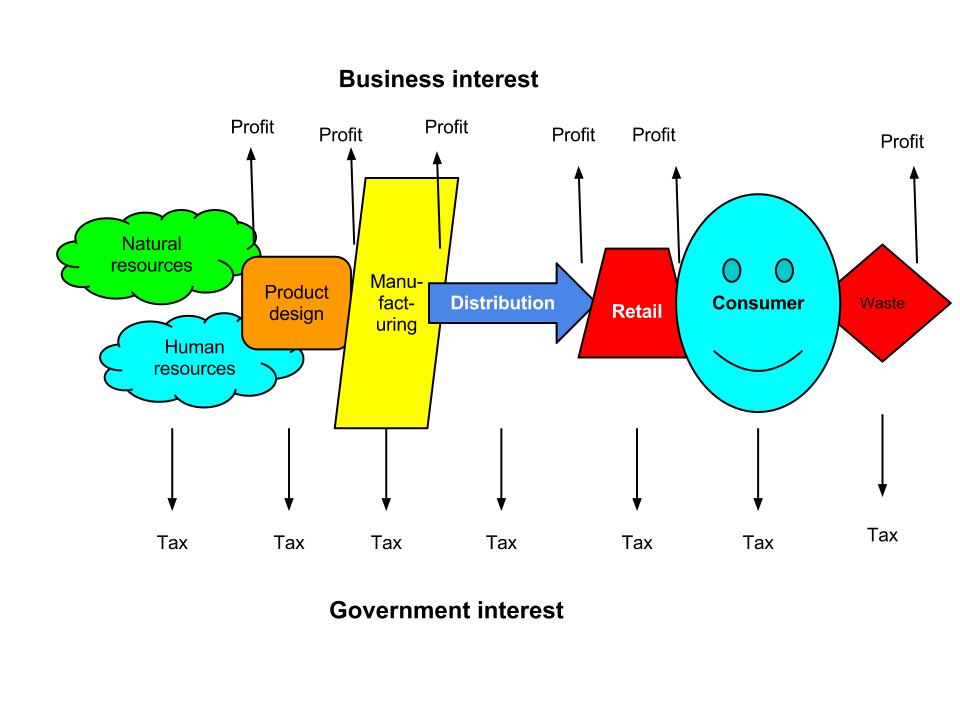
Property is past on and taxed in every step in the chain
Business in each step of the chain needs more and more profits to attend the increasing demands of shareholders. Shareholders own the business and value their ownership through the return they get on their investment. As a consequence the business wants volume sales and cost reduction in a competitive environment. As a side effect this chain optimization causes increased environmental pollution. The effects on human nature are also negative. It causes constant purchase stimulus, creating a mentality of greed, thirst for financial means to purchase more and a mentality of hoarding. There is a growing degree of individualism, distrust, criminality and psychological disorder around “the having”.
Governments see an increased need for infrastructures for logistics and retail activities but also suffer the negative consequences in health, psychological disorders and environmental pollution. The latter is demanding investments in rules, bureaucracy, police, health care, etc. This produces a steady increase in tax requirements along the chain to finance the growing social responsibility around purchasing power. Government hence stimulates further consumption through economies of growth in order to be able to finance the consequences (dual economy).
Obsolete type of economy
Meanwhile the entire structure of society around fragmented money driven and dependent consumer interests, shows a steady increase in problems, such as the reduced availability of natural resources for the increased global productivity, destruction of the environment to facilitate more logistics, the pollution of our habitat and increased global competition. Consequence driven investments in a greener society do not reduce the push for more consumption, on the contrary, it stimulates it even more to cover the costs of those investments. Business and government both use it as marketing arguments to stimulate the economy of growth even further. It all helps to delay disaster but it cannot avoid it. Overconsumption in a consumer economy has a structural damaging effect and leads irrevocably to crises.
Each of the fragmented pillars (government, business, etc) depends on the other’s growth, stimulating it according, increasing the problems faster than solving them internally in every fragmented layer or “slice” of interest. All the crises around the world are a consequence of an obsolete consumption driven system.
The problem of this consumption driven economy is the chain of exchange of ownership all the way up to the end-user. On and between each of the shackles in the chain the business and government interests are keeping the system in place out of self interest. No one in the chain takes responsibility (nor can be individually blamed) for the effects on humanity and our planet. In between the shackles shortages appear that lead to speculation and further value destruction in the chain, increading economies while decreasing quality of life.
Example: mobility
Mobility is a consequence of our consumer economy. We privately need mobility for work, social activities, family logistics, recreation and purchasing goods. For each of our requirements we have a whole variety of mobile alternatives, instrumentally at hand. We have a car, a bike, a scooter, maybe even a caravan, a trailer, etc. We can only use one of these instruments at any one time but possess it for our usage at will during the day. We consider this type of mobility part of our democractic freedom. But do we need to own it?
We seem unaware about the amount of resources that we block by keeping up a stock of individual mobility in our own ownership. The amount of space we need to store the options is tremendous, while not in use, while in use and when we arrive at our destiny. Not to mention the different types of infrastructures that are needed to provide safe usage. It all had an important impact on our economics for many decades. But also on our environment and health. This was countered by the growth of a consequences-economy in which healthcare techhnology managed to stretch our lives against a huge healthcare cost.
Today we face the problem that polution, scarcity of natural resources and usage of productive landscape is so big that it has consequences for human health, social stability and sustainable human progress.

In Hong Kong (China) 7 Million people suffer lung and heart problems due to air polution
User economy
If we would change our economy to one where we do not possess our goods but use them when needed, a lot of the problems would be solved. Why don’t we simply change to the new system if this is better for our environment and human health? We cannot because:
- We are used to “having in possession” all our alternatives
- Our society is based on the profit and tax structure related to purchasing, not the usage, to finance itself
The first has to do with mentality and the second with our social complexity. The economy is structured around our culture of possessions not for usage. If we want to change that we need to break up the chain, alter our culture and change our economic system all together. That is extermely difficult to do. This has significant consequences for our society. Let us simply look at the two issues I mentioned.
1. Mentality – culture of “having”
We possess everything simply because our society is based on that culture. If we decide to relinquish possession we could not yet make use of alternatives because their is no reliable infrastructure based on that usage. When I want to move from A to B and have no car or bike available to me then I have to rely on walking, a neighbor or the public transportation system. In very dense populations this may well be organized to an extend but in my small town I need to walk a certain distance to find a bus that goes every 30 minutes. Taxis are expensive as they do not just charge the fair of my travel from A to B, they also charge their own fair just to come to pick me up. A bus would be fine but it goes only so often. Meanwhile I am used to getting my transportation instantly by walking to my car or bike at my fron door.
So if I would want to get rid of my ownership I at least would want to have a reliable equivalent at hand. If I do not own but use then the service of usage has to become better than me as an owner.
The consumer society that I live in also requires that I travel between urban centers. The train system has shown important flaws, especially when we have extreem weather. I hate to see myself as single father, with a responsibility at home, stuck on a freezing train station without being able to get home to attend my children. Having my own means at least gives me a sense of control. Not that it is a guarantee that I get there but at least I have my own hands on the steering wheel. I have instant choices. And that feeling of independence is important to me.
Mentality also has to do with psychology.
Of course I understand that usage instead of property is important from a natural resource or space point of view. And I would be very willing to change my mentality if, and only if, my sense of freedom, security, choice and instant availability would be guaranteed. Ownership provides me with this sense of availability at all times, despite the destructive consequences for my environment. I am conscious of it but also have my selfish attitude. I am willing to jump on my bike when the weather is good, when I feel safe, but do not feel the need or obligation simply because our planet is in jeopardy. Who am I? My neighbors need also their consciousness building. When I see them buying and parking a car in our street for every family member my motivation to relinquish my comfort first has come to a minimum. “Them first” I would be inclined to say, or all at once.
Mentality shift has hence to do with multiple factors, not just my own consciousness and sense of responsibility. It has to do with availability of reliable alternatives, an equivalent sense of comfort and recognition of my efforts (I am not alone). Usage is not just confined to the mobility issue, it has to do with all sustainocratic processes around local four local sustainable human progress (food, security, health, wellness and education). When that is organized I would be pleased to try it out, fearfully because of lack of trust, but responsably as a global conscious citizen.
So change of mentality requires purpose driven cooperation between institutional AND civil interests. Both have to work together to make it happen.
In fact, in an economy based on usage we can learn to respect the usage of our natural resources in a reciprocal way. To do so we would need to address again the essentials of our existence within the context of our natural environment. Sustainocracy is all about that. If we use our environment effectively and with affection we can assure continuity of our existence. But to do so we need to give back what we have taken when we are done. That is the way nature works and it works exceptionally well. In fact, that is the way life and death works also in humankind. When we are born we use material from our environment for our carnal existence and growth. When we die we give it back to our environment through a burial or crematorial. Why wouldn’t we do that with all the other things that we use to serve or please us?

A circular economy of usage creates sustainable progress as profit
We should but we don’t, simply because we are not organized that way. To do so we need to change all our institutions, their way of functioning, as well.
2. Profit & Tax transformation
When we look again at mobility as significant example we see recently (last decade, with a push forward sinds about 2008) a rapid tendency in urban transformation. This is caused by the expected sharp decline of fosil fuel availability and the rise in cost price. 55% of humankind lives in cities nowadays depending on mobility for everything they need.
Industries and governments that have relied for over 100 years on the profits and taxability of cars as a consumable and luxury item. They are now facing an automotive crisis, starting the transformation within a dense urban setting. The maths of car sales and consumption of fuels does not add up anymore in a social and environmental context for the long term. Old business lobbies still remained strong for a while due to the amount of labour and financial interests in this traditional sector but eventually room has been created to develop alternatives. We see now the tendency of new local for local alternatives in mobility with great creativity at business and governmental level. Still, this is confined to the economy of scale presented by the urban concentrations. It could become much more affective if fragmented policy making would be replaced by holistic sustainocratic cooperations.
Taxable
The problem any government faces is that the car with all its fuel consumption was one of the biggest taxable instruments to finance the public administration. It was a real cash cow. Just like housing, energy, communications and food supplies. Now that this income is slowly evaporating a dual problem arises. Sticking to the example of mobility we see that new types of transportation, traffic and mobility require new infrastructures, which is a large investment. Meanwhile we are not entirely sure in which way mobility will evolve. This is also the case for any other human consumable. The old taxable cash cows disappear but nothing is definite to replace them. But the old costs of society keep growing.
How do you transform taxation from a consumer to a user economy?
Why would taxation need to remain the same? From a theoretical point of view it does not need to be the same at all. A new society would demand a new way of structuring government and by consequence also its finance. But you cannot instantly transform government and its dominated structures s.a. police, defence, infrastructures, justice, education or health care. They have been build up for many decades, centuries even. Restructuring involves large hierarchical structures of people, regulations, laws, positions of power, etc. It takes not only time. It demands general support, vision, hard work and accepting the psychology of change as a common transformative factor in which fear plays the most common human factor.
In a democracy a transformation is even more demanding and probably even impossible because of the fragmented party politics that have grown far from a common national purpose. Also people who vote tend to vote for what they have lost and not what they can achieve by working together.
When we take sustainocracy as a new structure for society at least all 4 pillars of society work out ideas together.

We all take responsibility together. The old chain is broken up through a purpose represented by one leading person’s initiative
We all realize that the traditional tax structure and government expenditure needs to be intensely revised. We see that there is a long term continuation of the effects of the old consumer structure on human health and the environmental polution. This affects again the long term government expenditure requirement in health care, and that is not backed by sufficient tax income in the short term of the new structure. Either public debt increases further, or….we all take responsibility (sustainocracy).
Everything needs to transform at the same time.
Also, business needs to transform. When new entrepreneurial initiatives appear that substitute the old traditional ones we see an equivalent need for transformation of social financing and government responsibility. Business is much more inclined to assume local responsibility for reliable public services in which circular economy of usage replaces the linear economy of ownership. Government is then forced also to change from a regulating and consequence driven authority to facilitating structure that introduce flexibility, transparency in change and cooperation. On the one hand this would attend the uncertainty of the future. On the other hand one needs to spread the investment over all parties and not just through governmental channels. Taxation cannot cover both the government transformation AND social transformation all by itself. Today we see many governments already with a rising national debt beyond reasonable proportions, just to avoid change. More debt to induce change would be unacceptable. Moreover we concluded that a society based on usage requires the transformation of everything, not just government.
Sustainocracy
That is where sustainocracy comes in and places the responsibility with all social parties involved. One single connecting specialist or pair of persons will do the trick. Me for instance. Taxation in the long term in an economy of usage can have similar proportions than the economy of consumption today. The money would however be used in a different way. But in the short term the tax income is much less. We see then a tremendous need to coordinate such transformation step by step in order to avoid a total financial chaos. Tax can then be something more than just money. In fact we all become local for local responsible for the circular economy of usage, creating the added value ourselves and sharing the benefits. In the consumer economy we see that people simply need money to keep the economy going. In an economy of usage people need to invest their talent and personal energy to create things to share (s.a. food, energy, housing, etc). Money is less important. Much more important is the level of co-creation.
This requires vision and coordination that cannot come from just government itself nor any other institutional structure. They are all too dependent on each other through the old chain of interrelated financial dependencies. The current institutional world would sooner drop into a huge crisis than take the initiative to transform together. That introduces the new connective leadership (no power, lots of authority) of members of the sustainocratic STIR Foundation. They assume the role of new purpose driven leadership that allows the institutional partners to join the challenge based on independent equality, rather than dependent inequality. Each participates with its one levels of power, authority and added value.
The challenge is hence extremely local, yet global at the same time, geographical and vertically institutional, and very human as well. It affects for instance the way multinational business develops and transforms from a global manufacturer to a local facilitator. Maybe in between business can still develop a mix of centralized manufacturing specialization and local holistic service responsibilities, with forward and backward logistics and reuse of resources. But if the transformation is not coordinated with business and governance involvement at the same time it will not happen.
As a consequence we can very well justify the complexity of the transformation from a logical and even scientifical point of view but not easily from a practical, operational one. We cannot pinpoint anyone today as a sole holistic responsible for sustainable human progress, unless one totally independent person stands up to do so (like I do in Eindhoven). The huge material interests that still make up the old world of the having, the consumer economy, have a tremendous blocking impact on the level of transformative change. This is being countered by a strong building up of explosive (agression) and creative (new initiatives) stress. It is becoming much better for the establishment to join sustainocracy and gain again instruments of effective power then to remain trying to patch up the old system our of unsustainable self interest.
Organically change may occur when old age parties find each other in purpose driven sustainocratic missions. But change will also occur through crises en chaos when powerful structures insist on their self interests beyond the limits of the ethically reasonable. There is a balance that needs to be found between the controled temporary maintenance of the old and the speed of change towards the new society. The process can be extremely dangerous for human kind yet can also be changed positively if sustainocracy is accepted by global institutional leaders, together.
Conclusion
The theoretical and ideological need for transformation between a consumer and user type of society and economy is beyond dispute. It can be morally, ethically and scientifically proven. The complexity of both mentality change and transformation of institutional positioning is however so large and significant that it takes local and global leadership to make it happen. As such the existing hierarchical leadership is not independent enough from their fragmented structures of power. Holistic leadership only exists at individual human level, cannot be institutionalized, just accepted as linking sustainocrat.
The fragmented institutional leadership, no matter how powerful in the old world, will eventually have to join the table of sustainocratic leadership. Institutions are human instruments, like a hamer, a screwdriver or a shovel. If we cannot get humankind to stand above its instruments we will face a huge humanitarian disaster. It is up to the human being in charge of such institutional instruments to accept taking seat at the table of human sustainocratic leadership.
The sustainocratic initiatives that we take in Eindhoven and Holland could be a source of inspiration and guidance to avoid human disaster and make change happen in a peaceful way. Then global business, governmental and scientific leadership would have to accept sustainocracy as I present it and join the table for the sake of their own leadership. Since such combination is unprecedented in the world it is hard to establish for the first time. But not imposible as I have done it before. If it is posible on a local for local level for the first time we should be able to address the issue on a global basis too.
Worth a try? Why not….Who should be at the table? Who cares to help?
Ethics is human, not institutional
Much is being discussed about “ethics” in business, finance, government, education, etc. The biggest misconception of all is to attribute ethics to institutions. Ethics is human, not institutional. An institution cannot be blamed for unethical behavior, their leaders and employees can.
Definition of Ethics:
Many people confuse ethics with social morality, as in religion, belief or cultural behavior. One of the more useful definitions of ethics is provided by wikipedia in the names of members of the foundation of critical thinking: “a set of concepts and principles that guide us in determining what behavior helps or harms sentient creatures”.
If fact ethics refers to “the conscious way we interact with our environment, human and living nature, in a constructive or destructive way”. Ethics is complex as it demand from us the conscious reflection about our progressive behavior and its consequences. Progress has always a destructive and constructive element, when initiated by human beings as well as evolutionary progress within nature. It opens up a large array of philosophical thinking on the extend of responsibility of the human impact on its environment. How ethic is it to destroy a certain natural landscape for our infrastructures, housing, industrial processes or even agriculture? Where does human progressive dominance end to allow room for other species to evolve or is human dominance and its effects on other species part of their own evolutionary challenge? Hasn’t the competitive crises in the human species stimulated our self-awareness in such a way that we became more creative and competitive? Hasn’t the anthropocene affected life of other species in such a way that new genetic variations have appeared that adopted perfectly well to the human dominance and even to human pollution? Isn’t humankind on its own a challenge for nature to react with destructive force to create balance again in living progress? How ethical must the human species be with its environment and what ethics can we expect from our environment?
When we look at the effects of humankind on its environment then this can be considered very high, especially now, in the era that we live in today. On the other hand we see that these effects are lethal for the long term human sustainability. It is expected that climate changes and pollution will eventually reduce humankind to a much smaller population then we count today. Within 40 years humankind may well implode to a size of little more than 1 billion people (as opposed to more than 7 billion today).
Ethics has hence nothing to do with the way we influence nature itself. This will bounce back to us with equal force as what we did to nature. Nature has this unique ability to find balance in all kinds of extremes, even against humanity. So when we refer to ethics we need to reflect on the way we affect nature in the short and long term to produce effects on us. With this type of ethical consideration we place human evolution within the meaning of sustainable human progress. In this sense we do not dominate nature as we affect our surroundings but assume an adaptive attitude around the effects of nature on us. Nature seeks natural balance no matter what effects this has on humankind. We however seek balance with our consciousness (learning process) about our surroundings to provide us infinite evolutionary chances using the environment properly. We become adaptive partners with our environment for our own benefit. Ethics then refers to the level of reciprocal balance we create with our universe in which we assure our health and security at all times by respecting nature for what it is.
So when people debate on institutional ethics we need to get to terms what an institution really is? From an operational point of view an institution is a specialized group of people performing to reach some predetermined team objective. There are many types of institutions that all perform different types of tasks in a human community. From an ethical point of view we can now look at the institution and determine what impact it has on our sustainable human progress from an environmental point of view? The problem we face is the paradigm in which such evaluation takes place.
Institutions have been traditionally registered and founded to become a legal entity that behaves according human, not natural laws. An institution is a legal instrument that allows the grouping of people around certain objectives protecting the integrity of the people against failure of the institution, while allowing the people involved to share the benefits of it. The institution can hence do things that people would maybe not do themselves from a moral point of view. What motives would an institution have to do what it does and can ethical values be attributed, and by who? Yes, we can, but not to the institution, to the people giving direction to the institution. Why?
The institution is a piece of paper. When no-one does anything with that piece of paper it will not do any harm or good. It is just a number. An institution becomes instrumental in the hands of the human being. It is the human being that deals with the institution that needs to be confronted with the ethics of this usage. The fact that an institution is constituted according to certain human laws does not liberate the user of the instrument from applying moral awareness and consider the ethics of its positioning or functioning. In our current society based on capitalist economics the morality of human progress is expressed in financial means. Within this paradigm ecology and human progress are considered a cost. Ethics are valued against the price one needs to pay and the material benefit one gets in return. The overall holistic picture of a universe reacting back to us is not considered tangible enough to be attributed to the ethics of a single institution nor of its leadership. It is the human system that is unethical because it shows a scientifically proven damaging track record against nature itself and especially our own expectations for a healthy future. What is then unethical? The financial system? Money? Capitalist economics? Consumption? Industrialization? Manufacturing?
None of this is unethical because for every system an alternative system can be chosen. The fact that humankind has self-aware choices makes the usage of instruments that have an unethical impact on our environment unethical. It can be compared with a word. The word itself can never be attributed an emotion or value. It is the context in which the word is being used. The same goes with money. Money has no value, it is the value we attribute to it in a certain context. We can compare it with a hammer. The hammer is a tool that can be used in a constructive way to create a chair. It can also be used to kill. In both cases ethics can be applied, not to the hammer but to the hand that uses it and the purpose it is used for.
So instruments like words, coins, hammers or registered pieces of paper have absolutely no ethical meaning until they are used by human beings for one or another purpose. Right now the ethics of humankind is extremely off course. We are all to blame but those who claim leadership and intentionally keep up the system that is so destructive, should be brought to justice. The problem we have is that ethics has not found its way yet sufficiently in our systems of human laws and that is what is urgently needed. Sustainocracy can be help because it provides the tooling necessary to make a natural selection. It also helps institutions to transform while they still can. The excuse is still that they did not know better, had no choice and were not aware of a new paradigm. Soon no-one will be able to hold with such excuse because new standards are being set. These standards are based on true ethics. When people have a choice they immediately are at fault when their choice is contrary to a true ethical paradigm such sustainocracy. At this stage humankind can not afford to accept unethical leadership or behavior anymore whether we like it or not.
 Sustainocracy, the new democracy