At the request of the global magazine “Mental health” I wrote a scientific article about this. This is based on another article of mine about the phenomenon of a mental “breaking point” or a change in thinking and acting that is motivated by moral meaning. This means that someone questions his or her own behavior, often pushed by the imposed norms of society or old personal ways of thinking (traditions, trauma), and decides to completely change course. A special side effect is that mental health is given a strong boost through meaning and a strong commitment to the moral values on which decision-making is based. In my case, this became the basis for the emergence of Sustainocracy as an evolutionary proposition for human societies. Over time, I came into contact with many people who walked with me on this path of Sustainocracy for some time. They often carried a mental backpack of old traumas, negative self-image, fears, insecurities, etc. that all in one way or another arose from the current money-driven and strongly hierarchical society. Due to the lack of an alternative, these people continued to have mental health problems. When they came into contact with Sustainocracy and the associated human values, a new perspective emerged, a form of meaning that contributed to a form of healing and empowerment for all kinds of people. This was often still hampered by the pressure of the system authorities and associated expectations, but the relativism had planted the seeds.
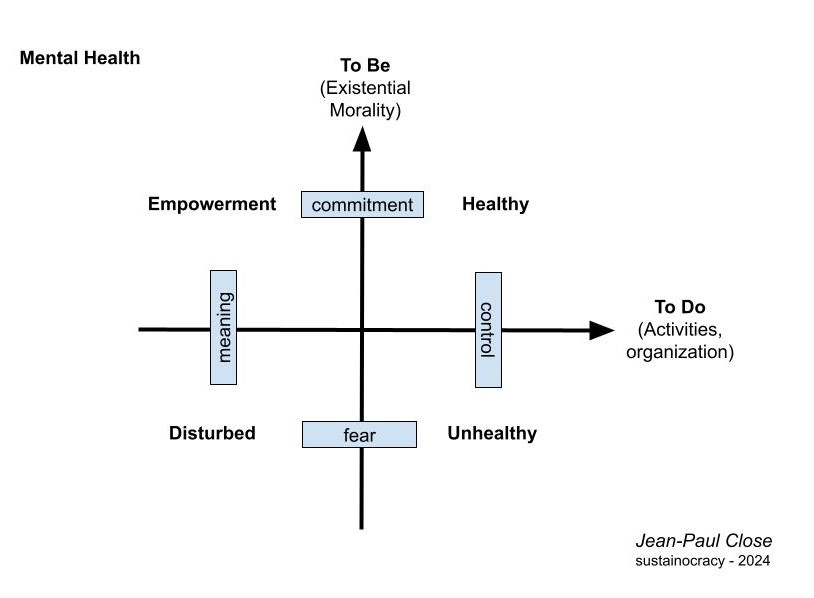
The current uni-dimensional money-driven society is structurally unhealthy and produces mental ill health as can be seen in the culture of fear that is also fueled by the polarization of political parties. The entire financial political structure is located in the unhealthy, immoral quadrant of the drawing. This is reflected in the many problems in the world that are often caused by this competitive control politics. We are all part of that, partly due to the forced dependency imposed by the system. My own personal turning point brought me to the point of commitment to human values. At that time I had no idea of the impact of this on the mental health of me and my environment in general. This is because I first had to let go of forms of unhealthy control and fears. I was able to do this with confidence because of the meaning that had invaded me. In all the activities that I subsequently developed, healthy, warm interpersonal ties were created, also with people in hierarchical positions of all kinds of companies and institutions, including governments. The shared commitment to, for example, the “healthy city” approach in Eindhoven and the surrounding area provided a healthy mental dose of meaning, creativity, mutual connections and goal-oriented motivation. These are all building blocks for mental health, in contrast to fear, uncertainty, competition, hatred, judgment, jealousy, etc. that are caused by our one-sided social management based on money, dependency, performance, political interests, competition, inequalities, control, meaningless growth (with many negative impacts), etc. We are often unaware of the mental ill-health that this form of society causes because we are completely mentally absorbed in the activities (work, consumption, entertainment) that are expected of us or have become part of our blind comforts. We often feel the symptoms of mental disturbance and unrest but do not make conscious connections because of the culture in which we live. We only notice the real difference when we let go of this, experience the turning point ourselves and let the meaning do its work. With Sustainocracy everyone has a choice. But the choice has a price. That price is not expressed in money but in letting go of control and fear, and embracing human values and cooperation. Mental health is a result.
 Sustainocracy, the new democracy