Home » Articles posted by Jean-Paul Close (Page 143)
Author Archives: Jean-Paul Close
The healthcare continuum revised
When health is recognized as core societal responsibility (Sustainocracy) the care for health approach affects the entire chain of healthcare well before the care demand starts.
My own STIR societal research foundation, together with AiREAS (air quality and healthy city) and the University of Technology of Eindhoven, apply participative learning with a group of 25 international students. We are looking for ways to use technology to affect the healthcare system within the challenges of Sustainocracy. We introduce a whole new way of thinking that can eventually transform the entire healthcare chain.

In the picture above on the “continuum of care” we see the entire healthcare chain and how it develops itself from prevention via early discovery of a health problem, all the way up to the last phases of anyone’s life.
But we miss something….
When we review our current society we notice that in terms of prevention there is little we can do since our political and economic structure, together with the lifestyle that belongs to it, contributes to our health reduction. In AiREAS for instance we look at our exposure to air pollution in relation to our lifestyle. Research revealed that 50% of the responsibility is of our own as we deal with our lifestyle and pollution in an unaware way. But the other 50% is caused by our surroundings and societal cultural management. This causes the enormous cost development of the healthcare chain, loss of quality of life, reduced productivity and millions of premature death across the world.
Before we enter the care continuum we need to ask ourselves in what societal context it is placed and how we could dispute this reality from our evolving self and collective awareness? In Sustainocracy we determined 5 leading core values for sustainable human evolution and progress, such as health and the quality of our air, food and what we drink. When we design society using those core values it will have a direct impact on the entire care chain but also the quality of our life and the related overall productivity of the community.
The students have been invited to the challenge to see how they can use techological instruments (such as games) to persuade citizens to participate in the health driven society. The students need to consider the fact that most citizens, and especially those who live their lives well before any preventive actions are considered, have totally different priorities than making time free for their health. What motivation will trigger them to participate? Are there target groups that are more inclined to participate than others?
A second part of the challenge is to find economic continuïty for the application of the technology by positioning it as proof of concept with measurable social, environmental and economic impact that is taken over by the consumer.
Our basic needs are in jeopardy
In Sustainocracy we defined our core values in terms of health, safety, regional cocreation, awareness and fullfilment of our basic needs (water, food, warmth and air). All our core values are at stake but when our basic needs are in jeopardy we have little evolutionary perspectives to look for. Life turns into a daily quest for survival. On a global scale the examples I use are small but when we look carefully we see them repeating themselves across the globe, affecting many billions of people. Often I am asked if Sustainocracy can help. It sure can but needs local commitment.
Water: In Bolivia 1000’s of persons queue up for their watersupplies as entire cities are running out of this basic need.
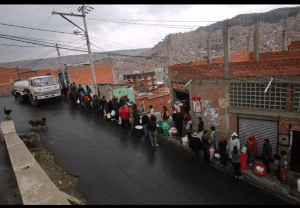
Bolivia, Peru and the rest of the Andes areas have severe water shortage
Worried scientists and local residents from the region have contacted me to see if the introduction of Sustainocratic processes could help overcome the problems by joining the hands of local governance, innovation, science and citizens. We believe it can but again needs local willingness to build the groups around water, health and cocreation. We can help with level 4 regional development but cannot take over responsibility.
Air: Over 476.000 yearly premature death are counted in Europe alone due to poor air quality, especially in urban city environments. In New Delhi (India) one of the worst ever periods of smog was lived through these weeks. The local government declares air pollution an emergency but continues developing their cities based on economic growth rather than health. Sustainocracy was explained in februari 2016 in New Delhi upon invitation of the Indian government but no proactive attitude has been seen sofar. We have AiREAS to help out but need local commitment.
Food: Today in Dutch newspaper: Over 30.000 plants are good for human consumption but our food supplies have fallen into the hands of speculative industrial food processes that concentrate on 4 mainstreams that provide 75% of our daily calories: wheat, corn, soja and rice. Our landscapes are ruined due to manipulated monocultures of this type of food, often with patented seeds controlled by multinationals ruining also our farmers, using pesticides, fertilizers, etc. Worried scientists admit that we leave the soil behind for our kids in worse shape than ever.
Warmth: Rosa, an elderly lady of 81 in the township of Reus (Spain) has become the example of heartless policies and unjust inequality in the capitalist communities. Rosa had no money to pay for her electricity bills and dies when her matress caught fire when she forgot to blow out a candle. Local sources say that a law had passed that prohibited energy suppliers to cut off poor people from supplies during winter time. The gas company had done so anyway claimen their unaware nest of her poor situation. Whatever the background and reasoning behind all this it shows us and the world how vulnerable we all are of external supplies and the behaviour based on self interest of enterprises and money driven governance.
It always happens to someone else, until one day it happens to you…….


Co-authors and enablers celebrate their AiREAS publication
Phase 3 of the healthy city project named AiREAS was focused on getting civilian engagement with the challenge of reducing the air pollution in town and improving the integral environmental and human health of the community. The results of nearly 2 years of investigation by scientists, civilians, civil servants and social entrepreneurs has been written down in this open access publication. It has become common practice in AiREAS that those who had a leading role in the process also co-author the publication of the findings. For some it is the first time their name is attached to a global manuscript. Others are already being referenced as authorities in their field of (scientific) expertise. It is also common practice that successes are being celebrated together with the enablers of the project. These enablers coauthored phase 1 of AiREAS which was published earlier this year. On the group photo, from left to right: Jaap Ham, Hans Verhoeven, Eric de Groot, Nicolette Meeder, Dilek Demir, Jean-Paul Close, Rüstem Demir, Edwin Weijtmans, Marco van Lochem and John Schmeitz. Missing are Mary-Ann Schreurs and Pierre Cluitmans who were bot travelling.


