Home » Society (Page 99)
Category Archives: Society
My open invitation to Pope Francis
Download the letter here: PopeFrancisinvite
STIR Logo
Eindhoven: May 21st, 2014
Your (W)Holiness Pope Francis,
There are various imperative reasons for me to address you personally, inviting you, together with the infrastructure and members of the Catholic Church, to take responsibility with me, using “Sustainocracy and the STIR loop”, to address the global humanitarian issues of our mutual concern (poverty, pollution, migrations, climate changes, human made and natural disasters, etc).
This letter introduces my peaceful yet powerfully logical approach, developed after many experimental practical steps, with strong spiritual enlightenment and guidance. It has now reached enough proven results and precedents to be able to expand across the world. This I cannot do alone, it would take too long. The Catholic Church is one of the few organizations that has all the instruments readily available for rapid and correct positioning of this transformative solution into the world. Here I explain why, how I envisage the process, with what precedents. In no circumstances political or economic standpoints will be taken, just humanitarian with sustainable human progress.
Recognizing the real problem
We both agree, in view of your acceptance of the position Holy Father as Jesuit and public appearances since then, that the current human system’s complexity, based on taxable consumer economics, produce consequences that need to be addressed urgently with sense of awareness and responsibility. We do not only cause poverty and migrations of desperate people, we also damage our environment to such an extent that the problems grow exponentially through human and natural catastrophes. We can attribute large part of the problems to the reigning political and economic systems with related human cultures. These systems, no matter how small or large, are complexly interrelated in a network of fragmented pieces of institutionalized self interest.
It are not just the parts of this puzzle that cause the problems, it is the complex way that all the parts interact together.
Acceptance of a humanitarian problem is not enough
Most political and social structures in the world accept the global issues as something that needs to be solved but find that their support is minimized by defending other priorities. The economic system’s reality sees the consequences as costs rather than humanitarian pain. It searches economic growth to address its consequences at the expense of making things worse. Political and economic leaders depend on this culture to obtain and sustain their position of authority. Their task is to provide for fragmented system growth, not for the holistic sustainable progress. Within the system they can feel solidarity with the complexity problem but cannot feel accountable for the solution as they only cover a minor part. The priorities of their functions are simply different, not interconnected in humanitarian responsibilities, just material ones.
Introducing Sustainocracy
“Sustainocracy” determines, based on historical evidence, that a society does not prosper in stability and wellness through speculative growth and competition. Instead it requires keeping harmonic stability in the following 5 collective local values:
- human health,
- safety,
- food (including drinking water),
- self awareness and
- self sufficiency.
When these values are not co-created and accounted for, the community becomes vulnerable, resulting always into dramatic periods of chaos, war and collapse. Preceding collapse there is always a rise of poverty, criminality, large differences in wealth development, growing bureaucracy, etc. On a local and global level all signs are alarming.
The Sustainocratic values should always be placed above economic and political interests, becoming a practical and democratic guidance for sustainable human progress. Considering this we can determine that the entire global human community is dangerously vulnerable and the system’s complexity only builds up the tension further until it collapses. In practical reality we can state that the current system’s complexity of consumer economics and financing of consequences through economic growth is the kernel of the problem. If we want to develop a stable, safe and progressive global community we need to redefine the system’s complexity and take transformative initiatives between one system and the other. This is a delicate problem that requires leadership, determination and transformative steps that allows for a peaceful transition without a global collapse, involving current system leaders, not excluding them.
Sustainocracy is a new system’s complexity, the STIR Loop the transformative means
Sustainable human progress is defined as: “to continuously work together to cocreate a healthy, safe, vital, self aware and self sufficient human community within the ever changing complexity of our natural surroundings.” When we put these natural humanitarian objectives upfront our democratic processes we get a new way of addressing our choices and priorities. This is then referred to as Sustainocracy (Sustainable human progress + Democracy).
Sustainocracy is then a choice, an understanding, just like any other paradigm. It does however offer better co-creative perspectives to solve global issues on a local basis than other paradigms, such as the one based on taxable consumer economics. Everybody, individually as self aware human being or as professional in a position of authority, can be invited to take responsibility and contribute to Sustainocracy through personal commitment. In fact, both paradigms can be positioned in parallel to each other to solve the most important humanitarian priorities first. In Holland we started with air quality. On islands such as Japan, Taiwan, Madagascar or the UK, we suggested to work on self-sufficiency in view of the vulnerability of millions of people after peak-oil. Coastal areas, with millions of people living in cities, need to address safety as a consequences of climate change and rising sea levels. Food and drinking water are issues for everyone, as well as new educational systems to prepare our current and next generations for their own primary humanitarian responsibilities. To do so we need to disentangle the financial dependence of transactions, debt and manipulation from the value driven responsibilities of local sustainable progress.
Initiating the STIR Loop
We distinguish now two different realities or paradigms: the local economic and political system’s reality and the choice to co-create Sustainocracy based on spiritual awareness and natural values. I have drawn these two realities as triangles among which there is a field of human made tension that can develop into sustainable progress or chaos and collapse:
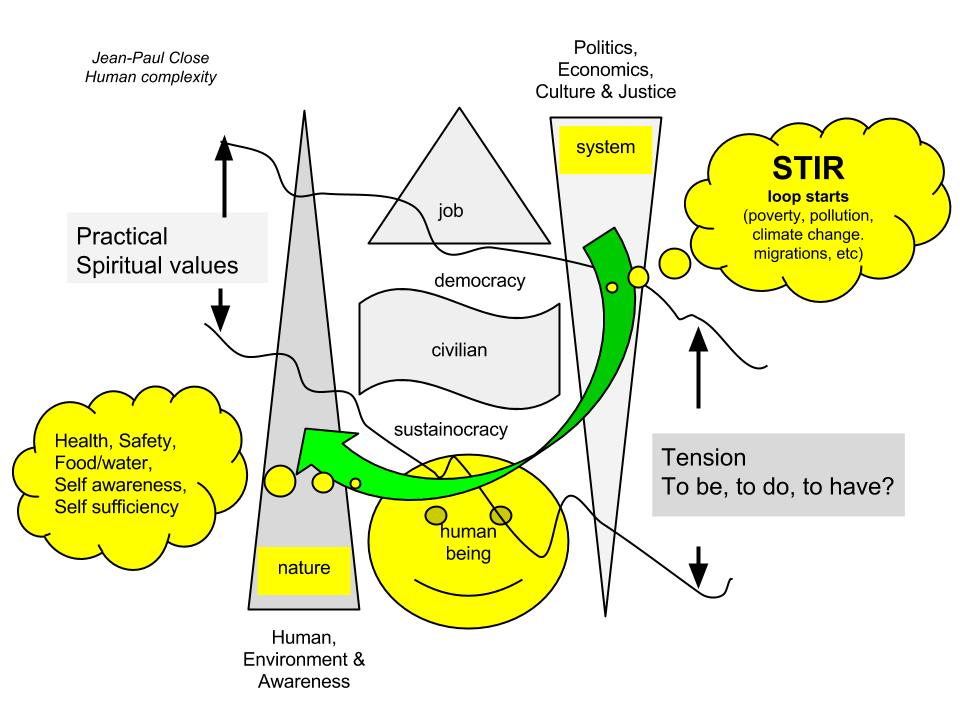
Bridging two paradigms for the sake of humanitarian sustainable progress
Two system’s in tension produce a choice through awareness
When presenting Sustainocracy as a functional alternative for co-creating humanitarian values in a new system’s complexity, anyone can be asked to participate and take responsibility. When a local humanitarian problem grows sufficiently out of hand to unstabilize the economic and political reality of a region then even the people in charge are willing to use and connect their authority to make a difference out of self interest.
Instead of addressing the consequences (s.a. air pollution, poverty, migrations, rising sea levels, etc) with financial means we invite all the affected to take responsibility for the real humanitarian needs (health, food, safety, etc) together with effort and talent. We always need to involve the 4 cornerstones of regional development to interact together:
- The local population itself (behavior)
- The local governance (infrastructure)
- Business (creativity)
- Science (knowledge)
These are used to interact in an economy of transactional exchange and hierarchies. Accepting the invitation to the table of Sustainocratic co-creation they also accept the different rules within the paradigm. In the next picture we see AiREAS, the first real Sustainocratic venture created in Eindhoven (Netherlands) in 2010 to address human health in relation to air pollution. In the picture we see all authorities that have taken responsibility together with the city as “living lab”. In 2014 the same group decided to expand the Sustainocratic method throughout Europe to experiment with cultural differences in co-creation based on equality.
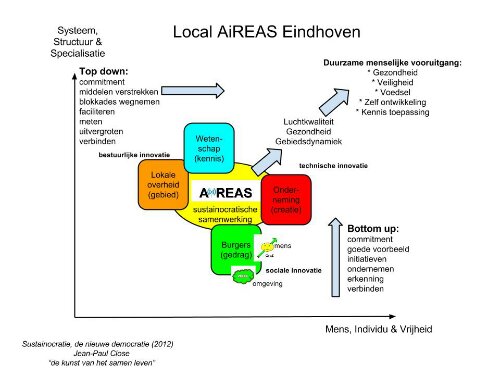
Top down and bottom in one process
One of the key problems that participants face in the Sustainocratic venture is the acceptance of the working of the value driven paradigm of co-creative responsibility rather that the costly and destructive paradigm of economic transactions and relationships. In reality they experience the very first half of the STIR Loop as pictured in figure 1, with a strong spiritual impact. Values are created that need support from the old paradigm. It takes a lot of personal leadership to go back into the old system’s reality and produce the required modifications that make the loop function optimally. Each of the participating partners acts fully out of fragmented self interest. The reciprocity (reward) is however measured in the contribution to the local sustainable human progress. This has obvious economic and political values too.
The other problem we face is that none of the four pillars can be the inviting party, simply because of the hierarchical working of the old paradigm. This introduces a key part in the process, represented by the Sustainocrat, the highly spiritually aware, humble but influential, connecting representative of the Sustainocratic paradigm.
The Sustainocrat is the inviting connecting party
We have to understand that on the human system’s side none of the fragmented parties can take the initiatives without becoming dominant over the others. In some cases local governments try to take responsibility just to find themselves resolving the issues through expensive bureaucracy, calls for tendering and tediously long implementation processes that do not necessarily produce labor nor cohesion in their community or the desired results. If on the other hand a local government wants to become a facilitating partner (as in Sustainocracy) then who should take the connecting responsibility?
The side of practical spiritual values of the Universe is represented by a single (mostly a team of two) person referred to as “the Sustainocrat”. He (or she) is independent from the reigning politics and economic systems, representing the higher values of Sustainocracy (Human and Ecological). This person invites and unites the four areas that form the sustainocratic venture around a pre agreed global issue for local co-creation of solutions. The Sustainocrat initiats and chairs the STIR loop.
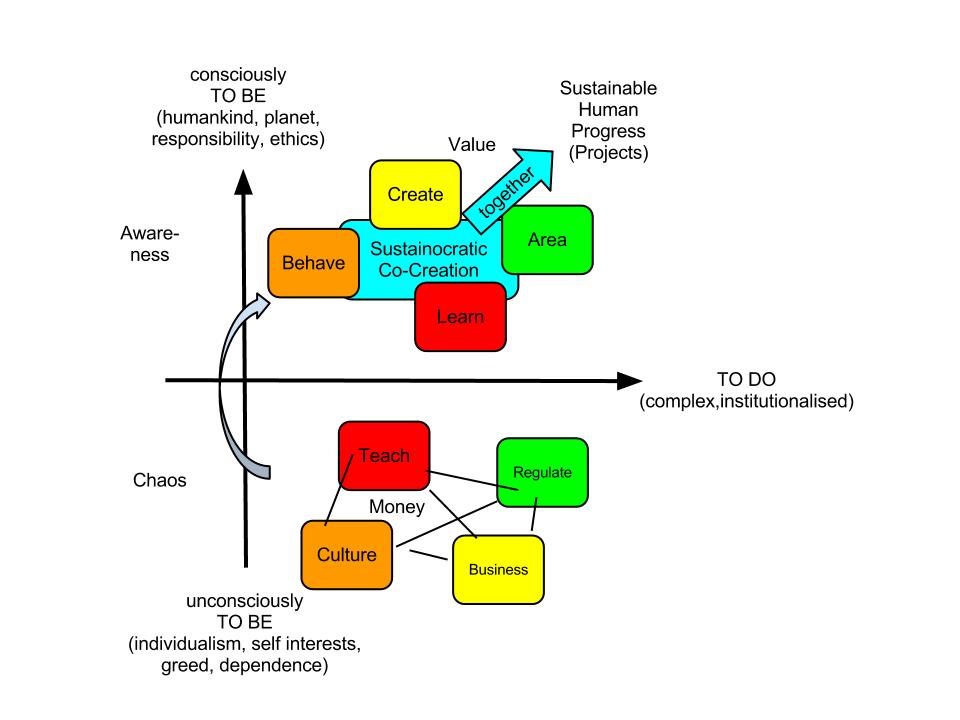
Positioning the Sustainocrat in the blue field
In the blue field we find the Sustainocrat
One of the biggest challenges of the Sustainocrat is not just to involve the institutional parties but to involve the local citizens too for social innovation. Such specialized individuals need the right level of education as well as empathy with their surroundings. The condition of independence from the system also means that the Sustainocrat is result driven out of which one is rewarded, not beforehand through a salary. In the material world of money dependence there are only few people willing to take such complex responsibility with the right capacity to interact with the hierarchies of the fragmented system structures. Within the Catholic Church a priest, under the right circumstances can be positioned as Sustainocrat with relative ease.
Conclusion
Within the Catholic Church a similar, especially humanitarian (the ecological issues were not present yet), commitment was asked when the Roman Empire collapsed, originating in a worldwide infrastructure that is still active today. The Catholic Church has both the infrastructure with buildings (old monasteries and churches) for the creation of a spiritual network of permanently structured STIR Loops nearby large human concentrations (s.a. cities), as well as the pastoral personnel, mentality and organization that can develop into local Sustainocrats with relative ease.
It is my firm desire to use the above to make the paradigm shift a fact across the world. I can imagine all kinds of obstacles but also acknowledge the unique times we live in a, with the Christian mission of God when blessed with both awareness and tools to protect God’s work against ourselves in a peaceful and respectful way.
I sincerely hope for your acceptance of my invitation. I remain of course available for further explanation and preparation of our important venture.
Yours faithfully
Jean-Paul Close
Sustainocrat
Eindhoven (The Netherlands)
Email: jp@stadvanmorgen.com
During the battle of the dinosaurs do not forget the butterflies
In the media and our own minds we pay too much attention to the battle of the dinosaurs but we forget the dominant leadership of the insects.
With this metaphor I try to open up our minds to the different realities that work in our own human “universe” of interactive values. Much of our attention (and fears) goes to the noisy battle of the giants (banks, big continental governments, large enterprises, etc). During the credit crisis the focus was on the over-sized banks that had started to take unprecedented risks to feed their hunger for growth and profit. We now get constant feedback on the economic power development of dinosaur China, the threat of Russia, the indexation of the stock markets, etc. We observe the global battle around fossil energy while territorial and financial dominance is being played in noisy way everywhere. The giants show the teeth, bark and move their muscles. They turn around each other and make aggressive moves. And we all watch as if were depending on the outcome. But we are not.
Despite the destructive forces of these monstrous battles we forget the insects. This part of the metaphor is as a natural reference to the creative and adaptive force of the enormous diversity of selfaware human individuals. When we take a closer look at humankind we see that at micro level the human world is changing as the dead dinosaur bodies pile up. When food prices doubled the Egyptians stood up as a swarm of wasps against their own dinosaur Mubarak. They won the temporary battle just to see new dinosaurs take power again. But what is done once is done again and again. The rule of nature is that the big only keep stable if in harmony with the small. When the balance is damaged the big will fight to avoid collapse but the small always wins. The real dinosaurs became extinct a long time ago. Now humankind build artificial ones of our own. Harmony is damaged because the big and powerful became arrogant and dominant, using the small rather than serving the balance. These artificial dinosaurs face extinction once again. They dissolve, leaving groups of individuals to find back their own colorful identify and freedom.
Within the enormous diversity of world of insects butterflies are a beautiful comparison to our own human diversity of awareness and behavioral coloring. We also see human beings go through the phases of development to eventual spread their own colorful wings of diversity. We avoid competition by evolving into the vast diversity of diversification through applied awareness. Finding like minded individuals we create stable communities with new system’s complexities that have a more sustainable nature than the dinosaurs, until they become the dinosaurs of the future again.
The battle of the dinosaurs takes our attention away from the beauty of the small world of our own butterflies. The world of sustainable human progress is not at the level of the powerful in battle of survival but with the adaptive, peacefully showing off our unique diversity in a changing world
Small beats big
What is it that individual human beings have (like insects and butterflies) that the dinosaurs (old systems) miss? Let us sum it up in large lines:
1. We need very little to survive compared to the big monsters.
2. Human beings can live, adapt and survive in real natural life while the monsters need to mix the virtual reality (money) with real (commodities) in a static robotic structure.
3. Humans display a large diversity of individual creative expressionism to solve the most complex issues. The monsters can only enlarge solutions, not create them. Some people already refer to the “failure of robotics”. I refer to the “redesign of system’s complexities”
4. Human beings are flexible due to their relative small size and freedom of choice.
5. Human beings can regroup together in new stable, harmonic communities, creating new system’s complexities.
6. Old sick human made system’s dinosaurs are made up of the commitment of the sum of humans. If this commitment disappears the system dies. No artificial laws, rules or slavery can hold it together for long.
7. The human being is nature and so are our systems. Laws of nature apply with which humankind can relate through empathy. When empathy disappears so does life. The system becomes a robot, not a community. Only communities last in nature.
It is very difficult to feel comfortable with this, especially if we feel so dependent of the dinosaurs. But when we discover the butterfly inside us we loose our fears and find our confidence again to address life to the fullest. During the battle of the dinosaurs we should not forget the butterflies. It’s the butterfly that lasts, not the dinosaur.

Jean-Paul
Want to find your own butterfly. Join our summer course “the breakthrough of empathy”
Shut up, I am busy
Today I read the quote of Jack Phillips, telegraph operator on the Titanic. He received various warnings about the approaching icebergs but reacted “shut up, I am busy! “.
Mr. Phillips at least knew what icebergs were and should also be aware of his responsibility to do something with the warnings. His only excuse for negligence could be his personal conviction that the Titanic was indeed unsinkable.
At the same time I receive messages that the current world of banking, business and politics use the same “shut up, I am busy” attitude. Plenty of warning calls tell about financial, ecological and humanitarian disaster which seem categorically ignored.
The difference with Mr. Phillips’s awareness of the danger of icebergs is that in banking, business and politics people don’t even know what goes wrong. They just do their job blindly, often fixing leaks to prevent their ships from sinking rather than change direction. They are managed by people who are already seated in their own lifeboats, equally unaware but suspicious of the risks. In economy it is not just the ship that is sinking, it’s the entire fleet. Captains tend to watch the sinking of the others, unaware of their own responsibilities in this.
Some of us, in view of disaster, build our own safe ships, without bankers, business or politicians. We don’t even warn anymore but simply invite people on board our boats. There is no “shut up, I am busy” attitude here but rather “come on board, and gives us a hand”.
 Sustainocracy, the new democracy