Home » Sustainocracy » books on sustainable human progress
Category Archives: books on sustainable human progress

Statistics don’t say much, actions do
Today I received a notification from Researchgate that my open access articles had reached the milestone of 8000 reads. I am grateful for the people that have trusted me enough to download one or more papers, hopefully for their benefit and inspiration. I have only been active on this platform for little time and it contains only a few papers.

My publishing activities have two purposes. The first is to clarify my own mind by unraveling the complexity of what I am experiencing by challenging existing norms with my own innovative ideas. The second is to share these experiences with the world, hoping that people get inspired to do something with it.
In 1996 I published my first book. It was in Spanish and devoted to the world of information technologies that was in the intense phase of transforming from analogue to digital. Today we can see the effects of the digitization in our homes and handheld telephones. Back then the different media had their own platforms and dedicated organizations behind each. The booklet was small and distributed through a leading national computer science magazine in Spain. 17.000 copies had been printed. It was so in demand that another 3000 were needed afterwards. It had been a voluntary exercise with no money involved, just a lot of time and energy, a goodbye exersize of my job as general manager at a large multinational.
My second book was in Dutch and self published in the Netherlands in 2005. It was about entrepreneurship in the 21st century. About 3000 were sold and distributed through my own efforts of populating the podia of business communities. It opened the doors of a large publisher that asked me to rewrite it into a special and enhanced version. This time over 6000 were sold, allowing me to do consultancy work. It also opened the doors of Nyenrode Business University for guest lectures and intense intellectual discussions about Business and Spirituality. An English version was written but I could not find a publisher for the international market. It has been collecting dust ever since, unfortunately.
It all together had made me aware of the need to develop the society of the 21st century. Subsequently I published a series of ideological books, first in Dutch, that were less successful, simply because they covered topics no-one had ever heard of. They were indeed necessary for me to learn to understand myself and clarify my own inner processes. These limited editions however did open doors again for me to enter a dialogue with a large diversity of people. They became the basis of working on Sustainocracy as a society model and the STIR foundation (2009) to research its introduction and implementation.
When this developed into the AiREAS cooperative for air quality and health; I again agreed with all partners to publish our experiences for worldwide usage. This time I did find a publisher. Both the books together have now reached over 44.000 downloads (17.000 and 27.000 respectively, since 2016). Despite this success there have been little consults from abroad to work out the AiREAS or Sustainocracy methods elsewhere. Actions to do so have still been limited to my own.

This shows that statistics do not say much. Actions that result from them, do. It is nice for my ego maybe to realize that it all starts summing up to about 80.000 reads. But when I look at the state that the world is in today, the toughness of breaking the old comfort zones and difficulty to activate or even inspire others, it all together is only a drop of water on a hot plate. I only can hope that it is seed material that eventually will show a new intellectual, responsible, ethical, action driven mentality prosper around the world for the benefit of humankind, our planet and our future generations.
Integral Ecology and Sustainable Business
With thanks to Laszlo Zsolnai and Ove Jakobsen I was invited to participate in the publication of this valuable book published through Emerald Publishing. My contribution is about the Participation Society, an analysis of the evolution of our societal structures and the emergence of taking responsibility together as citizens and policy makers when dealing with our core human and natural values.
The entire publication: http://www.emeraldinsight.com/doi/book/10.1108/S1572-8323201726
My chapter on the Participation Society: http://www.emeraldinsight.com/doi/full/10.1108/S1572-832320170000026013
The evolution of Sustainocracy
What started as a one man’s awareness breakthrough, that health and safety are natural core human values which stand above political, social and economic choices, evolved into an evolution of human societal development and multidisciplinary commitment to sustainable human development. Let us go through this step by step.
We all have a choice
We have a choice when awareness breaks through. When it does not then we remain trapped in a worldview imposed upon us by our reigning cultural surroudings and paradigm. It is as if nothing else exists or existed. The breakthrough opens our eyes to different realities and then the choice appears loud and clear. For me the choice was presented by life’s circumstances in two different occasions, the first in 1996, the second in 2003. The first time it affected me tremendously but did not pull me over the edge of making a definite choice, it just made me powerfully aware. The second time I made my definite and life changing choice. I became my own first Sustainocrat in a new world.
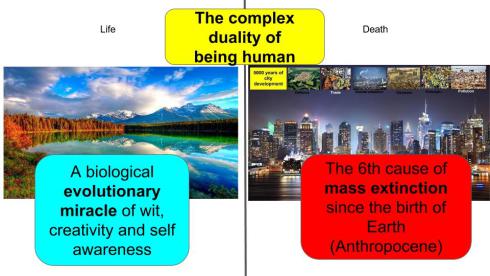
We all have a choice between life and death
Our current social political – economical paradigm evolves around death
Our consumption based global and local economy is based on trade of dead things. In order to make a product we need to get our resources from the living world, kill it and convert it into a consumable. We have built large marketplaces called cities in which we display the dead stuff in abundance to give the population a permanent sense of abundance. We only see this abunbance but do not sense the destruction this killing does to our environment. The killing is not visible because it happens outside the city while the city itself has eliminated all lifeforms other than the consumption based interaction with the human species.
Exponential growth of the human population, combined with the focus on trade of dead materialism, caused an exponential growth of devastation of our natural living environment. And we all contribute to it through our labor activities and blind consumption, often unaware of our shared responsibility in the disappearance of life on Earth and eventually that of our own.
Sustainocracy evolves around life
Having defined the 5 core values of sustaining life in an evolutionary manner, which had started with the first two (health and safety) within my own breakthroughs, a new social interaction appears. The 5 core values of Sustainocracy are:
- Health – The living nature is always healthy. If not the unhealthy dies and gets absorbed into a new cycle of healthy life. When humankind produces death just for the sake of abundance it interrupts the cycle of life and produces an avalanche of death. We humans are part of that cycle so inevitable we develop our own destruction too. Focus on health however is an awareness issue. Most people take health for granted and only become aware when sick. Becoming sick is a way of nature to develop also health through the development of our defenses. But self inflicted sickness is antinatural and we don’t know how to cope with it. That’s why cancer and other horrible deceases affect us. We also see that the human immunity is in decline. Health is hence a leadership issue, not democratically choicen but a core responsibility!
- Safety – Without safety there would be no community. The whole essence to create a community in the first place is to get a better position for safety for all members. It does not only refer to physical integrity but also respect, equality, trust and cohesion among each other.
- Local resilience – Working together to fullfil the basic human needs such as food and housing is key to remain committed to the community. In Sustainocracy the 5 values are leading, as they are core human interests. The democratic part of Sustainocracy is not to chose direction yet to chose the priorities for innovative change together through dialogue and consensus. Our core values are leading, not our self interests around materialism, leading by trust in our abilities rather than fear for shortages.
- Self awareness – Withou the awareness breakthrough the choices cannot be made as they do not reveal themselves. Awareness driven cocreation is hence both a community leadership and educational core value.
- Three basic needs: we all need 1 kg for food per day, 3 kg of drinking water and 30kg of healthy air. I expressed it all in kilo’s for the sake of comparison. The quality of our basic needs has to be outstanding since our body consists of the same elements. When we manipulate or polute our basic needs, we do the same with our own living essential. Food to live is totally different from food to stock a supermarket to create a sense of abundance.
Transition from death to alive
The regions that gradually evolve into Sustainocracy through core values driven multidisciplinary cocreation platforms (such as AiREAS or FRE2SH or STIR Academy) have to go through an intense transition. This can only be done when the 4 pillars of the local community carry this responsibility together:
- Local government: territorial responsibility for infrastructure and public funds
- Local innovative entrepreneurship: developing creative solutions
- Science and education: providing knowledge to the processes
- Local citizens: social innovation, cultural adaptation and behavior
In order to help these fundamental pillars to interact on the basis of equality the tables are presided by an independent Sustainocrat. The sustainocrat makes sure the core values remain leading and that the multidisciplinary cocreation breaks through its abstract discussions and gets to project definitions and commitment of the diversity of resources with an expected result.

Both paradigms coexist and gradually the emphasys will transit from the money dependent trade and control system to the multidisciplinary cocreation. This coexistence is especially demanding for those executives in institutions that are active in both worlds. It becomes easier when Sustainocracy is seen as the regional process for value creation and the old system for value consumption. Looking for local cylcic balance between creation and consumption is a huge step forwards and produces measureable productivity, wellbeing and resilience. A new economic cycle appears…..
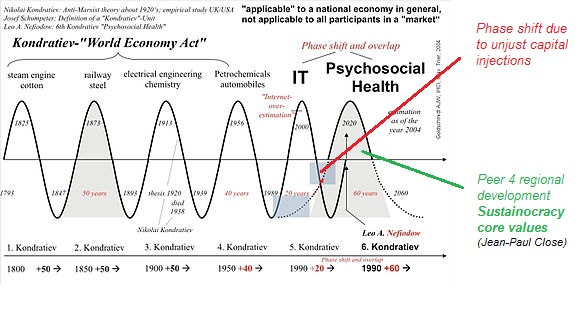
The main driver this time is not technology but the psychosocial health evolution and awareness breakthrough
Read more (free download through open access):
http://link.springer.com/book/10.1007/978-3-319-26940-5
 Sustainocracy, the new democracy