Home » Uncategorized (Page 63)
Category Archives: Uncategorized
Why we need money to show that we don’t need it
Sales tradition
We experience in our daily business life a money driven culture. We just tend to want to sell each other our products and services. So when I invite people to join a Sustainocratic cooperation they tend to ask two things to judge their opportunity: “Do you have a budget? What is your need?”. When I say that I have no budget nor direct need they often regard me as a waste of time.
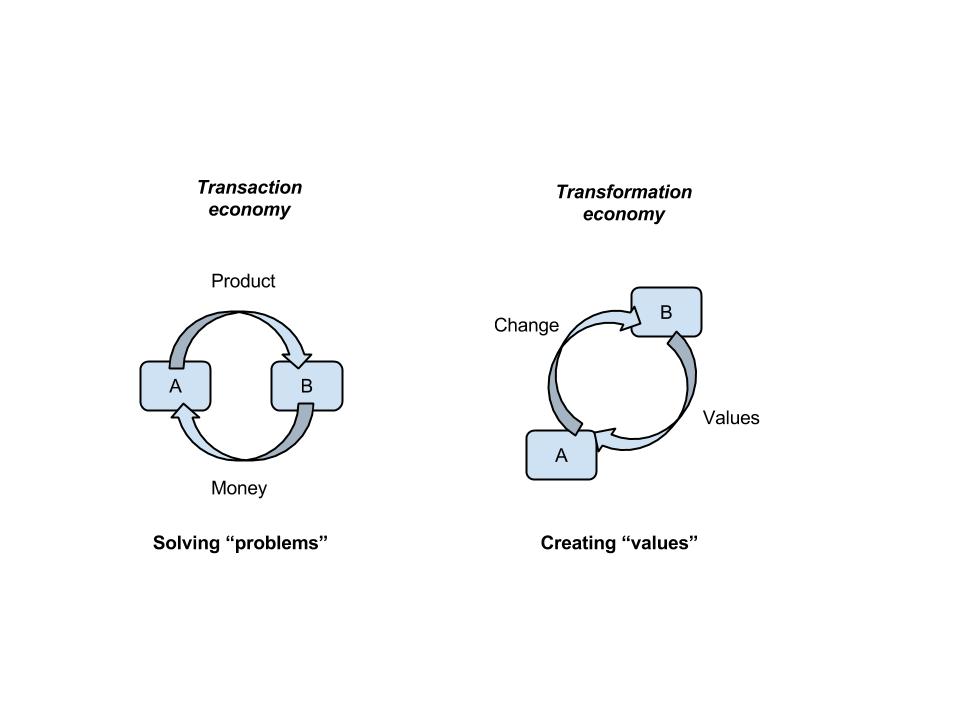
Two type of economy
Sustainocratic cooperative
This is a venture that takes responsibility for co-creation of something of true human value. One example is AiREAS that co-creates a “health city with healthy air”. AiREAS is entirely in the Transformation Economy but works with partners that excel in the Transaction Economy. Involved are all instruments that shape a human society: government, business, education, population.
We start with the higher purpose (healthy city) and work our way back to what we would like to modify today (priority). We start with an empty table and a powerful reason to be together. What the motivation us of the ones present is up to each of the partners. Their contradictions are usually their combined strengths. Together we define one or more projects and allocate resources. This is not just money. Also technology, manpower, knowledge, etc is allocated. Stip-step we call the process. It is focused on change.
Two economies, two different way to work
The transaction economy is focused on growth. Growth is a management issue and success is determined by rational wit, efficiency and control. Sales in a transaction environment is based on “solving problems”.
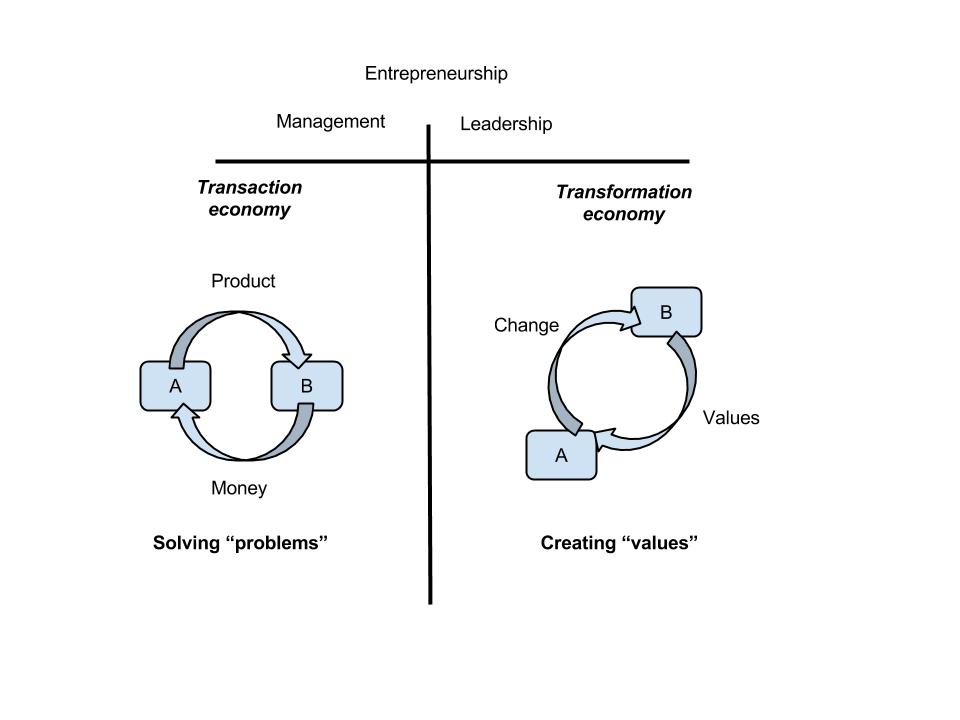
Management versus leadership
Change requires vision, guts and passion to go from one situation to a better one. Change is an investment around a responsibility of values that can be created. Transformation deals with an opportunity, not a problem.
Money needed, no money needed
In a transaction environment money is always needed to exchange for problem solving valuables. In a transformation environment no money is needed because there is no exchange of values, values are created. This requires talents and authority.
The two worlds need each other
Changes produces values that can be enlarged through sales within the growth environment of the world of transactions. The transactions world needs continuous renewal from the transformation world to avoid its saturation. We see in business (also in government) the tendency of unbalancing leadership and management. Management has the tendency of using a situation as unlimited cash cow. Leadership always wants the excitement of risk and change. Together they balance out very well but need totally different personalities to deal with the situation.
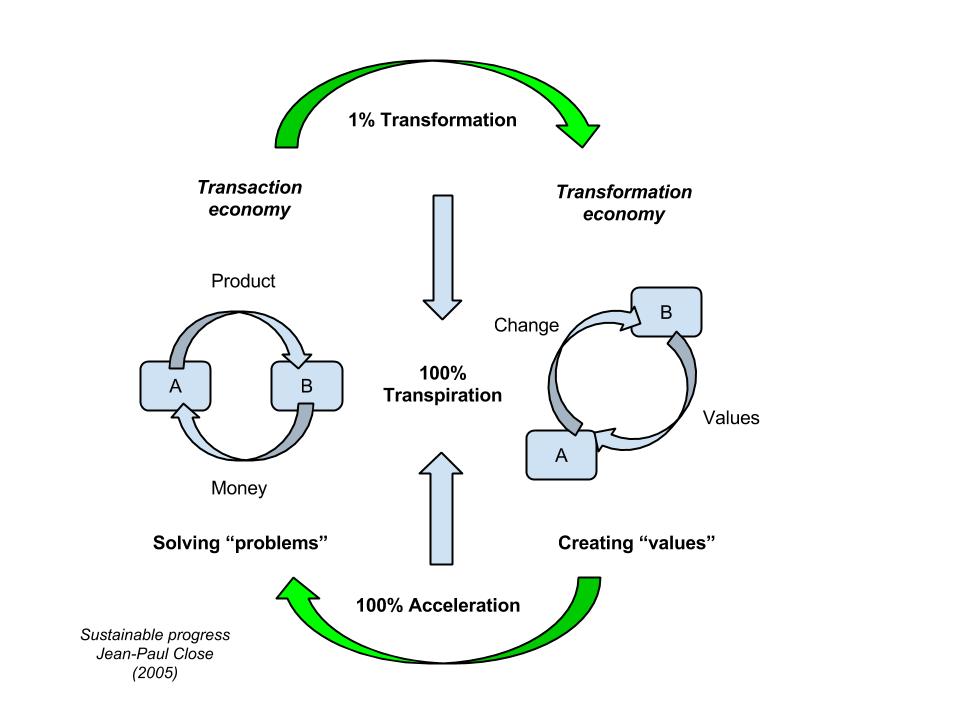
Two complementing worlds
When change is avoided
There are many situations when change is avoided. This is the case with national economies and their current tax infrastructures, or banks with their outstanding long term investments. Change will challenge their outstanding commitment and introduce risks. Many governments and banks cannot address change even if they wanted to. When hierarchies are built around growth, change is out of the question, even if it promises a new path for growth. Management people in power are more worried about what they can loose than what they can win.
Things change when a society is in long term crisis. When the old instruments do not work anymore new ones need to be tested and allowed. So when I introduced Sustainocracy as an engine of Transformative Change, it was dealt with as if it were Transactional. I invited people in business, government and science and they asked me how much they could grow in money making? Many even did not want to come aboard the venture if there was no money put upfront.
Transformation fund
AiREAS started with nothing more than a higher purpose and lots of passion and vision. Now we establish a transformation fund that is used for only one thing: to provide a sense of peace of mind to the transaction driven participants. They need to know that money is there for payment even through the fund is not touched. When values have been created in the AiREAS processes they are so unique and valuable to the rest of the world that each of the partners gets a fair share of wealth back. We even fill up the transformation fund with royalties before we need to pay out our participating partners. We show them that to create value we need no money, just confidence in our selves and a good reason to work together.
Money is a proof of valuable change used by those who follow leadership through effective problem solving management. In the STIR Foundation we opened now a transformation fund just to be able to increase our ambitions in the field of societal change for sustainable human progress. The higher the fund the more value we can create and the less funding we really need. Weird but just part of the time we live in.
Information? Just contact me: jp@stadvanmorgen.com
It’s happening
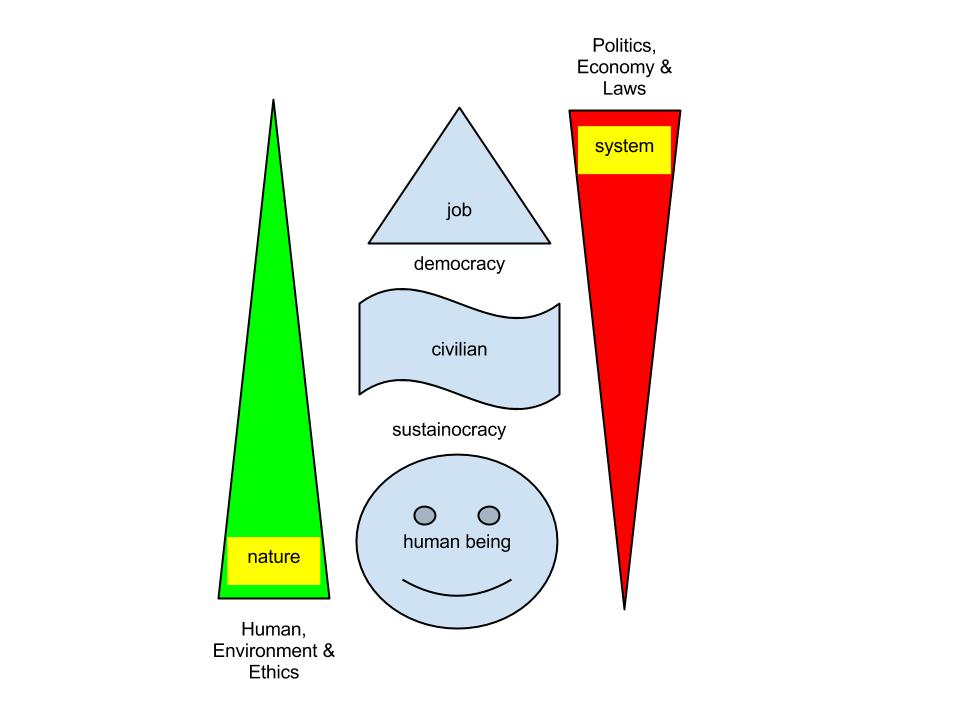
A lot is happening that is being seen as a crisis. But a crisis is simply a strong need and desire for renewal which is being blocked by something. The pressure builds up until it bursts into chaos. Freedom appears that allows finally for the renewal to take place. A lot of people refer to the problems as being economic. This is not so. They are very human. In fact the pressure is building up for the human being to stand up and break through. We tend to reason too much top down while freedom and renewal is found bottom up (see drawing above). The change in thinking is on its way. It’s happening.
Freedom?
When I interacted with people like Ervin Laszlo (Club of Budapest) and other influential people in the field of global visioning we talked about the Global Shift (Ervin) and Quantum Leap (me). In fact, what we both refer to the need for the human being to get back onto its evolutionary tracks.
Ever since the human being broke through the first time in its self awareness a few million years ago and “became human” as opposed to “animal” we have been struggling to deal with it. We have tried to throw off our animal origins by behaving in a dominant way over our surroundings. Our surroundings were so big that the effects were hardly noticed. Meanwhile we became also dominant over our own species. Every individual has animal roots in which we thrive for growth and competition yet we also have self awareness and reflection that gradually introduced ethics, morality and responsibilities. System thinking became dominant, evolutionary thinking disappeared.
Societies became so big, and structures of control and power so dominant that for many millennia the human being was very much preoccupied suppressing its own species through all kinds of dogmatic systems such as territorial ownership, heritage of properties, systems of law, religions, financial and other systems of debt, etc. We were forced (and accepted) to live under the influences of such systems without having a choice. We weren’t even massively aware of the choice as survival prevailed over understanding. Education was reserved for the elite. Those who became too wise to support the system had to fear for their lives leaving behind just samples of their written legacies or lock themselves away from daily reality in confinement of a religious order.
Education is key
Only around the 1900’s the first public education was introduced and generalized for the entire population. This was perceived as necessary to support the growing financial system around industrial processes that needed craftsmanship in great diversity. Educating people became a public service for the system support, rather than a master – pupil relationship. As public knowledge grew also auto-determination and self awareness grew. People became more involved in their securities and well being and less fearful to the mighty, visible and invisible.
In the 50’s of last century governments started to loose territorial power due to open borders, migration of cultures and globalization of financial interests. The only dominance that was still possible was through the evolution of local services, taxation of consumer patterns and a certain degree of regulation. The governments could not cope anymore with the complexity of society and started to introduce degrees of civilian involvement in the decision making processes.
The civilians became more and more aware and knowledgeable even though the involvement was still very much being influenced and manipulated by the systems of power and debt imposed by financial systems, hierarchies and churches. Meanwhile all kinds of people started to become aware of their natural spiritual origins and universal freedom. They became aware what it is to be a human being in the full, with absolute freedom and not simply a puppet in the system. They also became aware that this freedom comes with responsibilities too. This human being does not accept debt anymore nor systems of control and imposition. This human being understands that values need to be created through taking responsibility together.
Internet
The appearance of the internet in the early ’90’s helped make information available to everyone with the freedom of interpretation of the many “truths” that circulate. The pollution of our environment is growing, we see global warming, climate changes, multicultural migrations and clashes, the unethics of systems of debt to control people, etc. We live longer due to the exponentially growing medical and scientific knowledge with access to abundance presented by the artificial systems that surround us. We also become gradually aware of the destructive forces of these systems on our own health, social stability and natural resources.
People become spiritually aware that their natural human freedom is demanding to take responsibility and let go of the dominance that surrounds us. Many people feel this surge of inner freedom but often falsely interpret it as disturbing and fearful against their perceived systems dependence. They are neglecting their own natural feelings out fear for the unknown and their sense of security to reason from the system’s reality. Also the system’s professionals have difficulties with the demanding population that does not simply accept policies but demands explanations and often also take a different standpoint, willing to stand up against systems lack of morality.
In reality our true biological and spiritual human nature seeks ways to freedom and purpose to regain our evolutionary tracks. We realize deep inside that we have deviated too much, have created a self destructive dependency and now look for a new balance that challenges the system’s rational.
“Hi, I am human”
When I take the stand and talk to people I say “hi, I am a human!” They look at me surprised as they tend to reason first from their own hierarchical position and profession, then their citizenship and hardly reach out to consider their condition of “human being” and true freedom. It has been neglected and suppressed.
By inviting them to reason with me as a human being things change. We are a biological self aware creature of flesh and blood, that depends on its educated relationship with its environment, according to universal laws of health, safety and self determination. When people open up to that a new world appears to them. Then the Global Shift, the Quantum Leap happens inside them. They suddenly realize and become willing to deal with citizenship and professionalism from the human perspective (bottom up) rather than the system’s perspective (top down).
Experimenting with the new democracy, Sustainocracy, we even structure a new society around this human perspective, respecting the old one partially, as we need certain systems from specialized functions they carry for us to use as instruments. We cause a transformation of society from the dominant blocking to one that is transparent cooperative.
It does not happen all at once. It occurs with small steps, sometimes large boosts, all together, involving people who understand in all kinds of positions in society. When I started with this 15 years ago it was not yet possible and I stood alone. Now I can create real Sustainocratic ventures with top executives from government, science and business, involving people all over. I invite them as human beings first and than ask them to use their professional authority. In any case we see the process speeding up fast. The key steps for our liberation from our own selves were:
1750’s – industrialization
1900’s – education for all
1950’s – participation in policies
1990’s – un-manipulated self awareness through internet
2010’s – first sustainocratic ventures placing the human being at the center. Taking responsibility.
Conclusion: The human being is finally becoming aware what it is to be human in freedom.
It’s happening…….!
The first one for AiREAS

Today on September 17th 2013 the very first Airbox of AiREAS was installed in the city of Eindhoven (The Netherlands). It was an emotional event for all involved in this co-creating venture.
The emotions were not so much because of the unification of high tech elements inside the box, designed to measure the environmental conditions in the public space up to the smaller detail (ultra fine dust, sizes smaller than a virus). It was more because of the unique unprecedented multidisciplinary way this all had come about.
The Airbox, its design, the location of the boxes in the public space, the real time measurement, the level of detail of the measurements, the scientific research, the transparent nature of making the information available to the general public, has all come about through direct membership interaction between local citizens, the local government, scientific experts and technological innovators. They all accepted the civilian invitation to take responsibility for creating world’s first healthy city together.
This way of working is suggested by a new development, called Sustainocracy. It is a transformative way of addressing our democracy by accepting health to be a joined responsibility above political and economic forces. The acceptance, even by the local government, to become MEMBER of change in an open and transparent cooperative way, is unprecedented in the world.
AiREAS is formally a cooperative and works entirely through the commitment of its partners. It has no personnel, nor buildings, yet co-creates high tech, changes local cultures, modifies local law systems, changes leadership routines and performs purpose driven scientific research. It is a value driven movement that saveguards the values created together, making them available to the world through its institutional partners and directly by creating local AiREAS anywhere in the world through the dynamics of fractal growth. Sustainocracy is referred to as the “transformation economy”.
Initiating civilians: Jean-Paul Close ( founding father of Sustainocracy) anf Marco van Lochem (specialist in complex projects).
Government membership: City of Eindhoven and Province North Brabant
Business members – multinationals: ECN (Airbox development), Philips Electronics (key components for ultra PM measurement), Imtech (Collection Database and mobile app)
Business members: Local entrepreneurs
Scientific institutions: IRAS ( longue and respiratory) University of Utrecht, ITC ( modulation, space observation, allergy) university of Twente, University of Amsterdam (heart and artery)
Local citizen’s of Eindhoven.
For me personally this materializes a dream as it took me over 10 years to define Sustainocracy and make it work in practice. The Airboxes are only a step, significant but not more then a first step. However, as in real life no marathon has ever been run without taking that first step. It is just as significant as crossing the finish line. Healthy city, here we come!
 Sustainocracy, the new democracy