Our best wishes
Our value driven co-operations and all people involved wish you a “natural” and sustainable 2014

Jean-Paul Close, founding father of Sustainocracy, sustainocrat Nicolette Meeder, sustainocrat and co-responsible for STIR Academy and GroZ
 Marco van Lochem, co-responsible for AiREAS
Are we alone in the universe?
This week a satellite was put into orbit equipped with cameras that can see a hair at 1000 miles distance. Research is said to be focused on detailing space in a further attempt to discover other signs of life.
We are not alone
We already know that we are not alone in the universe. The theory is clear and was explained in my blog series about the “secrets of life“. The way life came about on Earth through harmonic frequencies shows that life itself is programmed as an integral part of the working of the universe and not reserved just for our planet. Our planet simply presented the right combination physical, environmental properties for life to set off. These life triggering properties are contained in the already accepted string theory of multiple dimensions of frequencies that hold the universe together. Part of it is sustaining the ability to trigger life.
From a probability point of view the likelihood of finding similar environmental properties as Earth anywhere in the universe is 100%. This means that life elsewhere has been triggered already many times. There is no doubt about that. We can even go further than that. We tend to take Earth as our point of reference because it is part of our perception of a particular, measurable reality. We cannot rule out that there are many more frequency combinations possible that result in material bonding to produce life within different environmental settings. This would kick off lifeforms in totally different conditions than on Earth.
The question hence is not “if” there is other life in the universe but where? And when we find this proof somewhere, how will it have evolved?
Evolution
What probability would lifeforms anywhere in the universe have to resemble in any way our own physical human nature and behavioral properties? That probability is low even though the evolutionary complexity that resulted in the human being does show mechanical logic. The human being is the result of billions of years of very local evolutionary steps that do not follow a straight line. Evolution is already a complex process within the context of life’s basic properties of growth, competition, change and harmony within the confinement of a single planet. This complexity is further influenced by many circumstances that life reacts to but does not control. Think of natural disasters that upset the planet as a whole or the climate and resources in which life develops. The disappearance of Dinosaurs for instance opened up a reality for smaller lifeforms to develop with a degree of success that probably would have been much more difficult if the dinos were still around. In a similar way there is also no guarantee that the human physical form of life survives time even on Earth.
Maybe the mechanical logic of our physical shape could have repeated itself elsewhere in the universe even considering a totally different starting point of life. Creative minds of SF films have come up with ideas of human like creatures that may even have outsmarted our physical design. From a logical point of view, despite the many possible differences, we can expect evolutionary similarities in the evolutionary diversity out there. Still this is a mere charming speculation as the forms that surround us on Earth show already a diversity that can only enhances exponentially when considering new and different habitats.
Consciousness
More likely is the possibility that lifeforms develop over time a similar level of consciousness as the human being. We even see this on Earth with species that are self aware, self reflective and reason by making complex choices. Other species even make or use tools for their benefit.
The human species may have members that reach exceptional levels of awareness compared to species around us, including even most fellow human beings. It is also known that trees even outnumber us when dealing with sensory techniques for life, symbiosis and survival. The question than arises to what extend sensory capabilities have given rise to self reflective properties, the ability to create tools (such as space travel) and for what purpose (we humans create tools for war and progress)?
Tooling and awareness building has provided the human being with a local competitive advantage on Earth under the circumstances in which we could evolve for a few million years. There is no reason to believe that these levels of consciousness cannot have been equaled or even enhanced by other lifeforms elsewhere in the universe.
What would that mean? When we look at ourselves we see that consciousness develops along the line of spirituality (meaning). It gave us initially a better competitive advantage to deal with changing circumstances but once we become dominant our only competition is with our own selves. We come to terms with ourselves through development of values that forcefully are not focused on winning a competition but on finding harmony through adjustments and diplomacy. We then discover spirituality inside by looking at our own inner harmony (the “I am” experience).
From a consciousness point of view other life forms will not differ from us because consciousness has to do with the same string theory of life creating. It is same throughout the universe. We interpret reality in a similar sensory way and eventually come to comparable conclusions.
When they reach a dominant position on their planet too they also are forced to create awareness and empathy and let go of competition. They will also learn to live an existence in moderation, developing ethics and responsibilities within the confinement and possibilities of their own habitat.
Why would such species want to concur space?
There are multiple reasons that compare with our own:
- Curiosity: One of the qualities of self reflective species is curiosity. Naturally we want to see for ourselves when we have the chance, opportunity and ability.
- Growth potential: A dominant species will always find limitations of growth. Adjustments and regulations to survive adequately will certainly be combined with the choice of looking beyond the confinement, including through space travel.
- Need: Survival is a key quality of life, enhanced by self awareness. When a species reaches this point of consciousness it also looks at self preservation beyond the limitations of the direct environment. Even Earth is not eternal. Not doing anything will eventually destroy the species. Knowing that it would be against the nature of life to accept it passively even though spirituality gives the certainty that life repeats itself eternally without need to preserve itself. It is not life that is being preserved through space travel but the self aware species.
When two species arrive at this point of local evolution, decide to go out into space and manage to meet, what would be their reaction?
I leave you with this question. For me the answer is logical and clear when reflecting about the development of life and its building blocks, both in material sense as immaterial (behavior and awareness). Maybe the answer is a reason for all dominant self aware species throughout the universe to decide not to want to concur space and leave the possibility and outcome to our vivid imagination.
Sustainocracy is a modern design of democratic freedom and society within the context of harmonic string relationships for sustainable human progress. We do envisage the universe as our potential habitat beyond Earth when time and knowledge is there. We then also expect encounters with lifeforms that did not develop on Earth.
Choices that affect the world
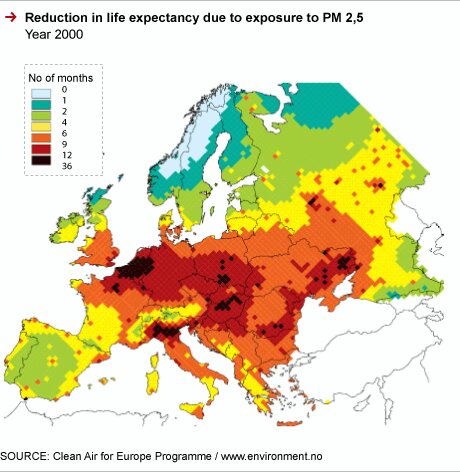
Life is full of choices. And choices have consequences. Take this chain of historic choices for instance in the Netherlands. The peaks in every picture are directly related. Now that our air is polluted, being number 1 cause of death in the public space, what should our next choices look like?
Goods distribution
The Netherlands choose to be the center of goods distribution for Europe ever since we discovered the waters for worldwide commerce. Our geographical positioning and trading history made the development of the large Rotterdam habor and infrastructures a logical choice.

Consumer economics
Since Europe decided to focus on consumption (leaving productivity to low wage countries) the combination of distribution, infrastructure and city development became economic growth patterns. Cities are ideal, concentrated consumer platforms for economic efficiencies.
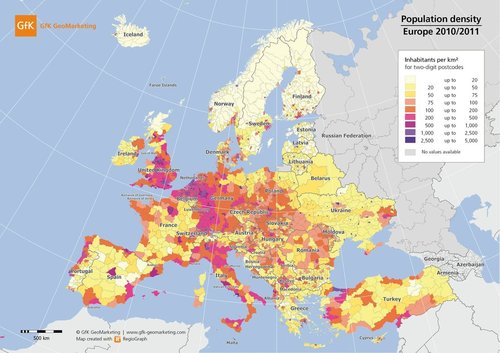
Population density, economic growth and health hazards are developing exponentially together
Air pollution
Choosing to use fuel combustion as mayor source of energy for mobility, heating and movement of goods shows consequences of premature death directly related to air pollution from burning fossil fuels. A large, services economy around the consequences develops.
Global warming, sea levels rising
The pollution contibutes to global warming with the consequence of sea levels rising. Large investments are needed to protect the Dutch mainland against the sea water. If this process continues large parts of the mainland will be flooded at places where the biggest city development has taken place. How do we protect millions or even billions of people?

Not much of Holland will be left
Global issues, local solutions, global application
When I choose to move from Spain back to Holland I noticed the equivalent reduction of quality of life due the combination of materialistic economic growth focus and growing consequences on health and environment. As a consequence my awareness developed around complex ethics and responsibilities. It became my choice to invite key local responsibilities (government, science, citizens and technology) to address People, Planet, Profit together rather than separately. Sustainocracy was born and AiREAS Eindhoven our first venture.
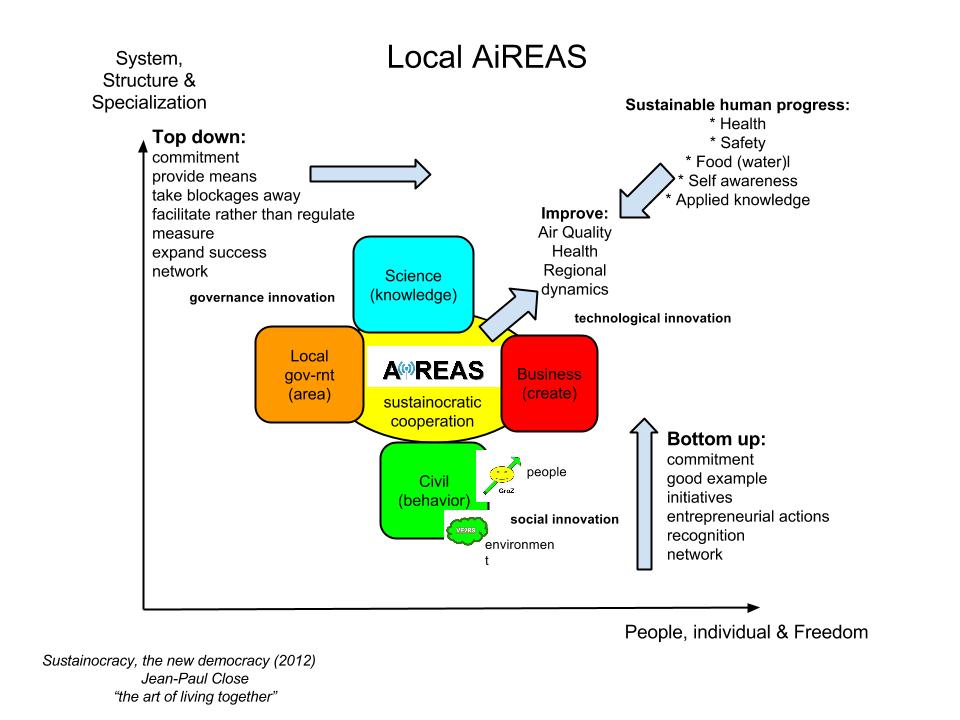
AiREAS is the first sustainocratic venture for healthy environments from a air quality point of view.
Choices are based on circumstances, opportunity and awareness. What would happen if Europe would change focus from consumption to productivity? What would happen if economic value would be given to positive human interaction rather than materials and goods? What would have happened to my awareness if I had stayed in Spain instead of moving to Holland? How can Holland cope with health responsibility when its economic positioning depends on unhealthy practice? What choices can we expect? What would happen if we did nothing?
Analysis of choices, consequences and sustainable human progress is becoming a modern science of its own. But whatever the outcome, the transformative reality is clear. If we do not work on those global issues locally with solutions fast we will be surprised by chaos and disaster. We will pay the highest price ever. Death. Now we still have a choice.
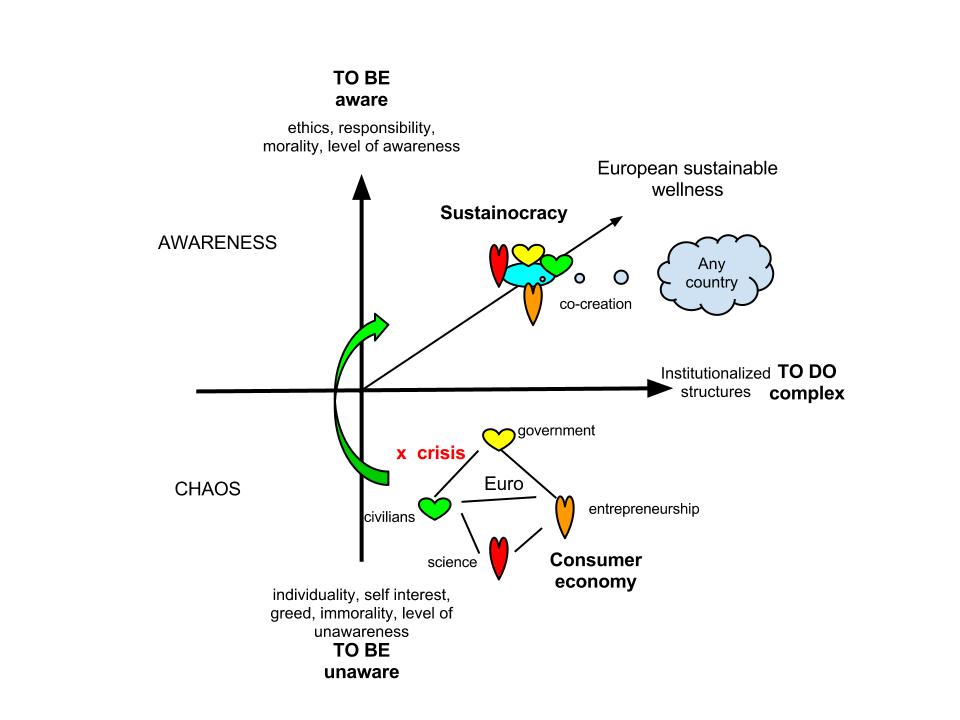
Two realities with the same players in the model (JP Close 2009) of human complexities: immoral financial growth and cocreation of solutions
Jean-Paul Close
 Sustainocracy, the new democracy