What makes a government “sustainocratic”?
A sustainocratic government is one that is willing to participate in purpose driven local multi-disciplinary teams without any more authority than facilitating regional development of sustainable human progress. For many governments today this would mean an overall transformation by stepping into the pack instead of the old dominant regulatory role. This transformation is necessary to pick up the challenges that human kind faces and that are shown through the appearance of all kinds of crises.
This is the comparison between traditional (current) and sustainocratic governance:

Transforming from one governance to the other needs others to become participatory too.
Most governments today are of the traditional type. In a money driven society the institutional interests have become so fragmented into isolated self-interests that all pieces of a society live a life of their own. This results local social consequences that need to be attended by the local governance in a reactive way. Local government uses taxation and debt to finance itself. Such governance feels powerful in its regulatory and controlling authority with a risk avoiding service to its population. This type of governance has become very vulnerable due to its disconnection from an evolutionary reality which develops beyond its control due to open borders and globalization of financial interests. Just the measures that fit the local consequences are within its span of control at the expense of its limited sources of financial income. This is explosively dangerous. Governance has nothing else to draw from then regulation, financing the growing consequence driven government dominated institutions (health care, police, expensive infrastructures, etc) through distribution and consumer growth while watching its society deteriorate.
Urgent need for change
In an open border, globalized world, such governments are vulnerable for any influences from elsewhere. Self interest does not lead to any partnership among governments as all search ways to keep up their necessary level of income at the expense of the others. Since local government income is dependent on levels of local consumption the stimulus is concentrated on keeping this in tact and growing, either through volume (automotive, food, energy, clothing, retail, logistics, etc) or through speculation (housing market, fashion, shortages in commodities, etc). This situation is unsustainable, resulting a ever growing public debt, internal instability, reduced government maneuverability, etc. Although powerful in regional regulatory dominance the governance has become ineffective, reactive and out of control. Such governance unavoidably leads to war and chaos, unless sustainocracy is applied.
The above suggests the urgent need of renovation of governance in an evolutionary sense. Sustainocracy is such next step in which regulatory dominance is transformed into facilitating partnerships through regional multi-disciplinary co-responsibility on human well-being issues. Key here is that governance assumes a territorial role of purpose driven technological and social innovation focused on sustainable local human progress instead of global competitiveness.
Self sufficiency
The most significant purpose of any community is to be as self sufficient as possible. Self sufficiency reduces the vulnerability due to the reduced dependence on others. Self sufficiency also requires the intense involvement of all local participants that shape and give content to the community. This is essentially what sustainocracy is all about: awareness, responsibility, participation and local wellness.
On paper this is easy to explain but how would one change a traditionally dominant regional governance into a facilitating sustainocratic partner? The logic maybe understood by local executives but the system is based on risk avoidance, regulation and control. Even if the executives wish to partner up in a sustainocratic processes they still face the need to involve their institutional structures too. Such structure is steered around the compliance of rules not bending the rules for progress. Executives run the risk of becoming non-compliant to their own systems of law. It is not simply a re-positioning of a business or letting a state go bankrupt. It means a totally new way of organizing society including jurisprudence. In a democratic society this can hardly be done because consensus is needed in a majority to make such drastic changes and such majority will never be found unless the society is in war or chaos already. Before that the conservative voices promising continuation of the past will always win from those who promise a better future.
Step by step
Governance cannot transform organically from traditional to sustainocratic. It would have to take the seat in the center of a sustainocratic process, relinquishing all its dominance. That is impossible to conceive in today’s reality. When government is willing to step into the pack with its territorial responsibilities and commitment, the pack will need to step up to take co-responsibility too. In an environment where the other social components have been living an independent, individualistic, self interested life, this is a new complexity to deal with. None of these parties can take over because it would make them dominant in the relationship which is not logical either. Co-creation and sharing responsibility hence needs to be placed with the context of a new, modern cooperative entity. This entity is independent and represents the purpose of the venture. Various purpose driven entities can be established in this way uniting the influence and authority of the four pillars of society (government, business innovation, science/education and the local civil population) around a single complex purpose for local self-sufficiency.
Experimental starts
In Holland I started sustainocratic ventures like that on a local for local basis. The first one is AiREAS, using air (environmental) quality measurements, related directly to human health, as trigger for social and demographic innovation. This is unique in the world. In the process of setting up this cooperative venture we needed to attend all the above transformative challenges. It is only succeeding because of the commitment of highly qualified people at the center with me and within the institutions that need to be involved. The intensity of the process from fragmentation to holistic cooperation is huge and vulnerable along the entire way because of the negative forces of individual institutional self interests fighting it continuously. It is a chicken and egg situation where partners are willing to join if governance is willing to step down and join the group based on equality rather than dominance. The only way governance can do that is by letting go of its financial control system over public means, providing cash to the sustainocratic venture with a demand (reciprocity) of shared result driven responsibilities.
Investing in change rather than maintenance
The financial commitment of using public funds from local taxes to invest in purpose driven ventures with the local population as beneficiary in wellness, is of course common sense. Yet traditional governance invests billions in maintaining an obsolete system, neglecting the building up of local for local self sufficiency. With only a fraction of all the investments that have disappeared into sustaining banks and bankrupt governments sustainocratic ventures would have already changed risk into sustainable local stability.
It is of course in the interest of a few people to keep a financial dominance out of self interest but common sense, and the availability of sustainocracy as new way of solving key human issues, will get a bottom up movement going starting primarily in the smaller urban centers where human interaction between institutional powers and civil entrepreneurship is still fairly close. State governance will change bottom up, peacefully if central governance is willing to let go of its financial dominance and dependencies, allowing things to happen for the sake of long term stability. Else populations will demand attention forcefully like they did in Egypt, Libya, etc. This is not necessarily done through acts of war or civil uproar. It can equally be done by demanding liabilities and responsibilities through the wisdom of the crowd and claiming constitutional human rights where they are being violated by money based governance that causes inequality, poverty, hunger and criminality. Social media are becoming a strong alliance of people demanding openness and transparency from governments. In many places in Europe and the rest of the world we see governments giving back regional development to their own people. In this peaceful process we observe that population can perfectly well carry the responsibility, especially when ventures are co-creative and partnered up by institutional interests together with creative local entrepreneurship focused on local wellness.
“Can do” needs the freedom of purpose driven ventures without the burden of old financial blockage. Taxation creates no value, creativity does, especially if directed at common human interests with involvement of all.

AiREAS is the first sustainocratic venture in the world
What makes a business “sustainocratic?
A sustainocratic business is essentially very different from a traditional type of business of today. The very first thing we notice is the positioning of the company. It recognizes the different paradigms or worldviews that reign the human worlds and places itself consciously in the field of complex human sustainable progress for well being, not financial greed. This positioning shows in its functioning in society. The company is purpose driven, extremely talented and very cooperative in all kinds of multidisciplinary ventures.
The business is very flexible, challenge driven within the scope of sustainable human progress. This requires a visionary leadership culture that goes beyond the board of directors where the results in human progress are leading the company, not financial KPI’s. The structure is dynamically organized allowing people to take their own initiatives, show self leadership and commitment with the end results that the company stands for. People do not work in the company, they contribute to a higher cause and are willing to give more of themselves than strictly asked for. Their personal return is based on business reciprocity. Hardly anyone is on the payroll but everyone is highly committed.
The organization shows organic growth through spontaneous division, local for local added value and multidisciplinary commitment. Not one of the subsidiaries is the same yet the commitment to the kernel of the company’s reason to be is the same for all. Management does not form a hierarchy but a functional facilitating cooperative.
Above all a sustainocratic business is willing to reinvent itself continuously or else risk to die. It takes calculated risks that have no financial impediment because progress is developed together with other parties. The company is run through multidimensional entrepreneurship (MDE) using the 5 keys of 21st century success (the 5K’s) and UNITED as local team builder and guidance. The company produces 4 x profit: profit for its customers, for society, the planet and as a consequence for itself (pyramid business paradigm). Money is a catalyst means that produces purposeful value.
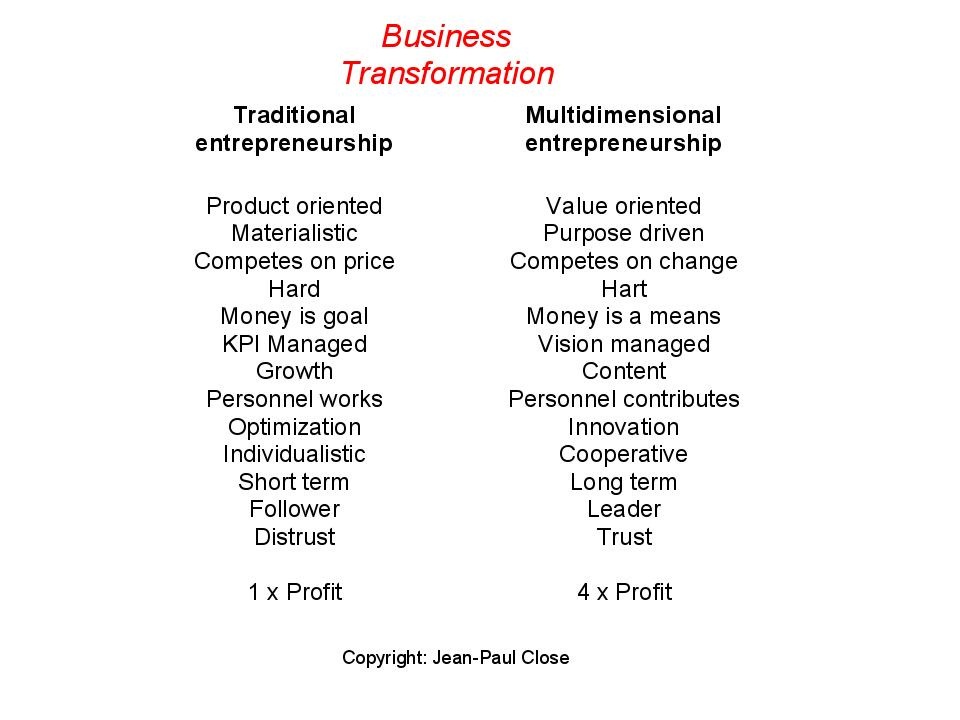
If you work at a company now how do you feel? Do you go to work to fill the pockets of your boss or do you contribute to a higher cause that makes you feel valuable yourself? Can you describe easily what benefits you company brings to the world? In SME type companies you may respond positively but in larger multinationals answers may be complicated. You evaluate for yourself “what responsibility you take?” Do you stick at the job for the salary? Or do you actually feel that you are contributing something by going to work? You always have a choice.
Route of least resistance – law of opposites
In various places of the world there are forthcoming general elections again, so are in the Netherlands. The public media circus has started again in which politicians compete with their lies to see if they can lure people to them. New political parties are not granted access to the commercial media that finds its friends in those who have most to give. New initiatives can’t grow in the darkness below powerful structures and need to wait until they fall over.
Or they find the route of least resistance.
Well-being is located at exactly the opposite side of the human complexity model from chaos. In human evolution societies reach the state of chaos normally due to the inflexibility of a long period of greed. Wellness is something that people tend to want to keep conservatively, creating systems to preserve it against progress. Progress is risky and could put wellness in danger. Greed gradually appears in the systems.

Greed is a brick wall for those who wish to move from chaos to wellness
So when people or institutions find themselves in or near the field of chaos they can do two things:
- Move back against the line of human evolution (clock wise circle) to get to wellness via greed. They would either have to become greedy to fit in (criminality, manipulation, aggression) or try to force their way through the massive opposition of hierarchies, bureaucracy and system rules. (the red line)
- Or choose the rout of least resistance through awareness, trust building, cooperation (the green line) and development of pre-paradigms until one breaks through to replace the old one.
Interestingly in the model the opposition between greed and spiritual awareness is also well visible in reality. The more greed develops in the system the more people oppose through spiritualization, still highly individual but with a gradual built up in the field of awareness. This group is also fed by people who follow the traditional line through chaos and search the enlightenment of conscious reflection when facing the aggression in chaos. They create renewal by proposing true alternatives.
The green line is the route of least resistance but needs the talent of organization and willingness of people to build a new, parallel society. People can group together and use the modern means of social and alternative media to communicate and build up sufficient strength against the organized dominance of greed. In the field of greed competition and self interest is high and deadly. It has the tendency to inflate as a bubble to explode into a crisis with chaos as a result. My people keep up powerful positions managing the old system out of self interest.
In the field of awareness the process is exactly opposite. People become so aware of themselves and society that they need to be challenged to join and become organized around progress. The more greed collapses into chaos, the stronger awareness can organize itself eventually into wellness.
The law of opposites rules here. When people claim in public that they want to go back into recent history because of the wealth of that moment they can try the difficult (impossible) or the easy way (complicated). The way back is the one in which no lessons are learned, no forward reflection takes place. There is a simple anxiety to relive something of the past. The way forward is the one where abundance of the past is learned from in perspective of the scarcity of today. Steps can be taken through awareness to develop a new society based on accumulated knowledge. The route of least resistance is the one of awareness, hence an inner one of reflection, and action based o trust in each other. Sustainable human progress hence has to do with applied knowledge in the warmth of social innovation. It can be applied, not by fighting the system of greed but by avoiding and even neglecting it, positioning your society building outside the dominant structures. If the latter are greedy for money, organize yourself without money.
Use the law of opposites and you will follow the green line without finding resistance.
 Sustainocracy, the new democracy