Pioneers of a new world
Introduction
This has become a long blog again. I introduce a solution for all humanitarian problems in the world and all related crisis. It requires a lot of explanation because it involves all current institutional powers in a new setting. And finally comes back to the power of our individual selves. Soon I will publish a booklet on the issue but my sense of urgency is so big that I cannot wait to reach out to those of you who can become already changers of the world after reading this. For humankind it could be the most important blog ever as long as I can reach out to you soul and make you aware. Please take some time to absorb the information and place your own self in perspective. See what happens when you suddenly realize that humankind could get to depend on your own next steps. It is fun AND a huge responsibility. Can you handle it? That is up to you. I am ready to help you when you are.
The destructive force of our institutions
Over the years we have grown dependent on institutional activities because of the impact they have on our lives. The unique capacity of an institution is that it can enlarge a single activity into huge proportions. A single human being cannot do that. We have grown to depend on the institutions because they provide us luxury articles, financial means, governance, jobs with related salaries, scientific knowledge, etc.
Most current institutional structures of today were born already some 150 to 100 years. The conditions in the human world were right back then to allow such fragmented focus to occur with the related growth of institutionalized power. Still now the discussions in this world only talk about growth and more growth as a single sign of strength. Due to this fragmented focus these organizations can only take responsibility for their own small field of highly specialized attention. They started to relate via this specialization to compliment each other in their objectives. A manufacturing company in the 19th century would have its own transportation system, energy supply, uniform making unit for their personnel, etc. But gradually in the 20th century the further specialization allowed institutions to focus on their core business and select suppliers to outsource their surrounding needs. In the middle of the 20th century the patchwork of specialized institutions because so large and so competitive in their mutual interaction that a chain of dependencies appeared and with it new techniques of managing the chain.
Due to the focus on fragmented institutionalized interests the awareness for “the whole” disappeared entirely. Things like pollution, usage of natural resources or humanitarian issues became subject to competitive policies. Institutional survival became more important than the consequences of such survival decisions. Non of these consequences could be challenged by any single authority. What authority should do that? A local government has no global authority to regulate. Yet they do have a dependence for economic growth, imports and exports as well as labor and tax perspectives. Global authorities on the other hand have no formal jurisdiction in the countries or in the institutionalized business enterprises and banking policies. They may have a bureaucratic influence on awareness (like VN resolutions) and certain fragmented authority on addressing common institutionalized interests (like military actions in Afghanistan or embargos on certain countries).
As fragmentation of power grows further, the chain of interdependence becomes more complex. Despite the competitive fragmentation and specialization each individually could grow due to globalization of markets. The competitive shakes outs would start the intense optimization processes in each of the institutions to remain competitive and attractive in the chain. As time went by we see each of them weaken in quality and strengthen in financial speculation. CEO’s and Country presidents became bankers and debt managers rather than protectors of value driven identities.
The overall shortage of resources started to demand its toll on the global organization of giants that could not feed themselves anymore on natural value creation. The liberalization of money from a valuable collateral (s.a. gold) allowed speculation to flourish as only remaining resource to sustain institutional fragmentation and growth. Access to the available resources became available to the highest bidder. Countries who wanted their populations to survive while active with some labor and high debt programs had to grow their debt themselves. The growth of institutions is still the blind common culture of executives and politicians but growth is already for a long time not possible anymore. Not as a natural process of value creation anyway. The only financial growth that can be achieved is through speculation around shortages but this is controlled only by the powerful and has nothing to do with the general public anymore. They are just manipulated to accept a debt they did not ask for and that solves nothing. Humanity is in the hands now of institutionalized, destructive, fragmentary focused financial robots that have no morality nor sense of responsibility except their own self interests, creating crisis after crisis, chaos upon chaos.
The pioneer
Now we go back to the beginning of this blog. The true power of an institution is its possibility to enlarge any fragmented specialization to huge proportions. Their handicap is that they cannot take responsibility other than for their own piece of specialized power. That goes for regional governments, business enterprises, educational institutions, etc, etc. None can take responsibility for true human values yet they all have interest in it because they are part of the institutional survival. Without consuming, demanding, debt creating, voting or working public the institutions will eventually die.
So in one way or another any institution has the intrinsic need to connect again to integral human values but cannot do that for the whole, just for a small part of it, competing for it. So when we talk about the taking of responsibility for human sustainable progress no one can or will stand up to take responsibility other than maybe some local politicians. They tend to promise responsibility that they cannot handle because it s beyond their control. They try to solve it in four year periods which many do not complete, by raising taxes and public debt with solving anything.
Only one can take responsibility and that is the pioneer. It seems funny that with all those incredibly big and seemingly powerful institutions the sole responsibility of human progress could lie in the hands of a bunch of pioneers. But it is true and makes perfect sense.
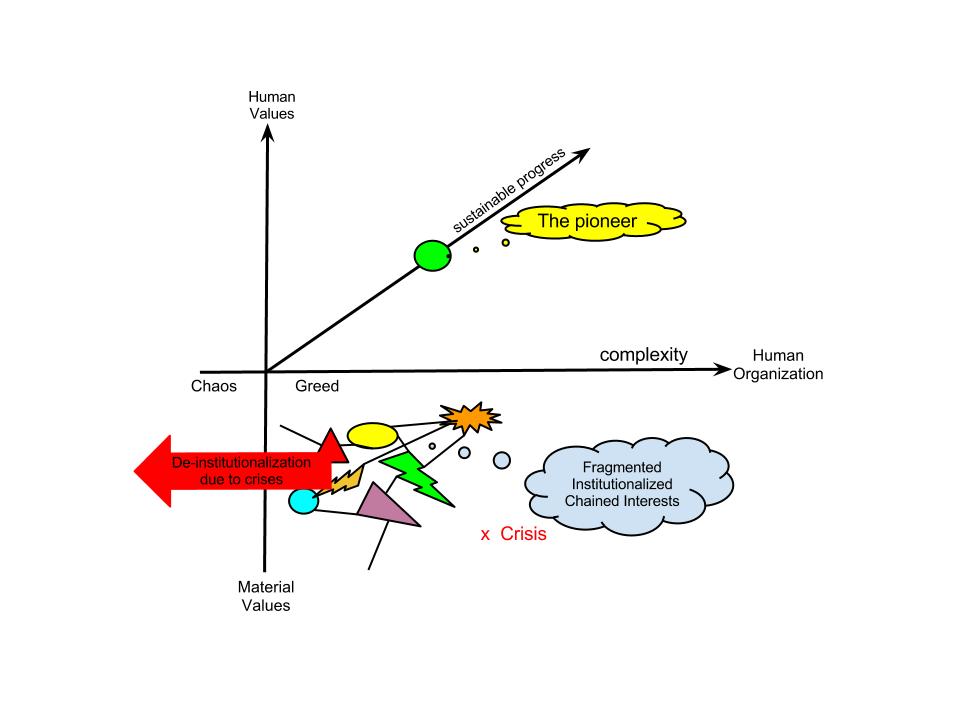
The pioneer positions him/her self in the field of sustainable human values and progress
The robotic institutions can be our enemy when we see their unconscious destructive force while preserving their self interest in their fragmented world of material power, but they can become our friends when we can get to use their institutional powers of expansion in a proper way.
Thanks to the de-institutionalizing powers of a crisis, in which the organizations need to go into survival mode, decreasing in size due to the lack of resources to draw from, they become also often sensitive for new ventures and responsibilities in which their field of expertise can excel. This is an opportunity for the pioneer but also for the institutions. How does it work?
The pioneer takes responsibility for a complex humanitarian progressive proposition. He or she subsequently invites all necessary institutional powers to help enlarge it.
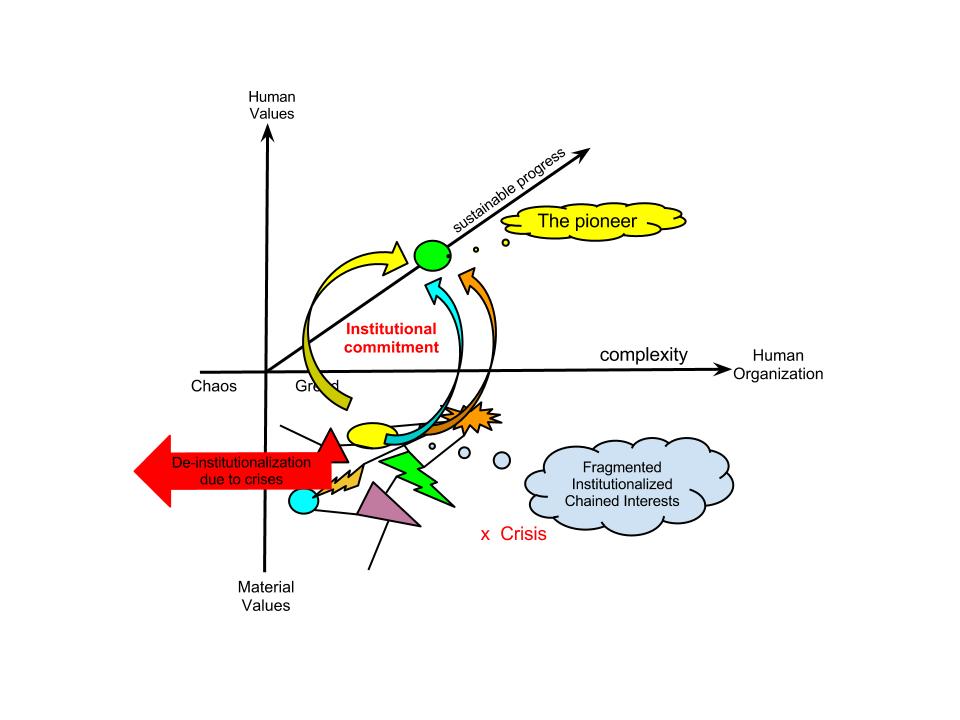
Institutional powers can be used to enlarge humanitarian interests
The role of the pioneer is to define complex progression based on human values. When inviting the institutional powers to join the pioneer they are asked to enhance the responsibility with their own institutional powers. To make a holistic proposition of human values one cannot just rely on a single empowering institution. If that were the case the institution would have done this already by itself. The complexity of the whole is that it needs the entire mix of authorities of a society to become effective, with the pioneer sitting bang in the middle.
Sustainocracy
In sustainocracy the pioneer takes the lead and invites the four key authorities that are needed to expand the human values into common wellness and progress:
- Local government
- Technological innovators
- Educators & scientific researchers
- The local public itself
Drawing all these authorities from the field of fragmented interests, they unite in the field of common responsibilities together with the pioneer. Seemingly contradicting interests suddenly start complementing each other as the focus lies on progressive goals outside the scope of self interest. The self interest can be complied with only if the common interest is achieved. This forces the authorities to enter into co-creative processes by trying to understand each other and join forces. The pivot is the pioneer who safeguards the humanitarian interests in a battle field of institutional giants.
In the Netherlands I have started experimenting with this pioneership. It resulted into a series of initiatives that are proving their value from a humanitarian perspective but also the institutional positioning into a new world. Each of the authorities has a chance to excel in its own field of competence, not by competing or creating interdependence but by combining the individual competences into a common goal. Since executives and personnel in such institutions are human beings too we find that the sensitivity of the hard material robotics become more soft to address human wealth issues through new types of policy makings.
The institutions change slowly into supportive and facilitating identities that gather new public admiration. They truly become extenders of human progress to which they attached their fragmented by highly specialized competences with new perspectives of survival first but institutional sustainability in the long term. The field of chaos can now be managed with the perspective of an institutional alternative, not just to create value but to contribute to a greater cause, enhancing it and expanding it.
Training school
To extend these finding globally I have started a training school for sustainocracy, training pioneers as well as institutional executives on their new age responsibilities and challenges when entering the field of sustainable progress and all related differences with the old paradigm.
http://www.eventbrite.com/myevent?eid=3558815513
Pass the word and help change the world.
Sustainocracy – not a choice nor a process
The fact that sustainable progress is not a democratic choice nor a transformative process was a true revelation to me these days. It is an act of taking responsibility. If I take responsibility I can ask others to so too, even institutionally. And if they do not take responsibility I can ask them to justify their reasons and even ask justice to speak out. Wow! Will the near future look like that?
I came to that revelation while wrapping up my new booklet on “the new society” with my conclusions. My model takes a complex issue (a human value s.a. health) in a region and asks business, government, science and the civil community to take responsibility together. Purpose driven, multi-disciplinary ventures appear s.a. AiREAS or STIR (initiatives that I started myself). Today I am still relying on the voluntary choice of an institution to participate despite the value driven purpose.

Taking responsibility together for sustainable progress
“Sustainocracy” defines the new model for society. The word is a fusion between Sustainable Progress and Democracy.
Sustainable Progress is in my view not a democratic choice but an imperative mission of humankind. The imposition on all of us to work together on a healthy, vital and safe human community seems very logical to me. New leadership in this new society is represented by someone who takes the initiative to create new age purpose driven venture based on that moral imposition. Why would a single person take such complex initiative? Because no one else can, not institutionally anyway, because of the way economics works.
My own awareness came when I was challenged to make an instant decision of human value. The safety of my children or my money driven career? There was no middle way. For me it was no choice, I was given no transition time, I had to make up my mind instantly. My decision was to bring my children into safety. What else? Would I at that instant be at ease with myself if I had made the other choice? Once a person is aware the decision is not a choice anymore, nor a process. It become an instant change of mindset, taking responsibility at once. After that moment, the consequences are huge because the process of no return starts when the new responsibilities need to establish and organize themselves in one’s life while letting go the old securities and way of life. But there is no way back. The new mindset was instant, the decision made and the consequences are logical and permanent.
This is key. When someone who is aware and has taken responsibility for sustainable progress and subsequently takes a seat on that line of sustainable progress in my model, starting to invite government, business authorities, scientific institutions and civil individuals to join him and take responsibility too for a complex local issue around human health, vitality or safety, can any such authority decline their participation? On what grounds?
In my own experience so far the institutional excuses have been as varied as:
- Not our main priority
- No people, time or money available
- If you have no budget we are not interested
- Don’t how to contribute
- Not taxable so we cannot support them
- My shareholders won’t let me
It is amazing that in the fragmented, consequence driven, money dependent organizations, the corporate interests have no connection at all to sustainable issues. Else there would be no issue to join the venture, would there? They would be honored, but they are not. Amazing! And even more appalling is the fact that this attitude is considered normal and legally supported. Right now our common focus is on the economies of growth without any interest or even awareness of the consequences of such mentality. Even the genuine invitation of participating with corporate talent and authority in value driven ventures is treated with apprehensive policy choices.
Sustainocracy is dictatorial from a perspective of a common human goal, and democratic in how to achieve it. Democracy by itself is inclined to sum up the self-interest up to a point of self-destruction (Club of Rome warns for this already from the 70s). It is necessary that we accept the greedy nature of humankind but also acknowledge the wisdom that sustainable progress is mandatory, not by human choice but by universal logic. A simple modification in our global systems of justice, defining that all institutional hierarchies should commit to sustainable progress by taking responsibility, could help reform instantly our global wellness expectations. This is of course wishful thinking at this stage, however while precedence with the new model grows the pressure on institutions to take responsibility will grow too.
Important for everyone to know is that sustainable progress can be instantly accepted everywhere in the world. It is now not a political choice anymore, nor a transition process that takes many years. It is a simple moment of instant truth in which we take responsibility or not. This decision is not made through voluntary choice but instant awareness, an act of consciousness that opens up our eyes to universal truth. When this occurs individually the consequences are personal and demanding. But can we expect this responsibility and awareness from our institutions? Yes, of course we can. They are not more than instrumental to human progress. We can demand from them to be constructive and not destructive.
There is not one single reason that would justify the lack of our participation, individually or institutionally, in human health, vitality and security improving missions defined by sustainable progress. It is up to ourselves to open up our eyes, take responsibility and expect others to do so too.
Urgency
When we live our life today we find that we need money to survive. If we take away money we have no access to the seeming abundance that surrounds us. We would have to create it ourselves. Our lifestyle is so complex and filled with gadgets that 100% individual self-sufficiency cannot create the same abundance. We would have to totally change our lifestyle or change way we gain access to the things we cherish in our daily life. This means that for an equivalent lifestyle we would have to transform our society into a new complexity. This only takes place when we start with ourselves.
When I became aware of my own vulnerability in a money driven dependency I needed to learn a whole new set of competences in an attempt to become more and more self-sufficient and therefor independent from money. With my university degrees and 8 spoken languages I could perfectly well get by in the money driven world that valued these talents in a globalizing world of financial speculation and supply chain efficiencies. But when I wanted to grow tomatoes in my back yard I was a total nitwit. In fact, from massive consumer to an independent self-sufficient producer was a frustrating encounter with my own uneducated discapacity.
It became clear to me that a global transformation would go from a highly complex, well organized world around systems of greed into an idealistic world of wellness that did not yet exist. Not because we do not want it to exist or even see the logic of it. Not because we do not have the insight, awareness, scientific knowledge or technology to shape it. We have it all.
No, simply because we lack the personal competences to get it organized. This new society, that needs to provide us with abundance with our direct involvement, is still totally empty. We all need to be re-educated, taken by the hand to show us how it is done, with a new mindset, a new mentality and a new motivation. This I can do for myself because I have the freedom of choice to a certain extend. But 7 billion people mixed up in financial, religious, state and other dogma’s will not come to insight together to stand up and start the change.
Meanwhile our financial markets and dependencies are leading to a point of overall collapse which is eminent. The abundance of today is unsustainable but the sense of urgency to transform is not there. Chance is that our current system collapses even before we have started to shape the new, value driven society. In fact, it has started to collapse already and many people around the world are suffering the consequences. Instead of learning from it and applying the proof to our own circumstances and start the change while we can, we sit back and let it all happen. When we go to the supermarket and find that we have no money we will not be able to buy our bread. But maybe we go to the supermarket and find that there is no bread anymore, even if we have money to buy it. The few remaining pieces of bread will cost a fortune and will feed someone for a day. And then it is over.
The sense of urgency is not just to gain awareness, we need to change our dependencies through self-leadership, acquire new competences and learn how to work together in new complex, value driven systems. And we need to do all this with the opposition of the old systems of dominant power that try to keep us away from taking such actions. This is virtually impossible. Even in the most favorable situation of individual, collective and institutional insight, the transformation will take many years (decades) to take place. And if so then we would need to put all our wit and talents together to avoid immense human suffering around the globe.
“Can do” is not just relative to “Undo” first but to “Let do” and our commitment to join forces and make it happen. Fast in this case is never fast enough. Experience in AiREAS shows that under the right circumstances human co-creation is virtually instant, with instant results. Knowledge how to do it is available, now find the right circumstances.
Note: the right circumstances are – when a local regional government (city, province) is willing to let go of control, including public money, making it available for an independent responsibility (purpose) driven coalition of that same government, scientific institutions, creative innovators and the local population.
 Sustainocracy, the new democracy