Our own required actions to extend our own “expiration date” as a species on our wonderful planet.
The first thing we need to do is stop relying on political and financial structures to solve our problems. These structures have been based historically on the use of human and material capital for their own financial and authoritative positioning. Most of the problems that we face in the world are caused by these structures and our own delegation of responsibilities. This does not mean that there are not many people in leadership positions doing their best. They face a type of DNA of these organisations that limit their options. To change this we need to look at ourselves, as human beings, to re-establish our core natural values and shared responsibilities. We can then help restructure the DNA of our institutions to become instrumental to human and planetarian wellness.
Taking responsibility again ourselves in 4 steps:
Here is a list of actions that we can develop ourselves and invite others (including institutions) to participate.
Establish local 4 local food communities
Food is not a commodity, it is a shared responsibility
This Urban Design Forum issued a set of recommendations for city councils to facilitate urban food community development.
The STIR Foundation, together with worldwide partners, initiated a global FRE2SH learning platform around re-designing our resilient food systems. We open up the dialogue around inspiring outdoor and indoor examples and techniques that colaborate with nature. You can participate in the program

Start taking care for each other again intergenerationally in communities that share housing, space and responsibilities
By developing again our communities we break with our individualism and start sharing our responsibilities and basic needs again. From a financial perspective individualisation was great, as everyone was stimulated to fullfill their individual needs in dependence of the financially structured services and dominance. From a sustainable progress point of view it was deadly since the first natural human need is the social cohesion, the community. In a community the basic needs such as care, food, water usage, energy usage, etc, can be regeneratively optimized in close cooperation with our natural environment.

Reduce our exorbitant energy usage by 70% or more
The main energy that we need as a biological living species comes from our food and the sun, not from the electricity plugs at home or a petrol station along the road. Our excess usage of energy can be found in our mechanized mobility, industrialized productivity, logistic systems, the many devices used in our homes for lighting and entertainment, our heating and cooking facilities, etc.
By developing our needs around local for local structures we can eliminate many energy wasting and highly polluting activities while optimizing our remaining requirements through clean resource management. Also community based living reduces our energy requirements due to the sharing of needs over groups of people. The related reduction of pollution will enhance our health and healthy living environment, reducing our healthcare needs and related infrastructures or bureaucracies.

Develop and accept only 4 x WIN institutions (multiple values driven, regenerative and non polluting governments and business enterprises) as supportive, non abusive instruments for human development.
Look at 4 x WIN here
Institutional DNA (In the 21st century: purpose and positioning in a 4 x WIN ecosystem) transformation is only possible when the entire institutional ecosystem transforms at the same time. This is done when we as human influencers put new demands on these structures. Instead of competing for financial, human and material resources (1 x WIN mentality, leaving the consequences to society, the planet and future generations, if any remain left) they start cooperating in core human values driven co-creation platforms. Money is not a main issue anymore, it is just a means, just like creativity, engagement, applied innovation, impactful applied knowledge, etc. The main issue and driving force is our shared and sustainable wellness in close cooperation with our natural environment. 4 x WIN is a mentality of shared responsibilities for human, societal, environmental welbeing and financial continuity (not necessarily growth).


The global Visioneers network is preparing a great launch and clustered platform for values driven actions.
Save the date: Sunday October 9, 2022 at 11 am PDT = 20.00 CET online and offline (Vancouver) event.
Humanity’s Golden Peace
An Entry to the Age of Global Consciousness
A Catalyst
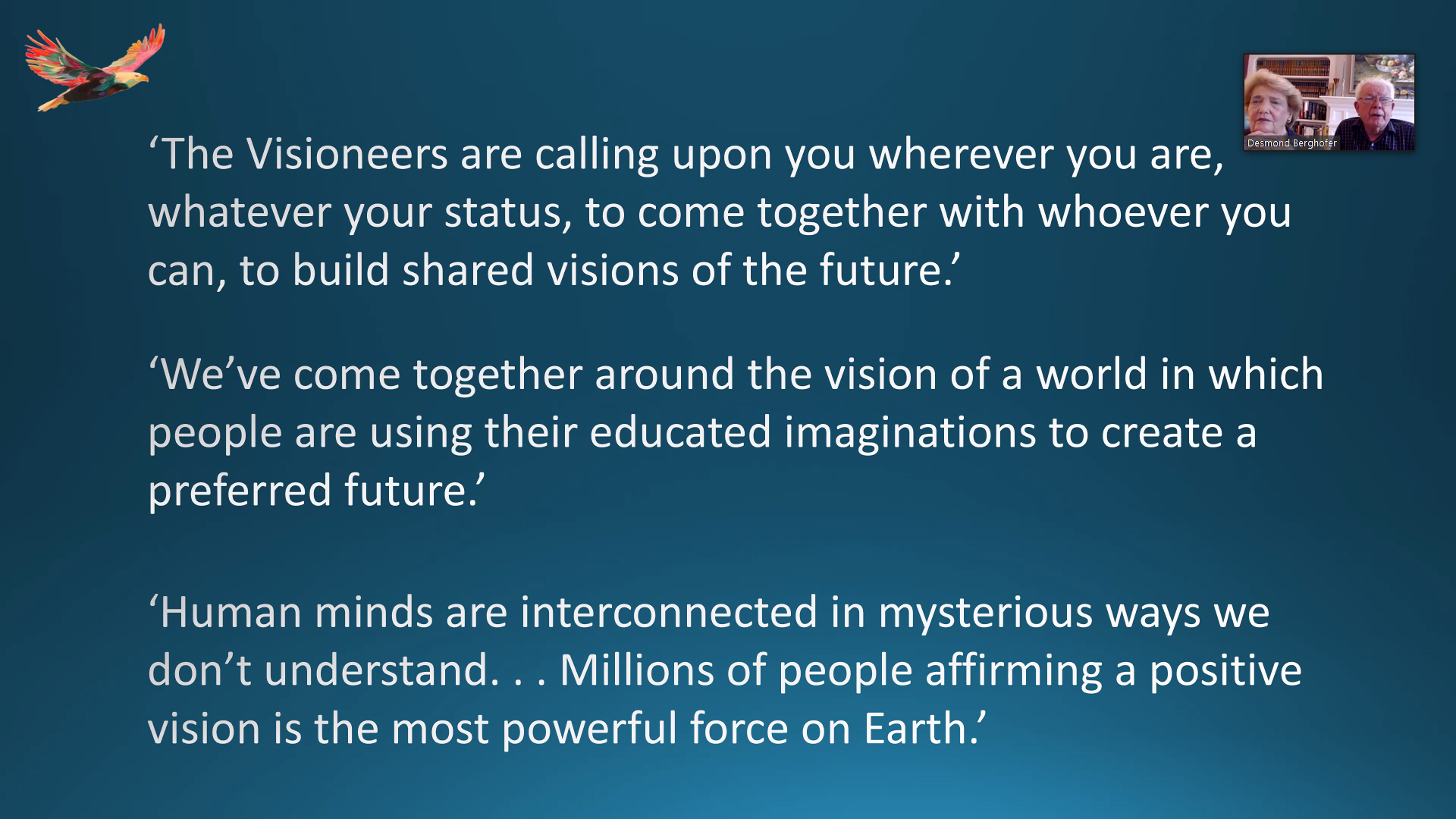
What is/are “the Visioneers”? In 1992 Dr Desmond Berghofer (Vancouver, Canada) published a book on his views of human development. Ever since he has been living his views together with his wife Dr. Geraldine Schwartz. Five years ago they started to extend Visioneers Awards to people who were recommended to them for their humanitarian work accross the world. So far over 300 awards have been extended by them forming a worldwide network of great people that have been making a difference. I myself was surprised and honored to be included in this network some time ago and also become part of their round table of about 30 Visioneers. I suddenly found myself surrounded with the greatest authors, TV personalities, musicians, peace activists, intellectuals, etc.

The event on October 9th? After all these many years of preparations, gathering wonderful people, extending awards to them, it is time to engage the whole world. Read about the plans here in the latest bulletin. The event will contain three parts:
- 1. The celebration and official designation of Visioneers Awards
- 2. Humanity’s Golden Peace, described in visuals, stories, music, poetry and songs, sending our message through the Arts, with choirs of many ages and voices and ongoing audience participation.
- 3. A mosaic of film clips, of 10 inspirational episodes of wisdom, stories of outstanding achievement and visions of Humanity’s Golden Future.
It is also the time to initiate the process of clustering Visioneers in Leadership Circles:
Visioneers Leadership Circles to be formed worldwide will be introduced as we wage peace and register our achievements on the Visioneers Wall of Stories, colour-coded to display progress on the United Nations 17 Sustainable Development Goals.
Geraldine Schwarz

How to stop narcissism spreading across the world
Natural human values as a universally shared responsibility for peace and progress
Today we had the opportunity to listen to the story of Wiecza Santos, a lawyer and human rights activist from Venezuela. She arrived in Eindhoven through the global Shelter City program. This provides people like her a place to stay in a peaceful environment to come to rest for a few months and have the opportunity to tell her story without risking her live.
This the story of Venezuela…..that caused 7 million people to flee the country and has most of the country is extreme poverty. A beautiful country with wonderful people, according the words of love, with tears in her eyes, of Wiecza. The country is destroyed by narcissism. And it is not alone in it. Narcissism is spreading causing totalitalism, human inquality, poverty, suffering, etc.


The question is: How can we help people like Wiecza? How can we help humanity that suffers from narcissism, dictators and their collaborators? How can we create a way that allows the international community to interfer when human rights are seriously and systematically violated. How can we create a way to justify people in general to defend our core natural human values, such as safety in broadest sense of the word. Safety representing not only physical integrity but also respect for people, cultures, our environment, life in general and above all the citizen´s ability to fullfill their own basic needs without hierarchical impediments. Such core natural human values are our shared responsibility. They cannot be delegated to political or business hierarchies. They are human essencials for sustainable development and progress. Hierarchies are to comply as much as we do as human individuals towards each other.
When one human being suffers humanity suffers. We all share the responsibility to take care of eachother from a core human values perspective.
If we do not then we put our own safety at risk due to the streams of refugees, the human suffering and mismanagement that we allow directly or indirectly.
Our international systems of law and politics do not mingle with the internal affairs of other countries, no matter how badly they are governed from a humanitarian perspective. And, as mentioned in the video, the current democratic voting system enhances despotism, especially when there is a lot of poverty that is made dependent of vital resources managed by those in power. In our money dependent reality this dependence has become a common fact and hence an easy feeding ground for manipulation and the growth of narcissism in business and politics. Human rights are then negelected out of political or financal interests that keeps these people in power. It equally makes the international community powerless due to its own rules.
Human rights issues in Venezuela have been recognized by the United Nations Human Rights Council. The council has issued a resolution for investigation of human rights violations in Venezuela. This has been extended already once until Sept. 2022. But what will happen if these violations are officially recognized? We have seen, through other long term conflictive countries, that the instruments available, such as sanctions, hit mostly the poor again and often empower the dictators even more as they victimize themselves. So not much can be expected from that.
Universal natural human values and shared responsibility
Accepting our core natural human values (health, safety, awareness, basic needs) not just as a right but also as a shared responsibility to enhance and protect, does give us the means and justification to interfer. When health is in jeopardy due to natural disasters or other problems we already have operational means to help nations out. But when safety is at stake we don´t, simply because we have not leveraged safety to the level of our shared humanitarian responsibilities. This is difficult because the political hierarchies that normally have to take such decisions are infested with such power hungry structures that want to avoid at all time such potential interference. It is therefor not up to hierarchies to adopt such agreements but we as human beings together. A core human values manifest in which we declare this common and shared responsibility at human level, extended to the institutional levels as a consequence. We do not only help build our constitutions and systems of law around those values but we also behave accordingly by creating communities among each other. And we demand from our functional hierarchies their compliance as instruments for human wellness, not human deterioration or suffering.
Like this we help people like Wiecza. Instead of fighting the suppression we unite the shared responsibility locally and internationally by building safety based communities and bring those who disturbe it to justice. This is also democracy, one based on our shared values, not on our forced and blackmailed dependence. We base our reality on our natural right to build communities around self sufficiency. No government or dictator can take that away from us nor feel safe from international interference.
Most of our international interactions will be dealt with through the open dialogue and diplomacy at institutional level and cooperation at human level. But when safety is at stake for millions of people we cannot hang back and wait. It is an equally shared responsibility to take corrective action. Key is to determine for ourselves the threshholds when dialogue is not delivering human respect anymore and interference is necessary. Tools like our core human values, 4 x WIN institutional governance, acceptance of our right for self sufficiency, etc are key to establish the corrective forces.
 Sustainocracy, the new democracy