Health leadership in the USA
A lot is being said about Donald Trump and not all of it is very supportive to say the least. Especially when it comes to his approach to deep state, kicking holy houses of the capitalist and warfare lobbies. With this tweet today he proves that actions say more than words. It is a type of health based leadership that I have not seen yet in our European cabinets.
Donald Trump on Twitter (X):
I am thrilled to announce Robert F. Kennedy Jr. as The United States Secretary of Health and Human Services (HHS). For too long, Americans have been crushed by the industrial food complex and drug companies who have engaged in deception, misinformation, and disinformation when it comes to Public Health. The Safety and Health of all Americans is the most important role of any Administration, and HHS will play a big role in helping ensure that everybody will be protected from harmful chemicals, pollutants, pesticides, pharmaceutical products, and food additives that have contributed to the overwhelming Health Crisis in this Country. Mr. Kennedy will restore these Agencies to the traditions of Gold Standard Scientific Research, and beacons of Transparency, to end the Chronic Disease epidemic, and to Make America Great and Healthy Again!
He has not even been installed yet and gets out the broom to whipe the floor in a way no one else has done before. On the contrary, the world is full of pain and trash because of politicians luring with business at the expence of our health and environment. This tweet at least is a breath of fresh air.
Impact of applying Sustainocracy
Today I received the following message from Uganda.
Nakivale Refugee Settlement, Uganda: Sustainocracy Impact
*3,000+ refugees benefited from sustainable agriculture training
*500+ children enrolled in vocational programs
*80% reduction in water-borne diseases
*90% increase in community-led initiatives
Empowered refugee leaders, improved social services, and enhanced resilience.
In a refugee camp, where financial poverty reigns, people depend on each other. But if there is no engagement leadership this hardly happens. And leadership needs to be empowered, not by hierarchical subordination but through methods of empowerment of their surroundings. With the set of core human values as a shared responsibility, the division of tasks (input) and the sharing of the output, becomes a valuable glue to form society. A society based on community spirit, leadership in terms of common wellness objectives, learning together and stimulating local solution driven creativity.
In the Western world, in which all the societal functions got strongly economized, fragmented and politized, the Sustainocratic approach can have equal benefits and many more. They however need to deal with the fragmented interests and established unsustainable public comforts that have grown over time. In the process of overcoming them we see benefits in terms of social cohesion, significant health improvement, less societal costs, improved mental health, increased creativity and innovation, elimination of poverty and individualism, etc. But these benefits are only experienced after the letting go process of the economic growth push of politics, the transformation of comforts and engagement of citizens and 4 x WIN adaptation of business entities. Not an easy task as a voluntarily driven process, avoiding the involuntary dramas of crises and recessions. Human tendency is to stick to its comforts until they break. Showing the benefits may get a percentage of society to engage and become a positive and evolutionary example for others to follow. Cudos to Nakivale in Uganda for being such an example.


Mental health empowerment
At the request of the global magazine “Mental health” I wrote a scientific article about this. This is based on another article of mine about the phenomenon of a mental “breaking point” or a change in thinking and acting that is motivated by moral meaning. This means that someone questions his or her own behavior, often pushed by the imposed norms of society or old personal ways of thinking (traditions, trauma), and decides to completely change course. A special side effect is that mental health is given a strong boost through meaning and a strong commitment to the moral values on which decision-making is based. In my case, this became the basis for the emergence of Sustainocracy as an evolutionary proposition for human societies. Over time, I came into contact with many people who walked with me on this path of Sustainocracy for some time. They often carried a mental backpack of old traumas, negative self-image, fears, insecurities, etc. that all in one way or another arose from the current money-driven and strongly hierarchical society. Due to the lack of an alternative, these people continued to have mental health problems. When they came into contact with Sustainocracy and the associated human values, a new perspective emerged, a form of meaning that contributed to a form of healing and empowerment for all kinds of people. This was often still hampered by the pressure of the system authorities and associated expectations, but the relativism had planted the seeds.
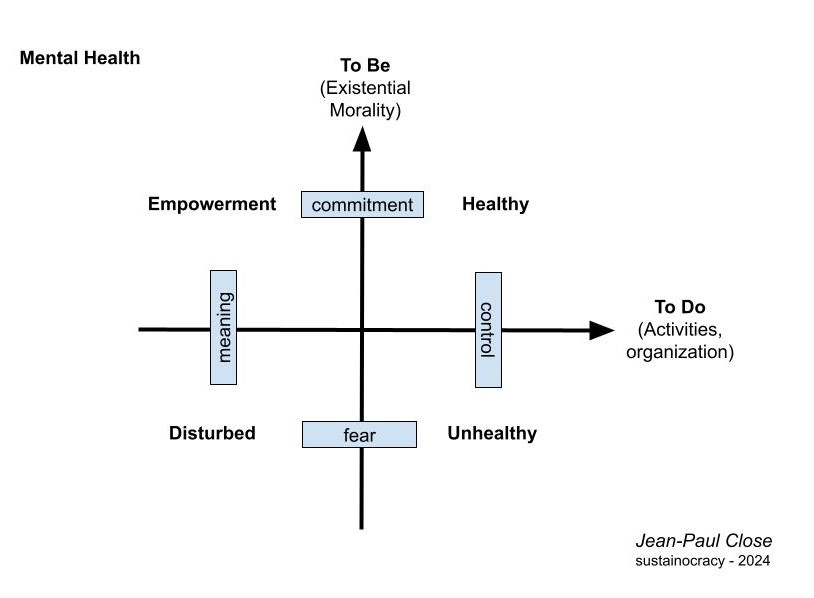
The current uni-dimensional money-driven society is structurally unhealthy and produces mental ill health as can be seen in the culture of fear that is also fueled by the polarization of political parties. The entire financial political structure is located in the unhealthy, immoral quadrant of the drawing. This is reflected in the many problems in the world that are often caused by this competitive control politics. We are all part of that, partly due to the forced dependency imposed by the system. My own personal turning point brought me to the point of commitment to human values. At that time I had no idea of the impact of this on the mental health of me and my environment in general. This is because I first had to let go of forms of unhealthy control and fears. I was able to do this with confidence because of the meaning that had invaded me. In all the activities that I subsequently developed, healthy, warm interpersonal ties were created, also with people in hierarchical positions of all kinds of companies and institutions, including governments. The shared commitment to, for example, the “healthy city” approach in Eindhoven and the surrounding area provided a healthy mental dose of meaning, creativity, mutual connections and goal-oriented motivation. These are all building blocks for mental health, in contrast to fear, uncertainty, competition, hatred, judgment, jealousy, etc. that are caused by our one-sided social management based on money, dependency, performance, political interests, competition, inequalities, control, meaningless growth (with many negative impacts), etc. We are often unaware of the mental ill-health that this form of society causes because we are completely mentally absorbed in the activities (work, consumption, entertainment) that are expected of us or have become part of our blind comforts. We often feel the symptoms of mental disturbance and unrest but do not make conscious connections because of the culture in which we live. We only notice the real difference when we let go of this, experience the turning point ourselves and let the meaning do its work. With Sustainocracy everyone has a choice. But the choice has a price. That price is not expressed in money but in letting go of control and fear, and embracing human values and cooperation. Mental health is a result.
 Sustainocracy, the new democracy