Expanding sustainocratic expertise worldwide, part 2

In the previous blog we had a look at COS3i and the School of Talents and Wellness. None of the initiatives were easy to build up as they require the application of a new mindset. Gradually more and more people and institutions arrive at the awareness that cocreation is also in their self interest. In my home town Eindhoven multidisciplinary cocreation was applied already in the 70’s to overcome the crisis of mayor industries going bankrupt or moving to low wage countries. The labor gap was big and unemployment needed to be addressed creativy. Triple helix interaction between business, government and education received the name of Brainport. It develop still in the money driven paradigm but could be seen as mayor step forward.

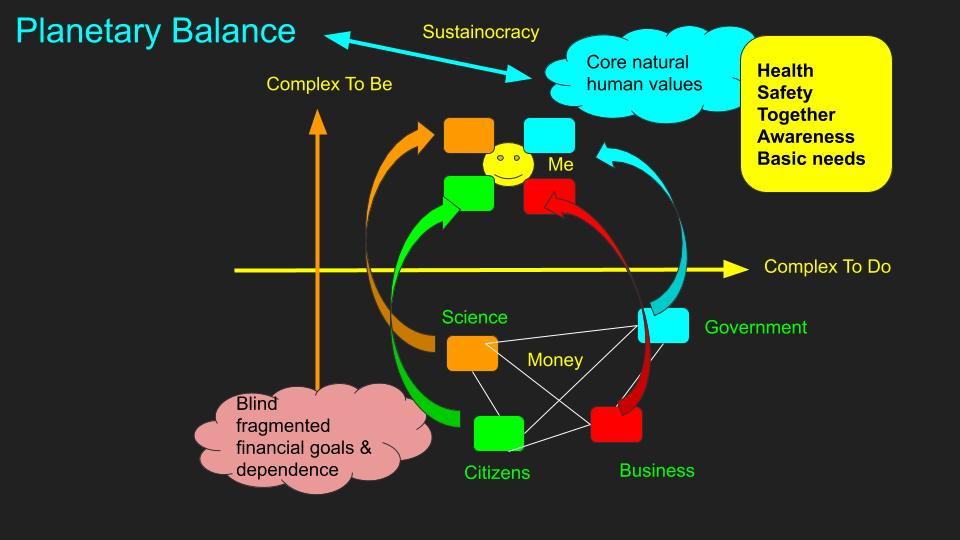
Sustainocracy in 2009 introduced two modications. The first was the participation society, or quadruple helix. It was initiated at human/citizen level, not institutional, positioning institutions as instruments for human resilience, not abuse. And secondly it was not money driven but focused on cocreation of our core natural human values locally. “The world upside down” an official reacted to the invitation. “The world put back to how it should be” was the sustainocratic reaction.

AiREAS, regional health and air quality

Working together on our environment

AIREAS is the very first multidisciplinary cocreation of a healthy environment. Even though the cocreation is still very much focused on measurement infrastructures (making visible the invisible) and citizen’s lifestyle, it is a start. Issues like regional development, energy, building routines, etc are not part yet of the cocreation despite the impact on the environment and people. Cities were never designed from an health perspective. Introducing this already over a decade now, has changed the public discourse, institutional positioning and decision making. It will not be long until the core values driven cocreation reality becomes meanstream.

Commitment for health and a healthy environment

The expertise in AiREAS is huge. For instance the use of measurement equipment of different suppliers. The relationship with health and behavior, policy making, stimulus to innovative entrepreneurship, etc. This is all published in open access papers and available for use in other cities around the world.

FRE2SH, regional food cocreation

A cocreation effort

When we realize that a city population is structurally dependent for food on big food chains and streams from outside the city, we can easily sense the vulnerability that this contains. Especially when we see that food production has developed over time as an industrialized process that misuses our planetary balance and resources. At the same time we all got disconnected from our natural origins to consume blindly the modified, processed food that we find in the mega supermarkets. The whole process is damaging in all aspects of sustainable life resilience. The only way forward is to re-engage with food and understand its important values for us in close balance with nature. But a city has hardly any space for productivity and the return of nature in our close vecinity. It requires a restructuring of our city design as well as our engagement in city food productivity.

Through the FRE2SH (Food, Recreation, Energy, Education, Safety and Health) community we started to experiment with all this. We also wanted to gradually give relief the rural areas in such a way that nature could recover itself after hundreds of years of structural landscape manipulation, destruction and use of chemicals. This is ofcourse extremely complex since many farmers were stimulated to grow out of cost efficiency, invest in technology or the growing regulations of government. At the same time they were squeezed by the massive centralized purchasing groups that place the profit of the chain in the city in a speculative manner. With huge debts, on te verge of collapse or bancrupcy the farmers are not easily convinced to turn their back onto their old business model. The city population is very used to the supermarkets and had little intention to join the food movement, except certain early adaptors. City government was not prepared to provide indoor or outdoor space destined for car parks, trade or housing.

We built up expertise in the following areas of interest:

  • Aquaponics
  • Mealworms
  • Permaculture
  • Foodforest
  • Circular, zero waste food systems
  • Food processing into catering meals
  • Green roofs
  • Vertical farming
  • Closed circuit water management
  • City logistics (walking, by bike)
  • Neighborhood farming
  • Multilevel process development (food, employment, education, etc)

Here we share a video in Dutch but an illustration for indoor farming. Further below you find some pictures of outdoor and processing processes.

How to get the world into a new paradigm?

The School of Talents and Wellness session today was dedicated to some reflection about interesting online encounters, such as Planetary Balance and Earth Odyssey. The question that was asked was “how can we proceed in expanding the new paradigm based on cocreation of our core natural human values?” The group of participants was relatively small. A very interesting analogy was explained by Barry Kort from a drama point of view. Eugen Oetringer tried to clarify using his theory on “what would Einstein do” and offering a prescription for change. Zvi Weinstein looked at it from a more practical viewpoint “We have a problem, we need to find a solution”. Jean-Paul Close explained his own method through the positive invitation to the new paradigm representing a yes/no choice for those affected by the choice.

Expanding sustainocratic expertise worldwide

Sustainocracy was born in Eindhoven, starting very small, within the living neighborhood of initiator Jean-Paul Close. The accumulated expertise over the last 15 years can be expanded across the world through the new and unique “Sustainocratic economy of growth of our core natural human values”. Here are the first two fields of attention, COS3i (Social inclusion, sustainable self governed communities) and School of Talents & Wellness (Participatory Learning).

The next blog will expand on the other three: AiREAS (air quality & health), FRE2SH (food resilience) and EQoL (Energy and Quality of Life).

COS3i: care for eachother

Community for social cohesion, inclusion and innovation

This is where it all started in 2005. When single father Close feared for the safety of his children due to aggressions after a traumatic divorce, he mobilized his multicultural neighborhood around the principle of shared values (health and safety). As a consequence he became aware of the problems people experience while living in an unfamiliar culture, with language problems and a very demanding local bureaucratic system. The same way he received help to rebuild his family life as a single father with two children, he started to help his neighbors in need. Together they modified the street for better protection and safety for the children, help was provided in childcare, writting letters to official channels for those who lack the language skills, initiate small scale food production in the gardens, celebrating each other’s rituals, share furniture or other materials for those in need. His movement was voluntary, motivated by the cold presence, pressure and prejudism of local government that refused to provide social assistance to him because “a highly educated man should not take care of the children. He should have a high end job to pay taxes in order to pay for the costly institutions that treat the children coldly as orphans”. This self centered, prejudist government approach was opposite the family and cohesion beliefs of Close. His views are that natural core values within his fatherhood are a basic personal and shared (family and neighborhood) responsibility. Government cannot replace this.

COS3i was formalized as a community and intensified in 2016 on city level, with the intention to unite all social entrepreneurship into a movement for value added citizen’s cooperation. It was also intended to engage people in healthy activities in colaboration of the AiREAS community established in 2010 for air quality. To his surprise the intentions were sharply blocked by city government. This interference could not stop the movement but did make it more difficult. Activities in all city neighborhoods included the initiation of food productivity, cooking, eating, singing and dancing together, city debats, music making, art and handcraft, circular reuse of used materials, empowerment of young people, shared mobility, hikes, walks, etc. Today it is growing towards a higher cocreation level of sustainable, inclusive neighborhoods and regional development. Certain government institutions engage slowly in the cocreation as citizen’s engagement is gradually becoming more valued by local government, showing the transformative complexity at all levels and in all silos of society.

Initiatives are intensified now also by other advisory parties that show how bankrupt certain big city players are going to be in the long run, including local government. The only way forward is the sustainocratic cocreation way, often only blocked by the selfish lobbies of certain remaining self interests of economic players. Sustainocratic initiatives are now also copied or adopted in other regions around the world, taking SDG (Sustainable Development Goals) priorities as poverty (1), social inclusion, climate action (13), reduced inequalities (10), sustainable communities (11), zero hunger (2) and partnerships (17) as COS3i results at neighborhood level. Or defining their own, such as the “child friendly city”.

STIR Academy, now School of Talents and Wellness

Learning by doing in our cocreative environment

When STIR was founded in 2009 engagement was sought through the organization of congresses and gatherings. Many of the people who joined still reasoned from the mindset of the traditional money driven paradigm. Cocreation was very difficult for people and (social) entrepreneurs to adhere to. Initiatives remained islands of individual closed ownership to protect potential income. The initiatives were also very much oriented at the current products and services that were critically reviewed from a sustainability viewpoint that had nothing to do with the core human values.

This showed that people were very little aware of new dimensions of societal engagement and its potential for them. This blindness motivated founder Jean-Paul Close to stop guiding people and take initiative himself. Like this he could experiment with his ideology and create proof of concept of the so called “awareness driven cocreation of core human values” and the appearance of a totally remodelled economy of growth. Two actions were taken: the first was to establish the very first true sustainocratic endeavour, called AiREAS (air quality and health). The second action was to create an environment for participatory learning.

Then STIR Academy borrowed a lecture theater of Fontys Highschool and openly invited anyone who wanted to join to come every fortnight to an evening lecture, against a minor contribution for the cost of coffee and thee. The first few years were very much dedicated to building awareness. Vaious learning programs were developed to engage young people, formal educational institutions and unemployed:

  • Let me go – creating an open space for learning creativity within the context of sustainocratic core human values
  • The voyage of the hero – empowerment of critical self reflection, self learning, team spirit, cocreation, innovation and regional development
  • Playful city – open gaming platform for sustainocratic awareness development through games
  • Our common future – student challenge (see video below)
  • Hackathons
  • Challenges
  • Student participatory practicals in town

Since 2017 the STIR Academy was renamed as School of Talents and Wellness. It gradually let go of only awareness finding by now enough people and organizations to start cocreating together. People were challenged to participate in sustainocratic programs and learn in the process, or start programs themselves. The school did not desire to become a competing institution, building, teaching or preaching environment. It seeks the cooperation with specialized cognitive educational partners, offering environments for students to define their own sustainocratic projects in our core human values environment using the expert direction chosen by the students.

  • Offer space and food for thought for Bachelor, Master and PhD research activities in a diversity of fields.
  • Erasmus+ exchange programs with different countries
  • Zoom encounters in different languages in order to stimulate the initiation of sustainocratic processes anywhere in the world.
  • Speeches, talks, presentations across the world

School of Talents & Wellness is now a worldwide learning movement in the sustainocratic world.