Home » Posts tagged 'Air quality' (Page 3)
Tag Archives: Air quality
Social inclusion
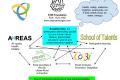
When our AiREAS POP research revealed that our exposure to air pollution was related for 50% to our selves, lifestyle became important also for us citizens. The other 50% was due to the political economic structures that feed our lifestyle. So when we address our lifestyle we address pollution, undesired illnesses, expansion of health care costs, wellness in general and even politics. This is a mayor revelation. We used to pinpoint to governance, now we can pinpoint to ourselves. In fact, our reality is what we percieve and make of it. Perception and make ability of change is an interesting concept worth exploring. Making visible the invisible is an aspect of AiREAS that goes beyond simple measurement of air pollution. We try to visualize the effects of behavioral change on our health and quality of life.
That’s how we arrived at creating COS3I. The S and 3 make a heart shape which refers to the passion of wellness driven cocreation. The COS3I word stands for Cooperative in Social Inclusion, Integration and Innovation, hence the 3i.
But social inclusion in what? In our STIR case we decided to invite people into our core human values as defined in Sustainocracy. Rather than moralizing about air pollution and our own responsibility we wanted to get social inclusion into care for health and our opportunities. This represents a total turn around for people’s thinking, transforming from structural dependence to self leadership, through awareness and engagement.
But people do not relate to stuff they do not see. A new dimension is therefor added to our human interaction. It is one of the positive enquiry, the positive invitation. the engagement to genuin values. When we started doing this all kinds of circles of common interests started to appear. Each could be related itself to social inclusion but also used to engage other citizens.

Each of these circles has very passionate people that wish to share their passion with others. We create neighborhood festivals in which we announce workshops and let people experience the circle’s energy with the invitation to engage. Despite the difference in focus the final effect of all circles together is a vibrant neighborhood and powerful wellness driven awareness and mentality. In the end the air quality improves through the social interaction, purpose driven social innovation and positive inclusion.

Smart city and future mobility
The 24 hours non stop HEX Hackathon on April 1st in Eindhoven was a brilliant setting of about 100 creative young minds.
About 20 teams were established and 6 challenges were presented, 2 of which were proposed by AiREAS (air quality, health and city dynamics) and the AiREAS partner TNO: Smart Cities have healthy air and Future Mobility if we ban the car from the city.
11 out of 20 teams choose to work on these two challenges. They were asked not only to be creative, societal relevance and impact was also key. They were already provided with three possible lines of thought: human persuasion to change behavior (leave that car and take some alternative transport means), think of alternative means that do not impact so negatively as cars in cities, or propose redesign of the city’s infrastructure.
Practical results:
- Team Delft: A game to make people aware of air quality and stimulate them to walk or go by bike.
- Cool kids can’t die: Awareness on air quality for kids
- NOObs: Future mobility using LoRa
- Belgians: Lifestyle app

- Heks Hacks: People receive an energy lable for their travel choices
- D3SH: Car Surf, a new way of dynamic carpooling
- R-aware: ???
- Autopool: Event based car pooling
- Eco Score: Competition between municipalities on “best Eco Score”
- Amelioration: ???
- Gone Good: the habit of doing good
- The challenge Crackers: define instant challenges
All teams have been invited to the School of Talents to further develop their creative ideas and introduce it into society using the network of the City of Tomorrow and AiREAS with the Sustainocratic coaching skills of the School of Talents.
Surprise at city awards for climate battle
Sept 23rd, 2014: Siemens and the C40 Cities Climate Leadership Group (C40) announced the winners of the City Climate Leadership Awards 2014 at a ceremony held on Monday night in New York City. The Awards honor cities all over the world for excellence in urban sustainability and leadership in the fight against climate change. The winning cities in the ten award categories are:
Amsterdam (Finance & Economic Development)
Barcelona (Intelligent City Infrastructure)
Buenos Aires (Solid Waste Management)
London (Carbon Measurement & Planning and Air Quality)
Melbourne (Adaptation & Resilience)
New York City (Energy Efficient Built Environment)
Portland (Sustainable Communities)
Seoul (Green Energy)
Shenzhen (Urban Transportation)
Read here the entire press release
In the international network circle of AiREAS (citizen’s driven healthy city cooperation, that started in Eindhoven and focuses on air quality and human health) people reacted with surprise that highly polluted London was awarded for Air Quality.
AiREAS is not submitted for these or any other award. We are hence not surprised. If you don’t buy a ticket don’t expect to win the lottery. It is not the state of pollution that matters but the effort a city does to solve the issue for human health and vitality. We @AiREASnl and City of Tomorrow (@STIRfoundation) reason using 4 paradigms, not just one. The award winning cities have every right to be highlighted, in their fragmented technologically innovative way.
What people tend to forget is that cities are the old conglomerates of “industrialised” financial and technological dependencies. People who live in cities enjoy the centralized facilities but depend for their basic needs (water, food, energy, clothing, etc) entirely of the system’s dynamics of the city with the surroundings, still totally based on money. To get access to money the citizens need to work or speculate. Due to system automation cities only develop consumers but not labor. Cities sustain themselves with growth, change, inflation or go broke.
Big enterprises such as Siemens depend on these huge city’s investments in technological solutions so award those that excel in this, rather than those (such as Eindhoven) that develop living lab solutions with their own population and entrepreneurship. In large cities systems prevail over human, responsibility driven interaction, simply because financial flows give old power to the political and economic structures. They however cover just part of the solutions.
Local responsibility is extremely cost and bureaucracy saving, very challenging even for the local creative forces that get involved in their own sustainable city progression with the development of a circular local economy, yet demanding a new local leadership mentality. It requires facilitating support from the policy makers, is not directly taxable nor instantly part of the global economic reality, so no reward system is in place yet to back it up. Local value systems appear in the city based on value creation and sharing. These subsystems detach from the large economies producing a power shift in the city.
That’s why solutions like Sustainocracy and AiREAS are not (yet) receiving global awards simply because they do not fit marketing communication plans. They just solve key local issues through co-creation, they don’t buy or sell them.
Four paradigms
Of the 4 paradigms available to cities, economic lobbies and fragmented power positions around public dependencies tend to push to a single focus, the one of technological innovation only, offered by the big global players. “Smart Cities” is not (yet) about people but mainly about (business) systems. From an overall global sustainable progress point of view we see that the other 3 paradigms need to be respected too, else the cities enter into chaos anyway. These other complementary 3 are however not money driven, hence hardly ever highlighted:
- Chaos: cities have to accept the collapsing of old obsolete structures and economic efficiencies to open up for overall renewal based on other types of innovative solutions (people, planet, profit) in a more holistic approach.
- Awareness: cities have to allow and help their self aware and responsible citizens to develop solutions of their own and connect to the evolution of their own community. This requires freedom for experimentation and innovation from inside the community. It opens up a new economic reality of cocreation, universal ethics, commitment and best practice from within.
- Harmony: cities need to learn to focus on harmony between nature, people, authority (rather than power) and their own regional self sufficiency.
Those cities that develop themselves using all the four paradigms (Sustainocracy) become strongholds of human evolution that contribute to the whole as well as the regional self. They become pearls of co-existence, harmony and flexibility. Then they will be rewarded by evolutionary progress and need to address the challenge of growth (in population) because of a livable, integral attractiveness, fulfilling the “sustainocratic dream” of sustainable human progress within, among others, climate awareness.

Jean-Paul Close – Sustainable progress starts at individual level and expands through value driven cooperation
Jean-Paul
 Sustainocracy, the new democracy