Home » Posts tagged 'AiREAS' (Page 12)
Tag Archives: AiREAS

Eindhovense kracht van het burger initiatief
Gemotiveerd door de komst van de CreatiVelo uit Luxemburg, een bakfiets op weg naar de klimaatconferentie in Glasgow, tonen wij de positieve voorbeelden in Eindhoven rondom klimaat bewustzijn en burger daadkracht, vaak in samenwerking met de lokale bestuurders in de stad. CreatiVelo zal op woensdag 13 oktober en donderdag 14 oktober video’s opnemen in de stad. Als voorproefje heeft de Stad van Morgen vanuit de AiREAS (luchtkwaliteit en gezondheid) deelname aan het klimaatfestival dit weekeinde in The New Block (Strijp-S) een zevental deelnemers gevraagd om hun bijdrage aan het klimaat in het kort toe te lichten.
De pitchen zijn in het Engels omdat we ze delen via social media ter inspiratie van de rest van de wereld, én we nemen ze mee naar COP26, de klimaattop in Glasgow in november dit jaar, om de kracht van het burgerinitiatief en onze netwerken te laten zien. Geniet hierbij al mee van een stukje Eindhovense inspiratie….
Dit is Joyce. Zij organiseert met haar team het klimaatfestival en wil dit jaarlijks laten terugkeren als bron van verbinding en inspiratie.
En dit is Anuj. Hij komt uit India maar woont nu in Eindhoven. Hij heeft zich aangesloten bij People for Planet om de dialoog over het klimaat verder vorm te geven.
Of Eva. Zij is raadslid in Eindhoven en zet zich in voor de systeemtransitie via de politiek en heeft ook haar eigen persoonlijke initiatieven.
En Rik uit de Irisbuurt. Samen met zijn buren hebben ze een deelauto coöperatief opgezet. 2 auto’s delen ze tussen 15 mensen. Zo besparen ze veel kosten, leren ze hun buren beter kennen en sommen vele voorbeelden op door niet te “hebben maar de delen”.
Niet te vergeten, Joris! Hij was boos op de wereld en teleurgesteld in de politiek. Totdat hij zich aansloot bij Extinction Rebellions en inzag dat hij veel zelf kon bijdragen aan de veranderingen.
Ook de Belgisch/Filipijnse Eindhovense, Roxanne, draagt haar steentje bij. Via een leuk spel daagt ze mensen uit tot bewustwording van eigen gedrag en wat men zelf kan bijdragen aan onze leefomgeving.
En tot slot in deze serie de filosoof Peter die graag omdenkt. “Als ik afval op straat kan gooien dan kan ik het ook oppakken”. Dit is zijn filosofie die hij met allerlei mensen tot uitvoering brengt. Een miljoen kleine, nagenoeg onzichtbare acties samen maken één grote zichtbare beweging!

Empowerment of our youth
Recent research has shown that over 80% our youth feels depressed about their future, let down by their governments, even betrayed. This feeling needs to be transformed into a sense of positiveness, a “can make a difference” attitude. Governments need to step aside and provide space for a new mindset, a new direction, a new humanitarian and ecological focus. Our youth can take the lead in open up that space, take action, become the leading force of societal renewal and change of perspective from fatalism in to opportunity.

Power of citizens networks, my presentation
My introduction of the Sustainocratic context was not taped during our online encounter about the power of citizens networks. I hence reproduce the slides here with some underlying text for them to make sense.
Sustainocracy stands for Sustainable HUMAN progress and our realtime Democracy. Sustainable Human Progress refers to our evolutionary existence as a selfaware species within (not at the expense of) our natural living environment.
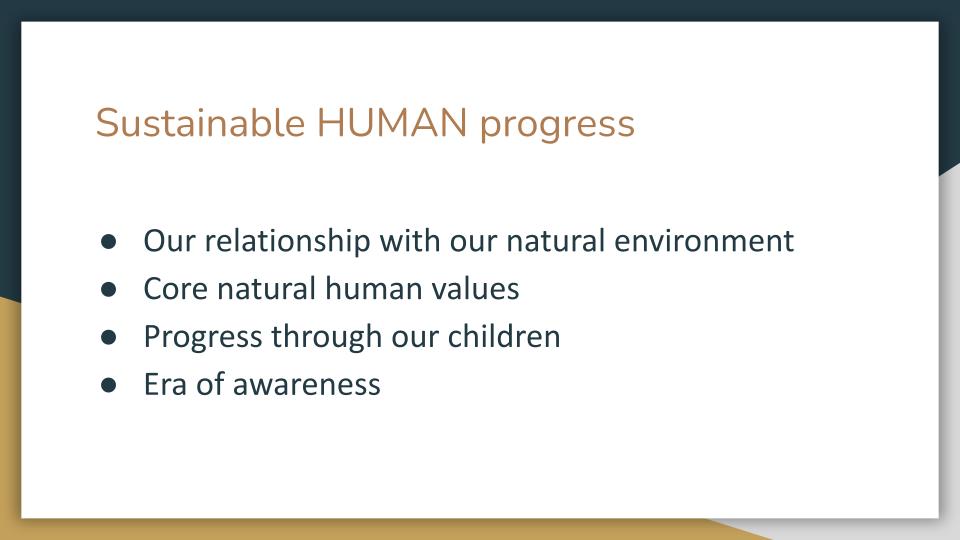
As human beings we are a living expression of our natural environment.
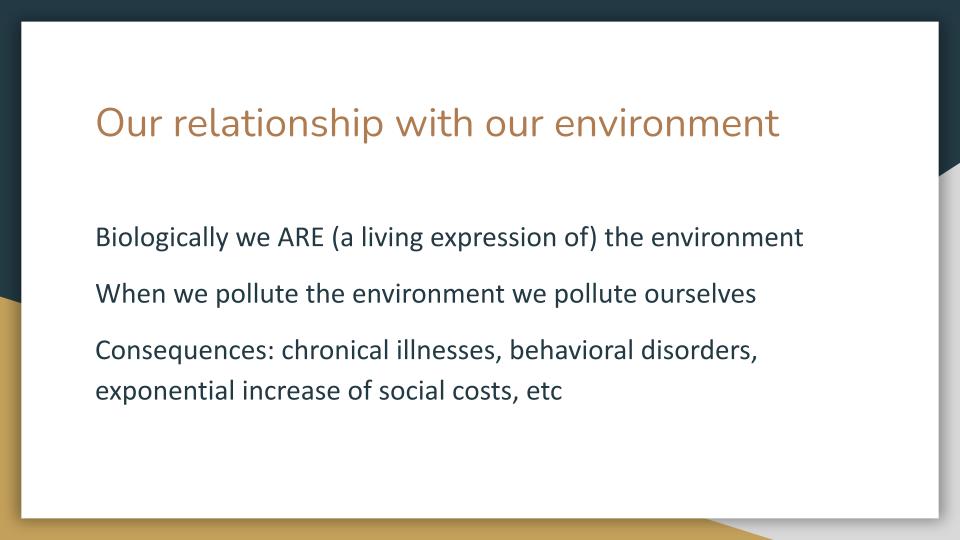
As human beings we are member of two ecosystems: the natural biological one, through which we evolved, and the financial/political one that we have created ourselves.
We tend to express ourselves in three ways, often in this priority: our function in society, as citizens and sometimes as human being. It is high time that we turn this around.
As a human being we are closest to nature, in fact we ARE nature. If we pollute or destroy our natural surroundings we pollute and destroy ourselves.
As a citizen we are part of a community that is ruled by community principles. These may or may not take our natural human biological complexity into account. In that community we act through functions, also called “jobs” or “our personal contribution”. These functions have objectives and also consequences. In our current societal system’s structure these functions tend to stand far from our biological living reality. Perhaps this abuse was alright when humankind was small enough to express itself well within the regenerative capabilities of our living planet Earth. It is not anymore, in many ways.
When we crossed the threshold of about 3 billion, without adjustment of our abusive system that makes use of humankind and our planet for financial benefits, we started to run into problems (plastic soup, pollution, chronical deseases, wars, climate issues, overconsumption, deforestation, refugees, huge migrations, etc).
If it were up to the abusive system the size of humankind is the problem. From a humankind perspective it is the abusive system that is the problem. In this duality only humankind itself can solve the tension. We need to address our sustainable human resilience by acknowledgement of our biological selves. As human being we stand closed to our natural selves.

If we only relate to nature without any community structuring, learning curves and adaptive creativity, we would be living chaos all the time (if we consider our global scale deployment as a species) due to the complex nature of nature. If we however manipulate and use nature abusively out of fragmented self interests then we eventually destroy ourselves.
Balance is found by finding a progressive and sustainable interaction between nature, our community and our functions. Sustainocracy positions itself at the side of our biological selfs and redefines our citizenship and system functions around a set of core natural values that are key for any lving species, including us a human beings and our sustainable resilience.
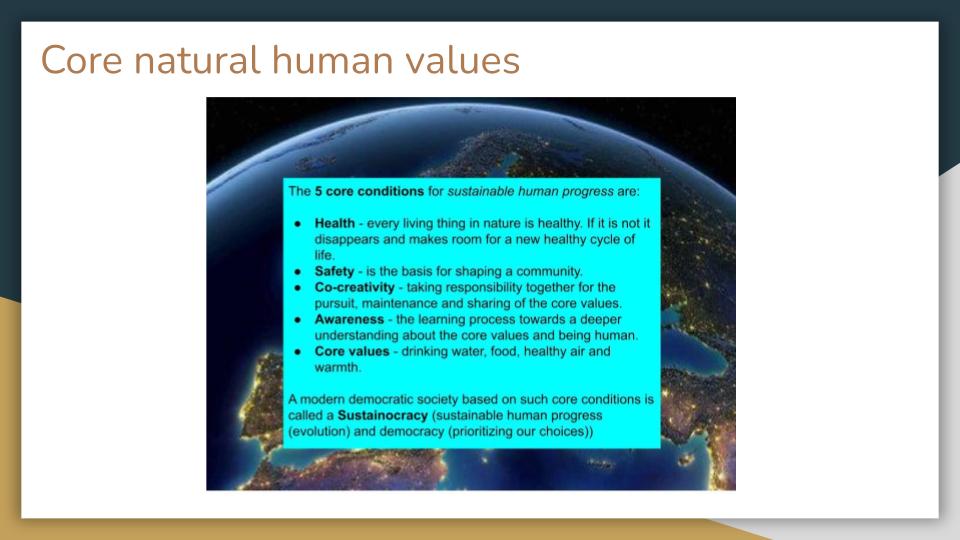
Due to our self created dependence on the political and financial systems we see that these core natural human values are being violated systematically and continuously. We abuse of our natural surroundings to sustain a highly structured, unhealthy and unsustainable lifestyle.
The only way to address and restore our core natural human values effectively is to let go of the political and financial hegemony of fragmented interests while concentrating on our shared responsibilities in the cocreation of these core values. This is where the power of citizens networks come in. We are closest to our authentic human nature and hence the only real reliable resource for effective change through awareness and purpose driven action.
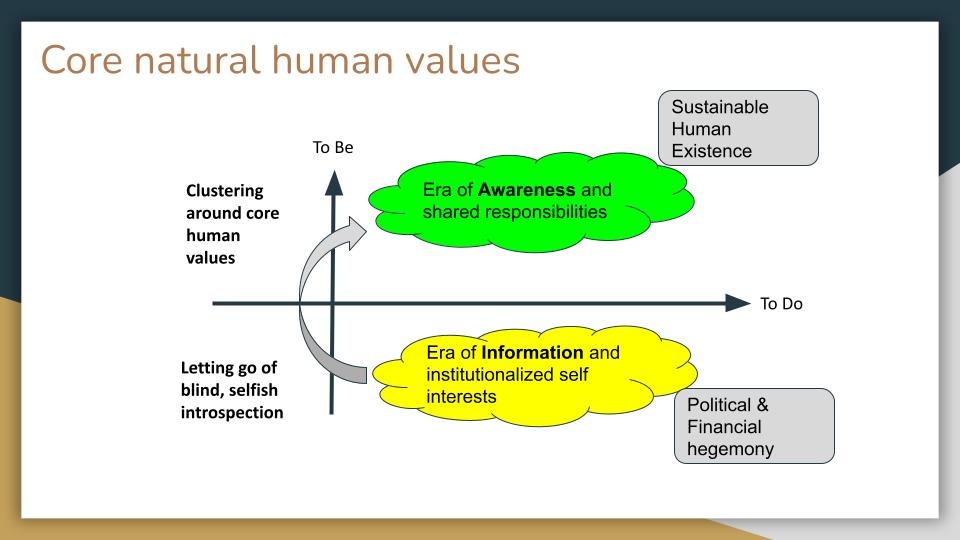
Below you find yet another representation of the transformation of societies based on human values centered cocreation and shared (people and institutions) responsibilities. The fragmented institutions and citizens join the same cocreation table and together define their priorities democratically within the context of the core values and sustainable human progress.
The institutions undergo a transformation by positioning their authenticity within the context of the common good, not just blind financial goals.

Yet another way of representing this evolution is the appearance of layer 4, awareness driven regional development, purely based on the shared responsibility for sustaining the core values locally, interlocally and hence globally.
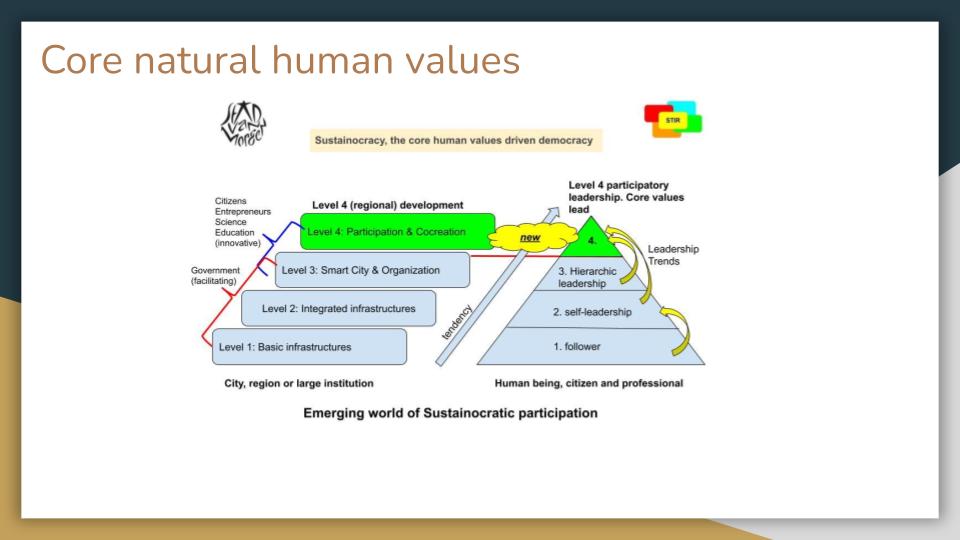
On the next slide you find examples of layer 4 Sustainocratic initiatives in the region of Eindhoven. The one on regional air quality (AiREAS) is the most consolidated and proof of concept. Its progress has been published and can be downloaded here free of charge. The healthy city focus was caused by the old political geographical bounderies. Gradually the initiatives expanded regionally, interregionally, cross border and with very broad participation.

In practice a level 4 participation table looks like this. It is being chaired by a Sustainocrat who represents the human being and the core values. The Sustainocrat unites all regional stakeholders at the same time based on equality, without hierarchy. In the case below regional air quality and health is leading. The multidisciplinary table and prioritized focus is a movement represented by a name: AiREAS (Air and Areas). Meetings are project and results driven, generally every three months or when needed. During the meetings decisions are made, resources allocated and responsibilities agreed among all. Many simultaneous projects can be defined at the same time, all in a SMART way. They are allocated funds with a 10-10-80 distribution:
10% = Sustainocrat (normally an couple of people taking care of the vision, priorities, follow ups and looking after the means)
10% = Learning process of effective and values driven cocreation among the partners
80% = project operational means according to budget agreements

Here is again the AiREAS example in the region of Eindhoven showing the incredible amount of engaged members in all disciplines of society.

Finally a slide about the engagement of our young generations. I cite here a poem by Marcus Link for his son (2004):
“I have been sailing under your command since long before my own adventures to a world that once was mine and now is yours —may you make it someone else’s.”
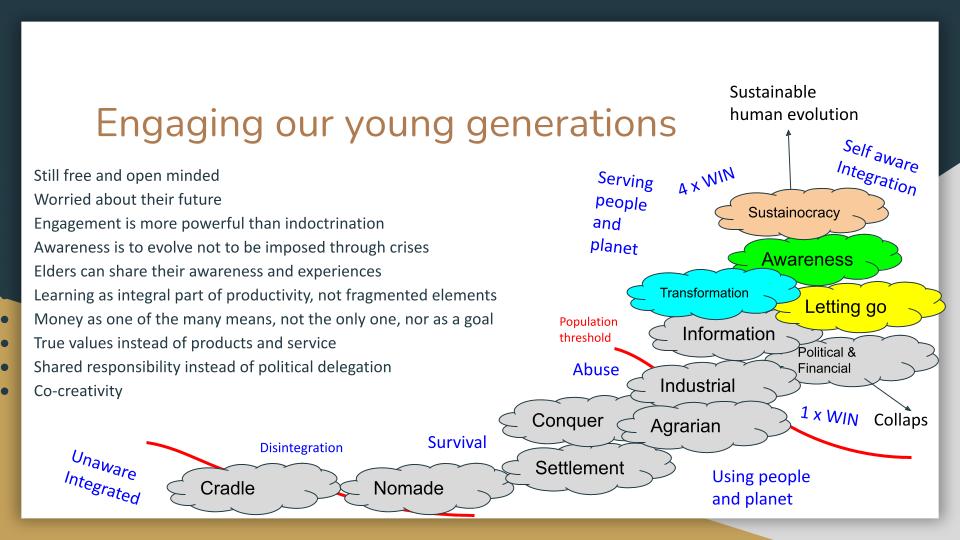
As such Sustainocracy positions itself in the era of awareness and spreads its roots and branches across the world. Citizens initiatives are the powerful juices of the branches. Two of such initiatives: Planet4Youth and Sensor Community, have been recorded on YouTube. They were presented after this Sustainocratic contextual positioning.

 Sustainocracy, the new democracy