Home » Posts tagged 'core human values'

Tag Archives: core human values

Podcast about sustainocracy and developing a new and sustainable reality together (8 minutes)

Modelling the World’s Floods & Building Fathom | The Enterprise Sessions with Professor Paul Bates ResearchPod

In this episode of Enterprise Sessions from the University of Bristol, Professor Michele Barbour speaks with Professor Paul Bates, world‑leading expert in flood inundation modelling and co‑founder of Fathom, one of the University’s most successful research‑driven companies.Paul reflects on a remarkable career that began with a Bristol PhD in the late 1980s and evolved into pioneering work that transformed global flood modelling. He describes the technological shift that enabled a new generation of high‑resolution terrain data, the academic debates that reshaped the field, and the multidisciplinary collaborations that built the foundation for Fathom’s modelling techniques.The conversation traces Fathom’s origins from two ambitious PhD students with an idea, through early years of bootstrapping, to international clients including insurers, banks, multinationals, and the World Bank. Paul also discusses the challenges of spinning out before universities had mature commercialisation systems, the importance of staying ahead of competitors through transparency and innovation, and the recent acquisition of Fathom by Swiss Re.Finally, Paul reflects on what research entrepreneurship means within academia, how Fathom has strengthened Bristol’s scientific capabilities, and what lies ahead for both him and the next generation of global flood models.🔍 In the episode:·        The origins of flood inundation modelling at Bristol·        How new airborne laser mapping transformed what was scientifically possible·        Overturning long‑held assumptions in the field·        The multidisciplinary team behind high‑resolution flood models·        Serendipity, road trips — and how two PhD students sparked a company·        Fathom’s unconventional path: bootstrapping, grants and early customers·        Data‑as‑a‑service before it was mainstream·        Building global flood maps used by insurers, governments and financial institutions·        Staying ahead of competitors by publishing methods openly·        Growing from four founders to a 50‑person global team·        Acquisition by Swiss Re and what it means for the future·        Entrepreneurship in academia: culture, opportunity and barriers·        The virtuous cycle between research and commercial innovation·        What’s next: NASA’s SWOT satellite and the next era of global flood modelling 🌐 About the Enterprise Sessions The Enterprise Sessions bring together a diverse mix of company founders and researchers who talk openly about their personal experiences of forming spinouts and start-ups, raising capital, academic-industry partnerships and the joys of translating research discoveries into real-world impact. The series aims to inform, inspire and challenge myths and stereotypes about research commercialisation and how businesses and universities can work together to tackle society’s biggest challenges.  👍 Like, Share, Subscribe, ExploreIf you found this episode inspiring or informative, please don’t forget to like and share. Visit our website or subscribe to the University of Bristol’s YouTube channel for more Enterprise Sessions.  https://www.bristol.ac.uk/enterprise-sessions Paul Bates – LinkedInMichele Barbour – LinkedIn
  1. Modelling the World’s Floods & Building Fathom | The Enterprise Sessions with Professor Paul Bates
  2. TB Testing: From validation to eradication
  3. Engineering Blood Cells | The Enterprise Sessions with Profs Ash Toye and Jan Frayne
  4. Beyond Opioids: Personalizing Pain Treatment Through Genetics
  5. Discover Reading: World Meteorology Day 2026

Basic principle of Sustainocracy, our real time democracy for everyone

New society, new claims, new perspectives

Sustainocracy was born ideologically in phases. First (in 1996 and 2005) out of frustration around the lack of humanitarian focus of the ruling system. Placing human wellness in terms of core natural human values at the kernel of societal development opened up a totally new way of thinking and handling. New claims were introduced for societal framing.
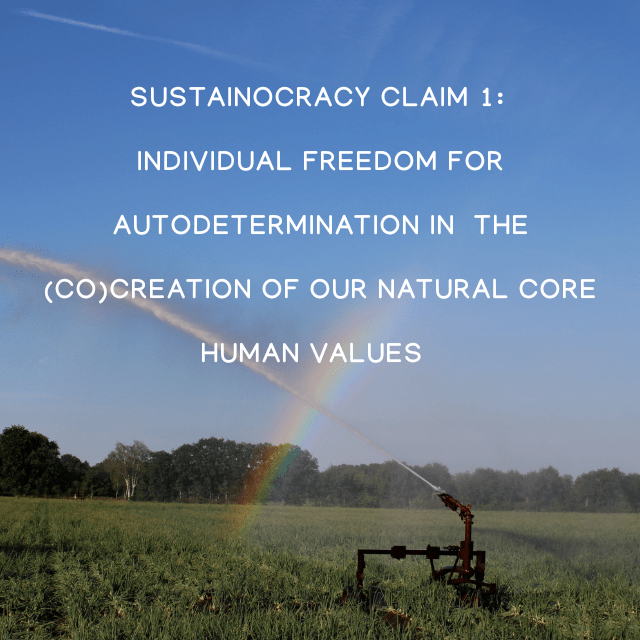
This claim cuts us loose from dependence of financial, political and material dominance, motivating us to work freely with our natural environment directly for our health, safety and basic needs.
This claim introduces our own responsability for our own sustainable wellness and progress

When we claim our natural freedom as human being we also need to accept the responsability that goes with it. No one will fullfill our needs but ourselves. No one can do this alone, hence we need to cocreate. With the current state of scientific and technological development we can become selfsufficient in abundance in even the most harsh environments. Sharing abundance among sustainocratic communities can overcome regional shortages. This also introduces a new way of dealing with our institutions…..
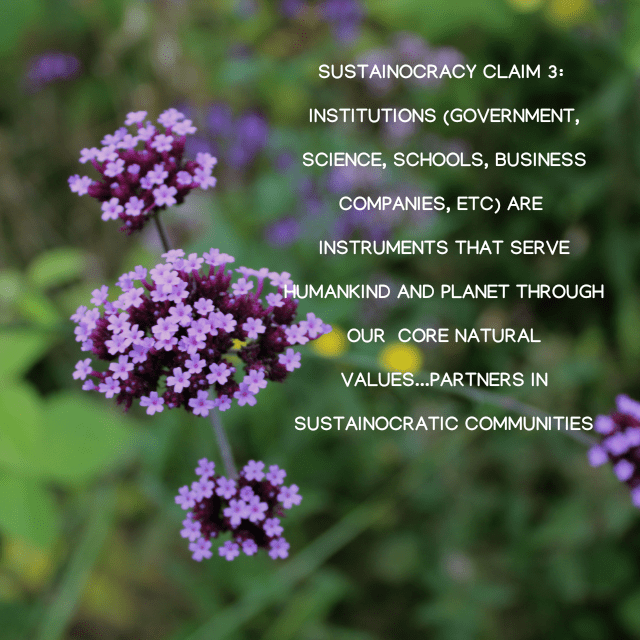
A new positioning of institutions including government makes such entities not financially focused but recognized expertise oriented.

So secondly Sustainocracy became a positive invitation to join. Institutions that develop authority in servant partnership with sustainocratic communities created a core values driven identity and related importance for the community in terms of available knowledge, technological innovation, etc. They become expert instruments in the hands of result driven projects…
Dominant are the core human values, not financial investors. Return on involvement is in terms of shared values and recognised expertise, not money. A totally new economy arises.

Money, talents, expertise, involvement, commitment, etc are means that are gathered on common project tables. Noone has more authority than others as the development of the core human values is leading. Equality and trust reigns. Result driven multidisciplinary action unites all into permanent values driven innovation.
The metamorphose from our global capitalist reality, that provided us with great instruments once placed in the sustainocratic context, demands a great leadership effort at all levels of society. The reward is a new balanced relationship with ourselves, our institutions and our planetary resources, as well as sustainable human resilience and wellness for all.

In the third phase Sustainocracy became a genuin practical choice, not just an ideology. To go for Sustainocracy we need no permision from anyone. It is a simple choice, as was demonstrated since 2009 with the efforts of the STIR Foundation in the Netherlands. After formulating the option the population and institutions were invited to join. When they did they started their own metamorphose and eventually consolidate the Sustainocratic communities that arise through the authority each brings into the process.

In 2015 the Sustainocratic way of working received public recognition after receiving a European Award and the analytical review in a paper. Now it is subject to PhD research in all fields, mentioned in scientific papers and published in general review papers. Sustainocracy is a new reality that grows in acceptance as an evolutionary step in the evolution of human societal participation structures for sustainable human resilience, progress and wellness.