Home » Posts tagged 'economics' (Page 4)
Tag Archives: economics
Pioneers of a new world
Introduction
This has become a long blog again. I introduce a solution for all humanitarian problems in the world and all related crisis. It requires a lot of explanation because it involves all current institutional powers in a new setting. And finally comes back to the power of our individual selves. Soon I will publish a booklet on the issue but my sense of urgency is so big that I cannot wait to reach out to those of you who can become already changers of the world after reading this. For humankind it could be the most important blog ever as long as I can reach out to you soul and make you aware. Please take some time to absorb the information and place your own self in perspective. See what happens when you suddenly realize that humankind could get to depend on your own next steps. It is fun AND a huge responsibility. Can you handle it? That is up to you. I am ready to help you when you are.
The destructive force of our institutions
Over the years we have grown dependent on institutional activities because of the impact they have on our lives. The unique capacity of an institution is that it can enlarge a single activity into huge proportions. A single human being cannot do that. We have grown to depend on the institutions because they provide us luxury articles, financial means, governance, jobs with related salaries, scientific knowledge, etc.
Most current institutional structures of today were born already some 150 to 100 years. The conditions in the human world were right back then to allow such fragmented focus to occur with the related growth of institutionalized power. Still now the discussions in this world only talk about growth and more growth as a single sign of strength. Due to this fragmented focus these organizations can only take responsibility for their own small field of highly specialized attention. They started to relate via this specialization to compliment each other in their objectives. A manufacturing company in the 19th century would have its own transportation system, energy supply, uniform making unit for their personnel, etc. But gradually in the 20th century the further specialization allowed institutions to focus on their core business and select suppliers to outsource their surrounding needs. In the middle of the 20th century the patchwork of specialized institutions because so large and so competitive in their mutual interaction that a chain of dependencies appeared and with it new techniques of managing the chain.
Due to the focus on fragmented institutionalized interests the awareness for “the whole” disappeared entirely. Things like pollution, usage of natural resources or humanitarian issues became subject to competitive policies. Institutional survival became more important than the consequences of such survival decisions. Non of these consequences could be challenged by any single authority. What authority should do that? A local government has no global authority to regulate. Yet they do have a dependence for economic growth, imports and exports as well as labor and tax perspectives. Global authorities on the other hand have no formal jurisdiction in the countries or in the institutionalized business enterprises and banking policies. They may have a bureaucratic influence on awareness (like VN resolutions) and certain fragmented authority on addressing common institutionalized interests (like military actions in Afghanistan or embargos on certain countries).
As fragmentation of power grows further, the chain of interdependence becomes more complex. Despite the competitive fragmentation and specialization each individually could grow due to globalization of markets. The competitive shakes outs would start the intense optimization processes in each of the institutions to remain competitive and attractive in the chain. As time went by we see each of them weaken in quality and strengthen in financial speculation. CEO’s and Country presidents became bankers and debt managers rather than protectors of value driven identities.
The overall shortage of resources started to demand its toll on the global organization of giants that could not feed themselves anymore on natural value creation. The liberalization of money from a valuable collateral (s.a. gold) allowed speculation to flourish as only remaining resource to sustain institutional fragmentation and growth. Access to the available resources became available to the highest bidder. Countries who wanted their populations to survive while active with some labor and high debt programs had to grow their debt themselves. The growth of institutions is still the blind common culture of executives and politicians but growth is already for a long time not possible anymore. Not as a natural process of value creation anyway. The only financial growth that can be achieved is through speculation around shortages but this is controlled only by the powerful and has nothing to do with the general public anymore. They are just manipulated to accept a debt they did not ask for and that solves nothing. Humanity is in the hands now of institutionalized, destructive, fragmentary focused financial robots that have no morality nor sense of responsibility except their own self interests, creating crisis after crisis, chaos upon chaos.
The pioneer
Now we go back to the beginning of this blog. The true power of an institution is its possibility to enlarge any fragmented specialization to huge proportions. Their handicap is that they cannot take responsibility other than for their own piece of specialized power. That goes for regional governments, business enterprises, educational institutions, etc, etc. None can take responsibility for true human values yet they all have interest in it because they are part of the institutional survival. Without consuming, demanding, debt creating, voting or working public the institutions will eventually die.
So in one way or another any institution has the intrinsic need to connect again to integral human values but cannot do that for the whole, just for a small part of it, competing for it. So when we talk about the taking of responsibility for human sustainable progress no one can or will stand up to take responsibility other than maybe some local politicians. They tend to promise responsibility that they cannot handle because it s beyond their control. They try to solve it in four year periods which many do not complete, by raising taxes and public debt with solving anything.
Only one can take responsibility and that is the pioneer. It seems funny that with all those incredibly big and seemingly powerful institutions the sole responsibility of human progress could lie in the hands of a bunch of pioneers. But it is true and makes perfect sense.
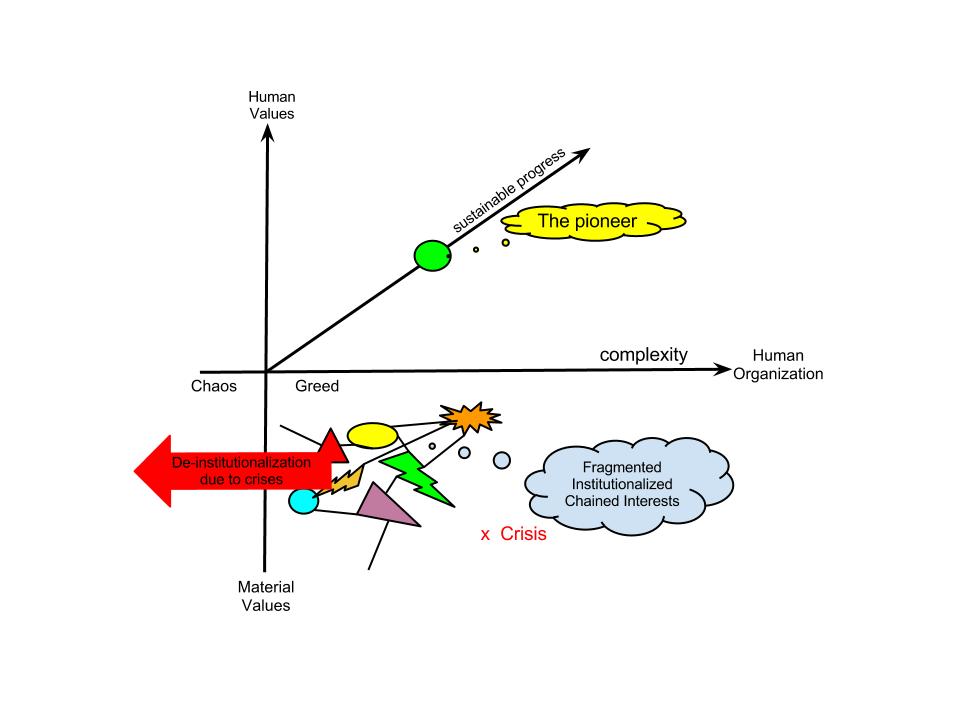
The pioneer positions him/her self in the field of sustainable human values and progress
The robotic institutions can be our enemy when we see their unconscious destructive force while preserving their self interest in their fragmented world of material power, but they can become our friends when we can get to use their institutional powers of expansion in a proper way.
Thanks to the de-institutionalizing powers of a crisis, in which the organizations need to go into survival mode, decreasing in size due to the lack of resources to draw from, they become also often sensitive for new ventures and responsibilities in which their field of expertise can excel. This is an opportunity for the pioneer but also for the institutions. How does it work?
The pioneer takes responsibility for a complex humanitarian progressive proposition. He or she subsequently invites all necessary institutional powers to help enlarge it.
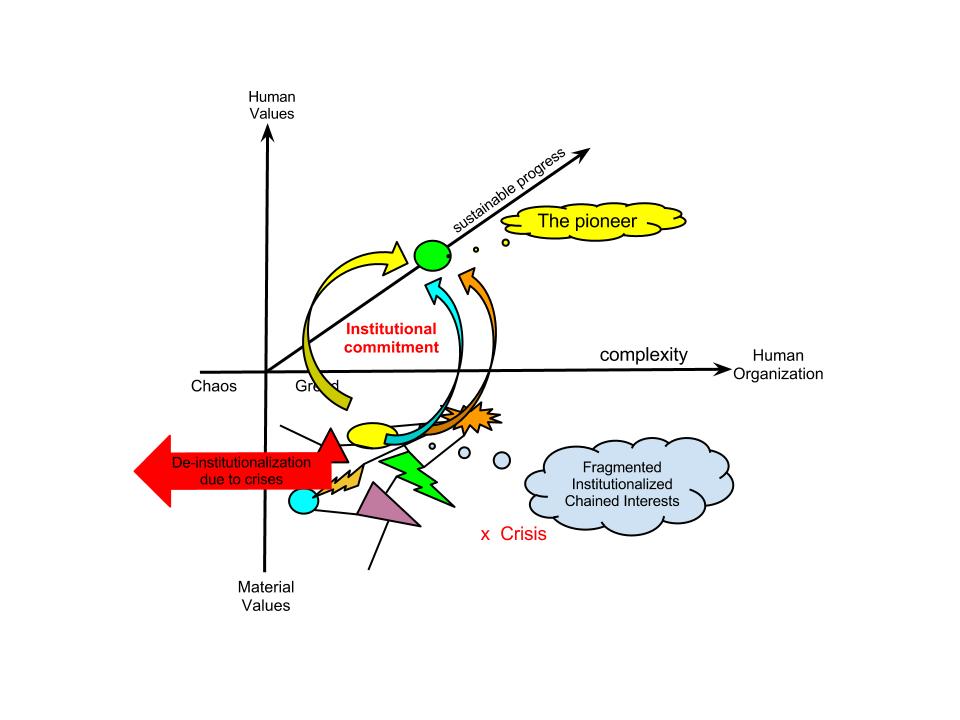
Institutional powers can be used to enlarge humanitarian interests
The role of the pioneer is to define complex progression based on human values. When inviting the institutional powers to join the pioneer they are asked to enhance the responsibility with their own institutional powers. To make a holistic proposition of human values one cannot just rely on a single empowering institution. If that were the case the institution would have done this already by itself. The complexity of the whole is that it needs the entire mix of authorities of a society to become effective, with the pioneer sitting bang in the middle.
Sustainocracy
In sustainocracy the pioneer takes the lead and invites the four key authorities that are needed to expand the human values into common wellness and progress:
- Local government
- Technological innovators
- Educators & scientific researchers
- The local public itself
Drawing all these authorities from the field of fragmented interests, they unite in the field of common responsibilities together with the pioneer. Seemingly contradicting interests suddenly start complementing each other as the focus lies on progressive goals outside the scope of self interest. The self interest can be complied with only if the common interest is achieved. This forces the authorities to enter into co-creative processes by trying to understand each other and join forces. The pivot is the pioneer who safeguards the humanitarian interests in a battle field of institutional giants.
In the Netherlands I have started experimenting with this pioneership. It resulted into a series of initiatives that are proving their value from a humanitarian perspective but also the institutional positioning into a new world. Each of the authorities has a chance to excel in its own field of competence, not by competing or creating interdependence but by combining the individual competences into a common goal. Since executives and personnel in such institutions are human beings too we find that the sensitivity of the hard material robotics become more soft to address human wealth issues through new types of policy makings.
The institutions change slowly into supportive and facilitating identities that gather new public admiration. They truly become extenders of human progress to which they attached their fragmented by highly specialized competences with new perspectives of survival first but institutional sustainability in the long term. The field of chaos can now be managed with the perspective of an institutional alternative, not just to create value but to contribute to a greater cause, enhancing it and expanding it.
Training school
To extend these finding globally I have started a training school for sustainocracy, training pioneers as well as institutional executives on their new age responsibilities and challenges when entering the field of sustainable progress and all related differences with the old paradigm.
http://www.eventbrite.com/myevent?eid=3558815513
Pass the word and help change the world.
The day after economics
Economics is out. We cannot keep progress or wellness away from people who cannot afford it. We cannot morally play with lives of millions or billions of people to fill the pockets of a few deadly soles. The era that this was tolerated is ending fast. We are entering a new era of wealth, the one that is not based on economics but on something else. I have called it Sustainocracy, just to give it a reference to talk about. What is the difference?
Modern economics is “the financial science to deal with shortages”. It has to do with money that is spend to purchase material goods, valued against the degree of desire and scarcity of the object. Entire nationwide economies are based on this system that places the availability of resources in the hands of people who make it available only to the highest bidder. Maintaining shortages raises the economic perspectives and it has become a game to deal with this in a globalized world for the benefit of those who can control certain material elements. We see this in commodities, housing, energy, food, loans, etc. This automatically means that people need money to gain access to wealth. Money is only made available to those who have work and work is only valued with money if it fits in the robotics of the system. In an other blog I already asked why the care taking activities of a housewife with small children was not valued in a money system while the labeling of packages in a logistics process is. Is the one more valuable then the other? Of course not, but the system determines what gets paid and what not. This regulated choice creates a society and the morality in it. The woman with small children gets no money and has not right to access wealth and the factory worker does. It is a choice and this choice needs to be turned around because it does not suit the general purpose anymore of sustainable progress. On the contrary. Extremely talented people necessary in all kinds of human needs are forced to work in the system on positions that contribute to problems simply because the system is organized that way.
And if you have no job you are obliged to get a debt in order to maintain a degree of wealth or wishes to survive, no matter what talent one has. Some do not even have access to the debt system and perish, supported by this inhumane system.
Dead end
The system of economies that are based on speculation around shortages are making our lives unsustainable, expensive and unstable. These systems collapse and receive a growing opposition of the general public that is willing to rise against those who block abundance to the masses. We simply have to recognize that economics has reached a dead end. Economies of growth only mean that they expand further the disaster just to finance the unbalanced debts of the past. The debts of countries rise simply because they produce only costs and no value anymore, despite the massive amount of talented people they contain.
There is a desperate need to deblock these human talents and make them work together on sustainable progress. That is what I call “the day after economics”. What is this other option?
Sustainocracy
We need to recognize that our resources on Earth are finite, but our talents grow in abundance. The more finite the material resources (food, water, oil, etc) are the more valuable they would become for all people if we want to sustain a minimum of living standard or even survival. We cannot sustain a financial system that speculates on the availability of resources in scarcity. It becomes a source of blackmail, not just over the pockets of the people but also playing with their lives. Capitalist economics are likely to become the genocide of the 21st century where certain people are willingly, for their own benefit, to keep life supporting and saving resources away from the public by pure financial speculation, causing death, war and disaster. We have already seen the consequences of this in commodities like grain, wheat, water, oil, etc. and the effects on global stability.
Sustainocracy therefor represents the “science of talented abundance through cocreation”. This meand that human scientific knowledge, productivity and progress is owned by the species and not members thereof. Human talent is value of humankind and should not be dealt with in confinement of scarcity but in abundance for progress. This means that every invention, every insight should reach all members of the species not just a selected few.
In Sustainocracy only one continuous goal is important for all members of a community: sustainable human progress, according to the definition described in a previous blog:
“continuously working together on a healthy, vital, safe and dynamic human society within the ever changing context of our natural local environment”.
This statement allows no political debate or speculation since the goal is for all members of the global community. Everyone can take responsibility for this sustainable progress by contributing with one’s own competences, talents and energy. All elements of such society are measurable, feeding in open reflection the interaction of people in the community. Application of knowledge and personal energy is key to address the changes provoked by any change that is being made. It gives a common purpose to a society.
Sustainocracy is Talent + Energy + Purpose = Sustainable Progress
The community based on sustainocracy does not necessarily need money to produce progress. Resources are used but only become valuable when introduced in the result driven processes. The results are delivered to the benefit of everyone in the community. There is no need to speculate with scarcity of resources since the community will become creative, using the local means that it has available to it. Communities become cohesive in human interaction on a local for local basis trying to avoid dependence on other communities. If such relationships are needed to exchange material resources then reciprocity is organised in exchange of talents. Payment in times of needs are not done in money but in talent which will help communities to deploy automatically the human and material resources needed to assure community progress and intercommunity relationship, even if particular communities have scarcity of resources but abundance in talents.
Money could be used to value the individual contributions to progress making the variables of “talent” (competences, knowledge and creativity) and “energy” (motivation, teamwork, involvement, etc) instruments of value that can receive recognition on individual level and maybe some sort of adhered status. The level of value can be determined by the community in a democratic process.
In all cases the local for local communities would become small local pearls of self sufficient centers in which sustainable progress would be carried by all members of the community. A woman who gives birth would as important as a man who helps to build a house. Community choices would be prioritized according the level of sustainable progress everyone desires, lead by the circumstances, not greed.
Sustainocracy represents peace and progress, a modern new way to step up the human evolution using our accumulated abilities and levels of awareness for the benefit of all, starting with the future perspectives of our children and the way we educate them today on how to take responsibility using talent and energy.
Sustainocracy has become the system to value talent and reciprocity in Sustainocratic processes)
2012 forecasts – the revolution of the concience
Here is the forecast for 2012 based on the model of the human complexities (“The Global Shift, a quantum leap in human evolution“, chapter 2, 2011) and related to the four quadrants that occupy our world in transformation the coming decade.

The revolution of the consciousness
1. The big splash
Most of our world economies are anchored in the unsustainable quadrant of greed. The credit crisis blew a big hole in the financial hot air balloon that was being filled up by governments, banks and business enterprises. The patchworks of capital injections don’t stop the system from collapsing simply because the collapse is part of a transformation and not a temporary recession. Many organizations and governments become aware of this but feel the burden of the old world still strongly present and are reluctant to take action, hoping for some miracle to happen still. Their professional mission is also to try to keep things going as it was against all odds.
The current world organization is historically fragmented into a network of geographic and business interests with money driven banks that are all linked up in a financial system. In such fragmented, money driven global society we see all the institutions take measures to save their own position, often at the expense of others. It seems all part of the game in which we see the worst of people dominate the scenes with tricks and manipulations to uphold old positions. Meanwhile the perspective of progress is lost out of sight. The consequences are that many institutions fail and crumble into sudden death due to lack of support, competitive strength, slow reaction time or total lack of sustainable basis.
Governments try to keep disaster away by injecting money they do not have, into old systems that do not solve anything anymore, just maybe increase the problem. And if no value is created there is nothing else to sustain the institutions than the injections that just delay their ending a bit more. More and more governments will go bankrupt or will try to slow down the inevitable by some measures (like economic reforms, raising taxes or whatever).
All banks have a large financial bubble that cannot be resolved so they only still remain in the picture because of the ties they have with in the form of debts that the public cannot and will not pay anymore forcing the banks into control of governments who placed trust in them with social security instruments. They fear loosing those too and with it the electoral support of their democratic backing. The outstanding loans of the banks have hardly any collateral anymore. They fall over further in 2012. More and more banks will not be able to comply with their obligations to the public that has its savings in it.
Businesses will try to go greener and greener, not just for marketing sake but also necessarily to compensate the competition for resources that outsizes the competition for sales. Products become more expensive in the markets of basic human needs. The green products do not stop the over- consumption that is still being stimulated by economies of growth, which eventually will create a further inflation due to a demand and growing shortages in deliveries. Prices rise and people cannot afford anymore their basic needs unless they get a higher personal debt which is unpayable already. The whole thing ends up in a big splash when all the global systems break their ties and focus on trying to do something about it locally.
2. Chaos
As the world’s large systems collapse along the line of organization complexities they enter the fragmented world of chaos where the local criminality and confrontations between people and systems grow, demanding local solutions around public safety, cohesion and integrity. The chaos in financial markets will be very large but isolated from the general public unless the systems place unjust dictatorial demands on the public (claiming taxes, mortgage funds, outstanding debts, etc) that will cause the rise of the masses against the systems. The public itself will also have plenty to demand that the old systems cannot give anymore s.a. pensions, social securities, insurance, etc. which will also get groups of people to the barricades.
The greatest problem in a situation of chaos is that groups of people try to take benefit of others through criminal activities and acts for survival. At the same time many will try to find others to blame for the entire situation. This entire process in a multicultural environment of migration is highly unstable and volatile. It will be highly dependent on the type of leadership that develops on extremely local basis to either escalate aggression or keep peace. All hopes are placed on the development of our consciousness, individually but also in the the institutions.
3. Awareness and consciousness
The positive thing is that this process is linear but affects people, countries and institutions in different phases. This means that many individuals already went through their personal chaos, process of letting go and enlightenment through the development of their consciousness. The growing amount of people with deep insight but also the cultural creatives that have views of the unsustainable situation of today, become representative of early experiments around creating a new type of society.
At this stage still it all depends on individuals, even people with a position in the established industries and governments who are standing up showing personal leadership in this complex situation. For quite some time new initiatives in the field of sustainable progress were crushed by the fearless and ruthless greedy systems of power in their attempt to keep their positions. This may still occur but more and more often we see the opposition grow using totally new instruments to organize the basics of a new society.
Most people and institutions do not want chaos, the threat of (civil) war or struggles around resources and gain insight rapidly. Businesses are repositioning themselves to serve a system by not producing products but sustainable results, involving many more people that strictly possible with the financial means they have. They start building on new value systems that are being developed together with the people who contribute to progress (instead of going to work. National governments loose control and need to allow local and regional governance to facilitate local for local recovery based on local self sufficiency and creation of local values.
What will happen with Europe? From an ideological point of view the concept of Europe was excellent but wrongly focused on financials and not on human progress. The financial Europe will necessarily collapse but the unity of Europe will eventually find some continuity in its own human consciousness of the need to develop global unity, not territorial fragmentation. This sustainable progress aspect of glocalization, local for local for global in a network of relations between self sufficient communities, can start in a new Europe.
The Euro will not be necessary in a world based on abundance of human talent and energy instead of the scarcity inherent to economics of growth. The development of content societies will create totally different needs and isolate the speculative systems that our now still powerfully in place. They are already under pressure living through their own shake out while respect and recognition for money itself and systems representing it, is rapidly deteriorating.
The revolution of the conscience will infect the entire global population as the pain of the old systems hits all people and the institutions. There will be large communities that may even not survive and the global human population will be reduced in the process. How much is difficult to say because it will also depend on the power of the grouping of the enlightened and the level of opposition or support received from the old establishments of remaining power and greed.
The revolution of the consciousness represents a new phase in human evolution and will go into our history as a decisive relatively short period of dramatic suffering, a collapse and recovery, but with a totally new elan of human continuity, respecting our species, its vulnerability, its relation with our natural environment and our evolutionary perspective.
In the end the revolution is the best thing that can happen to humankind but the suffering that will spread through the systems, societies and civilizations caused by the darkest side of human mentality, will be unprecedented in history too. There will hardly be any war but the conversion from total global financial dependencies to independence and self sufficiency is so intense that we will face important periods of structural shortages causing local panic, problems and signs of leadership and the lack thereof.
The long term peace that follows everything will not only be needed but will be secured by all involved to avoid new processes that have lead to the point of singularity and collapse. The global conscience will have made a giant leap that will not easily fall back in old human misbehavior. It will become the basis of a totally new phase in human progress.
And all this will happen in just a few decades and will be seen happening by most people that are alive today. The sooner one develops his or her own consciousness the sooner one can act accordingly.
 Sustainocracy, the new democracy