Home » Posts tagged 'food resilience' (Page 3)
Tag Archives: food resilience

Online debate: Our natural right to be (regionally) self sufficient?
Join our zoom Safari of July 28th at 16.00 CET about food resilience. “Poverty is not about money, it is about the lack of possibilities to be self sufficient” (Nashif Ahmed, Uganda).
Our FRE2SH interactive learning program consists of 10 modules. They discuss regional self sufficiency for food resilience world wide. The online Safari is an open dialogue about one of themes. In this case the right to be self sufficient. We use inspiration from Uganda with Nashif Ahmed who runs a small farm to provide a group of orphans with food and education.
We also invite three other speakers: Dr. Anna Berti Suman (Italy). She is a lawyer defending the right for self determination. Fabrizio Biganzoli (Italy), an environmental scientist and risk analyst.
And Danielle Carneiro (Brasil), a mother who transformed her life from lawyer in the financial markets into fighting food waste and developing food awareness.
Please register here for the free zoom encounter

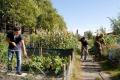
What can you expect from the 10 months FRE2SH OSFD online course on re-building resilient food systems?
The course is available worldwide online through OSFD (Online School of Food Design) for those who are working in the field of sustainability, resilient human and natural systems, redefinition of regional functions and societal interaction, in this case particularly focused on food. Other courses are being developed around other combination of core natural human values.
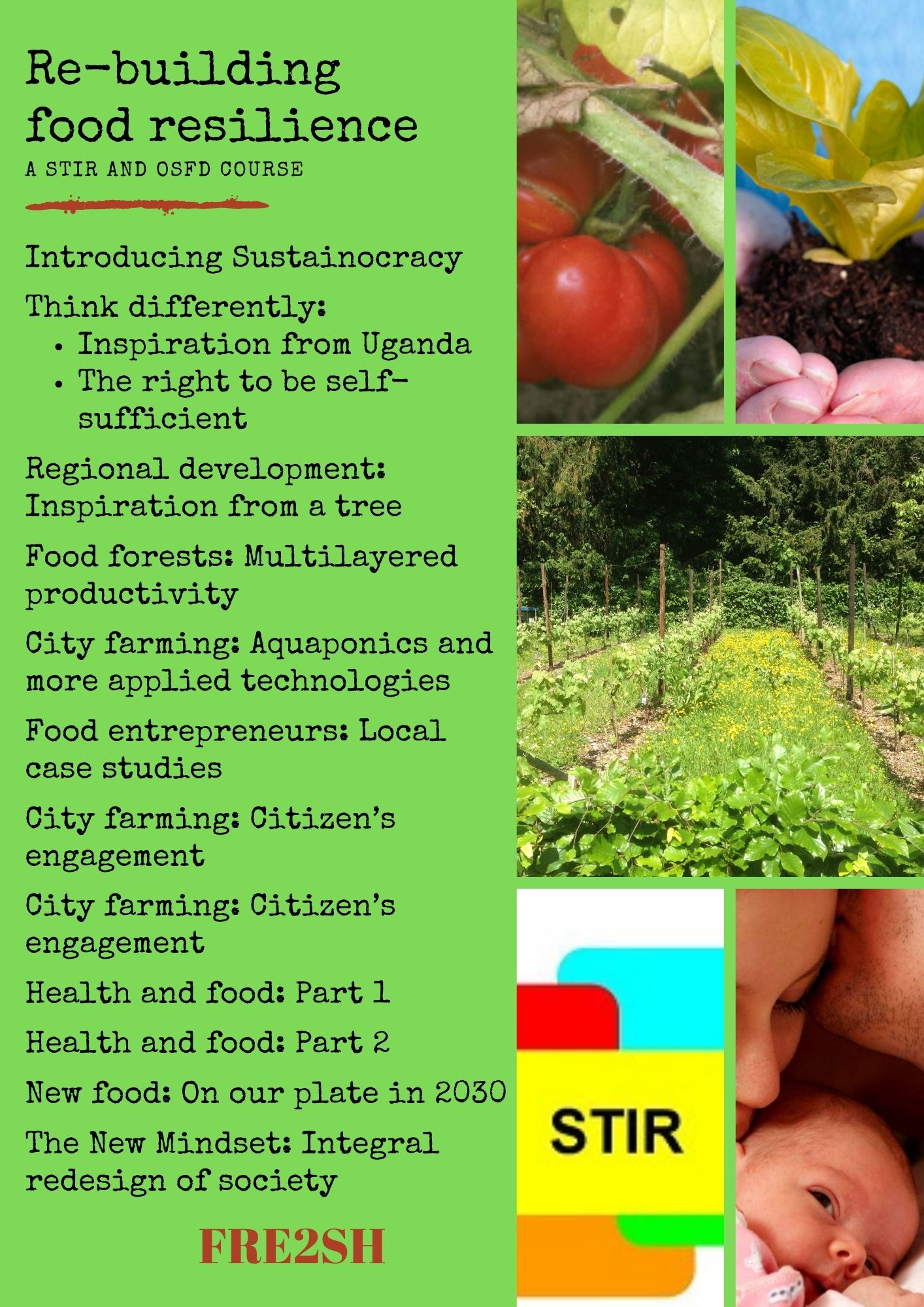
The course consists of 10 modules of local food self sufficiency community building. Each module is built around a particular theme with the overall scope of re-building food resilience and balance with ourselves and our natural environment. Each module contains:

The following topics are planned to be covered per module (subject to possible modification). You can subscribe through this link. We advice you to take the Aventurer option if you are really thinking of developing your local food system, or if you are already are active and need inspiration, international contacts or wish to share your thoughts. If you are just curious then the Seeker option is a your best value for money:
The course is a result of 12 years of experimentation by the STIR Foundation on sustainable human progress, including all kinds of food systems and citizen engagement routines. The overall objective is to create a global community around food awareness and engagement development, our core human values and sustainable development of our species by taking responsibility locally and together (people and institutions). We want to eliminate hunger through participatory sharing. We wish to share our evolutionary experiences, best practice and insights in order to provide sustainable wellness to all human beings in the world in collaboration with our natural environment. We intend to provide the insights and experiences as accessible as possible to the entire world.
Food life science
Our current food reality is highly difficient and needs revision in order to provide resilience of our health and continuity as a species. Life science shows that we do not just eat proteins, vitamins and carbonhydrates. We eat molecular and energetic information which is processed into our own living system.
With this information we need to review our nutritious means. Decades of tests with food in different environments show that food which appears the same has totally different nutritious values, depending on the type of environment it grew in. Experiments with biophotonic equipment in relation with effective soil base management and coherence among species has delivered very positive results.
With FRE2SH we intend to create communities of people that begin to rely entirely on the type of food that we produce together in our food resilience programs. We wish to see if we can show health and vitality improvements. This is important to reduce our dependence on health care and the related costs that tend to become unsustainably and exponentially high. It is also important to improve the wellness, engagement and productivity of our communities within a general sense of quality of life.
 Sustainocracy, the new democracy