Home » Posts tagged 'responsibility' (Page 5)
Tag Archives: responsibility
Integrating nature back into ourselves and our industrialized societies
Recently we enjoyed the regular online presentations of the Holos-Earth project organized by Claudius van Wyk. This time the session developed around the difference between the globalized industrialized environment, in which sustainability measures are taken in order to reduce its negative impact (do less bad), and placed based self sufficiency communities that develop around the positive impact of engagement with nature (do more good).
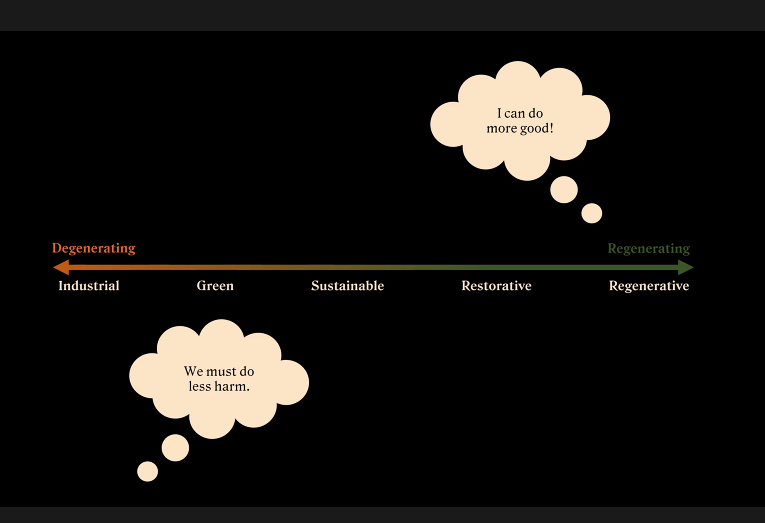
The left side of the picture (Degenerating, Industrial) is the industrial arena, degenerative from a nature point of view, generative from a financial point of view in the global capitalist consumer markets. The intentions to be more green don´t dispute the industrial fragmentation, technical focus and abundant use of natures resources. They are just attempting to be less harmful.
Currently cities are still a reflection of such degenerative dominance
If we look at the development of cities we see that they have been historically facilitating this industrial evolution. They got dominated by the different layers of finance: creative productivity and trade, expensive systems of remedial care and speculation around shortages. Everything, such as infrastructures, facilities, housing the workforce, integration of services (entertainment, care, mobility, waste management, supermarkets, water supplies, sewers, etc), education, etc were oriented at its (financial) effectiveness. The population in cities grew very distant from regenerative nature and its deliverables such as food, drinking water, material resources, healthy air, etc. Cities became extensively mechanized and filled with electronics, citizens blind consumers of all commodities.
Generations have become fully accustomed, even indoctrinated, by education and family heritage, to their citizen bubble of money dependence through competitive employability, entertainment and consumption. People in leadership positions are there to manage any of the related institutional bubbles.
Also the rural environment was industrialized to supply the never ending hunger for resources of each the silos of the industrial environments (business, cities, citizens). Regenerative nature was gradually converted into degenerative industrial productivity (the economy of extraction), destroying living ecosystems in order to develop manipulated, polluted, mass production of monocultures.
Regenerative nature
The right side of the picture shows the regenerative environment proper to living nature. This environment is not a financial economy. It is governed by the laws of nature (eco-nomos), a living ecosystem of interdependence, reciprocity and cooperation.
It is interesting to note that the human being is naturally part of this regenerative nature in our condition of a living species. Our sustainable expectations entirely depend on the optimal functioning of this ecosystem. Gradually people are discovering the intense emotional, spiritual, physical and mental impact (damage) that is caused by the degenerative industrialized environment. It is not only degenerative for the planet, its limited resources and living ecosystems. It is equally degenerative in many ways for entire humankind.
Jean-Paul Close (Founder of Sustainocracy)
Highly industrialized economies, such as the Netherlands, developed a society divided into silos based on specific interests and financial interdependence. The local government sees societal caretaking and protection as a cost which is covered by taxing labor while facilitating the industrial processes for profitability and growth. The degenerative spiral affects such societies as health deteriorates, populations grey, pollution is generalized, new labor is attracted from abroad, etc while societal costs, regulations and bureaucracies, developing exponentially. Also the impact of these societies on the world through the massive and global movements of goods is creating associated problems all over.
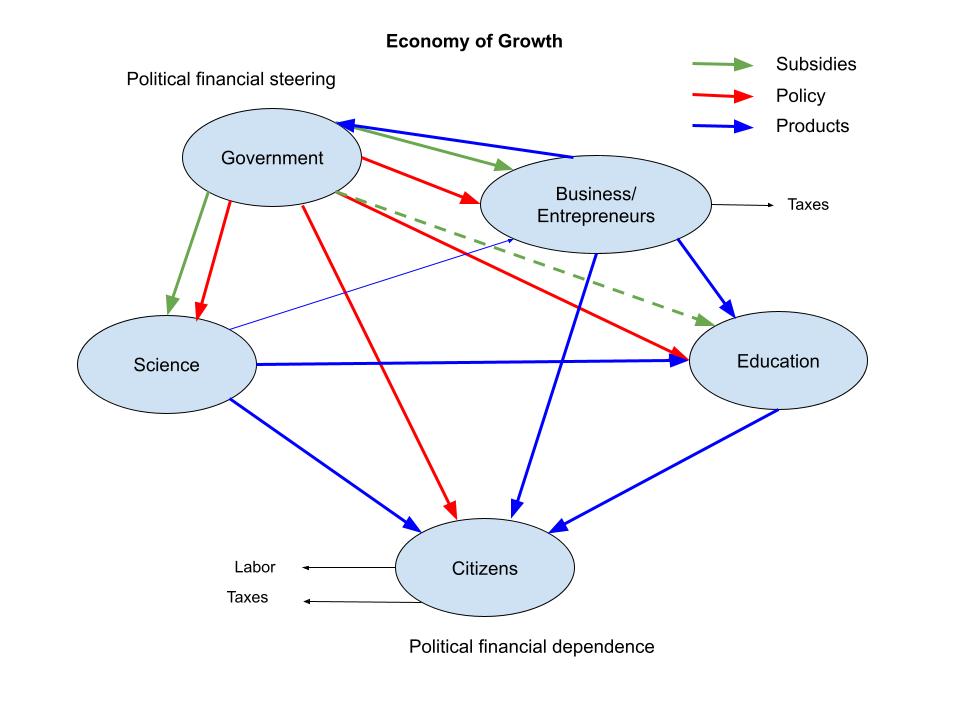
Such societies tend to get financially rich for certain stakeholders and degenerative in general (health deterioration, social deterioration, aggression, environmental deterioration, growth of bureaucracy, remedial expenses, political fragmentation, narcissism, etc). A mayor turnaround is needed, moving these societies strongly beyond sustainability, preferably towards (or into) the area of regenerative nature. This in fact means to bring back the living nature into these societies, not just as patches of nature, but integrated functionally into such communities. We even could use this to redesign the function of cities entirely and providing genuine purpose to people through meaningful participation. As such the Netherlands has the possibility to develop a modern, long term blueprint to redesign the functions of industrialized communities and large cities into multidimensional, well balanced ecosystems.
The problem we find is that the silos involved are too tunnel visioned to be motivated by themselves to take such steps of reintegration. They did show some convergence as a triple helix (science, government and business) to become successful together in applying for subsidies or developing cost saving synergies, but still within the financial dominance of the reigning mindset. So how should these silos, institutions and citizens alike, all together move to a common understanding around essential, natural values for resilience?
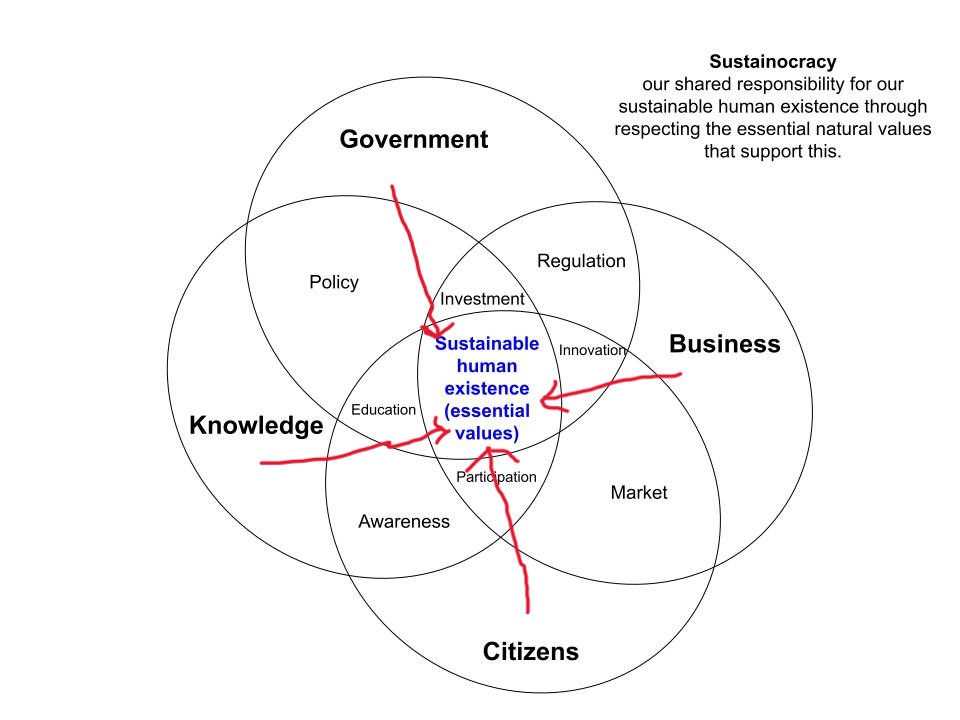
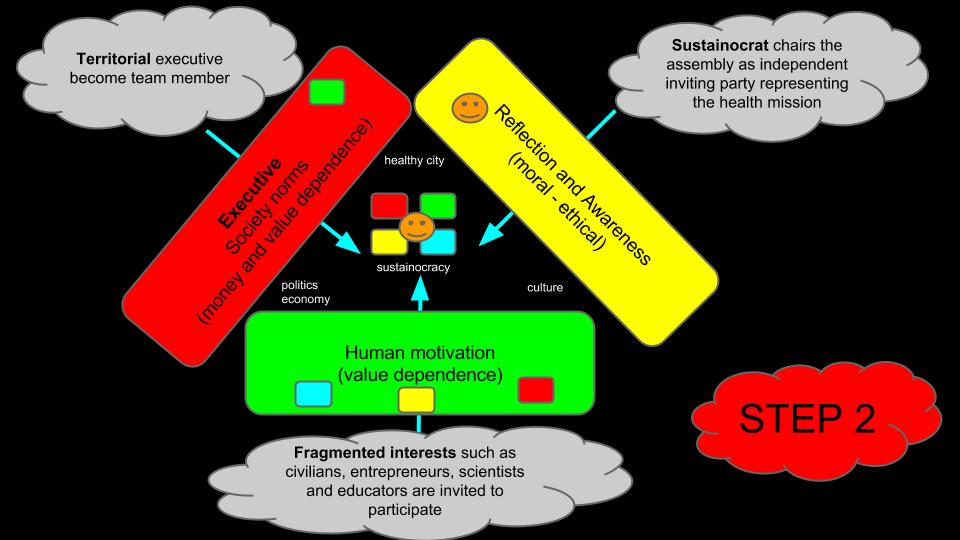
That is where STIR foundation comes in with our Sustainocracy approach. STIR positioned itself as research foundation to study human behavior, and especially when confronted with the essentials of our sustainable wellness. Instead of preaching about such core values we could measure the reaction to the invitation to join environments for sustainable human development as shared responsibility. Placing STIR amidst all the silos with the invitation to join into developing our resilience together, we could create an innovative open, common space for purpose driven interaction. With STIR managing the open space, not as another silo but as a partner organization, each could stay its authentic self, defend its self interests while contributing to the common good. STIR had defined five essential natural human values as shared responsibility of everyone (citizens and institutions) together.

But where to start?
We need to understand that the common denominator in all the expressions of humankind (industrial, capitalism, consumerism, religion, etc.) is the human being itself. The natural essentials expressed by STIR in Sustainocracy are valid for all the functional expressions, as a key responsibility, no matter what. After experimentation STIR arrived at a first step to try to get all stakeholders to join:
health.
Health is a largely unknown factor in human behavior as we tend to take it intuitively for granted. We only start taking health seriously when the opposite, sickness or disability, presents itself. Our first reaction is remedial, trying to address the illness to get back to our old comfort zone of health. But gradually over time we learn that health is more than developing remedial routines. We learn that it is a responsibility that needs to integrate itself into our understanding of life essentials and societal development. Health is much more than the absence of sickness. It comes with our understanding of a human being as a manifestation of the living nature that surrounds us. When we pollute or destroy that living nature we do the same harm to ourselves, no one excluded (status or financial interests do not exempt us from the impact of our actions on ourselves and our environment).
The combination of human and environmental health became the first step of STIR that received the positive engagement of all the silos.

In the center of the convergence of the bubbles of self interests each learn to develop empathy for each other´s contribution, looking at ways to enhance them with the contributions of one own. Science brings in existing knowledge, business develops innovative products, government facilitates with public money and infrastructures while citizens engage through motivation for behavioral change, applied innovations, etc. The cooperative center carries a totally different energy than what one is used in the rest of their own silos. It is a cultural challenge for participating executives to translate this positive regenerative energie into something that their institutions can work with. Not all institutions can cope with that since their reason to be developed entirely in the degenerative arena but most can, creating a self selecting shake out in the community.
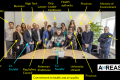
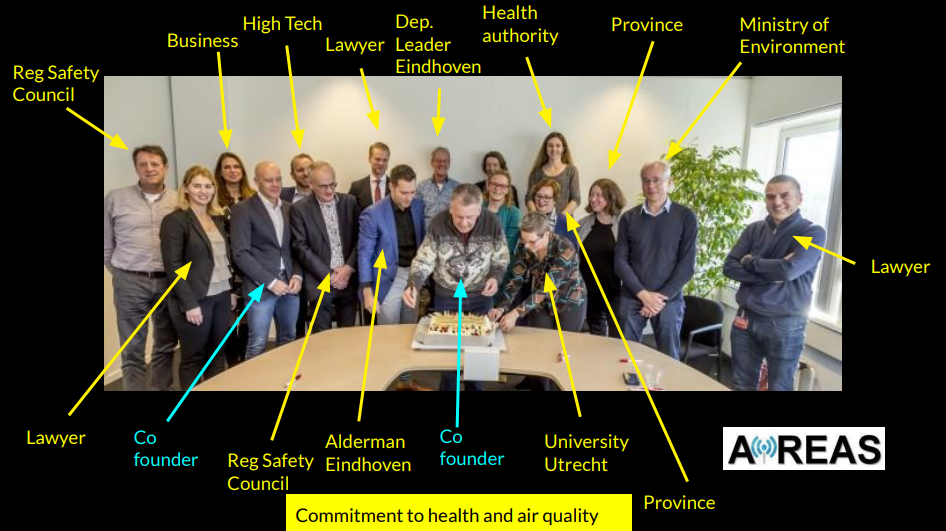
All involved develop levels of awareness of both the need to converge with the opportunities and challenges that arise while doing so. They don´t only join to help the others but also reflect about their own share of responsibility in the issues at hand. Both events, self awareness and cooperative co-creation of the common natural good of health, started a positive regenerative spiral of development. In the picture below we can see the engagement of a large diversity of institutions in the second wave of commitment to develop regional human and environmental health in the region of Eindhoven (Netherlands) with the involvement of 21 municipalities. In the center, cutting the cake for celebration, you find humble me, the only one without any other status than the representation of our core human natural essentials.
Visualizing the same picture in the format of merging silos we see this. AiREAS is the formal, legal partnership cooperative created by STIR to host the open space of co-creation of our health and healthy environment. It was formalized in order to be able to get projects on their way that were defined, funded and manned by the partners together:

Gradually a new ecosystem of interaction started to develop, among all silos together or some of the silos one to one. Also gradually more and more people got involved, through projects, challenges, presentation, usage of innovations, etc. We actively started to engage the younger generations that are still largely open minded, flexible and often hands-on aware of the issues at hand in the world. We also see that soft social skills develop in the world of services. Think of integral positive health, massage, meditation, nature based empowerment groups, urban food systems, etc. Gradually we see convergence around the essential values such as health to such an extend that we can even start concentrating activities in regional clusters that are focused on integral wellness through integral participation and cooperation with nature. All stakeholders have then assumed the same mindset and the habit to interact together to develop such “Health Valleys” (as opposed to the industrial alternative of silicon valleys).
The complexity of letting go
Once in the center of convergence into our natural values, all participants are challenged to let go of certain aspects proper to their traditional comfort zone while adopting other aspects, new ones. This is maybe the most complex part of the convergence because all those aspects of letting go have old interests attached to them. These can be within the scope of traditional behavior or working format of the institutions that need to be adapted. That can be done with the right motivation and leadership.
More complex is the acceptance that some of the essentials that we rely on for our sustainable existence as a species and cooperation with nature, have been integrated in the industrialized working formats, with huge financial interests and powerplays worldwide. These cannot be seen anymore as commodities. They need to be leveraged to the position of our shared responsibilities developed at local community level.

This literally changes everything, from the design and functioning of our cities, the position of the citizens, the functioning of our rural activities, the supply chain, our involvement, etc. In these areas the industrial processes are replaced by regenerative natural ones, collaborative programs together with nature. It also redesigns the financial economies, the citizen´s participation, the sharing and caring mechanisms in society in favor of all, etc.
It also redefines our inter human relationships. The safety and securities that we create together through integrating care for and with each other, the positive and constructive dialogue, the warmth of purposeful togetherness and sharing, the develop of respect for each other and our environment.

Also this is very challenging for people. In degenerative industrial based societies dependence develops fear, the focus on (financial) performance creates competition, individualism and traumas for those who cannot comply, is a mayor challenge for people. And also the related institutions that developed a tendency of societal push, distrust around use of social services, bureaucracy and regulations. Letting go of fear, competition, rules, distrust, etc is huge step for anyone and a mayor transformation of inner wellness that requires guts and trust. Guts is a highly individual aspect but trust is gained through the development of a trustworthy surroundings in which everyone can find him or herself. And this can also be found in the center of our community commitment around our shared responsibilities where everyone is respected, treated as an equal and contributing according their own possibilities and potential.











New blueprint for education in the 21st century
The prime concern of our current era is the assurance of our sustainable existence as the human species in a finite, polluted and destroyed environment. In the previous centuries we have violated the essential values of our existence, not knowing what they were. Today we do know, so we need to educate ourselves accordingly and take corrective measures to transform the violation of those values into sustainable progress.
In Sustainocracy (sustainable human progress and our shared responsibilities) we defined five of such values. None of them are currently taught in an overarching manner in our schools while they represent the fundamental blueprint for our evolutionary processes and learning criteria.
Jean-Paul Close, founder of Sustainocracy
Our learning dynamics are always placed in the context of the time in which we live. In the 19th and 20th century the industrial era ruled. Our education was geared towards the labor market. In the 21st century for the first time we have become fully aware of our vulnerability as a species in the finite space and the limited resources provided by our home planet Earth. We recognize now that our old path has become dystopian, potentially leading to self destruction. Our overarching learning dynamics are now about how to take responsibility for our sustainable existence. The labor market, the diversity of institutions, our entrepreneurship and business mentality, our science and our education, needs to be placed into that context.
The situation of today is very difficult and leads to confusion among those that have been used to trying to solve our issues in a remedial way, within the reigning tunnel visions such as money, technology, regulation, take overs, controles, genetic manipulation and redesigning our environment. These people have not yet understood the complexity of the essential for the sustainable presence of a species within a natural ecosystem. In fact “eco-nomy” refers in essence to the “laws of nature” and not the speculative format we have given to it based on our own laws. Deviating from the laws of nature in order to create our own financial ecosystem, based on making use of humankind and our finite environment for financial self interest, has brought to this dystopian point.
Does that mean that we have to change everything?
No, not at all. There will always be professional functions in society, the need for specialists, also at institutional level. There will even be elites, people that have more authority than others because of their position or expertise. And we all need our guided learning paths to develop ourselves in the complexity of daily life. What we we need to do is to acknowledge our shared responsibilities based on the essential values for a sustainable presence and future while adopting wholeheartedly this mindset. In Sustainocracy we defined a set of five essential values, each being a shared responsibility among all of us, people and institutions alike. These values correspond to the laws of nature. It may seem simple, just five essential values. But when we start taking them at heart they prove to be transformative of the entire societal dna, taking away stress and bringing wellness for all.
We are to place everything in this context of core values for our existence, including our financial economy of growth, our government structures, our own behavior, our care systems, entrepreneurship, productivity, engagement as citizens, etc. By doing so we also redefine the entire educational learning process. Instead of teaching domesticated obedience we learn about respect, tolerance, equality and working together in values driven routines. We learn about authenticity, contribution, reciprocity, safety, trust and the essential values applied to ourselves and all of us together. We learn to be responsible in our behavior, our actions, our creativity, our leadership and awareness development.
By doing so we resolve many of our problems, reducing the financial, humanistic and ecological burden of our abuses of the past and its consequences on us, our societies, economies and our environment. We heal our past and develop resilience in all layers of our existence.
The blueprint of our new age education
Taking the above seriously at heart we need to look at ourselves as human beings. We are unique manifestations of life within the context of our natural environment of fellow living species on a finite planet in space. We are blessed with self awareness and the unique observant self learning dynamics for our own benefit and resilience. As a species we have gone through huge, long lasting phases of confusion that became the foundation of our current understanding and learning processes. We are unraveling our understanding of what we are, developing both humility and determination. Today we are living the biggest turning point in history of humankind. This historical process is also needed as guidance for our youngest generations to a productive, engaged, happy and wellness driven adulthood and life’s fulfilment.
Playful childhood
The growing up of toddlers represents the discovery of the fascinating world that surrounds them. Experimentation is their name of the game. The protective guidance of the parents helps to avoid the dangerous pitfalls of life. Playing is key to deploy the physical motorist skills, balance, interpretation of danger, emotional skills, etc. Early communication skills to interact with the parents develop as the child grows up. The learning show be an open space for free discovery and experimentation within the contextual framework of the core natural values such as health and safety. The child learns to establish limitations, consider risks and warning signals, interpret communication and interact through expressing wishes, fear, pleasure, etc.
The “I am” learning path
Gradually the infant starts to discover his or her large diversity of abilities. At this early stage it is mainly a copying behavior of what is being observed through parents, brothers or sisters. This is enhanced when the child gets in contact with other kids. Here the child can potential start learning about the authenticity of its own being, the unique “I am” development. The natural attitude is to learn through comparison, competition, challenges, victories and disappointments. The learning skills need to develop around social values such as compassion, empathy, tolerance, equality, respect, self awareness, a positive self image, awareness, etc. Here a solid foundation is created for the emotional stability of the youngster. Play, music, theater, art help in the development of the expression based skills. It also is sense making for developing language and communication skills in at all levels of speech, listening and interpretation abilities.
The “we are” learning path
The following learning path is oriented around group processes, the awareness driven cocreation and participation. The underlying skills developments of the experimental playfulness and self awareness (I am) continue of course and require continuous attention. Now the fundament of togetherness is further elaborated within the function of recognizing each other’s unique abilities and contribution in the field of cooperation. The aspects of sharing, spreading the load of responsibilities, leaving no one behind, creating value together. taking initiative, leadership skills, creativity, entrepreneurship and sharing it among all, are key elements of this learning path. Community spirit, the value of care for and with each other, are extended also to the inter-generational levels of attention. Respecting the practical experience of elderly while appreciating the youthful energetic outbursts of the younger provides a magic melting pot of opportunities for progress. The elderly have to avoid the dogmatizing of processes, stimulating the youthful creativity of the upcoming generations. The younger generation have to learn to appreciate the guidance of the elderly with their levels of awareness breakthroughs and elaborated expertise.
The “shared responsibility” area
Reaching adulthood the young people have sufficient baggage to further specialize in certain functions. Meanwhile they develop harmonic relationships with their own potential partner, possibly having children of their own while playing a role in different communities that fit their personality, professionally and otherwise.
Era of integration
Meanwhile our societal construct transforms based on the core natural values that lead our progress. We peal off old societal laws around the financial hegemony and abuse, protecting ourselves against outbursts of narcissism and expressions of pure, destructive self interests. Entrepreneurship, governance and all other institutional expressions are redefined within the same values driven mindset and sharing of responsibilities. Certain key aspects of life, such as food, water, warmth and air are taken our of the arena of commodity based trade and placed within the area of integration of our shared responsibilities, cocreation, positive interaction with nature, regenerative processes, etc. It will give rise to totally new “eco-nomies”, levels of engagement and development of circular interactions. This makes also the adult world a field of continuous adjustments, learning, innovations, applied science and technologies. The early playfulness is never lost, nor the “I am” and “we are” quests in the dynamics of the evolution of life and circumstances. Shared responsibility for our core natural human values is never reaching a status quo. It is always a balancing act to achieve harmonization and integration that will show moments of scarcity, chaos and new impulses for awareness driven adaptations. But addressed together, with wisdom, care and respect for the Whole, the moments of adversity and abundance are celebrate equally, with joy, determination and trust.

STIR Foundation
For over a decade now STIR had been introducing this new learning path. At first we were rejected, now we are being gradually accepted by increasing numbers of partners and do we engage with large groups of people, especially young generations. Read more about the build up of our experiences here.

Becoming part of sustainable success in challenging times
The 4 x WIN community of level 4 core human values driven engagement is growing, becoming a modern success factor for all institutions, not just business. One can become part of it by committing to its mindset and action driven clustering.
4 x WIN
The tradition of business education made the positive financial bottom line the only measure of success. The possible negative consequences of such an approach were left to society, the planet or humankind (3 x LOSS). In the 21st century we realize that such a mindset is destructive beyond repair. Government regulation and largely ineffective, expensive remedial measures are often financed and suffered by the entire community, not the entrepreneurial perpetrators of the losses. Paradoxically the development of shortages, speculation, destruction, debt increase, dependencies, etc are wrongly presented as an economy of growth instead of one of deterioration. This is blindly immoral, unethical and unjustifiable for our present and future generations.
4 x WIN business develops an authentic multiple contribution to society in which the financial result is a logical consequence, not at the expense of humankind, society or the environment yet serving all three in a meaningful and measurable way.
- WIN for humankind measured in terms of the essential values for our existence as described in Sustainocracy.
- WIN for society in terms of developing social cohesion, reduced costs, shared wellness, equality, trust, circular economies, participatory societies
- WIN for our environment, through circular, regenerative processes, collaboration with nature, non destructive use of resources
- WIN for financial continuity, which may include growth if the value creation is desired elsewhere but content prevails, developed in a 4 x WIN environment..
4 x WIN entrepreneurship is not only reserved for business. It also applies to the government, citizens´ cultural and behavioral evolution, education, science, etc. In fact, the 4 x WIN mindset develops a sustainable wellness driven (local) interactive ecosystem and eco-nomy (rules of nature).
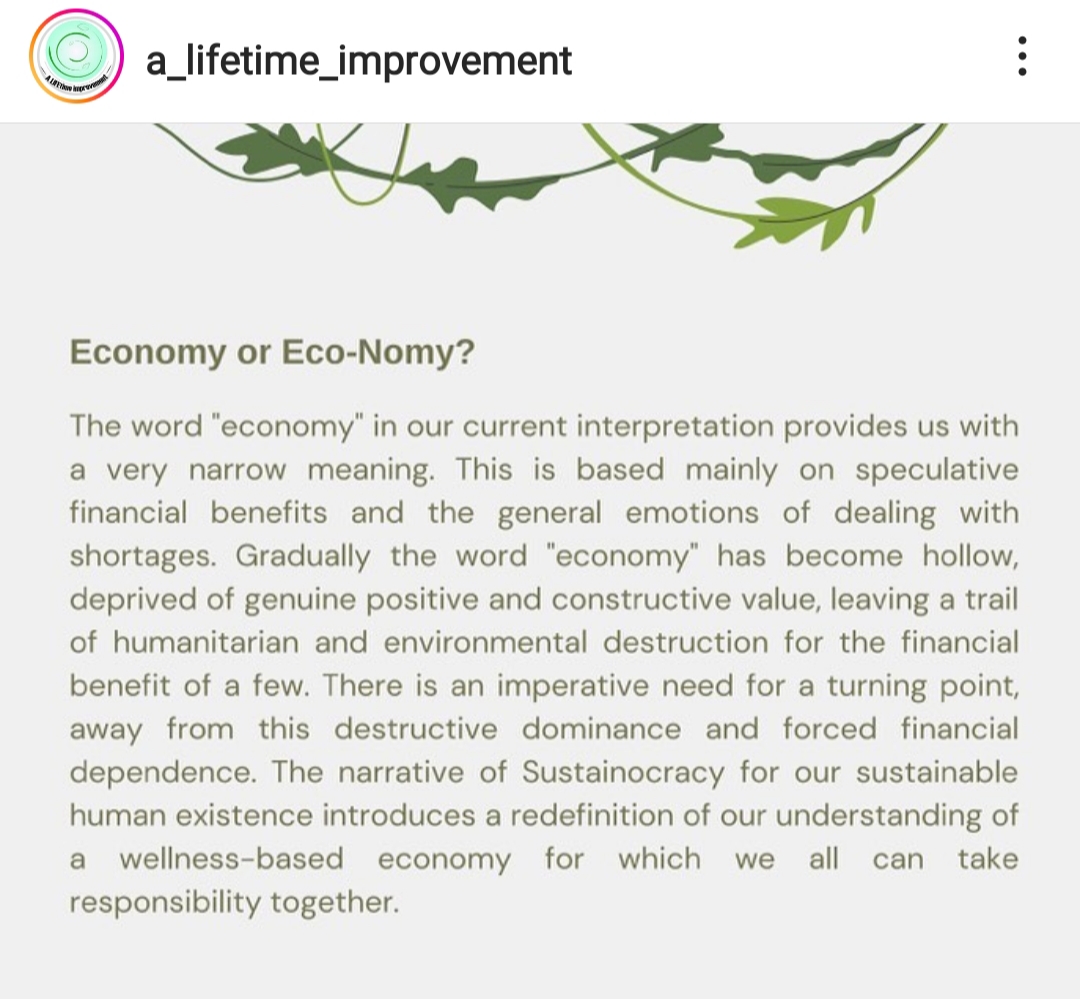
Eco (Nature) – Nomos (rules) = Eco-Nomy (rules of nature)
Shared commitment
The 4 x WIN environment does not fit in the traditional arena of exchange of products, services or policies. It represents the engagement with our essentials, using our innovative powers together with public funding, scientific knowledge and a results driven attitude. We coincide within the spectrum of developing, recovering or sustaining the essential human and natural values for our sustainable existence within the local demographical, cultural and historical complexity. The sum of all 4 x WIN Sustainocracies will form a 4 x WIN global wellness driven society. This level of society is also called the awareness driven co-creation level (Harvard) or layer of shared responsibilities for sustainable wellness (Sustainocracy). It is the incubator of values driven innovations, breakthroughs and new knowledge development. Apart from being a measurable, integrally positive contribution to society, a cost saver and proactive problem solver, it also feeds new success stories to the underlying layers of expansive economies of growth. Every new use of the innovations in this environment will again contribute until the value creation saturates and a new cycle needs to start.

It also helps the local governments to eliminate unnecessary and obsolete rules and regulations, with all the costly layers of law enforcement, remedial actions and controls. These old rules have been transformed into shared responsibilities and innovative change, reducing societal costs, deblocking societal progress and opening up to new positive financial impulses and the creation of jobs. 4 x WIN is most successful when all stakeholders in a region become part of this mindset and share all the benefits among each other.
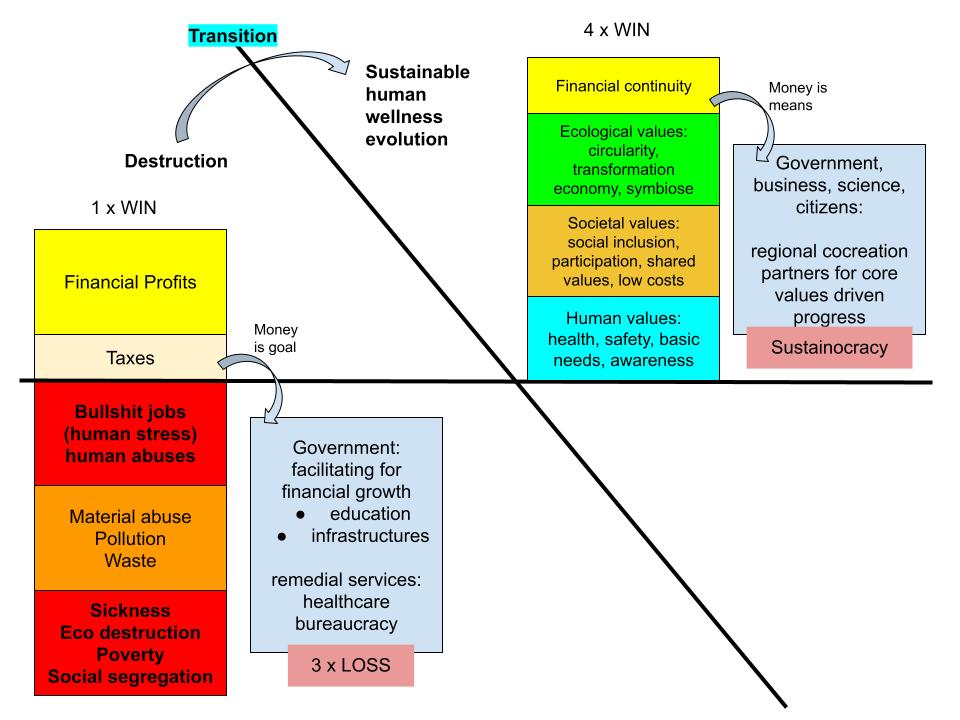
4 x WIN self diagnosis
Any institution can make a self diagnosis of its level of 4 x WIN compliance. One has to look with honesty at the four levels of value creation. This diagnosis starts at the executive level of commitment to 4 x WIN since it requires the commitment to innovation, awareness driven partnerships, genuine leadership, authenticity as an organization and its positioning in the ecosystem. It does not only look at the contribution of the organization to the common good, it also offers a mirror to the organization to optimize its own behavior and positioning effectively in the ecosystem. This is a totally different attitude than the finance driven competitive environment of the growth paradigm. The latter can well be part of the organization but never at the expense of the values created. Organizations tend to maintain the incubator part separate from the growth structures. This is to avoid unnecessary unrest or confusion in the organization and also to allow innovations to develop strength before they get passed to the arena of growth.
Some organizations, the so called “Me 2” organizations, emulate the leadership qualities of the 4 x WIN organizations through copying behavior and innovations while focussing on price reduction and volume. These structures will never have the same level of authenticity as the 4 x WIN ones.
Then the self assessment continues by analyzing the added value contributed to all human beings through the essential values for our sustainable existence, society and our environment. One does not only analyze the market approach but also the internal processes. Not every organization can achieve a full 4 x WIN positioning but indeed can always find multiple WIN for itself and never a negative area that produces loss in any of the domains. The best 4 x WIN assessment is done both by the surrounding 4 x WIN partners that coincide in the shared responsibility circle and the results obtained together within higher purpose all choose to serve together from an essential human values perspective.

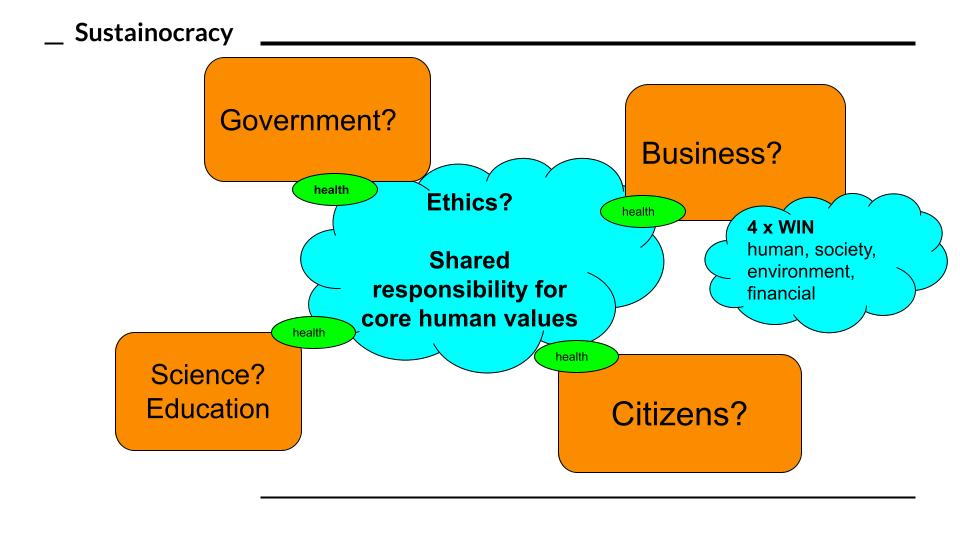
STIR 4 x WIN community and indexation
STIR adopted 4 x WIN as it was created by the predecessor of the foundation, the 5K consultancy group for new age entrepreneurship and business transformations. In fact it became the basis of Sustainocracy, involving all other stakeholders of society. The 5K consultancy group introduced the 5K index (2008) as a prelude to developing the 4 x WIN community of institutions that develop themselves according to this roadmap. A few booklets of particular sectors (Supermarkets, Banks, the Netherlands in general) were published (in Dutch) to show the market leadership positions of organizations in these sectors. That was before the open space for multidisciplinary cooperation was initiated and structures arose such as:
- AiREAS – regional air quality and health
- FRE2SH – regenerative local food self sufficiency
- COS3i – social inclusion and innovation
- STIR learning community – youth engagement and participatory 4 x WIN learning
In each of these purpose driven circles numerous people and institutions engage into the value creation processes, local or even globally. The idea arose to develop a European (and global) community that is 4 x WIN like minded and together address subsidy channels and financial contributors. The community develops through sharing best practices, their authenticity and commitment to the essential values of Sustainocracy. Like this we don’t have to go through the selection procedure of partners every time opportunities arise. We simply cluster among those who we already know with their commitment and participation.
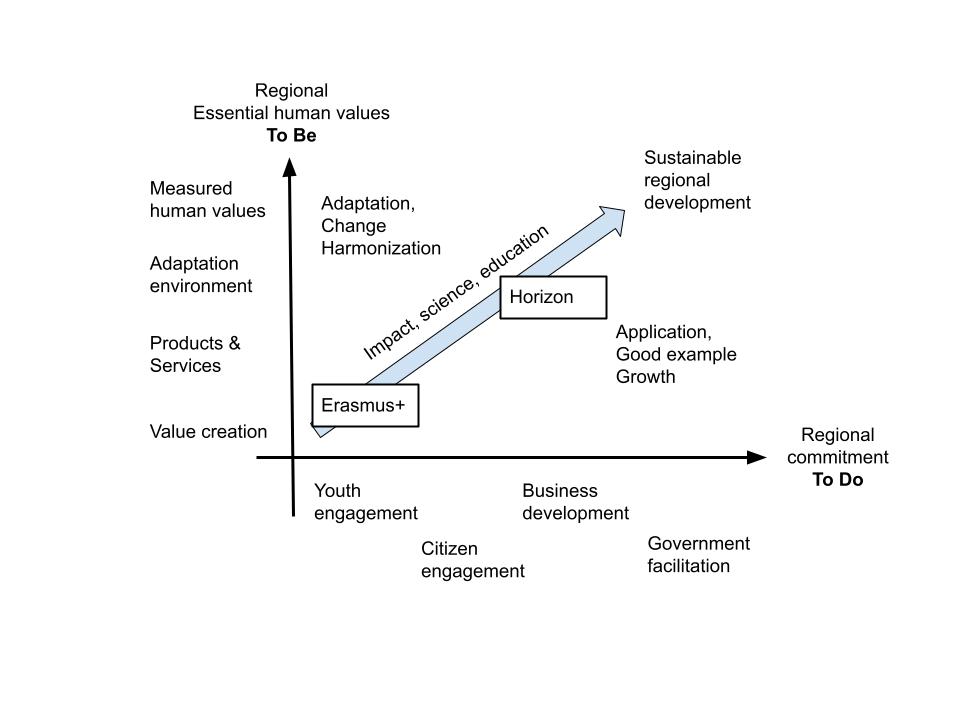
Together we make the difference in developing and implementing impactful things.
For joining the 4 x WIN community please contact
Jean-Paul Close
 Sustainocracy, the new democracy