Home » Posts tagged 'sustainability' (Page 10)
Tag Archives: sustainability
Free download The Truly Responsible Enterprise from author Tóth Gergely
Through this space, in the blog category of “books on sustainable human progress” I start to make knowledge available to you. This is part of the universal academic environment (The STIR Academy) that I am creating as part of the development of Sustainocracy as a new way of co-creating society in a value driven democratic way. In a Sustainocracy co-creative initiatives are taken in which education is always included free of charge, not free of responsibility. Via this means you get knowledge of a new society that you can process yourself. You now have a choice between paradigms. Knowledge helps you to develop awareness on which choice provides you with the best prospects to conduct your life in an exciting and sustainable way. The authors you meet here are also invited by me to take co-responsibility when Sustainocracy extends across the world. This have the same choices as you yet through their publications they show that they are maybe a step closer.
Tóth Gergely
I met this extremely interesting Hungarian intellectual and author, Tóth Gergely, in September 2012 during the three day Euro-SPES encounter on Spirituality and Sustainability in Visegrad (Hungary). In Hungary we find many people with deep understanding on the subject but they publish in the very difficult local Hungarian language. I am very pleased to be able to share this document in English with you. Interesting to note is perhaps that Tóth also makes his work available to you free of charge, just like me and the others in the STIR Academy. We are convinced that knowledge is not just for those who can afford it but part of humankind that should be freely available and used for sustainable human progress.

Tóth Gergely
Download 0 The TRE here
Here you’ll find the biography of Tóth Gergely he describes himself in 2009 on the back of this work:
Tóth Gergely is a Hungarian citizen who was born in 1970. Together with his wife they bring up their four children. By education he is an economist and holds an M.Sc. in Business Administration, and a Ph.D. in environmental management. He has studied and worked for long periods in the USA, Holland, Germany, Romania and the Baltic States. He is fluent in English and German. With other collegues Tóth Gergely established the Hungarian Association for Environmentally Aware Management (KÖVET) in 1995; he remained the executive director of this NGO till 2006 and has since then acted as secretary general. He also worked as the executive director and then vice president of the International Network for Environmental Management (INEM) between 2000 and 2005. Since 2006 he has been an assistant professor at the University of Pannonia in Keszthely, teaching economics, environmental management and global trade. Tóth Gergely holds 18 honors and awards, including the ‘Pro Scientia’ prize of the Hungarian Academy of Sciences, awarded in 1995. He has managed and supervised
20+ larger projects, financed by the European Union and other donor agencies. He has contributed to 30 books, has published 50 articles in professional journals and over the last 12 years has held 180 lectures in Hungarian and international conferences and training workshops. Beyond his children, his hobbies are writing, triathlon and other sports.
Top 7 readings after 5 years blogging and blueprint for prosperity
Change
Someone who wants “to change the world” has an easy job. He or she simply has to change oneself and the world has changed. All you have to do thereafter is to show people how you are by being yourself. This serves as inspiration to some and may eventually spread…..In times of internet, with the possibility of blogging, to express our ideas and show the world the changes one has made, this process gets a modern unprecedented dimension. The problem people face is the huge amount of information that becomes available and the selection one makes for one’s own inspiration. By doing so one creates his or her own world of information and personal progress.
My own progression
After 5 years of blogging I see a progression in my own activities and also in the way I share this with my surroundings. I also see a steady and even exponential progression in the support I receive from you. The amount of readers has exploded in recent months and my practical contribution to the world through Sustainocracy is becoming a serious source of inspiration for people across the world. When I look at the blog items that drew most attention I see a certain tendency too, obviously provoked by myself through social media and public presentations, but also by a growing interest by you around the different views that I present. WordPress advises, through its statistics, that I should pick up these items and continue that line of inspiration for you.
The top 7 readings and topics are:
1. Why people avoid spirituality – This post was extensively read by the academic world after my presentation during the scientific encounter on Sustainability and Spirituality in September 2012 in Hungary.
2. Alternative definition of Sustainable Development – This post is key because it is used all the time to define the ethical basis of Sustainocracy. So every time I address and audience I need to clarify this point first to create the right mindset to follow my statements. The post is there extensively used by me as hyperlink.
3. Feminizing masculine cultures in crisis – This post appeals much to female groups who see a justification in it for their own emancipation. The masculinity of current manipulation and speculation of economies is often despised and purposely negated by masculine authorities but strongly recognized by the feminine structures causing an interesting Yin-Yang also among my readers.
4. The day after economics – I found that this post was appreciated by a broad audience that saw it as an eye opener to a trusted paradigm that was falling apart without anyone really knowing what was happening. “Economics” is a word that is seen as eternally connected to human development. To project it as a finite thing with a “life before and after” got readers to open up their mind to new worldviews.
5. Kondratieff versus Close – This recent post was re-blogged various times by people who like the analytics of human and economic systems.
6. Anthropocene I and II – Many people do not realize the effect we have on our surroundings and that this even is being defined as “an era” that will leave a lasting print or scar on the face of the Earth just like other natural disasters of the past.
7. Why only Sustainocracy can save the human world – This post is especial popular among the growing list of supporters of Sustainocracy as a solution.
Blueprint for prosperity:
I will certainly come back to these in forthcoming posts, as the trusted old world collapses and we all need to put our shoulders under the renewal. From the above posts, and observing the line of progression I made in my own work, we can define the key ingredients for a stable society:
- Ethics should rule (eg. Sustainocracy), not money
- Higher human purpose should lead the democracy, not economies of growths
- Self-sufficiency should prevail in primary requirements (food, housing, energy) to avoid dependencies
- Co-creative craftsmanship should provide sustainable local human progress
- Harmonious partnerships should connect self-sufficient neighboring regions for safety and sharing prosperity
We still have some work to do before this blueprint will be accomplished. What goes for societies, goes for us individually too. We are back again where I started. Change the world by changing first oneself by taking the above blueprint at heart. The rest will come automatically.
Warm regards,
Jean-Paul
Students today (121212) define their own challenge for Europe
“If you can dream it, you can do it” (Walt Disney)
“Optimism is the faith that leads to achievement”
“What you do today can improve all your tomorrows” (Ralph Marston)
Eindhoven (Holland) 12.12.12 at 12.12 a small group of students, age 17 and 18, taped their own video message. It is destined at their own generation in Europe asking them to take also “responsibility for our own future” and meet in 2013 in Hungary.
A challenging call was formulated to meet in the course of 2013 and joinedly discuss and step up their vision for a strong self sufficient Europe and unite together to make the best of it. The recorded videomessage can be seen here and will be distributed across Europe. It will be used to invite students and their institutions to team up and come to a purpose driven encounter in which “our common future” will be defined and expanded further, taking this 121212 encounter as a first stepping stone.
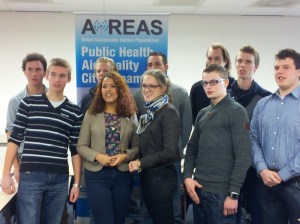
The challengers
Jason, Shari, Veerle, Randy, Bas, Koen, Willem-Jan, Simon, Bart, Arjen
The students’ encounter started at 09.00 a.m. in Fontys Highschool with scholars from both the ROC Highschool and Fontys Eindhoven. An open discussion followed on general issues that concern us individually and all together. This discussion will be summarized on video too. It was impressive, Topics that were dealt with were:
- Multicultural society – the need to adapt to a region, learn the language and show commitment to contribute to the region’s prosperity. There was a sharp disapproval of the growing aggression and a call for tougher punishment measures. Local languages and cultures should be respected even in a broader context when dealing with a united Europe. Shari suggested that we should try to understand each other better even in communication as interpretation of the same words can be different by different cultures.
- Crisis – a strong need was felt to recover stability in terms of jobs and opportunities. The lessons learned from history and our past should be taken seriously. Those who misused the system (bank and government officials) should be punished severely. Willem-Jan: “We accept to take our responsibility and even take our losses as long as we can be confident that these same mistakes and missteps are not taken again”. Banks and governments should develop an ethical responsibility and code of conduct.
- Responsibilities – every single person is him and herself responsible for their own future, not government or some institution. We should show solidarity with the Greek, Spanish and maybe consider one single European government to establish a balance with China, Russia, USA, etc. It is not about money only.
- Sustainable societies – this should be our common goal, not economies or growth. Arjen: “Sometimes one step back means that you can go forward”. Governments should not accept lobbies out of self interest from eg. oil companies but accept change and invest in using technology for our self sufficiency and sustainability.
- Willem-Jan: “We need to learn to live and work together”
The whole interchange of impressions was filmed by Hein, owner of CityTV.nl Eindhoven.
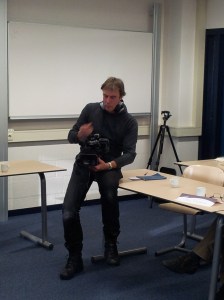
Hein filming this unique event
The openness and transparency of these students was heart warming while they all really had significant views and something to say. Their worldviews had been developed through international visits and projects.
Coach Wim Grommen added that there are 5 basic issues that need to be attended always to create a stable, sustainable community:
- Food
- Health
- Security
- Prosperity
- Knowledge
There is no money in this list and examples were given of communities that develop prosperity without using money.
One of the two girls, Veerle, proposed that the group would make their own videostatement for the 2013 event. One of the students already had one prepared. He also supplied the one-liners at the start of this blog:
**********Jason Clarke**************
“Do you want to change the world we live in today? Are you up for the challenge of making the world a better place to live in? Do you have perseverance, courage and will to reach your goals that will benefit society? The Europe of Tomorrow challenge is the event where you should show your unique talents and share your knowledge, skill and experience with others.
Playing a key role in your team and show your uniqueness that will make the difference! It’s about what you stand for, what you want and how to reach your goals. Share your belief, passion and enthusiasm with others. “Together we can change the world forever”
Making the difference starts with believing in yourself.”
***********************
The statement was received with applause and it was decided to use it here and on the forthcoming event site. Veerle took the lead in defining a shorter message specific for the video, the “call to their own generation”. After some group discussion the definite version was written on the whiteboard. Then this co-creative group decided to make the statement together in front of the camera…….
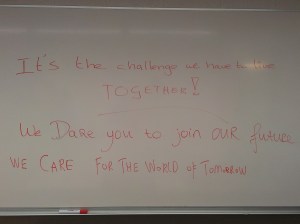
The final statement and challenge
Conclusion 12.12.12 of these students:
All:”We do not have a choice, we need to change our economies and societies into sustainable self sufficiency, applying innovative technology and vision by working together and eliminating misusage of power that blocks this progressive transition.”
This was the admirable conclusion in a morning’s debate of a small group of European 17 and 18 year old students, the “next generation”. It certainly gives the satisfying feeling that our future is in good hands with this generation. It was questioned if students across Europe would have a similar sensitivity? So the challenge was formulated for the 2013 event to check this out and get them to react and join.
The 2013 event:
In September 2013 we will all gather in Hungary. Students from all over Europe are challenged to make this happen. Students and European schools that wish to participate can ask already for the instructions for pre-subscription and preparation by mailing to:
Jean-Paul Close email: jp@stadvanmorgen.com
Thanking all those who participated today in this small but significant event, also part of the global “Day of Interconnectedness”, we certainly hope that we have created a stepping stone for a great event in 2013 and beyond.
 Sustainocracy, the new democracy