Home » Posts tagged 'sustainability' (Page 11)
Tag Archives: sustainability
Why only sustainocracy can save the human world from disaster
The current economic structure of our global society is based on consuming goods rather than using them. What is the difference? And why would the consumer type of economy be obsolete? And why should it be replaced by a user type of economy? What consequences does it have for our daily lives? And what consequences will we suffer if we do not change?
Throughout the explanation I will fall back on a useful example: mobility.
Sustainocracy is such a purpose driven economy based on usage. But first…
Consumer economy
In this type of economy we simply purchase whatever we need for a living. This means that we take ownership of the goods. Consumer economy has evolved ever since the start of industrialization. In order to make products available to the consumers around the world we need to install an infrastructure for manufacturing the supplies, retail outlets, waste management of packaging and obsolete stuff, financial systems for payments, etc. The relationship between the consumers who purchase daily needs, suppliers offering products and services, money systems providing cash and loans, governments providing infrastructures and regulations, is based on a composition of value added resources (products), logistics (distribution), financial profits and taxes.
A business network that sells the products focuses on profitable consumption, the government that provides infastructures concentrates on taxable consumption.
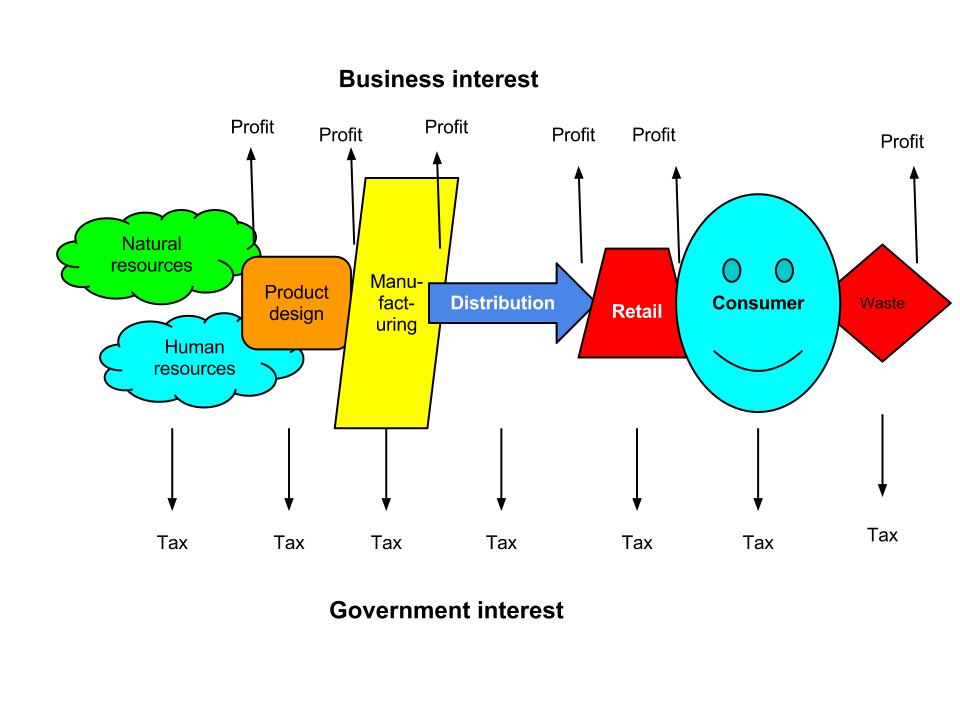
Property is past on and taxed in every step in the chain
Business in each step of the chain needs more and more profits to attend the increasing demands of shareholders. Shareholders own the business and value their ownership through the return they get on their investment. As a consequence the business wants volume sales and cost reduction in a competitive environment. As a side effect this chain optimization causes increased environmental pollution. The effects on human nature are also negative. It causes constant purchase stimulus, creating a mentality of greed, thirst for financial means to purchase more and a mentality of hoarding. There is a growing degree of individualism, distrust, criminality and psychological disorder around “the having”.
Governments see an increased need for infrastructures for logistics and retail activities but also suffer the negative consequences in health, psychological disorders and environmental pollution. The latter is demanding investments in rules, bureaucracy, police, health care, etc. This produces a steady increase in tax requirements along the chain to finance the growing social responsibility around purchasing power. Government hence stimulates further consumption through economies of growth in order to be able to finance the consequences (dual economy).
Obsolete type of economy
Meanwhile the entire structure of society around fragmented money driven and dependent consumer interests, shows a steady increase in problems, such as the reduced availability of natural resources for the increased global productivity, destruction of the environment to facilitate more logistics, the pollution of our habitat and increased global competition. Consequence driven investments in a greener society do not reduce the push for more consumption, on the contrary, it stimulates it even more to cover the costs of those investments. Business and government both use it as marketing arguments to stimulate the economy of growth even further. It all helps to delay disaster but it cannot avoid it. Overconsumption in a consumer economy has a structural damaging effect and leads irrevocably to crises.
Each of the fragmented pillars (government, business, etc) depends on the other’s growth, stimulating it according, increasing the problems faster than solving them internally in every fragmented layer or “slice” of interest. All the crises around the world are a consequence of an obsolete consumption driven system.
The problem of this consumption driven economy is the chain of exchange of ownership all the way up to the end-user. On and between each of the shackles in the chain the business and government interests are keeping the system in place out of self interest. No one in the chain takes responsibility (nor can be individually blamed) for the effects on humanity and our planet. In between the shackles shortages appear that lead to speculation and further value destruction in the chain, increading economies while decreasing quality of life.
Example: mobility
Mobility is a consequence of our consumer economy. We privately need mobility for work, social activities, family logistics, recreation and purchasing goods. For each of our requirements we have a whole variety of mobile alternatives, instrumentally at hand. We have a car, a bike, a scooter, maybe even a caravan, a trailer, etc. We can only use one of these instruments at any one time but possess it for our usage at will during the day. We consider this type of mobility part of our democractic freedom. But do we need to own it?
We seem unaware about the amount of resources that we block by keeping up a stock of individual mobility in our own ownership. The amount of space we need to store the options is tremendous, while not in use, while in use and when we arrive at our destiny. Not to mention the different types of infrastructures that are needed to provide safe usage. It all had an important impact on our economics for many decades. But also on our environment and health. This was countered by the growth of a consequences-economy in which healthcare techhnology managed to stretch our lives against a huge healthcare cost.
Today we face the problem that polution, scarcity of natural resources and usage of productive landscape is so big that it has consequences for human health, social stability and sustainable human progress.

In Hong Kong (China) 7 Million people suffer lung and heart problems due to air polution
User economy
If we would change our economy to one where we do not possess our goods but use them when needed, a lot of the problems would be solved. Why don’t we simply change to the new system if this is better for our environment and human health? We cannot because:
- We are used to “having in possession” all our alternatives
- Our society is based on the profit and tax structure related to purchasing, not the usage, to finance itself
The first has to do with mentality and the second with our social complexity. The economy is structured around our culture of possessions not for usage. If we want to change that we need to break up the chain, alter our culture and change our economic system all together. That is extermely difficult to do. This has significant consequences for our society. Let us simply look at the two issues I mentioned.
1. Mentality – culture of “having”
We possess everything simply because our society is based on that culture. If we decide to relinquish possession we could not yet make use of alternatives because their is no reliable infrastructure based on that usage. When I want to move from A to B and have no car or bike available to me then I have to rely on walking, a neighbor or the public transportation system. In very dense populations this may well be organized to an extend but in my small town I need to walk a certain distance to find a bus that goes every 30 minutes. Taxis are expensive as they do not just charge the fair of my travel from A to B, they also charge their own fair just to come to pick me up. A bus would be fine but it goes only so often. Meanwhile I am used to getting my transportation instantly by walking to my car or bike at my fron door.
So if I would want to get rid of my ownership I at least would want to have a reliable equivalent at hand. If I do not own but use then the service of usage has to become better than me as an owner.
The consumer society that I live in also requires that I travel between urban centers. The train system has shown important flaws, especially when we have extreem weather. I hate to see myself as single father, with a responsibility at home, stuck on a freezing train station without being able to get home to attend my children. Having my own means at least gives me a sense of control. Not that it is a guarantee that I get there but at least I have my own hands on the steering wheel. I have instant choices. And that feeling of independence is important to me.
Mentality also has to do with psychology.
Of course I understand that usage instead of property is important from a natural resource or space point of view. And I would be very willing to change my mentality if, and only if, my sense of freedom, security, choice and instant availability would be guaranteed. Ownership provides me with this sense of availability at all times, despite the destructive consequences for my environment. I am conscious of it but also have my selfish attitude. I am willing to jump on my bike when the weather is good, when I feel safe, but do not feel the need or obligation simply because our planet is in jeopardy. Who am I? My neighbors need also their consciousness building. When I see them buying and parking a car in our street for every family member my motivation to relinquish my comfort first has come to a minimum. “Them first” I would be inclined to say, or all at once.
Mentality shift has hence to do with multiple factors, not just my own consciousness and sense of responsibility. It has to do with availability of reliable alternatives, an equivalent sense of comfort and recognition of my efforts (I am not alone). Usage is not just confined to the mobility issue, it has to do with all sustainocratic processes around local four local sustainable human progress (food, security, health, wellness and education). When that is organized I would be pleased to try it out, fearfully because of lack of trust, but responsably as a global conscious citizen.
So change of mentality requires purpose driven cooperation between institutional AND civil interests. Both have to work together to make it happen.
In fact, in an economy based on usage we can learn to respect the usage of our natural resources in a reciprocal way. To do so we would need to address again the essentials of our existence within the context of our natural environment. Sustainocracy is all about that. If we use our environment effectively and with affection we can assure continuity of our existence. But to do so we need to give back what we have taken when we are done. That is the way nature works and it works exceptionally well. In fact, that is the way life and death works also in humankind. When we are born we use material from our environment for our carnal existence and growth. When we die we give it back to our environment through a burial or crematorial. Why wouldn’t we do that with all the other things that we use to serve or please us?

A circular economy of usage creates sustainable progress as profit
We should but we don’t, simply because we are not organized that way. To do so we need to change all our institutions, their way of functioning, as well.
2. Profit & Tax transformation
When we look again at mobility as significant example we see recently (last decade, with a push forward sinds about 2008) a rapid tendency in urban transformation. This is caused by the expected sharp decline of fosil fuel availability and the rise in cost price. 55% of humankind lives in cities nowadays depending on mobility for everything they need.
Industries and governments that have relied for over 100 years on the profits and taxability of cars as a consumable and luxury item. They are now facing an automotive crisis, starting the transformation within a dense urban setting. The maths of car sales and consumption of fuels does not add up anymore in a social and environmental context for the long term. Old business lobbies still remained strong for a while due to the amount of labour and financial interests in this traditional sector but eventually room has been created to develop alternatives. We see now the tendency of new local for local alternatives in mobility with great creativity at business and governmental level. Still, this is confined to the economy of scale presented by the urban concentrations. It could become much more affective if fragmented policy making would be replaced by holistic sustainocratic cooperations.
Taxable
The problem any government faces is that the car with all its fuel consumption was one of the biggest taxable instruments to finance the public administration. It was a real cash cow. Just like housing, energy, communications and food supplies. Now that this income is slowly evaporating a dual problem arises. Sticking to the example of mobility we see that new types of transportation, traffic and mobility require new infrastructures, which is a large investment. Meanwhile we are not entirely sure in which way mobility will evolve. This is also the case for any other human consumable. The old taxable cash cows disappear but nothing is definite to replace them. But the old costs of society keep growing.
How do you transform taxation from a consumer to a user economy?
Why would taxation need to remain the same? From a theoretical point of view it does not need to be the same at all. A new society would demand a new way of structuring government and by consequence also its finance. But you cannot instantly transform government and its dominated structures s.a. police, defence, infrastructures, justice, education or health care. They have been build up for many decades, centuries even. Restructuring involves large hierarchical structures of people, regulations, laws, positions of power, etc. It takes not only time. It demands general support, vision, hard work and accepting the psychology of change as a common transformative factor in which fear plays the most common human factor.
In a democracy a transformation is even more demanding and probably even impossible because of the fragmented party politics that have grown far from a common national purpose. Also people who vote tend to vote for what they have lost and not what they can achieve by working together.
When we take sustainocracy as a new structure for society at least all 4 pillars of society work out ideas together.

We all take responsibility together. The old chain is broken up through a purpose represented by one leading person’s initiative
We all realize that the traditional tax structure and government expenditure needs to be intensely revised. We see that there is a long term continuation of the effects of the old consumer structure on human health and the environmental polution. This affects again the long term government expenditure requirement in health care, and that is not backed by sufficient tax income in the short term of the new structure. Either public debt increases further, or….we all take responsibility (sustainocracy).
Everything needs to transform at the same time.
Also, business needs to transform. When new entrepreneurial initiatives appear that substitute the old traditional ones we see an equivalent need for transformation of social financing and government responsibility. Business is much more inclined to assume local responsibility for reliable public services in which circular economy of usage replaces the linear economy of ownership. Government is then forced also to change from a regulating and consequence driven authority to facilitating structure that introduce flexibility, transparency in change and cooperation. On the one hand this would attend the uncertainty of the future. On the other hand one needs to spread the investment over all parties and not just through governmental channels. Taxation cannot cover both the government transformation AND social transformation all by itself. Today we see many governments already with a rising national debt beyond reasonable proportions, just to avoid change. More debt to induce change would be unacceptable. Moreover we concluded that a society based on usage requires the transformation of everything, not just government.
Sustainocracy
That is where sustainocracy comes in and places the responsibility with all social parties involved. One single connecting specialist or pair of persons will do the trick. Me for instance. Taxation in the long term in an economy of usage can have similar proportions than the economy of consumption today. The money would however be used in a different way. But in the short term the tax income is much less. We see then a tremendous need to coordinate such transformation step by step in order to avoid a total financial chaos. Tax can then be something more than just money. In fact we all become local for local responsible for the circular economy of usage, creating the added value ourselves and sharing the benefits. In the consumer economy we see that people simply need money to keep the economy going. In an economy of usage people need to invest their talent and personal energy to create things to share (s.a. food, energy, housing, etc). Money is less important. Much more important is the level of co-creation.
This requires vision and coordination that cannot come from just government itself nor any other institutional structure. They are all too dependent on each other through the old chain of interrelated financial dependencies. The current institutional world would sooner drop into a huge crisis than take the initiative to transform together. That introduces the new connective leadership (no power, lots of authority) of members of the sustainocratic STIR Foundation. They assume the role of new purpose driven leadership that allows the institutional partners to join the challenge based on independent equality, rather than dependent inequality. Each participates with its one levels of power, authority and added value.
The challenge is hence extremely local, yet global at the same time, geographical and vertically institutional, and very human as well. It affects for instance the way multinational business develops and transforms from a global manufacturer to a local facilitator. Maybe in between business can still develop a mix of centralized manufacturing specialization and local holistic service responsibilities, with forward and backward logistics and reuse of resources. But if the transformation is not coordinated with business and governance involvement at the same time it will not happen.
As a consequence we can very well justify the complexity of the transformation from a logical and even scientifical point of view but not easily from a practical, operational one. We cannot pinpoint anyone today as a sole holistic responsible for sustainable human progress, unless one totally independent person stands up to do so (like I do in Eindhoven). The huge material interests that still make up the old world of the having, the consumer economy, have a tremendous blocking impact on the level of transformative change. This is being countered by a strong building up of explosive (agression) and creative (new initiatives) stress. It is becoming much better for the establishment to join sustainocracy and gain again instruments of effective power then to remain trying to patch up the old system our of unsustainable self interest.
Organically change may occur when old age parties find each other in purpose driven sustainocratic missions. But change will also occur through crises en chaos when powerful structures insist on their self interests beyond the limits of the ethically reasonable. There is a balance that needs to be found between the controled temporary maintenance of the old and the speed of change towards the new society. The process can be extremely dangerous for human kind yet can also be changed positively if sustainocracy is accepted by global institutional leaders, together.
Conclusion
The theoretical and ideological need for transformation between a consumer and user type of society and economy is beyond dispute. It can be morally, ethically and scientifically proven. The complexity of both mentality change and transformation of institutional positioning is however so large and significant that it takes local and global leadership to make it happen. As such the existing hierarchical leadership is not independent enough from their fragmented structures of power. Holistic leadership only exists at individual human level, cannot be institutionalized, just accepted as linking sustainocrat.
The fragmented institutional leadership, no matter how powerful in the old world, will eventually have to join the table of sustainocratic leadership. Institutions are human instruments, like a hamer, a screwdriver or a shovel. If we cannot get humankind to stand above its instruments we will face a huge humanitarian disaster. It is up to the human being in charge of such institutional instruments to accept taking seat at the table of human sustainocratic leadership.
The sustainocratic initiatives that we take in Eindhoven and Holland could be a source of inspiration and guidance to avoid human disaster and make change happen in a peaceful way. Then global business, governmental and scientific leadership would have to accept sustainocracy as I present it and join the table for the sake of their own leadership. Since such combination is unprecedented in the world it is hard to establish for the first time. But not imposible as I have done it before. If it is posible on a local for local level for the first time we should be able to address the issue on a global basis too.
Worth a try? Why not….Who should be at the table? Who cares to help?
Why people avoid Spirituality
From Sept 21 -23 a group of academic and entrepreneurial visionary intellectuals from 14 countries met for the annual conference of EURO-SPES. The topic was “Spirituality & Sustainability” and the gathering took place in Visegrad (Hungary), 40 km north of Budapest. Our organizing host was Prof. Laszlo Zsolnai.
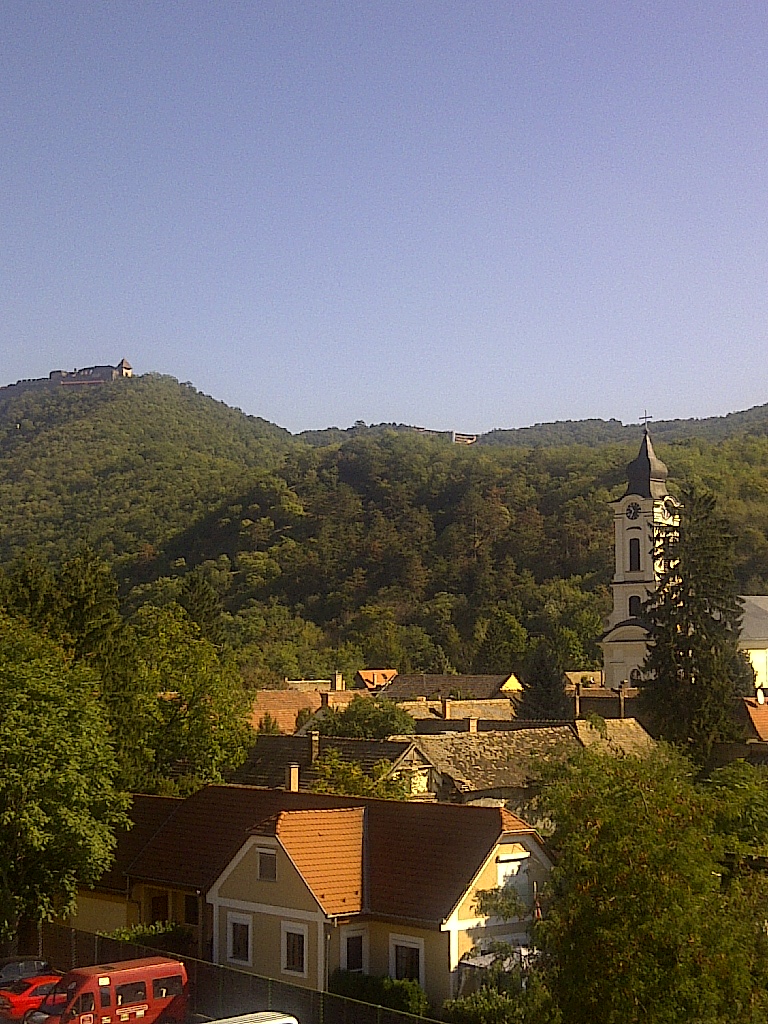
A beautiful weekend in a beautiful place full of history
Spirituality is a word that in the world of hard materialism is being neglected or despised as being soft or religious. This is a huge misconception and a true mental and practical blockage for development of true sustainable progress. Spirituality has various definitions as participating scientists correctly pointed out but the general description of the word is “the inner quest for the true meaning of our existence”. For people who live the simplified life of materialism such quest is of course a scary confrontation with their own consciousness and certainly something to be avoided. The world of the “having” is exactly opposite of the world of the “being”. Both reject each other like poles of a magnet. The transit from a “having” kind of mentality to one in search for identity (being) is usually referred to as a “crisis”. The process is one of letting go (voluntarily or involuntarily) of material securities and trying to find comfort in the new world of inner feelings and meaning.
In such open field of emotions people start reacting in many ways, some aggressive or depressed, others become artists or find unprecedented hidden forces of leadership. During the conference we were enlightened with views in each of these fields of expertise. Academic research is showing the importance of spirituality for humankind to recover from crises and develop sustainable evolutionary progress through the renewal of true meaning. It represents a combination of rationalization of inner search for meaning and putting the growing awareness into practice in experiments around new ways of organizing ourselves, individually and as a community. This is called the pre-paradigm, a phase before, after or within crises, in which alternatives develop to a reigning paradigm that is falling apart. Such pre-paradigms are always confrontational to the one that is being disputed. A pre-paradigm uses the logic of spiritual consciousness and is usually neglected and even denied by those who are unaware, or intentional to uphold the existing paradigm out of personal or institutional interests. The old paradigm has lawful support while the new paradigm has the power of timeless meaningfulness.
It was shown that such human evolutionary patterns of obsolete but reigning paradigm, crisis, pre-paradigm development through spirituality, and the opposition between old and new paradigm, are a natural evolutionary phenomena of a self-aware species. Even the dramatic consequences of a powerful yet obsolete paradigm, that could cause death and destruction, can be seen as a universal natural disaster hitting humankind, forcing ourselves to renew our spiritual awareness and develop a new evolutionary cycle. But this natural phenomena is of course not an excuse for those who are aware of it to let it happen just like that. The force of reasoning and new paradigm development is nowadays, thanks to many modern elements of peaceful reflection, education and opposition, capable of overcoming a forthcoming crisis without the natural need for or potential threat of a mass destruction.

Academic intellectuals, artists and entrepreneurs from 14 countries meet for the paradigm shift
Sustainability was explained from an existential and practical point of view, using also nature as a point of inspirational reference. Various presentations coincided about the forthcoming mayor crash, a melt down of the world order of economics after decades of exponential growth and speculation. For the first time academic financial specialists looked at the broader picture and showed the unsustainable truth of current economic materialism. Not many presentations could pinpoint yet a solution. Some were still tempted to use economic instruments that were contrasted by others, including me, as “decades too late” and at this stage unrealistic and equally obsolete.
Solutions needed to be found in the inner world of reflection, awareness and consciousness, not the external worlds of old material securities. My own practical presentation of sustainocracy was well received. As I was one of the very first to present my case I had three more days left to get some deepening reflection about it with those who connected with the complexity of my line of thinking and my practical proof of concept that already went beyond the phase of pre-paradigm. During the questioning rounds after each presentation the power of my own model of human complexities proved its worth for my own inner guidance for reflection and interaction with the others.

The psychology of change in a paradigm shift is the true transformative challenge of humankind
The complexity of the current global situation was also beautifully shown through expressions of art around the world, presented by academic scientists, and available to create awareness in a difficult world of opposition, apathy, ignorance, commercial over-communication, fear and manipulation. The surprising beauty or challenging intellectual creativity brought forward in all kinds of artistic disciplines was mind blowing. Speakers could pinpoint where the problems were in the unbelievable massiveness of humankind in the world today, but also that solutions were not easily at hand. Humankind was expecting solutions from the external material world while all agreed that the real solutions needed to be found in the inner world of meaning through spirituality and structural renewal of our civilization’s organization around life and evolutionary essentials.
Many presentations therefor referred to the necessary inner quest for reason and meaning, not just as an individual but also as an organization and entire civilization. Many also referred to the powerful explosive potential that spirituality has when it hits the individual and the masses. “Water must flow freely” (biologist and journalist) Janos Vargha stated when he explained his decades of battle against the system of political and economic madness when the Danube was nearly doomed for exploitation with damaging effects beyond repair. He won!

In the red circle the “monster of the Danube”, artificial remains of human institutionalized madness
And so will spirituality as this too must flow freely. The dam that was going to affect natural life, including human’s, in and around the Danube, is now a metaphor for the blocking forces of artificial institutionalized economic and political interests that stand free flow of awareness and reason in the way. Public opposition builds up powerfully and eventually breaks through the dam with force. Right now we are all like Janos in the 80’s, claiming the free flow of meaningful reason and renewal in a peaceful but demanding way, before damage is irreparable. We have time at our side, those who try to uphold their unsustainable power position do not. This personal reflection should give us trust, no matter what happens:
“Spiritual meaning will eventually win as it always has, simply because it has eternity on its side while the temporary power of the self proclaimed mighty dies with those mortals that try to uphold it in their lifetime”.
The encounter was very powerful indeed and finalized with people who found each other in meaning, reasoning and purpose. Friendships were born, alliances too, and solutions were shared that went beyond the stage of experimental pre-paradigm. During that weekend in Visegrad along the Danube bend of Hungary the cultivators of a new human future shared seeds to sow across the world. The new paradigm of sustainable human progress exists and will grow there where true spirituality meets with purpose driven leadership and entrepreneurship.
Humankind, crises and sustainocracy
Nicolette Meeder (The STIR Academy – teaching sustainocracy) asked me to draw and explain the two lines of human complexities so that she could film it. It is generally believed that people tend to understand a verbal and visual explanation better than when just reading about it. We found a nice location nearby in Eindhoven (Holland): the 11th century watermill that was painted in 1884 by Vincent van Gogh and made world famous since then.
For your comfort I recorded the same short message in three languages:
- The TO DO line stands for level of organization, knowledge, structure, group activities, inventions, institutionalization, action, etc. It is refered to as a masculine line (Yang).
- The TO BE line stands for level of spirituality, awareness, consciousness, reflection, morality, cohesion, purpose, etc. It is refered to as a feminine line (Yin).
Both lines interact equally producing sustainable progress as we see in families and need to bring structurally into communities. If we don’t we will face cyclic moments of wealth and chaos.
Dutch: http://www.youtube.com/watch?v=9ZkQogXzZNE
English: http://www.youtube.com/watch?v=uWgVbDL4Tco
Spanish: http://www.youtube.com/watch?v=eRIFol217pc
While sitting there enjoying the beautiful weather, the wind, the trees and the beauty of ancient human ingenuity it is difficult to imagine that we are all capable of destroying it all out of greed and lack of consciousness. It reminded me of my second blog, on november 2nd 2008 (nearly 100 blog items away now and still very relevant) stating that the credit crisis was just the beginning of a huge human challenge but not of nature.
It is equally difficult to understand that we need to take personal responsibility to make a difference and cannot rely on institutions that have developed into blown up, destructive, fragmented human structures that give us money in exchange for our labor to uphold their destructive existence. We call this “work” and need the financial means to “live”. Due to our dependence on “money” we may become aware that this work in institutions is potentially destroying our life but we are forced to continue if we want to survive the short term. This is a crazy paradox.
I introduced Sustainocracy some time ago to position institutional activities in the field of sustainable human progress. This requires executives to make a choice of responsibility. “What do they take responsibility for?”, their CV as a destructive old paradigm manager or the CV as institutional transformer through personal leadership? Sustainocracy helps them because they cannot take responsibility for the entire human progress from within a fragmented institutional specialization. They need to take responsibility together with other, different, institutional responsibilities in a co-creative, non competitive, purpose drive environment.
When that occurs everything changes. People who are employed will not go to work anymore. They will contribute to the human progress that the company stands for in its sustainocratic ventures. Success is not measured in KPIs (Key Performance Indicators) but in true improvement in human health, stability, safety, etc performed by all participants together and each being rewarded for their specific part in the progression.
Some people ask me why human beings need to progress? My answer is that we need to adapt continuously to our ever changing environment. Every change induces new changes which make us change again. This fundamental and necessary alertness to adaptive to ever changing circumstances can be filled with wisdom, awareness and innovation. We call that progress because we learn over time to do this better. Our mission is not to eliminate change from our lives through control but live with change effectively through awareness and consciousness. Then we will progress in a sustainable manner.
Please comment openly through reactions on this blog.
 Sustainocracy, the new democracy