Home » Posts tagged 'sustainable progress' (Page 6)
Tag Archives: sustainable progress
Our own required actions to extend our own “expiration date” as a species on our wonderful planet.
The first thing we need to do is stop relying on political and financial structures to solve our problems. These structures have been based historically on the use of human and material capital for their own financial and authoritative positioning. Most of the problems that we face in the world are caused by these structures and our own delegation of responsibilities. This does not mean that there are not many people in leadership positions doing their best. They face a type of DNA of these organisations that limit their options. To change this we need to look at ourselves, as human beings, to re-establish our core natural values and shared responsibilities. We can then help restructure the DNA of our institutions to become instrumental to human and planetarian wellness.
Taking responsibility again ourselves in 4 steps:
Here is a list of actions that we can develop ourselves and invite others (including institutions) to participate.
Establish local 4 local food communities
Food is not a commodity, it is a shared responsibility
This Urban Design Forum issued a set of recommendations for city councils to facilitate urban food community development.
The STIR Foundation, together with worldwide partners, initiated a global FRE2SH learning platform around re-designing our resilient food systems. We open up the dialogue around inspiring outdoor and indoor examples and techniques that colaborate with nature. You can participate in the program

Start taking care for each other again intergenerationally in communities that share housing, space and responsibilities
By developing again our communities we break with our individualism and start sharing our responsibilities and basic needs again. From a financial perspective individualisation was great, as everyone was stimulated to fullfill their individual needs in dependence of the financially structured services and dominance. From a sustainable progress point of view it was deadly since the first natural human need is the social cohesion, the community. In a community the basic needs such as care, food, water usage, energy usage, etc, can be regeneratively optimized in close cooperation with our natural environment.

Reduce our exorbitant energy usage by 70% or more
The main energy that we need as a biological living species comes from our food and the sun, not from the electricity plugs at home or a petrol station along the road. Our excess usage of energy can be found in our mechanized mobility, industrialized productivity, logistic systems, the many devices used in our homes for lighting and entertainment, our heating and cooking facilities, etc.
By developing our needs around local for local structures we can eliminate many energy wasting and highly polluting activities while optimizing our remaining requirements through clean resource management. Also community based living reduces our energy requirements due to the sharing of needs over groups of people. The related reduction of pollution will enhance our health and healthy living environment, reducing our healthcare needs and related infrastructures or bureaucracies.

Develop and accept only 4 x WIN institutions (multiple values driven, regenerative and non polluting governments and business enterprises) as supportive, non abusive instruments for human development.
Look at 4 x WIN here
Institutional DNA (In the 21st century: purpose and positioning in a 4 x WIN ecosystem) transformation is only possible when the entire institutional ecosystem transforms at the same time. This is done when we as human influencers put new demands on these structures. Instead of competing for financial, human and material resources (1 x WIN mentality, leaving the consequences to society, the planet and future generations, if any remain left) they start cooperating in core human values driven co-creation platforms. Money is not a main issue anymore, it is just a means, just like creativity, engagement, applied innovation, impactful applied knowledge, etc. The main issue and driving force is our shared and sustainable wellness in close cooperation with our natural environment. 4 x WIN is a mentality of shared responsibilities for human, societal, environmental welbeing and financial continuity (not necessarily growth).


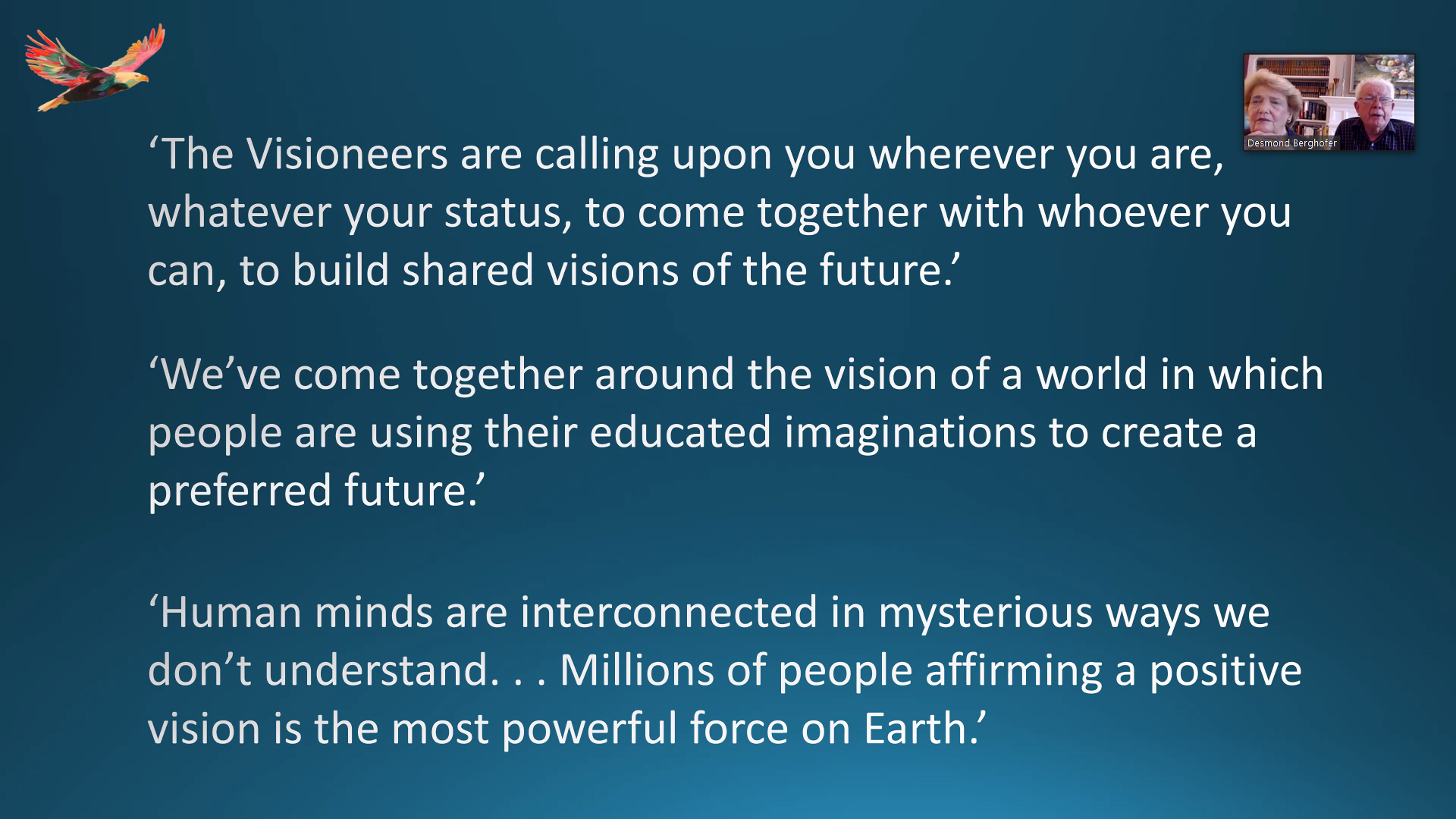
The global Visioneers network is preparing a great launch and clustered platform for values driven actions.
Save the date: Sunday October 9, 2022 at 11 am PDT = 20.00 CET online and offline (Vancouver) event.
Humanity’s Golden Peace
An Entry to the Age of Global Consciousness
A Catalyst
What is/are “the Visioneers”? In 1992 Dr Desmond Berghofer (Vancouver, Canada) published a book on his views of human development. Ever since he has been living his views together with his wife Dr. Geraldine Schwartz. Five years ago they started to extend Visioneers Awards to people who were recommended to them for their humanitarian work accross the world. So far over 300 awards have been extended by them forming a worldwide network of great people that have been making a difference. I myself was surprised and honored to be included in this network some time ago and also become part of their round table of about 30 Visioneers. I suddenly found myself surrounded with the greatest authors, TV personalities, musicians, peace activists, intellectuals, etc.

The event on October 9th? After all these many years of preparations, gathering wonderful people, extending awards to them, it is time to engage the whole world. Read about the plans here in the latest bulletin. The event will contain three parts:
- 1. The celebration and official designation of Visioneers Awards
- 2. Humanity’s Golden Peace, described in visuals, stories, music, poetry and songs, sending our message through the Arts, with choirs of many ages and voices and ongoing audience participation.
- 3. A mosaic of film clips, of 10 inspirational episodes of wisdom, stories of outstanding achievement and visions of Humanity’s Golden Future.
It is also the time to initiate the process of clustering Visioneers in Leadership Circles:
Visioneers Leadership Circles to be formed worldwide will be introduced as we wage peace and register our achievements on the Visioneers Wall of Stories, colour-coded to display progress on the United Nations 17 Sustainable Development Goals.
Geraldine Schwarz

11 years of AiREAS, part 2, the transformation
In part 1 we explained how the start of our AiREAS community in 2011 attracted the element of (financial) self interest of the participating institutions and people.
- Business wanted to sell their expertise and products. Addressing their polluting manufacturing methods and logistic deliveries was another issue.
- Science was looking for the financing of (PhD) research projects. Showing us the results of other research, directly related or even exactly the same, was avoided.
- The city was looking for applied innovation and avoidance of limiting factors for growth. Taking measures for improving air quality and health was up against the diversity of political interests.
- Citizens were known to complain a lot. But when asked to take responsibility together their absence was mindblowing.
The issue of health was an interesting means for all, not a primary goal (yet). This is of no surprise. The mainstream societal ethics was about the solidarity with the financial system. Health was generally dealt with as a remedial issue, often by other institutions than the ones that contributed to the unhealthy problem. Establishing AiREAS as a non financially driven entity could even be considered contextually illegal. Nevertheless we together decided to go ahead anyway.
So health and air quality was primarily an issue of the founders of AiREAS, local entrepreneurial citizens who brought in their own motives. At human level all institutional people involved engaged positively with this health thinking, but at institutional level the objectives of these organisations were leading for them as employees. This lead to the common saying in AiREAS:
Self interest is your best motivator as a participant in AiREAS. Feel free to represent it to the full in the AiREAS community as long as it contributes to the common mission and goal of air quality and health.
This lead to very interesting confusion among the partners. A product supplier for instance would normally expect to finish a relationship with a customer when sending the invoice and getting paid. In the case of AiREAS the relationship only started when the products were delivered, installed and made available for use. The products themselves were not important, their expeted functional results were, placed within the context of the health and air quality objectives. In a five year partnership arrangement this would mean a long period of feedback to the supplier with possible needs for product adjustments and readjustment of services.
The same was for all the partners. They had to get used to this health and air quality overall umbrella for their AiREAS engagement. Angry citizens were asked to think of their own contribution to air pollution in their daily lives, not just fingerpointing at others. Scientist were asked to bring in the existing expertise prior to getting their research contracts. The local government realized that if they participate in measuring air quality, there is also an expectation to do something with the data and insights.
Gradually each of the participants started to transform as an organization and become more and more proactive in the field of health and air quality development.
Some even developed an attitude of: now that we can do it ourselves, why do we need AiREAS? This led again to confusion, especially for them. AiREAS started to work with other regions in order to avoid having to deal with these commitment fluctuations. In the end most would return to the multiple level engagement dynamics of AiREAS, simply because health and a healthy region cannot be developed by any single institution itself. It needs to be done together. But this is a learning process. After all, we all we come from a world full of self centered silos, individualistic interests and self determination. This resulted in the following AiREAS rule….
Whatever one can do by oneself, one does by oneself. Whatever is too complex, we do together.
This rule had a double purpose. The first to avoid abuse of making cheap use of others for things that really belong to oneself. The other to stick to real and exciting complexity levels of execution of challenging projects together. Gradually participating members of the community started to understand the additional value of working together in AiREAS.
We called the concept: One plus one is much more than two!
It developed the identity and authenticity of each of the partners in the relationship with the others in order to optimally start valuing each other and incorporating each in a common higher goal and purpose. The specific added value, that only appears when both (or more) work together, is unique and magically effective. It really enhances the position of all involved. In AiREAS competition among the partners does not exist. Each engages based on their own unique contributive value.
Another issue that required the learning process of all partners involved was the fact that AiREAS was a dynamic ecosystem, not a controled fixed structure. One participates, suggests or joins processes and celebrates end results, but no one controls anyone or others. Many cooperative clusters can emerge, all at the same time, under the flag of AiREAS. One participates, or not. It is always an open invitation and a contributive choice.
The first AiREAS project was the design, implementation and use of a fine maze, city air quality measurement system focused on citizen´s exposure to air pollution. End 2013 the installations took place and for the first time we made Visible the Invisible, for all that participated. We could suddenly see the effects of Newyear fireworks, the impact of bbq-ing during a windstill summer evening, etc. With this measurement system as a backbone and reference, more projects were proposed and defined together.
Other municipalities started to engage and with it also other partners. AiREAS grew as an ecosystem in which everyone can find their own space and engagement. By doing so every new participant started to mark their presence as a valuable additional resource. They also needed to go through the learning process of developing cocreation instead of their traditional trade attitude.
Together we had developed an enormous amount of knowhow. But there was still one thing missing: Genuine changes in societal functioning.
Everyone involved in AiREAS had undergone transformative changes in their commitment, functioning and even their organizational reason to be. The participating institutions became examples of structures moving from a traditional 1 x WIN to a multiple WIN positioning. Their old focus on financial results or cost coverage had transformed into the desire to make impactful positive footprints in society. Also the executive management culture was changing. Multiple WIN thinking wishes to make a difference. And together this could be done.
But the most difficult was still to come. The extention of all changes into the operational reality of society.
 Sustainocracy, the new democracy