Home » Posts tagged 'to be'
Tag Archives: to be

Spirituality and Business
Prof. Dr. Sharda Nandram reflects about this during the Nyenrode University “radical thinkers” event. You can watch and listen to her arguments here.
It is of course admirable that a Business University takes a stand away from the traditional bottom line business philosophy that we tend to call “1 x WIN, 3 x LOSS” referring to the negative impact on society, the human being and our environment, purely out of financial win motivation. When I myself occupied general management positions in big multinational I had been drawn into that same tunnel vision and related competitive complexity. Only after leaving such a position I started to develop my own awareness resulting in the 4 x WIN entrepreneurial ideology of the 21st century. That is how I got to intellectually and spiritually interact intensely with the predecessor and mentor of Nandram, Prof. Dr. Paul de Blot. It was in that occasion that I briefly met Ms Sharda as highly valued disciple of Paul in Nyenrode.
In my quest to develop a societal evolutionary path it became key to simplify the process, despite the complexity of the engagement and transformational consequences. It is not so much radical thinking but more the acceptance of a shared collective social, humanitarian and ecological responsibility. The five essential values for our sustainable human existence, as defined in Sustainocracy, also reflect the “To Be” spirituality, the meaningfulness, of a new era for institutions and institutional positioning. This “To Be” is not only relevant for the business environment but also for government institutions, scientific and educational organizations and even us as citizens in a new world of shared responsibilities. This “To Be” then determines the “To Do” impact and action driven reality of these institutions. It would fill in the K2 and K3 referred to in the speech as “unknown” and “belief” into belief in one’s authenticity as institution and its positive contributions to our harmonic and symbiotic relationship with our selves and our natural environment.
Our spiritual (non religious) evolution from “conscious competition and survival” to “conscious living in harmony”
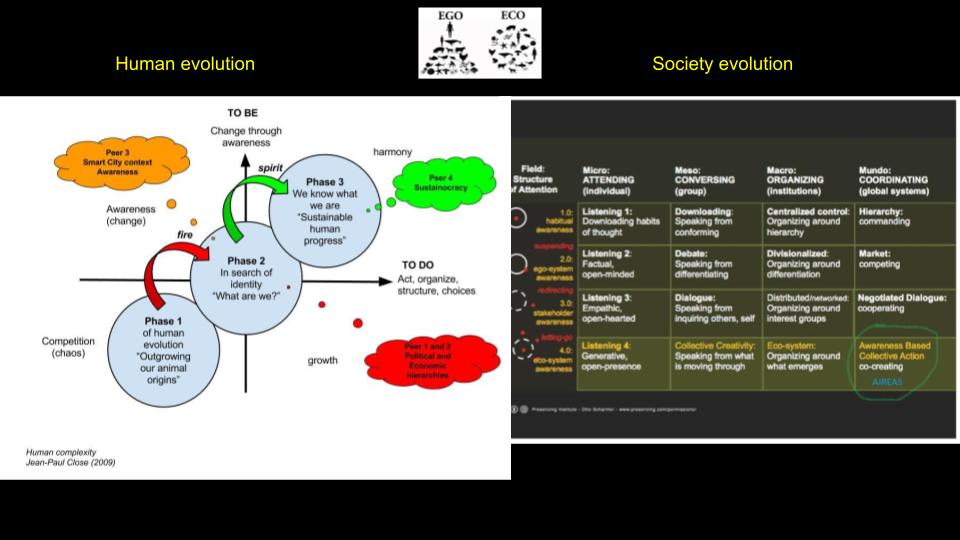
Our societal path from hierarchical self interests to shared responsibility and sustainable progress

How would women approach the global challenges of Sustainable Human Progress?
When talking about sustainability we never refer to the housewife and her children. We hardly mention the perspectives of our youngst generations. What happens with all those climate, poverty and war refugees? Are we having the right discussion?
Should we change our narrative? Within the human complexity model of Sustainocracy the “To Be” line refers to our core natural human values. This line is referred to as our feminine energe, the one reflecting the moral and ethical guidance of our actions (the “To Do”). This feminine line of inner guidance is also very strongly represented in women, especially those who have become mother. Our values when dealing with our children have their own priorities. This is also the origin of Sustainocracy. Hence the question: How would women approach the global challenges of Sustainable Human Progress? Who are our role models? What should be our reference framework?
Join our zoom session on Tuesday, October 26th at 16:00 Central European Time (CET).
The purpose of life
Recently I met a few biologists. I wanted to relate allergies of pollen with our measurements of air pollution. Pollen is not necessarily a pollutant but a natural contribution to our environment. It becomes a pollutant when the pollen reaches huge quantities due to the intervention of human regional design that focuses on the concentration of single species for urban or rural planning purposes. When in a cocreation process of healthy cities all these issues are relevant. Human influence is much more widespread than the simple registration of particulat matter.
Our discussion took a strange turn when I refered to our awareness driven multidisciplinary actions around core human values (sustainocracy). The biologists raised their sholders and claimed that nature would take care of us as a polluting species that causes its own anthropocene. Afterall the human being is a simple and temporary wrinkle in the evolution of life forms and will eventually be eliminated in the natural processes of cleaning up.
I refused to go along with this simplistic attitude of laisez faire, the reluctance that everything is outside our scope of influence anyway, which would give us as species the free ticket to do whatever we like. I asked the biologists what the purpose of life is if we are exempted from protecting and sustaining it? To my surprise their reaction was that life has no purpose at all. In their view the essence of life is useless, senseless and without any special contribution to anything. How could seemingly intelligent people, who had made it their scientific job to research lifeforms, come up with such statement?
There was no discussion possible and I left with the inner query to prove the contrary. Life in my view is the most valuable thing that the universe has produced, a miracle of dead material that groups together in a diversity of living formats. How can that be called meaningless and useless? But then we get to the question of its “purpose”. Why does life exist? What does it contribute?
When I studied the mechanisms of the first sparks of life in a specific environment, that moment when molecules group together and become a life form, just like that moment of our own individual conception, I had determined that unique and rare ability in the universe called “awareness” even at the most elementary level of our submolecular existence. It is this unique way energy and mass combine in vibrant frequencies that interact with their surroundings. As soon as this happens the molecular and energetic reality actually starts to exist. Something that we are not aware of does not exist. Awareness hence is a fundamental condition to elevate nothing into something. Life forms develop around awareness to feed, meet, breed, sense danger and love, react and make choices.
The purpose of life hence is the confirmation that the universe exists, that we exist and that we have reached a point to actually try to understand what existance really is. We can perceive, process and reflect about it. What use would a universe have if it is not conscious of its existence? It would cease to exist if there is no way to be able observe or sense it. Our evolution within life is based on the development of awareness, the processing of what is. In that sense life is the single purpose of any existence whether dead or alive. We need to protect life and develop our awareness as we live in order to observe the intensity of what it is to exist, not just as a human being but as a living self reflective universe. The purpose of life is the awareness that things exist.
I am aware so I exist. I am aware because I am alive. Life’s purpose is hence our proof of our existence and that of all living and non living forms.
 Sustainocracy, the new democracy